
Meeting the stringent demands of modern automotive engineering, particularly for critical components like chassis systems operating under complex loading and harsh environmental conditions, requires advanced materials offering an exceptional blend of strength and toughness. High-grade ductile iron, with its superior mechanical properties and excellent castability, stands as a pivotal engineering material in this domain. The pursuit of lightweight and high-performance vehicles has intensified the need for cast components that not only exhibit high tensile strength and hardness but also retain sufficient ductility and impact resistance. Achieving such performance levels, specifically grades equivalent to or exceeding QT800, in the as-cast condition presents a significant and valuable challenge for the ductile iron casting industry.
The traditional pathway to high strength in ductile iron casting often involves post-casting heat treatments, such as normalizing or quenching and tempering. While effective, these processes introduce additional costs, extended production cycles, and increased energy consumption. Therefore, developing robust methodologies for producing high-grade ductile iron directly in the as-cast state is of paramount industrial importance. This approach hinges on the precise control of microstructure through optimized chemistry and solidification conditions. The core challenge lies in simultaneously ensuring a high graphite nodule count with excellent spheroidicity and roundness, while tailoring the matrix to a specific, strong morphology—typically a fine pearlitic or a controlled mixed (ferrite-pearlite) structure—and minimizing casting defects like shrinkage porosity.
This research is dedicated to overcoming these challenges. It systematically investigates the synergistic effects of key alloying elements, primarily Copper (Cu) and Tin (Sn), coupled with optimized spheroidizing and inoculating practices, to establish a reliable production process for high-performance as-cast ductile iron. The goal is to consistently achieve a material that meets or exceeds the mechanical property thresholds for demanding applications without the need for subsequent heat treatment, thereby enhancing efficiency and cost-effectiveness in ductile iron casting.
Methodology and Experimental Procedures
The production of high-grade as-cast ductile iron is a multifaceted process requiring meticulous control at every stage, from charge calculation to final pouring. The foundation of achieving target properties lies in the precise design of the chemical composition.
1. Chemistry Design and Alloying Strategy: The chemical composition was formulated to promote a pearlitic-dominated matrix directly from the mold. Two principal alloying elements were selected for their matrix-stabilizing effects: Copper (Cu) and Tin (Sn).
- Copper (Cu): Cu is a well-known pearlite promoter. It dissolves in ferrite and austenite, lowering the carbon activity and suppressing the formation of ferrite, especially the “bull’s-eye” ferrite around graphite nodules. It encourages the formation of a fine, uniformly distributed pearlitic matrix, enhancing strength and hardness without severely compromising machinability. Its content must be balanced to avoid excessive segregation which can lead to embrittlement.
- Tin (Sn): Sn is a potent pearlite stabilizer, even more effective than Cu on a weight-percentage basis. A minute addition can dramatically increase the pearlite content, leading to significant gains in strength and hardness. However, its use requires extreme precision, as excess Sn (typically >0.1wt.%) can lead to complete pearlitic matrices with drastically reduced ductility and increased brittleness due to intercellular segregation.
Manganese (Mn) was maintained at a moderate level to aid pearlite formation, while strictly controlling residual elements like Phosphorus (P) and Sulfur (S) to minimize their detrimental effects on toughness. The base composition and the variable levels of Cu and Sn tested are summarized in Table 1.
| Batch ID | C | Si | Mn | P (max) | S (max) | Cu | Sn | Mg (res.) |
|---|---|---|---|---|---|---|---|---|
| 1 | 3.6 | 2.4 | 0.7 | 0.05 | 0.02 | 0.8 | 0.04 | 0.02-0.05 |
| 2 | 3.6 | 2.4 | 0.7 | 0.05 | 0.02 | 1.0 | 0.05 | 0.02-0.05 |
| 3 | 3.6 | 2.4 | 0.7 | 0.05 | 0.02 | 1.2 | 0.06 | 0.02-0.05 |
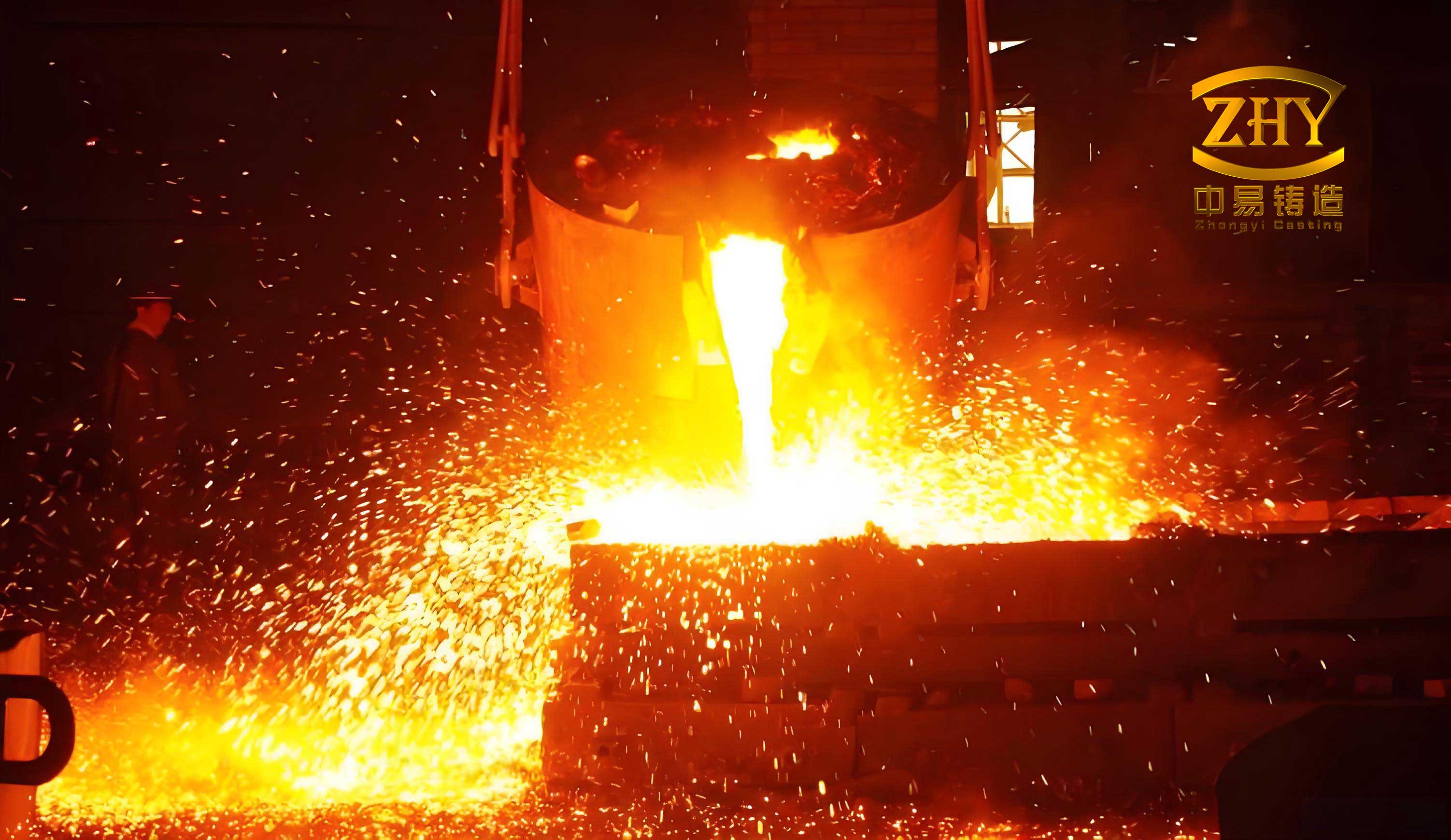
2. Melting and Charge Make-up: A 6-ton medium-frequency induction furnace was used for melting. The charge consisted of 30-40% steel scrap and 60-70% in-house returns, aligning with standard operational practices for cost-effectiveness and material sustainability. Carbon was adjusted to the target level of 3.6wt.% using high-quality recarburizer added during the charging process.
3. Treatment and Pouring Process: The treatment process is critical in ductile iron casting for achieving high nodule count and good morphology.
$$ \text{Fe-Si-Mg}_{(alloy)} + \text{Fe}_{(melt)} \rightarrow \text{Graphite Nodules} + \text{MgO, MgS, etc.} $$
The treatment was performed using the sandwich method in a preheated ladle. A rare-earth-bearing magnesium ferrosilicon alloy (Fe-Si-Mg-RE) was used as the spheroidizing agent, with an addition of 1.0wt.%. Inoculation was carried out in two stages: a primary inoculation (0.25wt.% Fe-Si-Ba) during transfer (post-inoculation) and a late-stream inoculation using a highly efficient inoculant fed into the metal stream during pouring at a rate of 6 g/s. The reaction time was controlled to be over 30 seconds. The pouring temperature was tightly maintained between 1390°C and 1410°C to ensure good fluidity while minimizing fade effects. The entire process from the end of treatment to the completion of pouring was kept under 10 minutes.
4. Casting and Sampling: Castings were produced using green sand molds on a high-pressure automatic molding line. The casting design included a gating and feeding system optimized for soundness. Separately cast test samples (Y-blocks, see schematic) were poured from the same ladle as the production castings to ensure representative material properties. These samples were used to machine standard tensile test bars (Φ14 mm gauge diameter). Hardness was measured directly on designated areas of the casting itself.
5. Characterization and Testing: The mechanical properties evaluated included tensile strength (UTS), yield strength (YS), elongation at fracture (El.), and Brinell hardness (HBW). Microstructural analysis was performed using optical microscopy on polished and etched samples. Key metrics such as nodule count, nodularity, graphite shape factor (roundness), and the area fraction of pearlite were quantitatively assessed using image analysis software. The relationship between microstructure and mechanical properties can be conceptually framed by considering strength contributions:
$$ \sigma_y \approx \sigma_0 + \Delta\sigma_{ss} + \Delta\sigma_{gb} + \Delta\sigma_{disp} + \Delta\sigma_{ppt} $$
Where $\sigma_y$ is the yield strength, $\sigma_0$ is the lattice friction stress, $\Delta\sigma_{ss}$ is solid solution strengthening, $\Delta\sigma_{gb}$ is grain boundary strengthening, $\Delta\sigma_{disp}$ is dispersion strengthening (from graphite nodules), and $\Delta\sigma_{ppt}$ is precipitation strengthening (from carbides in pearlite). In ductile iron casting, $\Delta\sigma_{disp}$ and $\Delta\sigma_{ppt}$ are dominant factors influenced by processing.
Results and In-Depth Analysis
The experimental results clearly demonstrate the profound and interactive influence of Cu and Sn on the microstructure and, consequently, the mechanical properties of the as-cast ductile iron.
1. Microstructural Evolution:
Effect of Copper: With increasing Cu content from 0.8wt.% to 1.2wt.%, a clear trend was observed. The graphite morphology showed a slight coarsening, with a reduction in nodule count and an increase in average nodule diameter. The spheroidicity, however, remained largely acceptable. The most significant change occurred in the matrix. The area fraction of pearlite increased progressively, while the amount of free ferrite, particularly surrounding the graphite nodules, decreased. This aligns with Cu’s role in suppressing the ferrite transformation during the eutectoid reaction, favoring pearlite formation. The pearlite itself appeared with a finer interlamellar spacing at higher Cu levels.
Effect of Tin: The addition of Sn, even in small amounts (0.04-0.06wt.%), had a more pronounced effect on graphite morphology. A marked increase in the nodule count and a significant improvement in the roundness (shape factor) of the graphite nodules were recorded. The spheroidization rate improved noticeably. Regarding the matrix, Sn acted as a powerful pearlite stabilizer. The pearlite area fraction increased substantially with Sn addition. At 0.06wt.% Sn in combination with higher Cu, the matrix approached a fully pearlitic structure with only minimal, isolated ferrite regions. This refinement and stabilization of the matrix directly translate to enhanced mechanical properties.
2. Mechanical Property Analysis:
The tensile and hardness properties for the different alloy combinations are consolidated in Table 2.
| Batch (Cu/Sn wt.%) | Tensile Strength (MPa) | Yield Strength (MPa) | Elongation (%) | Casting Hardness (HBW) |
|---|---|---|---|---|
| 1 (0.8 / 0.04) | 795 | 505 | 6.8 | 245 |
| 2 (1.0 / 0.05) | 825 | 517 | 6.3 | 258 |
| 3 (1.2 / 0.06) | 845 | 530 | 5.1 | 272 |
| Ref. (1.0 / 0.00) | 747 | 492 | 7.9 | 223 |
The data reveals a strong correlation between alloy content and performance. Increasing both Cu and Sn leads to a monotonic increase in tensile strength, yield strength, and hardness. For instance, compared to the reference sample with only 1.0wt.% Cu and no Sn, the optimized Batch 2 (1.0wt.% Cu + 0.05wt.% Sn) showed a strength increase of over 10% (from 747 MPa to 825 MPa) and a hardness increase of 35 points HBW. The critical finding is the behavior of ductility. While elongation decreases with increasing alloy content—a typical strength-ductility trade-off—the decline is remarkably moderate. The elongation of Batch 2 remained above 5%, which is a satisfactory level for many high-strength applications. This indicates that the synergistic use of Cu and Sn, within the specified ranges, effectively strengthens the matrix through microstructural refinement without inducing excessive brittleness often associated with single-element over-alloying or carbide formation.
The superior properties can be attributed to several concurrent mechanisms enhanced by the optimized ductile iron casting process:
- Matrix Strengthening: Cu and Sn work synergistically to promote a fine, continuous network of pearlite. The interlamellar spacing ($\lambda$) of pearlite is a key strength determinant, following a Hall-Petch type relationship: $\Delta\sigma_{ppt} \propto \lambda^{-1/2}$. The refined pearlite from our alloying directly contributes to higher strength.
- Graphite Morphology Enhancement: Sn appears to improve the efficacy of inoculation, leading to a higher nodule count and better roundness. Superior graphite morphology reduces stress concentration sites, which helps in preserving ductility and fatigue resistance despite the stronger matrix.
- Solid Solution Strengthening: Both Cu and Sn in solid solution within the ferrite lamellae of pearlite provide additional strengthening, described by: $\Delta\sigma_{ss} = k_{ss} \cdot c^{n}$, where $c$ is the solute concentration and $k_{ss}$ is a scaling factor.
The process stability was also notably improved. The defined treatment and pouring windows, combined with the robust chemistry, resulted in consistent microstructures and reduced property scatter from casting-to-casting, which is a vital requirement for industrial ductile iron casting of safety-critical components.
Conclusions and Industrial Implications
This research successfully demonstrates a viable and optimized pathway for the as-cast production of high-grade ductile iron, achieving properties that meet the demanding requirements of advanced automotive components. The key conclusions are:
1. The combined and controlled addition of Copper (Cu) and Tin (Sn) is a highly effective strategy for producing high-strength ductile iron in the as-cast condition. An optimal combination was identified at approximately 1.0wt.% Cu and 0.05wt.% Sn.
2. Tin plays a crucial dual role: it significantly refines and improves the graphite morphology (increasing nodule count and sphericity) while powerfully stabilizing a fine pearlitic matrix. Copper complements this by further promoting pearlite formation and contributing to solid solution strengthening.
3. Through this synergistic alloying and a tightly controlled ductile iron casting process (encompassing precise charge make-up, effective spheroidization/inoculation, and controlled pouring conditions), a mixed pearlitic-ferritic matrix with excellent graphite characteristics was consistently obtained.
4. The resulting material exhibits an outstanding combination of mechanical properties in the as-cast state: tensile strength >800 MPa, yield strength >500 MPa, elongation >5%, and hardness ~250-260 HBW. This performance portfolio satisfies the specifications for high-grade ductile iron such as QT800-5 and related standards.
5. Eliminating the need for a separate heat treatment cycle offers substantial advantages in terms of production lead time, energy consumption, manufacturing cost, and part distortion control. This makes the developed process economically attractive and sustainable for high-volume ductile iron casting operations.
The findings of this study provide a clear framework for foundries aiming to produce premium as-cast ductile iron components. Future work could explore the effects of these alloying strategies on dynamic properties such as fatigue strength and fracture toughness, and further optimize the process for different section sizes and casting geometries to expand the application range of this advanced material.