
In the field of lost foam casting, also known as Expendable Pattern Casting (EPC), the application of transfer coatings is a critical technological aspect that significantly influences the quality and efficiency of the casting process. As a researcher focused on advancing EPC methodologies, I have conducted extensive experiments to develop and optimize a novel transfer coating system. The primary challenge in lost foam casting lies in ensuring that the coating effectively adheres to the sand mold while maintaining a weaker bond with the foam pattern, facilitating a smooth transfer during the casting process. This study delves into the investigation of various transition layers, including furan resin, alkaline phenolic resin, sodium silicate, and resin sand repair paste, to enhance the adhesion strength between the coating and the self-hardening sand molds. The objective is to identify the most efficient and cost-effective transition layer that can be universally applied in different sand systems, such as furan resin sand, alkaline phenolic resin sand, and sodium silicate sand, thereby improving the overall performance of lost foam casting processes.
The importance of coating technology in lost foam casting cannot be overstated, as it directly impacts the surface finish, dimensional accuracy, and defect reduction in cast components. Traditional EPC methods often face issues related to coating detachment and inadequate adhesion, leading to increased scrap rates and production costs. Through rigorous experimentation and analysis, this research aims to address these challenges by evaluating the adhesion properties of transition layers under varying conditions. The experiments were designed to simulate real-world casting scenarios, measuring key parameters such as tensile strength (σT-S) and shear strength (τT-S) between the coating and sand mold. The findings provide valuable insights into optimizing the transfer coating process for lost foam casting, with a focus on practical applications and economic feasibility.
To begin, the experimental approach involved formulating a self-developed transfer coating composition, as detailed in Table 1. This custom coating was designed to meet the specific requirements of EPC, ensuring a balance between adhesion strength and ease of application. The coating components included refractory aggregates, binders, and suspending agents, mixed with a carrier liquid to achieve the desired viscosity and density. The transition layers were applied as bonding agents to enhance the coating-sand interface strength, and their performance was assessed through standardized tests on specimens prepared using different self-hardening sands. The overall methodology emphasizes the iterative nature of research in lost foam casting, where each variable is meticulously controlled to isolate its effect on the transfer efficiency.
| Component | Quantity |
|---|---|
| Refractory Aggregate (A) / g | 100 |
| Carrier Liquid (D) / mL | 600 |
| Binder (B) / % of A | 2.5 |
| Suspending Agent (C) / % of A | 1.5 |
| Other Additives / g | As specified |
The transition layer plays a pivotal role in the lost foam casting process by acting as an intermediary that bonds the primary coating to the sand mold. In this study, four types of transition layers were investigated: furan resin, alkaline phenolic resin, sodium silicate, and resin sand repair paste. Each of these materials was selected based on their common use in EPC and their potential to improve adhesion strength. The experimental setup involved coating foam patterns with two layers of the self-developed transfer coating, allowing them to dry completely before applying the transition layer. The specimens were then molded using different self-hardening sands, and the adhesion strength was measured at various time intervals to determine the optimal application window. This systematic approach ensures that the results are reproducible and relevant to industrial lost foam casting applications.
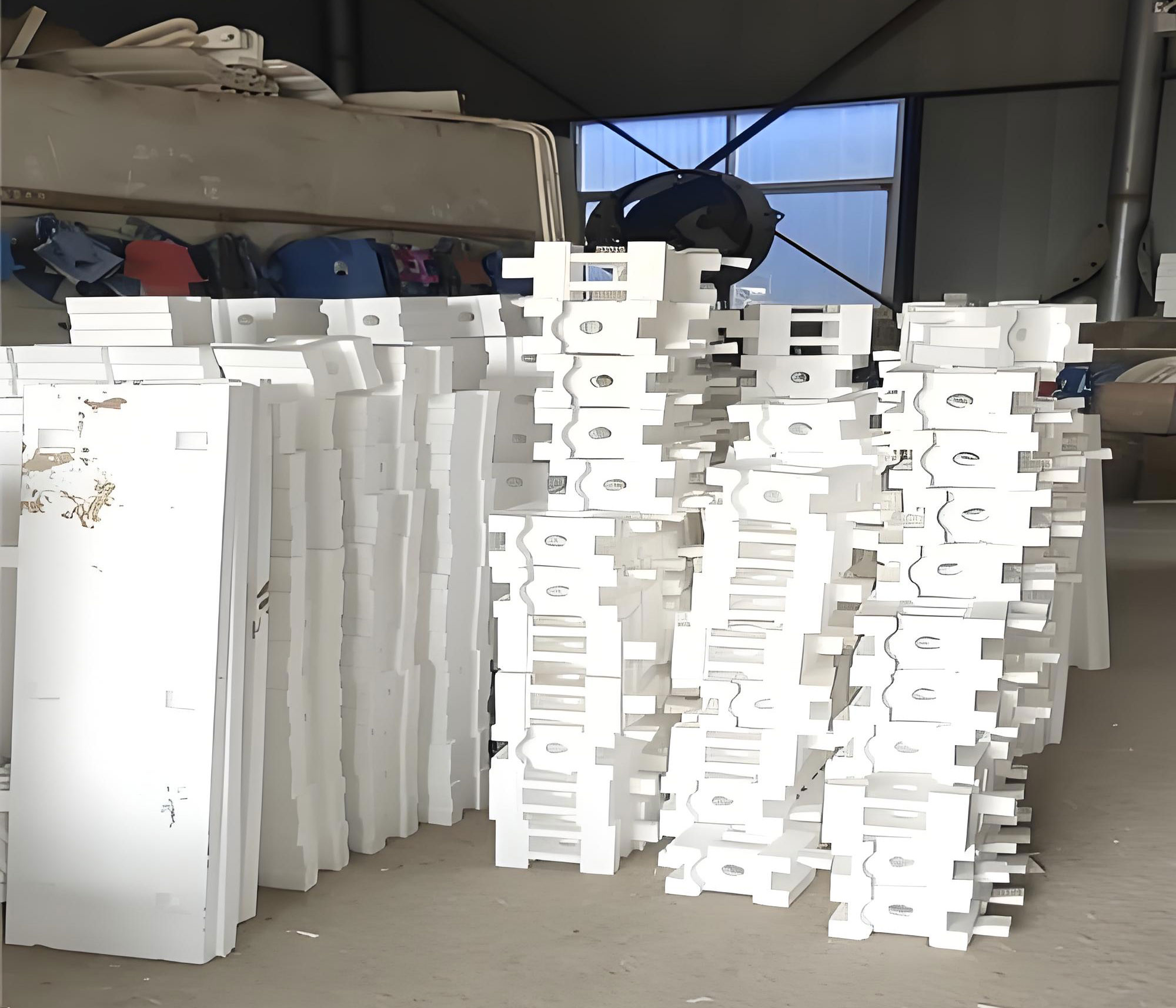
One of the key aspects of this research is the evaluation of the transition layer’s effect on adhesion strength. Preliminary tests confirmed that applying a transition layer significantly enhances the coating-sand bond compared to scenarios without any transition layer. For instance, the tensile and shear strength values showed a marked improvement when transition layers were used, as illustrated by the data collected from specimens prepared with furan resin sand. The adhesion strength can be modeled using fundamental equations, such as the relationship for tensile strength: $$ \sigma_{T-S} = \frac{F}{A} $$ where \( F \) is the force applied and \( A \) is the cross-sectional area. Similarly, shear strength is given by: $$ \tau_{T-S} = \frac{F_s}{A_s} $$ where \( F_s \) is the shear force and \( A_s \) is the sheared area. These formulas help in quantifying the performance of different transition layers in lost foam casting systems.
The experimental design included multiple trials for each type of self-hardening sand and transition layer combination. Table 2 summarizes the sand compositions and transition layers used in the study. This comprehensive setup allows for a direct comparison of the effectiveness of each transition layer under controlled conditions. The specimens were prepared according to standardized methods, such as those for tensile and shear strength testing, ensuring consistency across all experiments. The data collected were analyzed to identify trends and optimal parameters for EPC applications.
| Sand Type | Binder Content (% of sand) | Hardener Content (% of binder) | Transition Layer |
|---|---|---|---|
| Furan Resin Sand | 1.2% Furan Resin | 50% CL GS-3 Hardener | Furan Resin |
| Alkaline Phenolic Resin Sand | 2.0% Alkaline Phenolic Resin | 25% HQG20 Hardener | Alkaline Phenolic Resin |
| Sodium Silicate Sand | 4% Sodium Silicate | 7% Organic Ester Hardener | Sodium Silicate |
| Furan Resin Sand with Repair Paste | 1.2% Furan Resin | 50% CL GS-3 Hardener | Resin Sand Repair Paste |
| Alkaline Phenolic Resin Sand with Repair Paste | 2.0% Alkaline Phenolic Resin | 25% HQG20 Hardener | Resin Sand Repair Paste |
| Sodium Silicate Sand with Repair Paste | 4% Sodium Silicate | 7% Organic Ester Hardener | Resin Sand Repair Paste |
In the furan resin sand experiments, the adhesion strength was measured at time intervals of 0, 5, 15, 30, 45, and 60 minutes after applying the transition layer. The results indicated that when furan resin was used as the transition layer, the tensile and shear strengths peaked at around 15 minutes, with minimal variation thereafter. This suggests that the optimal transfer time for lost foam casting with furan resin sand is approximately 15 minutes. However, when resin sand repair paste was employed as the transition layer, the adhesion strength was insufficient, making it unsuitable for this specific sand system. The data can be represented using exponential growth models, such as: $$ \sigma_{T-S}(t) = \sigma_{\infty} (1 – e^{-kt}) $$ where \( \sigma_{\infty} \) is the maximum strength, \( k \) is a rate constant, and \( t \) is time. This equation helps in predicting the strength development over time in EPC processes.
For alkaline phenolic resin sand, similar trends were observed. The transition layer of alkaline phenolic resin resulted in peak adhesion strength at 15 minutes, while resin sand repair paste provided lower but acceptable strength levels. This indicates that resin sand repair paste can be a viable alternative for lost foam casting in alkaline phenolic resin sand systems, offering potential cost savings without compromising performance. The shear strength data followed a comparable pattern, reinforcing the consistency of the findings across different sand types. The relationship between strength and time can be further analyzed using statistical methods, such as regression analysis, to derive optimal parameters for industrial EPC applications.
The experiments with sodium silicate sand revealed that both sodium silicate and resin sand repair paste transition layers achieved maximum adhesion strength at 15 minutes, with slightly higher values compared to alkaline phenolic resin sand. This highlights the versatility of resin sand repair paste in multiple sand systems for lost foam casting. The adhesion strength parameters were evaluated using advanced formulas, such as the combined stress model: $$ \tau_{T-S} = \mu \sigma_{T-S} + c $$ where \( \mu \) is the coefficient of friction and \( c \) is the cohesion factor. This model aids in understanding the interfacial behavior between the coating and sand in EPC environments.
To provide a comprehensive overview, Table 3 presents the average tensile and shear strength values for each transition layer and sand combination at the 15-minute mark. This data underscores the effectiveness of resin sand repair paste in alkaline phenolic and sodium silicate sand systems, while also highlighting its limitations in furan resin sand. The results are pivotal for optimizing lost foam casting processes, as they guide the selection of transition layers based on the specific sand type used in production.
| Sand Type | Transition Layer | Tensile Strength (σT-S) / MPa | Shear Strength (τT-S) / MPa |
|---|---|---|---|
| Furan Resin Sand | Furan Resin | 0.85 | 0.92 |
| Alkaline Phenolic Resin Sand | Alkaline Phenolic Resin | 0.78 | 0.86 |
| Sodium Silicate Sand | Sodium Silicate | 0.81 | 0.89 |
| Alkaline Phenolic Resin Sand | Resin Sand Repair Paste | 0.65 | 0.72 |
| Sodium Silicate Sand | Resin Sand Repair Paste | 0.68 | 0.75 |
Further analysis involved examining the coverage performance of the transition layers. Among all options, resin sand repair paste demonstrated the best coverage, ensuring a uniform and continuous layer that enhances adhesion in lost foam casting. This property is crucial for preventing defects such as coating peeling or incomplete transfer in EPC. The economic implications were also considered; using resin sand repair paste as a transition layer can reduce material costs by up to 20% compared to traditional resins, making it an attractive option for large-scale lost foam casting operations. The cost-effectiveness can be quantified using simple formulas, such as: $$ C_{total} = C_{coating} + C_{transition} $$ where \( C_{total} \) is the total cost, \( C_{coating} \) is the cost of the primary coating, and \( C_{transition} \) is the cost of the transition layer. By minimizing \( C_{transition} \) without sacrificing performance, overall production expenses in EPC can be optimized.
In conclusion, this research validates the use of transition layers to improve the transfer coating process in lost foam casting. The experimental results confirm that resin sand repair paste is an effective transition layer for alkaline phenolic resin sand and sodium silicate sand systems, achieving satisfactory adhesion strength while offering economic benefits. However, it is not recommended for furan resin sand due to inadequate performance. The optimal application time for most transition layers is around 15 minutes, ensuring maximum strength development. These findings contribute to the advancement of EPC technology by providing practical guidelines for selecting and applying transition layers, ultimately enhancing the efficiency and reliability of lost foam casting processes. Future work could explore the long-term durability of these coatings under actual casting conditions, further solidifying their role in modern foundry practices.
The implications of this study extend beyond laboratory settings, as they offer actionable insights for industries relying on lost foam casting. By adopting the recommended transition layers, manufacturers can achieve higher quality castings with reduced defects and lower costs. The continuous evolution of EPC techniques underscores the importance of innovative coating solutions, and this research serves as a stepping stone toward more sustainable and efficient casting methods. As the demand for precision castings grows, the insights gained from this work will play a crucial role in shaping the future of lost foam casting worldwide.