
Large-scale castings play a pivotal role in modern equipment manufacturing, where advanced casting processes and numerical simulation technologies have become indispensable for quality optimization. This article systematically reviews the application progress of sand casting and other mainstream processes while highlighting breakthroughs in multi-physics coupling simulation techniques.
1. Advanced Casting Processes for Large Components
1.1 Sand Casting Innovations
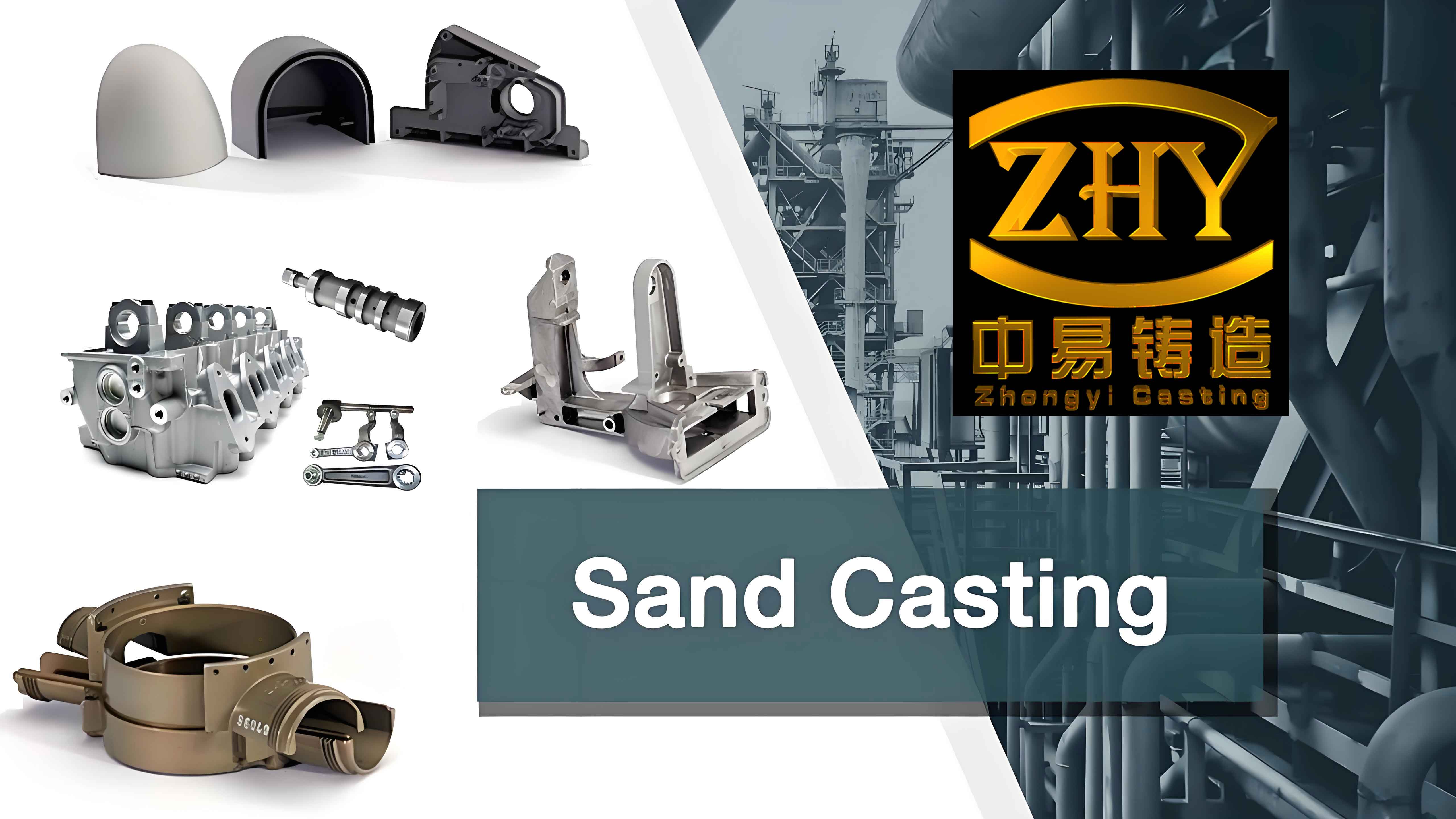
Sand casting remains the dominant process for heavy castings due to its cost-effectiveness and adaptability. Recent advancements focus on:
- Binder optimization: Development of organic/inorganic hybrid binders improves mold strength by 15-20%
- Sand reclamation systems achieving ≥95% reuse efficiency
- Real-time mold hardness monitoring using IoT sensors
The fundamental heat transfer equation governing sand casting solidification:
$$ \frac{\partial T}{\partial t} = \alpha \left( \frac{\partial^2 T}{\partial x^2} + \frac{\partial^2 T}{\partial y^2} + \frac{\partial^2 T}{\partial z^2} \right) + \frac{L}{c_p} \frac{\partial f_s}{\partial t} $$
Where $T$ is temperature, $α$ thermal diffusivity, $L$ latent heat, and $f_s$ solid fraction.
| Process | Typical Size Range | Surface Roughness (Ra/μm) | Dimensional Tolerance (mm/m) |
|---|---|---|---|
| Sand Casting | 0.1-300 tons | 12.5-25 | ±2.0-5.0 |
| Investment Casting | 0.1-500 kg | 3.2-6.3 | ±0.5-1.5 |
| Die Casting | 0.1-50 kg | 0.8-3.2 | ±0.2-0.5 |
1.2 Specialized Casting Techniques
While sand casting dominates heavy-section components, other processes show unique advantages:
- Vacuum-Assisted Casting: Reduces gas porosity by 40-60% through 10-2-10-3 mbar vacuum levels
- Centrifugal Casting: Achieves 15-20% higher density in cylindrical components through centrifugal forces:
$$ \sigma_c = \frac{\rho \omega^2}{8g} (3R^2 – r^2) $$
Where $σ_c$ is centrifugal stress, $ρ$ melt density, $ω$ angular velocity.
2. Numerical Simulation Breakthroughs
2.1 Multi-Physics Coupling Models
Modern simulation integrates multiple physical fields:
$$ \begin{cases}
\rho \left( \frac{\partial \mathbf{v}}{\partial t} + \mathbf{v} \cdot \nabla \mathbf{v} \right) = -\nabla p + \mu \nabla^2 \mathbf{v} + \mathbf{F}_b \\
\frac{\partial T}{\partial t} + \mathbf{v} \cdot \nabla T = \alpha \nabla^2 T \\
\sigma_{ij,j} + F_i = 0
\end{cases} $$
Coupling fluid dynamics, heat transfer, and stress analysis.
2.2 Defect Prediction Algorithms
The modified Niyama criterion for sand casting shrinkage prediction:
$$ NY^* = \frac{G}{\sqrt{\dot{T}}} \cdot f_s^{0.5} $$
Where $G$ is temperature gradient, $\dot{T}$ cooling rate. Threshold values:
- Steel: NY* < 0.7 °C0.5/mm
- Aluminum: NY* < 1.2 °C0.5/mm
| Software | Mesh Type | Max Elements | Sand Casting Module |
|---|---|---|---|
| ProCAST | FEM | 50 million | Advanced |
| MAGMA | FDM | 100 million | Excellent |
| AnyCasting | FVM | 30 million | Standard |
3. Industrial Applications and Case Studies
A sand-cast turbine housing simulation demonstrates modern capabilities:
- Filling time optimization reduced from 18.6s to 14.2s
- Shrinkage volume decreased by 63% through riser redesign
- Residual stress prediction accuracy reached 89% vs experimental measurements
The thermal stress calculation during sand casting cooling:
$$ \sigma_{thermal} = E \alpha \Delta T \left( \frac{1}{1-\nu} \right) $$
Where $E$ is Young’s modulus, $α$ thermal expansion coefficient, $ν$ Poisson’s ratio.
4. Future Development Trends
Emerging technologies transforming sand casting:
- AI-driven process optimization reducing trial runs by 70-80%
- 3D sand printing enabling complex geometries with 0.3mm feature resolution
- Digital twins achieving 95% prediction accuracy for defect formation
The intelligent sand casting system framework:
$$ \Psi_{system} = \int_{0}^{t} \left( \beta_1 S_{process} + \beta_2 D_{quality} + \beta_3 E_{energy} \right) dt $$
Where $β$ coefficients represent process stability, quality detection, and energy efficiency factors.
Continued innovation in sand casting simulation and process integration will drive the next generation of heavy equipment manufacturing, particularly for components exceeding 50-ton weight class with complex internal structures.