
With the rapid advancement of modern industries, traditional casting methods struggle to meet the growing demands for high-precision and high-performance components. Lost foam casting (LFC), an innovative technology utilizing expandable foam patterns, has emerged as a transformative solution. This article comprehensively reviews current research progress in LFC variants, simulation methodologies, and future development trends.
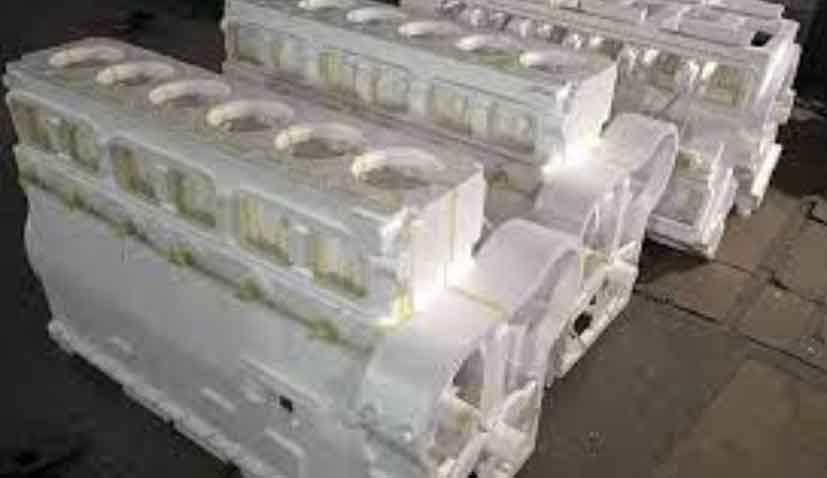
1. Advanced Lost Foam Casting Processes
1.1 Vacuum Low-Pressure Lost Foam Casting
This hybrid process combines vacuum-assisted LFC with low-pressure casting, significantly enhancing metal fluidity and microstructure refinement. The governing equation for pressure control can be expressed as:
$$ P_{\text{system}} = P_{\text{vacuum}} + \rho g h + \frac{1}{2} \rho v^2 $$
Key advantages include:
| Parameter | Conventional LFC | Vacuum Low-Pressure LFC |
|---|---|---|
| Surface Roughness (μm) | 6.3-12.5 | 3.2-6.3 |
| Porosity (%) | 1.97 | 0.16 |
| Tensile Strength (MPa) | 231 | 278 |
1.2 Vibratory Lost Foam Casting
Mechanical vibration during solidification modifies grain structures through enhanced nucleation:
$$ N = N_0 \exp\left(-\frac{\Delta G^*}{kT}\right) \left[1 + \frac{\varepsilon}{\varepsilon_c}\right] $$
Where \( \varepsilon \) represents vibration energy density and \( \varepsilon_c \) denotes critical energy threshold. Optimal parameters typically fall within:
- Frequency: 50-150 Hz
- Amplitude: 0.1-0.5 mm
1.3 Expendable Pattern Shell Casting
This LFC variant combines investment casting advantages with foam pattern elimination. The shell thickness (\( \delta \)) follows:
$$ \delta = k \sqrt{\frac{\mu Q}{\rho g}} $$
Where \( k \) represents material constant and \( Q \) denotes coating flow rate.
2. Numerical Simulation in Lost Foam Casting
2.1 Filling Process Modeling
The coupled gas-liquid flow dynamics are described by:
$$ \frac{\partial (\alpha \rho)}{\partial t} + \nabla \cdot (\alpha \rho \mathbf{u}) = S_g $$
$$ \alpha_l + \alpha_g = 1 $$
Where \( \alpha \) represents phase fraction and \( S_g \) denotes gas generation rate from foam decomposition.
2.2 Solidification Simulation
Thermal transport during solidification follows:
$$ \rho C_p \frac{\partial T}{\partial t} = \nabla \cdot (k \nabla T) + L \frac{\partial f_s}{\partial t} $$
Critical simulation parameters include:
| Parameter | Typical Range |
|---|---|
| Pouring Temperature | 680-750°C (Al) |
| Vacuum Pressure | 0.02-0.06 MPa |
| Cooling Rate | 10-50°C/s |
3. Process Optimization Strategies
Multi-objective optimization for lost foam casting parameters can be formulated as:
$$ \text{Minimize } F(\mathbf{x}) = [f_1(\mathbf{x}), f_2(\mathbf{x}), f_3(\mathbf{x})] $$
Where:
- \( f_1 \): Defect probability
- \( f_2 \): Energy consumption
- \( f_3 \): Cycle time
4. Future Development Trends
Emerging directions in lost foam casting technology include:
- AI-driven process control systems
- Hybrid additive manufacturing-LFC integration
- Sustainable pattern materials development
- Multi-scale multiphysics simulation frameworks
5. Conclusion
Lost foam casting continues to evolve through technological innovations and computational advancements. The integration of advanced process variants with sophisticated simulation tools positions LFC as a vital manufacturing solution for complex, high-performance components across industries.