
In my extensive practice with resin sand casting, I have developed a deep understanding of the methodologies required to achieve high-quality castings. This process, which utilizes resin-bonded sand molds, is pivotal for producing precise and reliable components, particularly in industries such as metallurgy and heavy machinery. The core advantage of resin sand casting lies in its ability to create complex shapes with excellent dimensional accuracy and surface finish. However, mastering it involves meticulous attention to detail across various stages, from mold preparation to pouring and solidification. Throughout this article, I will share insights on optimizing the resin sand casting process, emphasizing defect prevention strategies that have proven effective in my hands-on experience. The keyword ‘resin sand casting’ will be frequently highlighted, as it encapsulates the essence of this technique, which relies on chemical binders like furan resin to enhance mold properties compared to traditional green sand methods.
The foundation of successful resin sand casting begins with precise mold design and core placement. One critical aspect I have focused on is ensuring the accurate positioning of protective tubes or chills within the casting. In my projects, I establish a reference hole during the initial stages, which serves as a benchmark for installing these tubes in subsequent operations. This approach guarantees positional accuracy, minimizing deviations that could lead to defects. For instance, by using a template made from composite boards, I can verify core head locations and orientations, ensuring consistency between upper and lower curved surfaces of the pattern. This step is vital in resin sand casting, as any misalignment can cause issues like mismatches or dimensional errors in the final casting. To illustrate, consider the formula for calculating positional tolerance based on reference points: $$\Delta P = \sqrt{(\Delta x)^2 + (\Delta y)^2}$$ where $\Delta P$ represents the positional error, and $\Delta x$ and $\Delta y$ are deviations in horizontal and vertical directions, respectively. By controlling these variables through standardized templates, I achieve tighter tolerances in resin sand casting applications.
When it comes to fixing embedded elements like serpentine tubes, I employ a robust method involving welding with steel rods, followed by suspension onto the cope section of the mold. In resin sand casting, securing these components is crucial to prevent exposure or displacement during pouring. For example, I use 12 mm diameter steel rods welded to the tubes and the cope, ensuring they remain intact under thermal stresses. This technique reduces the risk of defects such as exposed pipes, which can compromise casting integrity. The mechanical strength of the resin sand mold plays a role here; thus, I often calculate the required bonding strength using: $$F_b = \sigma_s \cdot A$$ where $F_b$ is the bonding force, $\sigma_s$ is the shear strength of the resin sand, and $A$ is the contact area. By optimizing resin content and sand compaction, I enhance $F_b$ to withstand thermal expansion forces during casting.
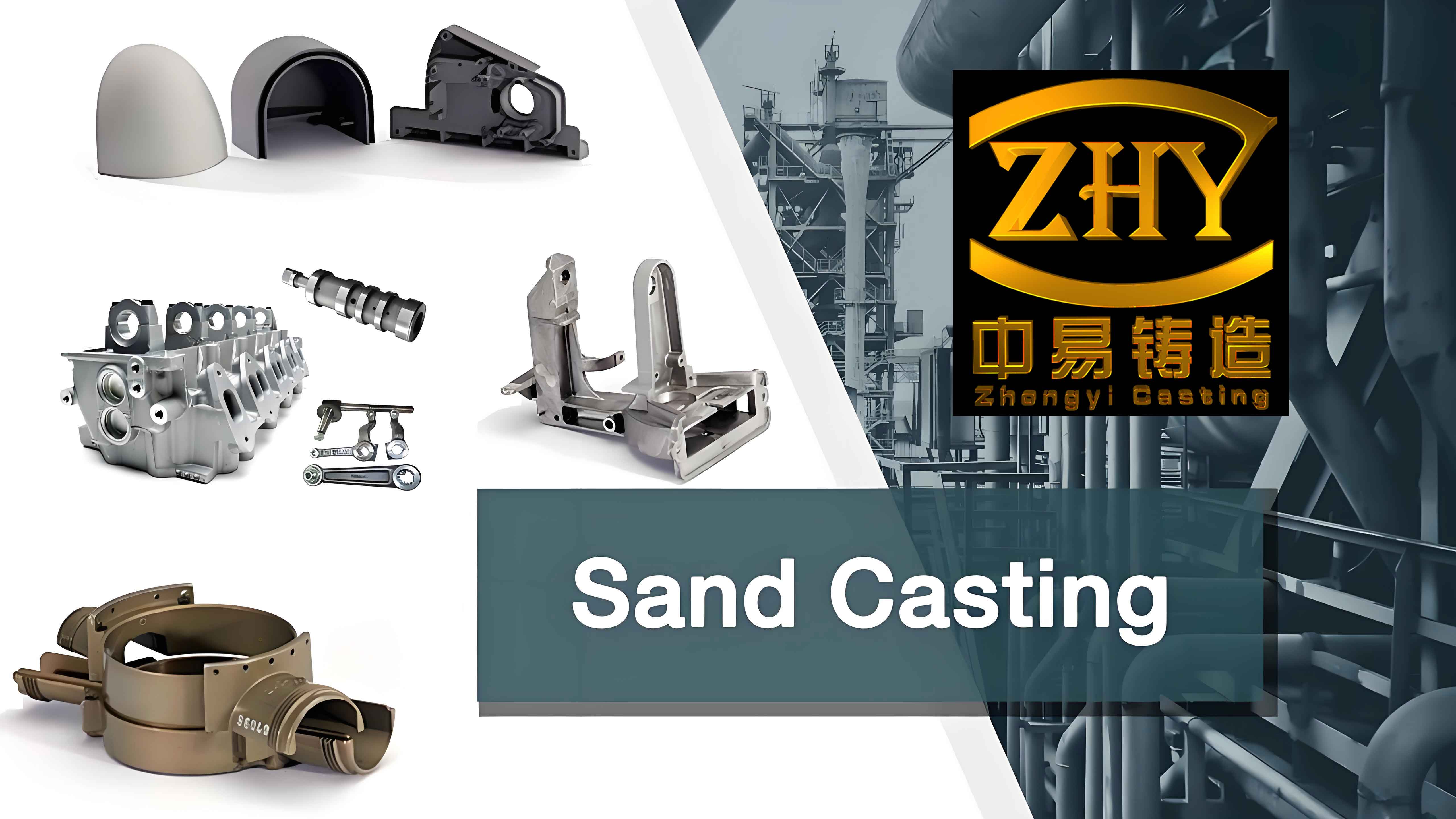
Preventing sand-related defects is a paramount concern in resin sand casting. One common issue is sand inclusion or scabbing, especially around protective tubes. In my experience, I have transitioned from using tightly rammed molding sand to packing asbestos ropes around these areas. This change provides greater yieldability, buffering the pressure from thermal deformation of the tubes and preventing mold damage. Additionally, I reinforce the mold surface by inserting iron nails to improve sand strength and resistance to scabbing. The gating system design also contributes significantly; I prefer inclined gating with ingates located near the tube ends. This ensures rapid filling of the lower sections, reducing the likelihood of sand erosion. The fluid dynamics can be described by Bernoulli’s equation for flow rate: $$Q = A \cdot v = A \cdot \sqrt{\frac{2 \Delta P}{\rho}}$$ where $Q$ is the flow rate, $A$ is the cross-sectional area, $v$ is velocity, $\Delta P$ is pressure difference, and $\rho$ is molten metal density. By adjusting these parameters, I optimize filling to minimize defect risks in resin sand casting.
Another key step in resin sand casting is mold assembly and drying. I advocate for a hot closing approach, where the mold and embedded tubes are preheated to around 450°C for over four hours. After removing surface residues from the tubes, they are fixed in place, and the mold is re-dried before closing. This method maintains a mold temperature above 100°C during pouring. The benefits are multifold: it reduces gas generation by ensuring dryness, minimizes thermal gradients between the sand and tubes, and promotes simultaneous solidification for denser castings with smoother surfaces. In resin sand casting, controlling temperature is critical; I often use the Fourier heat conduction equation to model thermal profiles: $$\frac{\partial T}{\partial t} = \alpha \nabla^2 T$$ where $T$ is temperature, $t$ is time, and $\alpha$ is thermal diffusivity. By preheating, I reduce $\nabla^2 T$, leading to more uniform cooling. Furthermore, replacing clay strips with asbestos ropes for mold verification addresses dimensional expansion issues, enhancing accuracy in resin sand casting processes.
Pouring techniques are equally vital in resin sand casting. I implement high-temperature tapping and low-temperature pouring, typically controlling tap temperatures between 1380–1410°C and pouring temperatures around 1280°C. The pouring sequence starts with a small stream, gradually increasing to a rapid flow to quickly fill the cavity, ensuring simultaneous solidification. Finally, as metal rises to the risers, I revert to a smaller stream to facilitate gas and inclusion removal. This approach leverages the principles of fluidity and solidification kinetics in resin sand casting. The Chvorinov’s rule can be applied to estimate solidification time: $$t_s = B \left( \frac{V}{A} \right)^2$$ where $t_s$ is solidification time, $B$ is a mold constant, $V$ is volume, and $A$ is surface area. By optimizing pouring parameters, I minimize $t_s$ variations, reducing shrinkage defects. This methodology has proven effective for medium and small-sized blast furnace cooling walls and similar embedded-tube plate castings in resin sand casting applications.
Transitioning to defect analysis, furan resin sand casting, while superior in many aspects, is prone to specific flaws if not managed properly. Based on my observations, common defects include gas holes, pinholes, mechanical penetration (metal penetration), sand inclusion, veining, chemical adhesion, erosion, scabs, inadequate hardness, poor spheroidization, hot tearing, carburization, sulfurization, and dimensional inaccuracies. Each of these stems from factors like material selection, molding operations, and process design. To systematically address them, I have compiled insights into causes and preventive measures, often using tables and formulas for clarity. For instance, gas-related defects in resin sand casting are frequently linked to resin composition and mold hardening. The gas evolution volume can be estimated by: $$V_g = k \cdot m_r \cdot f(N)$$ where $V_g$ is gas volume, $k$ is a constant, $m_r$ is resin mass, and $f(N)$ is a function of nitrogen content. By selecting low-nitrogen resins (e.g., with N < 2% and high furfuryl alcohol content) and minimizing resin addition, I reduce $V_g$, thereby mitigating gas holes.
Mechanical penetration or metal penetration in resin sand casting often results from inadequate sand gradation or coating issues. I address this by optimizing sand grain distribution to have 3–4 peak sizes, which improves packing density. Additionally, using high-viscosity coatings (e.g., above 30° Bé) or double-layer coatings enhances mold surface resistance. The penetration depth can be modeled using Darcy’s law for flow through porous media: $$d_p = \int_0^t \frac{K \cdot \Delta P}{\mu \cdot L} dt$$ where $d_p$ is penetration depth, $K$ is permeability, $\mu$ is viscosity, and $L$ is characteristic length. By reducing $K$ through better sand compaction and coatings, I limit $d_p$. Moreover, maintaining proper sand usability time is crucial, as expired sand loses surface strength, increasing penetration risk in resin sand casting.
Sand inclusion and veining are other concerns in resin sand casting. Veining, characterized by fin-like projections, occurs due to thermal expansion mismatches between sand and coatings. To prevent this, I prioritize reusing reclaimed sand, as repeated cycling reduces silica expansion through phase transformations. Adding binders and iron oxide powder also helps buffer expansion. The thermal expansion coefficient $\beta$ of sand is critical here, with the strain given by: $$\epsilon = \beta \cdot \Delta T$$ By using reclaimed sand with lower $\beta$, I minimize $\epsilon$ and coating cracks. For chemical adhesion, which involves slag formation, I control factors like sand refractoriness and iron oxide content in reclaimed sand through magnetic separation, keeping Fe₂O₃ below 1%. The likelihood of adhesion $L_a$ can be expressed as: $$L_a \propto \frac{T_p – T_s}{T_m}$$ where $T_p$ is pouring temperature, $T_s$ is sand sintering temperature, and $T_m$ is melting temperature. By lowering $T_p$ and using high-refractoriness sand, I reduce $L_a$ in resin sand casting.
Erosion and scabs in resin sand casting are often related to gating design and sand strength. I ensure that ingates do not directly impinge on mold or core surfaces, and I avoid using sand beyond its workable time. Repairing molds properly and optimizing gating to prevent turbulence are key steps. The erosion rate $E_r$ can be approximated by: $$E_r = C \cdot \rho_m \cdot v^2$$ where $C$ is a constant, $\rho_m$ is metal density, and $v$ is flow velocity. By designing gating systems to reduce $v$, I mitigate erosion. For scabs, which arise from prolonged heating, I increase pouring speed and use heat-resistant coatings. Inclined pouring for large flat castings also helps distribute heat evenly.
Metallurgical defects in resin sand casting, such as inadequate hardness or poor spheroidization, require compositional adjustments. Due to slower cooling in resin sand molds, graphite precipitation increases, leading to lower hardness. I counteract this by reducing carbon equivalent (CE) or adding pearlite-stabilizing elements like chromium or copper. The hardness $H$ can be correlated with cooling rate $R_c$: $$H = H_0 – k_h \cdot R_c^{-1/2}$$ where $H_0$ is base hardness and $k_h$ is a material constant. By alloying, I adjust $H$ to meet specifications. For spheroidization issues in ductile iron castings, which may stem from sulfur infiltration from hardeners, I increase nodularizer additions to maintain residual magnesium above 0.045% and use alkaline coatings for desulfurization.
Hot tearing and surface defects like carburization and sulfurization are particularly relevant in steel castings with resin sand casting. To enhance mold yieldability and prevent hot tearing, I add 2–3% collapse agents such as wood flour or shell flour to the sand. Incorporating polystyrene foam blocks in large cores also improves flexibility. The stress during cooling $\sigma_c$ can be estimated by: $$\sigma_c = E \cdot \alpha \cdot \Delta T$$ where $E$ is Young’s modulus, $\alpha$ is thermal expansion coefficient, and $\Delta T$ is temperature drop. By reducing $\sigma_c$ through yieldable additives, I minimize tearing risks. For carburization in low-carbon steels, I add oxidizers like iron oxide to the mold or coatings to prevent carbon pickup. Similarly, for sulfurization, I use coatings with manganese-based powders to absorb sulfur. The carburization depth $d_c$ follows a diffusion law: $$d_c = \sqrt{D \cdot t}$$ where $D$ is diffusion coefficient and $t$ is time. By applying barriers, I limit $d_c$.
Dimensional accuracy in resin sand casting is influenced by variable shrinkage rates. Unlike clay sand, resin sand molds exhibit higher and non-uniform shrinkage, ranging from 0.7% to 1.1% for iron castings. I address this by measuring pattern and casting dimensions to establish empirical shrinkage factors. The shrinkage $S$ can be modeled as: $$S = \beta_s \cdot (T_p – T_s) + \gamma$$ where $\beta_s$ is shrinkage coefficient, $T_p$ is pouring temperature, $T_s$ is solidus temperature, and $\gamma$ is a mold-dependent constant. By calibrating $\beta_s$ for specific resin sand casting setups, I improve dimensional consistency.
To summarize the defect prevention strategies in resin sand casting, I have compiled a comprehensive table below. This table categorizes common defects, their primary causes, and recommended measures based on my practical experience. It serves as a quick reference for optimizing resin sand casting processes.
| Defect Type | Primary Causes | Preventive Measures in Resin Sand Casting |
|---|---|---|
| Gas Holes and Pinholes | High nitrogen resin, excess resin, insufficient mold hardening, wet coatings | Use low-N resins (N < 2%), minimize resin addition, ensure full hardening, apply high-Bé coatings and dry thoroughly |
| Mechanical Penetration | Poor sand gradation, weak coatings, low compaction, expired sand | Optimize sand grain distribution, use high-viscosity coatings, improve compaction, control sand usability time |
| Sand Inclusion and Veining | Thermal expansion mismatch, high silica sand, inadequate coatings | Reuse reclaimed sand, add collapse agents, use chromium sand for critical areas, apply robust coatings |
| Chemical Adhesion | Low sand refractoriness, high Fe₂O₃ in sand, excessive pouring temperature | Select high-refractoriness sand, perform magnetic separation, control pouring temperature, enhance coatings |
| Erosion and Scabs | Turbulent gating, weak sand strength, prolonged heating | Design enclosed gating systems, repair molds properly, increase pouring speed, use heat-resistant coatings |
| Inadequate Hardness | Slow cooling in resin sand molds, high CE value | Adjust alloy composition (e.g., add Cr, Cu), optimize cooling rates, reduce CE |
| Poor Spheroidization | Sulfur infiltration from hardeners | Increase nodularizer dosage, use alkaline coatings, maintain high residual Mg |
| Hot Tearing | Restrained thermal contraction, low mold yieldability | Add yield agents (e.g., wood flour), incorporate foam blocks, reduce section thickness, use chromium sand |
| Carburization | Carbon pickup from resin decomposition | Add oxidizers (e.g., iron oxide) to mold or coatings, use chromium sand |
| Sulfurization | Sulfur migration from binders | Apply desulfurizing coatings (e.g., Mn-based powders), control binder chemistry |
| Dimensional Inaccuracy | Variable shrinkage rates | Calibrate shrinkage factors empirically, measure patterns and castings, optimize process parameters |
In addition to the table, I often use formulas to quantify relationships in resin sand casting. For example, the gas generation potential $G$ of a resin can be expressed as: $$G = \int_{0}^{t} \dot{Q}_g dt$$ where $\dot{Q}_g$ is the gas evolution rate, which depends on resin type and temperature. By selecting resins with low $\dot{Q}_g$, I minimize gas defects. Similarly, the mold strength $\sigma_m$ in resin sand casting is a function of resin content $C_r$ and curing time $t_c$: $$\sigma_m = \sigma_0 \cdot \ln(1 + k_m \cdot C_r \cdot t_c)$$ where $\sigma_0$ and $k_m$ are constants. Optimizing $C_r$ and $t_c$ ensures adequate strength without excessive gas evolution.
Another aspect I emphasize in resin sand casting is the reuse of sand through regeneration systems. The loss on ignition (LOI) of reclaimed sand is a critical parameter; for iron castings, I maintain LOI between 2.5–3.0%, and for steel castings, between 1.5–2.0%. This controls gas generation and improves surface quality. The LOI can be monitored using: $$\text{LOI} = \frac{m_i – m_f}{m_i} \times 100\%$$ where $m_i$ is initial mass and $m_f$ is final mass after ignition. By managing LOI, I enhance the sustainability and consistency of resin sand casting operations.
Pouring system design in resin sand casting also benefits from mathematical modeling. I often apply the principle of continuity and energy conservation to design gating that minimizes turbulence. For a system with multiple ingates, the flow distribution can be calculated using: $$Q_i = \frac{A_i \cdot \sqrt{2g h_i}}{\sum A_j \cdot \sqrt{2g h_j}} \cdot Q_{\text{total}}$$ where $Q_i$ is flow through ingate $i$, $A_i$ is area, $h_i$ is head height, and $g$ is gravity. By balancing $Q_i$, I ensure uniform filling and reduce erosion risks. This meticulous approach has allowed me to achieve high yields and minimal defects in resin sand casting projects.
Furthermore, the interaction between mold materials and molten metal in resin sand casting can be analyzed through thermodynamic models. For instance, the risk of chemical reactions leading to slag formation is assessed using Gibbs free energy: $$\Delta G = \Delta H – T \Delta S$$ where $\Delta H$ is enthalpy change, $T$ is temperature, and $\Delta S$ is entropy change. By choosing sands with high chemical stability (e.g., zircon sand for critical sections), I ensure $\Delta G$ remains positive, inhibiting adverse reactions. This scientific foundation supports the empirical practices I have developed over years in resin sand casting.
In conclusion, resin sand casting is a versatile and precise method that demands comprehensive knowledge of materials, processes, and defect mechanisms. Through my first-hand experience, I have refined techniques for positioning elements, preventing sand-related issues, optimizing pouring, and addressing metallurgical defects. The integration of tables and formulas, as shown, provides a structured framework for understanding and implementing these strategies. By consistently applying these principles and adapting to specific casting requirements, I have achieved reliable results in producing high-integrity components. The repeated emphasis on ‘resin sand casting’ throughout this article underscores its centrality in modern foundry practices, and I encourage practitioners to leverage these insights for continuous improvement in their operations.