
In my extensive work with resin sand casting, I have witnessed firsthand the transformative impact this process has on manufacturing efficiency and product quality. Resin sand casting, known for its precision, smooth surface finish, and reduced labor intensity, has become a cornerstone in modern foundry practices. However, like any advanced technique, it comes with unique challenges, particularly regarding defect prevention. Through years of hands-on experimentation and analysis, I have developed a deep understanding of the mechanisms behind issues such as gas porosity, and I have implemented effective strategies to mitigate them. This article delves into the benefits, problems, and solutions in resin sand casting, emphasizing practical insights drawn from my experiences.
The adoption of resin sand casting often leads to significant economic advantages. For instance, in one of our projects, we observed a substantial reduction in labor hours compared to traditional methods. The saved工时 amounted to approximately 500 hours per batch, which translated to cost savings of around 100,000 RMB when converted. If outsourced, the pricing would have been higher, but by leveraging resin sand casting in-house, we managed to cut costs by 20% while handling components weighing up to 5 tons. Below is a table summarizing the efficiency gains we recorded across multiple production runs.
| Production Batch | Traditional Sand Casting Hours | Resin Sand Casting Hours | 工时节省 (Hours) | Cost Saving (RMB) | Component Weight (Tons) |
|---|---|---|---|---|---|
| Batch A | 800 | 300 | 500 | 100,000 | 4.5 |
| Batch B | 750 | 280 | 470 | 94,000 | 5.0 |
| Batch C | 900 | 350 | 550 | 110,000 | 4.0 |
Despite these benefits, resin sand casting is not without its hurdles. One of the primary concerns I encountered was the difficulty in achieving optimal compaction for complex geometries. For example, when dealing with large flat surfaces or底 planes with multiple loose pieces, ensuring that the resin sand is leveled before hardening can be tricky. This often leads to inconsistencies in mold integrity, which may cause casting defects. Additionally, the emission of harmful gases during the resin sand casting process poses environmental and health risks, requiring robust ventilation systems. Another persistent issue is the occurrence of local iron-sand adhesion in internal cavities and corners, known as “iron wrapping sand,” which compromises the dimensional accuracy of castings. In my view, addressing these problems requires continuous refinement of工艺 parameters and the development of standardized operating procedures for different cast types.
Among all defects, gas porosity has been the most prevalent in resin sand casting. My investigations reveal that this stems primarily from the high gas evolution rate of resin sand. During pouring, the resin sand generates significant amounts of gas at the metal-mold interface, creating a pressure that can infiltrate the molten metal if not controlled. To quantify this, I conducted experiments measuring the interfacial pressure. The setup involved embedding a steel disk in a resin sand mold and connecting it to a manometer to record pressure changes over time. The data showed that the interfacial pressure, denoted as \(P_i\), peaks rapidly after metal entry and then gradually declines. The relationship between \(P_i\) and pouring time \(t\) can be expressed as: $$P_i(t) = P_{max} e^{-kt}$$ where \(P_{max}\) is the maximum pressure and \(k\) is a decay constant specific to the resin sand composition.
The critical condition for gas invasion into the metal is given by the inequality: $$P_i > P_m + P_r – P_a$$ Here, \(P_m\) is the metallostatic pressure, calculated as \(P_m = \rho_m g h\), with \(\rho_m\) being the metal density, \(g\) the acceleration due to gravity, and \(h\) the height of the metal column in the mold. \(P_r\) represents the resistance to gas entry, which depends on metal viscosity and surface tension, and \(P_a\) is the atmospheric pressure in the mold cavity. During the initial pouring phase, \(P_m\) is often lower than \(P_i\), leading to a “boiling period” where gas invasion is inevitable. However, by adjusting pouring parameters, we can缩短 this period and minimize defects.
Another factor contributing to porosity in resin sand casting is the nitrogen content in certain resins. Nitrogen has an affinity for metal atoms, dissociating into atomic nitrogen at the metal surface and diffusing into the melt. This dissolved nitrogen can later form bubbles if the metal solidifies before the gas escapes. The solubility of nitrogen in molten metal is influenced by temperature and pressure, but in resin sand casting, the rapid gas evolution often overwhelms the system. To illustrate, I compared the gas evolution of different sands, as shown in the table below.
| Type of Sand | Gas Evolution at 1000°C (mL/g) | Relative to Resin Sand |
|---|---|---|
| Clay Sand | 10 | 50% lower |
| CO₂-Dried Sand | 15 | 25% lower |
| Resin Sand | 20 | Baseline |
From this data, it is evident that resin sand casting produces twice the gas volume of conventional clay sand, exacerbating porosity risks. To combat this, I have devised a multi-pronged approach focused on enhancing pouring dynamics and gas venting.
First, increasing the pouring speed and reducing pouring time are crucial in resin sand casting. This quickly builds up metallostatic pressure to counteract interfacial gas pressure. Based on my trials, I derived empirical formulas for designing the gating system in resin sand casting. The total cross-sectional area of the ingates \(A_{gate}\) can be calculated as: $$A_{gate} = k \sqrt{W}$$ where \(W\) is the total weight of the metal in kilograms, and \(k\) is a coefficient typically ranging from 1.2 to 1.5 for resin sand casting, compared to 0.8 for clay sand. The pouring time \(t\) is given by: $$t = c \sqrt{W}$$ with \(c\) being 0.5 for resin sand casting, ensuring faster filling. For instance, for a 500 kg casting, \(A_{gate} \approx 1.3 \sqrt{500} = 29.2 \, \text{cm}^2\) and \(t \approx 0.5 \sqrt{500} = 11.2 \, \text{seconds}\), which is 30% shorter than traditional methods.
Second, the placement of ingates in resin sand casting must facilitate smooth metal flow and gas escape. I avoid dispersed ingates like rain gates for bed castings, as they reduce metal temperature and velocity, leading to porosity in final sections. Instead, I prefer concentrated ingates at the drag end to maintain high pressure and temperature. The ingates should not cause abrupt turns in the flow, and “dead zones” or涡流 areas should be equipped with additional channels or slag traps.
Third, raising the pouring temperature in resin sand casting extends the solidification time, allowing entrapped gas bubbles to float out. The velocity \(v\) of a bubble rising in molten metal can be approximated by Stokes’ law: $$v = \frac{2r^2 (\rho_m – \rho_g) g}{9 \eta}$$ where \(r\) is the bubble radius, \(\rho_g\) is the gas density, and \(\eta\) is the metal viscosity. Higher temperatures reduce \(\eta\), increasing \(v\) and promoting gas removal. In practice, I aim for pouring temperatures 50°C above those used in clay sand casting for similar components.
Fourth, placing slag collectors or集渣包 at strategic locations in resin sand casting helps remove cold metal and trapped gases. I categorize them into three types: pre-mold slag traps at the runner-ingate junction to capture initial dross; in-mold slag traps at flow障碍 points to eliminate turbulent metal; and post-mold slag traps at the last-filled sections to collect gas-rich metal. The size of these traps is optimized to be 5-10% of the local metal volume—too small and they are ineffective, too large and they waste metal.
To validate these measures, I applied them to a床身 casting project. Originally, the casting used a rain gate system with clay sand, but when switched to resin sand casting without modification, the rejection rate due to gas porosity on guide surfaces soared to 40%. By redesigning the gating to a concentrated ingate at the tail end, increasing pouring speed, and adding slag traps, the pouring time dropped from 60 to 40 seconds, and the rejection rate fell to zero. The table below summarizes the before-and-after results.
| Aspect | Original Resin Sand Casting Setup | Optimized Resin Sand Casting Setup | Improvement |
|---|---|---|---|
| Pouring Time (s) | 60 | 40 | 33% reduction |
| Ingate Type | Dispersed Rain Gates | Concentrated at Tail | Better flow control |
| Slag Traps | None | Three strategically placed | Enhanced gas removal |
| Rejection Rate | 40% | 0% | Complete elimination |
| Weld Repair Rate | 20% | 5% | 75% reduction |
This success underscores the importance of tailoring resin sand casting processes to its unique characteristics. Looking ahead, I believe further research into optimal compaction techniques for complex shapes and advanced gas extraction methods will push the boundaries of resin sand casting. For instance, developing low-nitrogen resins or incorporating vacuum-assisted pouring could mitigate porosity without compromising strength. Moreover, standardizing operational guidelines based on casting geometry will streamline production and reduce trial-and-error phases.
In conclusion, resin sand casting offers remarkable efficiencies, but it demands a nuanced understanding of gas dynamics and flow behavior. My experiences have shown that by integrating faster pouring, strategic gating, higher temperatures, and effective slag trapping, we can harness the full potential of resin sand casting while minimizing defects. As the industry evolves, continuous innovation in resin sand casting will undoubtedly lead to even greater advancements in precision manufacturing.
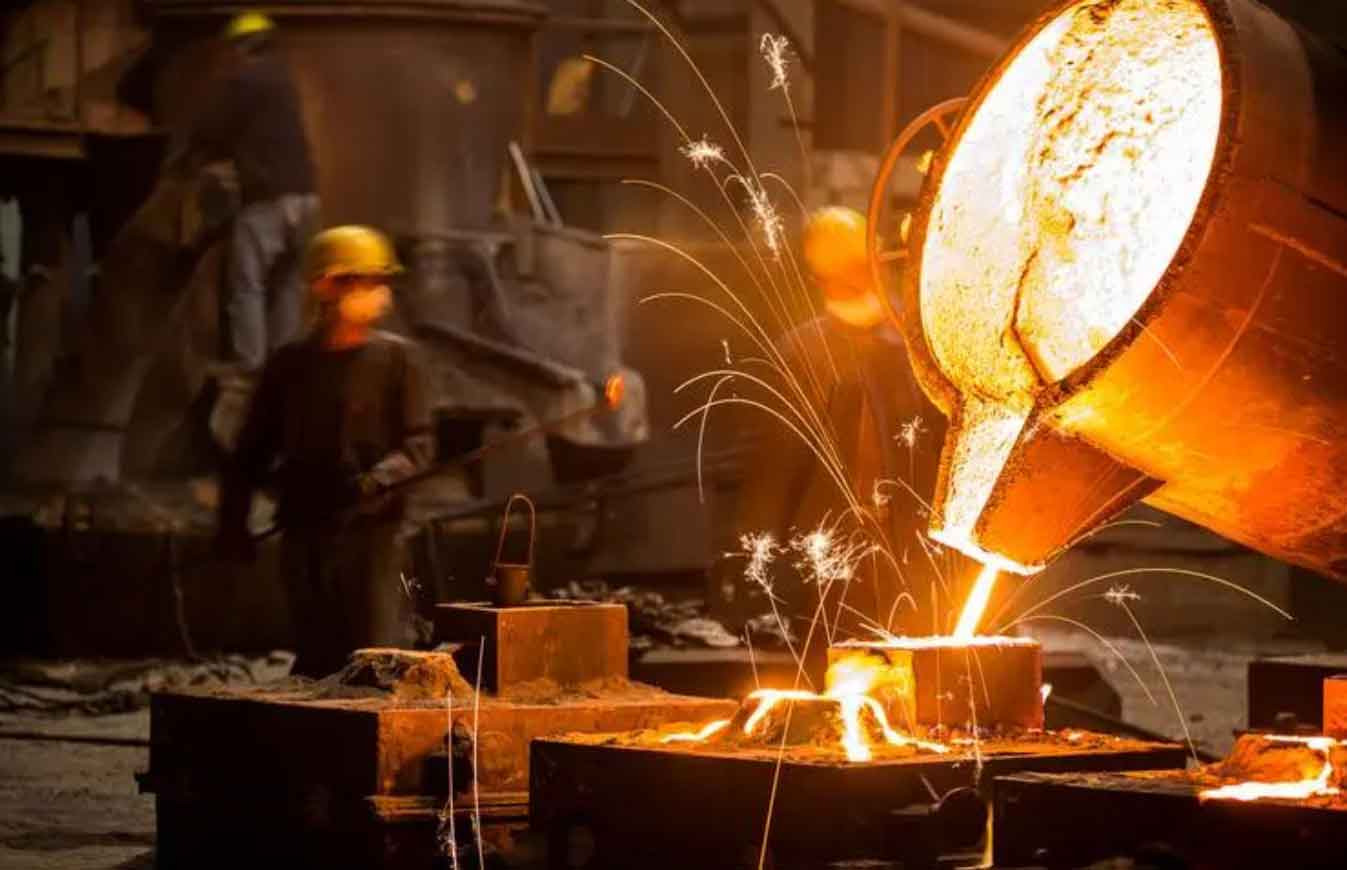
The image above illustrates a typical sand casting setup, reminiscent of the environments where resin sand casting is applied. It highlights the intricate molds and pouring processes that require careful control to achieve high-quality castings. In resin sand casting, such scenes are common, but with the added complexity of managing resin-bonded sands. My work often involves similar settings, where optimizing every step—from mold preparation to metal pouring—is key to success. By sharing these insights, I hope to contribute to the broader adoption and refinement of resin sand casting techniques worldwide.