
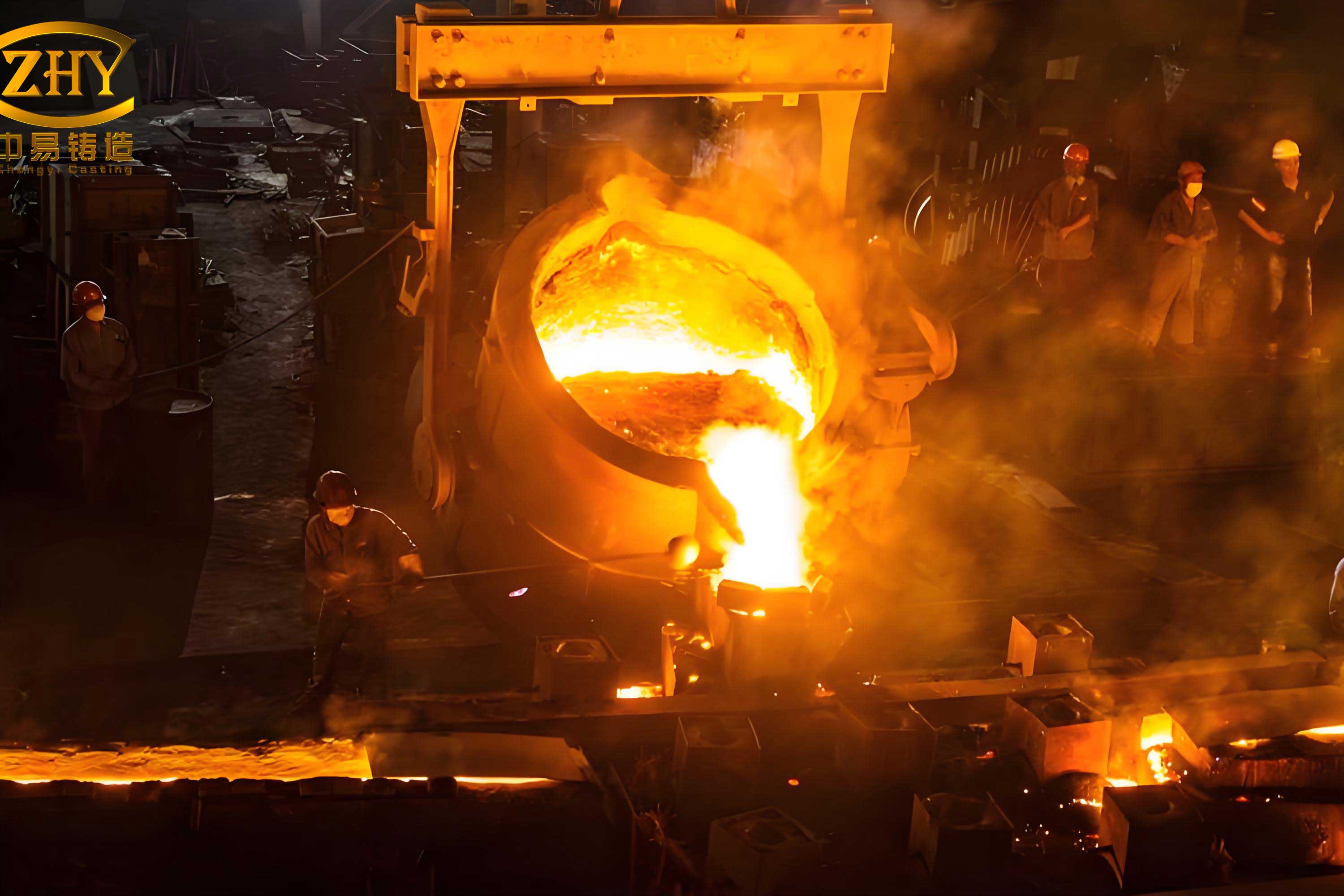
As a foundational pillar of modern industry, sand castings play a critical role in equipment manufacturing, accounting for a high proportion of components in machinery such as internal combustion engines, where they constitute approximately 80%. However, the traditional sand casting industry has long been characterized by labor-intensive processes, high energy consumption, significant environmental pollution, and a reliance on outdated equipment. This “rough and dirty” phase hinders progress, especially as skilled labor becomes scarce. In recent years, the advent of 3D printing technology, specifically applied to sand castings, has brought about a transformative shift. We have embarked on a journey to leverage additive manufacturing to overcome these challenges, aiming to redefine the future of sand castings through innovation.
The core of this revolution lies in the use of 3D printing for sand molds and cores. Traditional sand casting involves multiple steps: pattern making, molding, core making, and assembly, which are time-consuming and limit design flexibility. In contrast, 3D printing sand castings utilizes a binder jetting process, known as 3DP technology. Here, a print head deposits binder onto a thin layer of sand particles, layer by layer, to build complex geometries directly from digital models. This method eliminates the need for physical patterns, enabling rapid production of intricate sand castings with high precision. The fundamental principle can be summarized as an additive process where each layer contributes to the final form, mathematically represented as: $$ V_{\text{mold}} = \sum_{i=1}^{n} A_i \cdot h $$ where \( V_{\text{mold}} \) is the volume of the sand mold, \( A_i \) is the cross-sectional area at layer \( i \), \( h \) is the layer thickness, and \( n \) is the total number of layers. This layered approach allows for unprecedented design freedom in sand castings.
Industrial-grade sand mold 3D printers represent a significant leap over conventional systems. We have developed equipment that features large-scale integrated array print heads and dual workboxes for simultaneous printing, dramatically enhancing productivity. Key performance metrics include a printing speed increased to over 350 layers per hour, a build volume of up to 2500 mm × 1800 mm × 1000 mm, dimensional accuracy of ±0.35 mm for printed sand castings, and compressive strength exceeding 6 MPa. These specifications ensure that the technology meets the demands of various materials and large-scale sand castings. To illustrate, consider the following table comparing traditional sand casting methods with 3D printed sand castings:
| Aspect | Traditional Sand Casting | 3D Printed Sand Castings |
|---|---|---|
| Lead Time | Weeks to months (due to pattern making) | Hours to days (direct from CAD) |
| Design Complexity | Limited by pattern and core assembly | Highly complex geometries possible |
| Material Waste | High (e.g., sand disposal, pattern wear) | Low (binder and sand optimized) |
| Labor Intensity | High (manual molding and handling) | Reduced (automated printing) |
| Environmental Impact | Significant (dust, emissions, waste) | Improved (closed-loop systems possible) |
The application of 3D printing in sand castings yields profound benefits. Firstly, it shortens the production workflow drastically. By directly fabricating sand molds from 3D data, we bypass traditional steps like pattern creation, core making, and mold assembly. This compression of the process can be quantified using a time reduction factor: $$ T_{\text{reduction}} = \frac{T_{\text{traditional}} – T_{\text{3D printed}}}{T_{\text{traditional}}} \times 100\% $$ where \( T_{\text{traditional}} \) and \( T_{\text{3D printed}} \) are the total times for producing sand castings via respective methods. For many sand castings, this reduction exceeds 50%, accelerating time-to-market.
Secondly, 3D printing enhances the quality and performance of sand castings. The precision of printed sand molds reduces casting defects such as misruns or shifts, leading to superior mechanical properties. The sand mold strength, crucial for withstanding molten metal pressure, is optimized through binder formulation. We can express the relationship between binder concentration and compressive strength as: $$ \sigma_c = k \cdot C_b^n $$ where \( \sigma_c \) is the compressive strength (in MPa), \( C_b \) is the binder concentration, \( k \) is a material constant, and \( n \) is an exponent typically between 1 and 2 for sand castings. This ensures that sand castings produced via 3D printing meet rigorous standards.
Thirdly, design flexibility is greatly increased, lowering development costs and manufacturing complexity. With 3D printing, intricate internal passages and lightweight structures become feasible in sand castings, which were previously impossible or prohibitively expensive. This enables optimization of sand castings for performance, such as reducing weight while maintaining strength. For instance, topology optimization algorithms can generate designs that minimize material usage: $$ \text{Minimize: } \int_{\Omega} \rho \, dV \quad \text{subject to: } \sigma \leq \sigma_{\text{allowable}} $$ where \( \rho \) is density, \( \Omega \) is the design domain for sand castings, and \( \sigma \) is stress. Such designs are directly realizable through 3D printed sand molds.
Fourthly, 3D printing promotes green and intelligent manufacturing for sand castings. By automating mold production, it improves workplace conditions, reduces labor intensity, and cuts human resource costs. The digital nature of the process aligns with Industry 4.0, enabling smart factories where sand castings are produced with minimal intervention. Energy consumption per unit of sand castings can be modeled as: $$ E_{\text{unit}} = \frac{E_{\text{printing}} + E_{\text{material}}}{N_{\text{castings}}} $$ where \( E_{\text{printing}} \) is energy for printing, \( E_{\text{material}} \) for sand and binder production, and \( N_{\text{castings}} \) is the number of sand castings produced. 3D printing often reduces \( E_{\text{unit}} \) compared to traditional methods due to less waste and efficient resource use.
The impact on the sand casting industry’s transformation is monumental. Globally, the casting market is valued around trillion, with sand castings comprising a dominant share. In many regions, especially where multi-variety, small-batch production prevails, traditional sand casting faces challenges like quality inconsistency and labor shortages. 3D printing offers a viable path for upgrading these sand casting operations. We envision a future where smart factories, centered on 3D printing for sand castings, integrate robotics, AGVs, and automated storage to form intelligent units. The scalability of this approach can be summarized in the following table outlining the evolution:
| Stage | Description | Key Technologies for Sand Castings |
|---|---|---|
| Traditional | Manual labor, pattern-based, high waste | Conventional molding machines |
| Transitional | Adoption of 3D printing for prototypes and complex parts | Industrial sand mold 3D printers |
| Smart Unit | Integrated 3D printing with automation for batch production | 3D printers, robots, AGVs for sand castings |
| Smart Factory | Full digitalization, IoT, and AI-driven optimization | Networked 3D printing cells, predictive maintenance |
Looking ahead, the development of industrial sand mold 3D printing equipment will focus on higher efficiency, lower costs, and broader material compatibility. Print speed, for instance, can be enhanced through multi-head systems, modeled as: $$ S_{\text{total}} = m \cdot S_{\text{head}} $$ where \( S_{\text{total}} \) is the overall printing speed, \( m \) is the number of print heads, and \( S_{\text{head}} \) is the speed per head. This drives down the cost per sand casting, making the technology accessible for mass production. Additionally, advancements in binder chemistry will expand the range of alloys suitable for sand castings, from aluminum to steel and beyond.
The economic implications are substantial. With a potential market size in the hundreds of billions, the integration of 3D printing into sand casting promises to reshape the industry. We project that within a decade, a significant portion of sand castings will be produced via additive methods, transitioning from “rough and dirty” to “green and smart” manufacturing. This aligns with global sustainability goals, as 3D printing reduces the carbon footprint per sand casting by minimizing waste and energy use. A simple environmental impact score can be defined: $$ \text{EIS} = w_1 \cdot W + w_2 \cdot E + w_3 \cdot P $$ where \( W \) is waste generated, \( E \) is energy consumed, \( P \) is pollutants emitted, and \( w_i \) are weights for sand castings production. 3D printing typically yields a lower EIS for sand castings.
In conclusion, 3D printing technology is poised to revolutionize the sand casting industry. By enabling direct digital manufacturing of sand molds, it addresses long-standing challenges in efficiency, quality, and environmental impact. We are committed to advancing this innovation, from point-level breakthroughs in 3D printing for sand castings to line-level integration of smart units and ultimately surface-level deployment of smart factories. The journey towards a casting powerhouse is underpinned by these advancements, ensuring that sand castings remain a vital, yet modernized, component of the manufacturing landscape. The future of sand castings is bright, driven by additive manufacturing and digital transformation.