
In my exploration of manufacturing processes, I have found that casting, particularly sand casting, stands as a cornerstone of metal forming due to its versatility and economic efficiency. The process involves pouring molten metal into a mold, allowing it to solidify and cool, thereby obtaining a part or a rough blank. This method, known as metal liquid forming or casting, is extensively applied across mechanical engineering. For instance, in ordinary machine tools, castings account for 60% to 80% of components, while in heavy machinery and mining equipment, this figure exceeds 80%. Therefore, it is imperative to delve into the theoretical foundations of casting processes and the intricacies of various methods, with sand casting being a focal point. This article aims to comprehensively examine the characteristics, classifications, solidification modes, and methodologies of sand casting, leveraging tables and mathematical formulations to elucidate key concepts.
Casting, as I understand it, is inherently a phase transition from liquid to solid, which imparts distinct advantages and limitations. The ability to shape complex geometries with minimal constraints makes it indispensable, yet the resultant microstructural properties often require careful consideration. Over the years, I have observed that sand casting remains the most prevalent technique globally, accounting for over 90% of cast production, due to its adaptability and cost-effectiveness. Through this discourse, I will synthesize principles from metallurgy and engineering to provide a detailed perspective, emphasizing the role of solidification behavior and mold materials in determining final part quality.
Characteristics and Classification of Casting
From my experience, the fundamental attributes of casting stem from its liquid-to-solid transformation. These characteristics can be summarized as follows, which I often reference when selecting manufacturing methods for components:
- Formation Convenience and Adaptability: The liquid state allows for intricate shapes and sizes, from small precision parts to large structural elements. Materials are not limited to metals; polymers and ceramics can also be cast. This flexibility makes sand casting ideal for prototypes and complex designs where other processes falter.
- Cost-Effectiveness: The proximity of cast blanks to final shapes reduces material waste and machining time. Raw materials are abundant, often incorporating recycled scrap, and equipment investments are relatively low compared to forging or machining centers. Thus, sand casting is economically viable for both small and large batches.
- Microstructural and Performance Limitations: As I have noted in practice, cast structures typically exhibit coarse grains, chemical inhomogeneities like segregation, and inferior mechanical properties relative to wrought materials. Consequently, castings are best suited for static or low-stress applications, such as housings, frames, and supports, where strength is secondary to shape complexity.
To quantify these aspects, I often relate the cost savings in sand casting to reduced machining volumes. For example, the material utilization efficiency $U$ can be expressed as:
$$ U = \frac{V_{\text{part}}}{V_{\text{cast}}} \times 100\% $$
where $V_{\text{part}}$ is the volume of the final part after machining and $V_{\text{cast}}$ is the volume of the as-cast blank. In sand casting, $U$ often exceeds 70% for net-shape designs, highlighting its efficiency.
Casting methods are broadly categorized into two groups, as I classify them based on mold materials and filling mechanisms:
| Category | Sub-types | Key Features | Typical Applications |
|---|---|---|---|
| Sand Casting | Manual Sand Casting | Flexible, suitable for single pieces or small batches; uses sand-based molds. | Custom prototypes, large castings like engine blocks. |
| Machine Sand Casting | Automated for high productivity; employs patterns and presses for mold making. | Mass production of automotive components. | |
| Special Casting | Metal Mold Casting | Permanent metal molds; high cooling rates. | Aluminum alloys for repeated use. |
| Pressure Die Casting | Injected under high pressure; excellent surface finish. | Zinc or magnesium alloy housings. | |
| Centrifugal Casting | Rotational forces distribute metal; dense structures. | Pipes and cylindrical parts. | |
| Investment Casting | Lost-wax process; high precision. | Aerospace turbine blades. | |
| Low-Pressure Casting | Controlled filling via gas pressure; reduced turbulence. | Automotive wheels. |
As I emphasize, sand casting dominates the industry due to its simplicity and scalability. The choice between manual and machine sand casting hinges on production volume and part complexity, factors I always evaluate in process planning.
Solidification Modes of Castings
In my analysis, the solidification process is critical to casting quality, as it dictates microstructure, defect formation, and mechanical properties. Solidification, or crystallization for metals, involves the transition from liquid to solid state. The resulting grain structure—whether columnar or equiaxed—depends on alloy composition and thermal conditions during sand casting. I define three distinct solidification modes based on the width of the mushy zone (the region between liquidus and solidus temperatures), which I frequently model in simulations.
The temperature gradient $G$ and growth rate $R$ are key parameters I use to describe solidification. The mushy zone width $\Delta T_m$ relates to the alloy’s freezing range $\Delta T_f = T_l – T_s$, where $T_l$ is the liquidus temperature and $T_s$ is the solidus temperature. In sand casting, the low thermal conductivity of sand molds often leads to slower cooling, affecting $G$. The solidification time $t_s$ can be approximated by Chvorinov’s rule:
$$ t_s = k \left( \frac{V}{A} \right)^n $$
where $V$ is the casting volume, $A$ is the surface area, $k$ is a mold constant (higher for sand casting due to insulating properties), and $n$ is an exponent typically around 2. This influences grain size; for instance, longer $t_s$ in sand casting promotes coarser grains.
The three solidification modes are detailed below, which I correlate with common alloys used in sand casting:
| Solidification Mode | Alloy Examples | Mushy Zone Width | Grain Structure | Typical Defects |
|---|---|---|---|---|
| Layer-by-Layer (Directional) | Pure metals, eutectics (e.g., gray cast iron, Al-Si alloys), low-carbon steels | Narrow ($\Delta T_m \approx 0$) | Columnar crystals growing inward | Shrinkage porosity at center, hot tearing |
| Pasty (Mushy) | Broad freezing range alloys (e.g., Al-Cu alloys, tin bronze, ductile iron, high-carbon steels) | Wide ($\Delta T_m$ large) | Equiaxed grains throughout | Microporosity, segregation |
| Intermediate (Mixed) | Medium-carbon steels, white cast iron, some brass | Moderate | Mix of columnar and equiaxed | Variable properties, grain boundaries |
I often illustrate these modes with temperature profiles. For layer-by-layer solidification, the interface between solid and liquid is sharp, described by a moving boundary condition. The growth velocity $v$ of the solid front can be derived from heat transfer:
$$ v = \frac{k_m G}{\rho L} $$
where $k_m$ is the thermal conductivity of the mold (lower for sand, slowing $v$), $\rho$ is density, and $L$ is latent heat. In pasty solidification, nuclei form uniformly, and the solid fraction $f_s$ increases gradually with temperature drop, following the Scheil equation for non-equilibrium conditions:
$$ f_s = 1 – \left( \frac{T_m – T}{T_m – T_l} \right)^{1/(k_p-1)} $$
where $T_m$ is the melting point of the pure solvent, $T$ is the local temperature, and $k_p$ is the partition coefficient. This leads to solute enrichment in residual liquid, often causing segregation in sand castings.
From my perspective, controlling solidification in sand casting is paramount. For instance, using chills (metal inserts in sand molds) can locally increase $G$, shifting an alloy from intermediate to layer-by-layer mode, thereby refining structure. I have applied this to improve the toughness of steel castings in sand foundries.
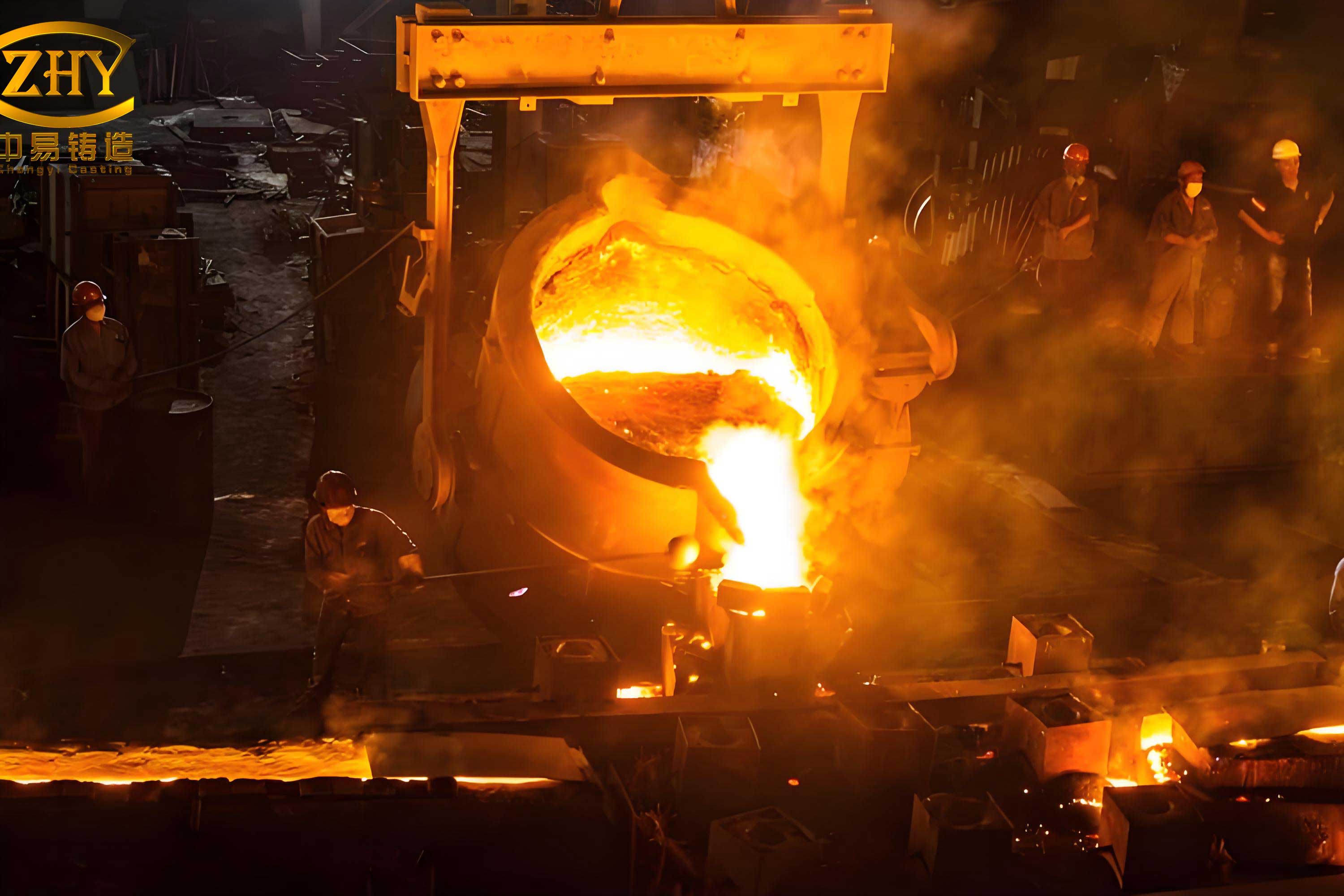
As seen in the image above, sand casting produces diverse components, from simple brackets to complex engine blocks. The visual quality often reflects the solidification mode; for example, parts with smooth surfaces may indicate layer-by-layer solidification, while rough textures might stem from pasty solidification defects. In my work, I use such observations to troubleshoot sand casting processes.
Methods of Sand Casting
Delving into sand casting methodologies, I regard it as a holistic process encompassing mold preparation, metal handling, and post-casting operations. The term sand casting specifically refers to using sand as the primary mold material, with gravity filling the cavity. Its prevalence stems from the recyclability of sand and the ease of pattern making. I break down the process into key stages, each influencing the final outcome.
Sand Casting Process Flow
In my practice, the sand casting sequence typically involves these steps, though variations exist based on part design and production scale:
- Pattern Making: A replica of the part, often oversized to account for shrinkage. Patterns can be wood, metal, or plastic.
- Mold Making (Coping and Drag): The pattern is embedded in sand within a flask to form the mold cavity. This includes gating systems (runners, risers) for metal flow and feeding.
- Core Making: For internal features, separate sand cores are produced and placed in the mold.
- Drying (if applicable): Some molds are baked to enhance strength, though green sand (moist) molds are common.
- Assembly (Closing): The cope and drag are joined, with cores positioned.
- Melting and Pouring: Metal is melted in furnaces and poured into the mold at controlled rates.
- Cooling and Solidification: The mold is left undisturbed, following the solidification modes discussed earlier.
- Shakeout and Cleaning: After cooling, the sand is broken away, and the casting is cleaned of residues.
- Inspection and Finishing: Defect checks, machining, and surface treatments are performed.
I often model the pouring process using fluid dynamics. The flow rate $Q$ through a gating system in sand casting can be estimated by Bernoulli’s principle, considering friction losses in sand molds:
$$ Q = A_g \sqrt{2gH} \cdot C_d $$
where $A_g$ is the gate area, $g$ is gravity, $H$ is the metallostatic head, and $C_d$ is a discharge coefficient (typically 0.6-0.8 for sand molds due to rough surfaces). Proper gating ensures complete filling without turbulence, critical for sound castings.
Molding Materials
The properties of molding sand, which I meticulously specify, directly impact casting quality. Sand casting relies on mixtures of silica sand, binders (e.g., clay, resins), and additives (e.g., coal dust, water). I evaluate these materials based on five key attributes, as tabulated below:
| Property | Description | Ideal Value for Sand Casting | Measurement Method | Impact on Casting Defects |
|---|---|---|---|---|
| Plasticity | Ability to retain shape under pressure | High for intricate details | Compression tests | Poor plasticity leads to mold collapse or blurred features. |
| Strength (Green/Dry) | Resistance to erosion and deformation | Moderate to high (e.g., 0.5-1.5 MPa) | Universal testing machines | Insufficient strength causes mold cracking or metal penetration. |
| Refractoriness | Resistance to high temperatures without fusion | High (silica sand melts ~1700°C) | Pyrometric cone tests | Low refractoriness results in sand fusion and surface defects. |
| Permeability | Ability to allow gas escape | High (e.g., 100-200 permeability number) | Permeability meters | Low permeability traps gases, causing blowholes or porosity. |
| Collapsibility (Yield) | Ease of sand removal after casting | Good to prevent stress on casting | Shakeout time measurements | Poor collapsibility leads to hot tears or distortion. |
I often formulate sand mixtures using empirical relations. For example, the green strength $\sigma_g$ of clay-bonded sand can be expressed as a function of moisture content $w$ and clay percentage $c$:
$$ \sigma_g = \alpha \cdot c \cdot w^2 + \beta $$
where $\alpha$ and $\beta$ are constants determined experimentally. Optimizing these parameters is crucial for efficient sand casting, especially in automated systems where consistency is key.
Molding Techniques
In sand casting, molding methods fall into manual and machine categories, each with distinct advantages I leverage based on production needs.
Manual Molding: As I have applied in small foundries, this involves hand tools for sand ramming and pattern removal. Techniques include:
– Whole Pattern Molding: For simple shapes without undercuts.
– Split Pattern Molding: Using two-part patterns for complex geometries.
– Core Assembly: Integrating cores for hollow sections.
Manual sand casting offers flexibility but is labor-intensive, with productivity rates around 5-10 molds per hour per worker. I calculate labor cost $C_l$ as:
$$ C_l = t_m \cdot R_w \cdot N $$
where $t_m$ is mold-making time, $R_w$ is wage rate, and $N$ is number of workers. For single pieces, this is often acceptable.
Machine Molding: In high-volume sand casting, I rely on machines for consistency. Processes include:
– Jolt Squeeze: Vibrations compact sand, followed by pressure.
– Impact Molding: High-pressure impulses for uniform density.
– Pattern Draw: Automated pattern withdrawal using ejectors.
Machine sand casting significantly speeds up production, with rates exceeding 100 molds per hour. The mold density $\rho_m$ achieved affects permeability; I model it as:
$$ \rho_m = \rho_0 + k_p \cdot P $$
where $\rho_0$ is initial sand density, $k_p$ is a compaction factor, and $P$ is applied pressure. Higher $\rho_m$ improves strength but may reduce permeability, necessitating trade-offs in sand casting design.
I also consider advanced sand casting methods like shell molding, which uses resin-bonded sand for better surface finish. However, traditional green sand casting remains dominant due to its cost and versatility.
Advanced Considerations in Sand Casting
Reflecting on my experience, I recognize that sand casting is not static; it evolves with technology. Computational simulations, for instance, allow me to predict solidification patterns and optimize gating systems before physical trials. Finite element analysis (FEA) models heat transfer during sand casting, solving the heat conduction equation:
$$ \frac{\partial T}{\partial t} = \alpha \nabla^2 T + \frac{L}{c_p} \frac{\partial f_s}{\partial t} $$
where $\alpha$ is thermal diffusivity, $c_p$ is specific heat, and $f_s$ is solid fraction. Such tools help mitigate defects like shrinkage cavities, common in pasty solidification alloys cast in sand molds.
Moreover, sustainability in sand casting is a growing focus. I advocate for sand reclamation systems that recycle used sand, reducing waste. The recyclability ratio $R_r$ for sand in foundries can exceed 90%, calculated as:
$$ R_r = \frac{M_{\text{reclaimed}}}{M_{\text{total used}}} \times 100\% $$
This aligns with eco-friendly manufacturing trends, making sand casting even more attractive.
In terms of material science, I explore alloy modifications for better sand castability. For example, adding inoculants to cast iron promotes graphite formation, easing pasty solidification issues. The effect on mechanical properties, such as tensile strength $\sigma_t$, can be correlated with grain size $d$ via the Hall-Petch equation:
$$ \sigma_t = \sigma_0 + k_y d^{-1/2} $$
where $\sigma_0$ and $k_y$ are material constants. Finer grains, achievable through controlled cooling in sand casting, enhance strength.
Conclusion
Through this extensive discussion, I have articulated the multifaceted nature of sand casting, from its foundational principles to practical applications. The solidification modes—layer-by-layer, pasty, and intermediate—profoundly influence microstructure and defect formation, necessitating careful control in sand casting processes. By employing tables and mathematical formulations, I have highlighted key parameters like temperature gradients, mold properties, and production metrics. Sand casting, with its adaptability and economic benefits, continues to be a vital manufacturing method, especially when combined with modern techniques for quality assurance. As I move forward, I anticipate further innovations in sand casting, driven by digitalization and material advancements, ensuring its relevance in the evolving industrial landscape.