
In our manufacturing operations, we have historically relied on sodium silicate sand and resin sand processes for producing steel castings such as side frames, couplers, and other railway components. To reduce production costs, enhance sand reclamation rates, and minimize environmental impact, we decided to transition to green sand molding, utilizing both shooting and vibration molding methods. During trial production, we encountered various sand casting defects that challenged product quality. By leveraging advanced quality control practices from domestic and international sources, we successfully addressed these issues and developed effective countermeasures. This article shares our first-hand experiences in analyzing and controlling sand casting defects, with a focus on green sand molding for steel castings and aluminum alloy castings, emphasizing the recurring theme of sand casting defect prevention.
The green sand molding process offers significant advantages, including production flexibility, high efficiency, short cycles, and cost-effectiveness due to the absence of expensive binders like resins. However, it is prone to sand casting defects such as sand inclusions, blowholes, shrinkage porosity, surface burns, cracks, and mold wall movement, which increase welding repair work and cleaning costs. To improve profitability, we prioritized defect control across all production stages. Below, we detail the causes, impacts, and control measures for these sand casting defects, incorporating tables and formulas for clarity. The sand casting defect reduction strategy is crucial for maintaining competitiveness in foundry operations.
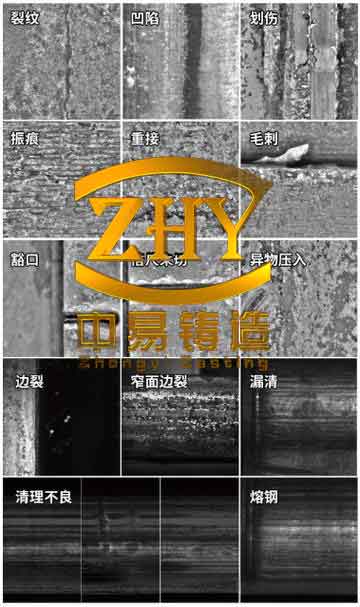
One of the most common sand casting defects in green sand molding is sand inclusion, which manifests as embedded sand particles on the upper or lateral surfaces of castings. This sand casting defect arises primarily from thermal expansion of the sand mold surface. Key factors include low thermal conductivity of the sand, which creates temperature gradients and differential expansion; inadequate sand strength or moisture content; non-uniform mold compaction; poorly designed venting systems; and improper gating that causes erosion. The impact is increased cleaning workload and potential scrap if severe. To mitigate this sand casting defect, we optimized sand composition and molding practices, as summarized in Table 1.
| Sand Casting Defect Type | Primary Causes | Preventive Measures | Impact on Production |
|---|---|---|---|
| Sand Inclusion | Thermal expansion, low sand strength, uneven compaction, poor venting, gating erosion | Use finer base sand, add anti-burn additives, improve compaction uniformity, optimize gating design | Increased cleaning, possible scrap |
| Blowholes (Gas Porosity) | High moisture in sand, inadequate venting, core gas entrapment, wet charge materials | Control sand moisture, enhance venting, dry charge materials, use degassing techniques | Welding repairs, hidden safety risks |
| Shrinkage Porosity | Insufficient feeding, improper riser design, lack of chills | Optimize riser size and placement, employ chills or chromite sand, simulate solidification | Scrap due to internal defects |
| Surface Burn-on (Sticky Sand) | Low refractory base sand, high oxide content, insufficient coating | Use high-silica sand, apply refractory coatings, control sand chemistry | Difficult cleaning, surface roughness |
| Cracks | Material properties, poor mold yield, thermal stresses | Adjust alloy composition, improve mold yieldability, control cooling rates | High rework rate, performance issues |
| Mold Wall Movement (Swelling) | Insufficient mold hardness, weak flask design | Increase compaction, reinforce flask ribs, ensure proper clamping | Dimensional inaccuracies, overweight castings |
Blowholes, another prevalent sand casting defect, appear as smooth-walled cavities due to gas entrapment during solidification. These can be classified as invasive gases from the mold or evolved gases from the melt. Causes include improper base sand selection, excessive sand moisture, poor venting, wet charge materials, and high pouring temperatures. The impact ranges from repairable surface defects to hidden internal voids that compromise integrity. To control this sand casting defect, we focus on sand preparation and melting practices. For instance, the gas evolution potential can be modeled using the formula for gas pressure in molds: $$P_g = \frac{nRT}{V}$$ where \(P_g\) is the gas pressure, \(n\) is moles of gas, \(R\) is the gas constant, \(T\) is temperature, and \(V\) is volume. Minimizing \(n\) through dry materials and good venting is key.
Shrinkage porosity and shrinkage cavities are sand casting defects related to inadequate feeding during solidification. They often occur in heavy sections or near risers if the casting design lacks proper compensation. The causes include undersized risers, absence of chills, and incorrect gating. The impact is severe, as internal shrinkage can lead to scrap and safety hazards. We address this sand casting defect by applying Chvorinov’s rule to estimate solidification time: $$t = k \left( \frac{V}{A} \right)^2$$ where \(t\) is solidification time, \(V\) is volume, \(A\) is surface area, and \(k\) is a mold constant. By optimizing the volume-to-surface area ratio via risers and chills, we enhance feeding efficiency. Table 2 summarizes shrinkage control methods.
| Method | Application | Formula/Principle | Effectiveness |
|---|---|---|---|
| Riser Design | Provide liquid metal feed | Modulus method: \(M = V/A\) | High, if properly sized |
| Chill Placement | Localize cooling | Heat transfer: \(Q = k A \Delta T / d\) | Moderate to high |
| Gating Optimization | Control pouring sequence | Fluid dynamics: Bernoulli’s equation | Essential for uniformity |
| Simulation Software | Predict hot spots | Finite element analysis | Very high for design validation |
Surface burn-on or sticky sand is a sand casting defect where sand grains fuse to the casting surface, increasing cleaning difficulty. It results from low refractory properties of base sand, high oxide content (e.g., Na₂O, K₂O, FeO), and insufficient mold coating. The impact is exacerbated in complex geometries where cleaning is arduous. To prevent this sand casting defect, we select high-purity silica sand and apply refractory coatings. The sand sintering tendency can be expressed by the liquidus temperature formula for silicate systems: $$T_l = T_0 – \sum (k_i \cdot x_i)$$ where \(T_l\) is liquidus temperature, \(T_0\) is pure silica melting point, \(k_i\) are constants, and \(x_i\) are oxide mole fractions. Minimizing low-melting oxides reduces burn-on.
Cracks, though less common in green sand due to better mold yield, can still occur as a sand casting defect from thermal stresses or material issues. Causes include high carbon content in steel, rapid cooling, and restrictive mold designs. The impact is high rework rates and potential performance failures. We control this sand casting defect by adjusting alloy composition and improving mold yieldability. The thermal stress during cooling can be approximated by: $$\sigma = E \alpha \Delta T$$ where \(\sigma\) is stress, \(E\) is Young’s modulus, \(\alpha\) is thermal expansion coefficient, and \(\Delta T\) is temperature gradient. Reducing \(\Delta T\) through controlled cooling helps.
Mold wall movement or swelling is a sand casting defect where the mold deforms under metallostatic pressure, causing dimensional errors. It stems from low mold hardness and weak flask design. The impact includes overweight castings and scrap. We address this sand casting defect by enhancing compaction and flask rigidity. The mold hardness \(H\) can be related to compaction energy \(E_c\) by: $$H = k_h \cdot E_c^m$$ where \(k_h\) and \(m\) are constants. Increasing \(E_c\) through better molding machines improves hardness.
To systematically control these sand casting defects, we implemented measures across sand preparation, process design, and operational steps. For sand selection and compounding, we aim for properties like good flowability, plasticity, strength, permeability, and refractoriness. We use finer base sand (e.g., AFS grain fineness number >60) to improve compactability and reduce porosity. Additives like starch and bentonite blends enhance toughness and surface strength, cutting sand inclusion and burn-on. The optimal sand mixture can be modeled using the following formula for green strength \(S_g\): $$S_g = a \cdot C_b + b \cdot C_s + c \cdot W$$ where \(C_b\) is bentonite content, \(C_s\) is starch content, \(W\) is water content, and \(a, b, c\) are coefficients determined empirically. We maintain \(S_g\) above 0.1 MPa for steel castings.
In process design, we leverage simulation software to validate gating, risering, and venting before production. Key principles include: placing vents strategically to avoid gas entrapment, ensuring riser safety margins of 20–30 mm, designing gating systems to minimize erosion, and reinforcing flasks with ribs for better compaction. The gating ratio is optimized using fluid flow calculations to reduce turbulence, a common cause of sand casting defects. For example, the flow rate \(Q\) through a gate is given by: $$Q = C_d \cdot A \cdot \sqrt{2 g h}$$ where \(C_d\) is discharge coefficient, \(A\) is gate area, \(g\) is gravity, and \(h\) is metallostatic head. Controlling \(Q\) prevents mold erosion.
Operational controls are critical. We enforce strict procedures in molding, core-making, melting, and pouring. Molding ensures uniform compaction; cores are well-vented; charge materials are dried to below 0.1% moisture; and pouring is done at controlled temperatures (e.g., 1550–1600°C for steel) with proper slag removal. Coating application is standardized, with thicker layers in high-heat areas like riser necks. We also monitor sand properties daily using tests for moisture, strength, and permeability, as per Table 3.
| Parameter | Target Range for Steel Castings | Test Method | Impact on Sand Casting Defects |
|---|---|---|---|
| Moisture Content | 3.0–4.5% | Drying loss | High moisture causes blowholes; low reduces strength |
| Green Compressive Strength | 0.12–0.18 MPa | Universal strength tester | Prevents sand inclusion and swelling |
| Permeability Number | 80–120 | Standard permeability test | Reduces gas-related sand casting defects |
| Compactability | 35–45% | Compactability tester | Ensures uniform mold hardness |
| Loss on Ignition | 2.5–3.5% | Combustion at 950°C | Indicates binder content; affects burn-on |
Transitioning to aluminum alloy castings, we also address pinholing, a specific sand casting defect in alloys like ZL104. Pinholing refers to hydrogen porosity formed during solidification, visible only after machining. According to industry standards, pinhole defects are graded from Level 1 (best) to Level 5 (worst) based on density and size, as shown in Table 4. Our requirement is Level 1 or better to avoid scrap. This sand casting defect stems from hydrogen absorption in the melt, often due to wet charge materials or improper degassing.
| Pinhole Level | Pinhole Density (holes/cm²) | Pinhole Diameter (mm) and Distribution | Acceptability in Our Production |
|---|---|---|---|
| 1 | ≤5 | ≤0.1 mm: 90%; 0.1–0.2 mm: 10% | Acceptable |
| 2 | ≤10 | ≤0.1 mm: 80%; 0.1–0.2 mm: 20% | Marginal, requires review |
| 3 | ≤15 | ≤0.3 mm: 80%; 0.3–0.5 mm: 20% | Unacceptable |
| 4 | ≤20 | ≤0.5 mm: 70%; 0.5–1.0 mm: 30% | Unacceptable |
| 5 | ≤25 | ≤0.5 mm: 60%; 0.5–1.0 mm: 30%; >1.0 mm: 10% | Unacceptable (scrap) |
To reduce this sand casting defect, we implemented stringent controls. Raw materials are inspected for dryness; charge materials are limited to 30% returns; and melt treatment includes grain refinement with Al-Ti-B and modification with Al-Sr. Degassing is performed using rotary impeller degassing for 15 minutes, followed by holding. The hydrogen solubility in aluminum follows Sieverts’ law: $$C_H = k_H \sqrt{P_{H_2}}$$ where \(C_H\) is hydrogen concentration, \(k_H\) is a constant, and \(P_{H_2}\) is hydrogen partial pressure. By reducing \(P_{H_2}\) through degassing and using dry tools, we lower \(C_H\) below 0.15 mL/100g Al. Pouring temperature is kept at 720–740°C to minimize gas evolution. Additionally, mold sand for aluminum uses low-moisture content (2–3%) and high permeability to vent hydrogen quickly.
The integration of these measures has significantly cut sand casting defect rates in our foundry. For steel castings, defect-related scrap dropped by over 30% within six months, while aluminum pinhole defects now consistently meet Level 1. Key lessons include the importance of sand property control, simulation-driven design, and operator training. Each sand casting defect, whether in steel or aluminum, requires a tailored approach based on root-cause analysis. We continue to refine our processes, exploring advanced binders and real-time monitoring to further mitigate sand casting defects.
In conclusion, green sand molding is an economical method, but it demands meticulous control to avoid sand casting defects. Our experience shows that by optimizing sand composition, designing robust processes, and enforcing strict operational disciplines, we can minimize defects like sand inclusion, blowholes, shrinkage, burn-on, cracks, and swelling. For aluminum, pinholing is controlled through melt treatment and sand management. The recurring theme is proactive management of sand casting defect sources across the production chain. As we expand our green sand applications, these insights will guide ongoing improvements, ensuring high-quality castings at lower costs and reinforcing the viability of this traditional yet adaptable process.