
In my work as a foundry engineer, I have been deeply involved in the production of engine cylinder block castings using a wet green sand molding line. The process relies on a GF multi‑contact high‑pressure molding line with flask dimensions of 1220 mm × 950 mm × 400 mm (350 mm). The cylinder block, designated as D‑block, is made of HT250 gray iron, weighing 179 kg, with dimensions 756 mm × 356 mm × 419 mm. The pouring temperature ranges from 1430 °C to 1450 °C, and we employ a stepped gating system with a pouring time of 17–19 s. Each flask contains one casting, and the mold surface is coated with an alcohol‑based coating. The core package consists of a phenolic resin main core, furan resin auxiliary cores, a resin‑coated sand water jacket core, and resin‑coated sand tappet cores.
Previously, the scrap rate for sand casting defects such as sand inclusion and scabbing on the upper external cavity of the D‑block was very low, around 0.1%. However, it suddenly rose to 5%. Extensive data analysis revealed a clear pattern: about 65% of these sand casting defects occurred at the bottom flange of the upper mold, while 35% appeared near process holes. The morphologies were also different. At the bottom flange, a thin layer of iron skin peeled off, leaving a 2–3 mm thick layer of sand entrapped beneath. Near the process holes, a scab of about 2 mm thickness was observed, often accompanied by sand holes. These sand casting defects were difficult to clean and sometimes led to outright rejection of the casting.
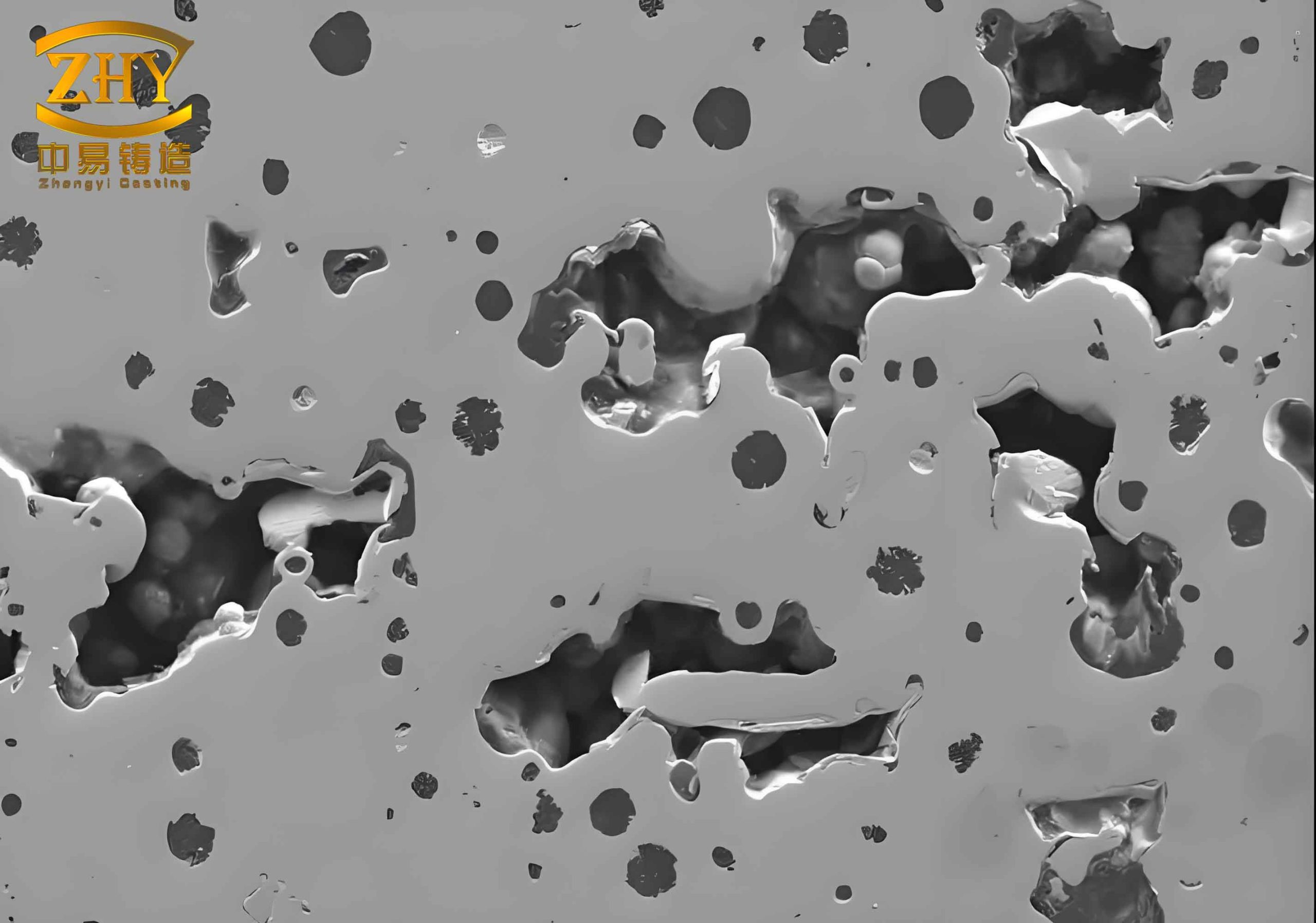
The root cause investigation started with the molding sand parameters. Table 1 summarizes the typical sand properties at the time of the problem.
| Property | Value |
|---|---|
| Moisture content (%) | 2.9 – 3.1 |
| Effective bentonite (%) | 8.0 – 8.3 |
| Coal dust (%) | 4.2 – 5.0 |
| Green compression strength (MPa) | 0.19 – 0.21 |
| Hot wet tensile strength (kPa) | 3.0 – 5.0 |
| Compactability (%) | 36.0 – 38.0 |
The hot wet tensile strength was within specification (≥2.5 kPa), so we initially thought it was not the primary cause. However, during pouring we noticed a strong spray of iron (water explosion) that was strongly correlated with the sand casting defects. Further investigation onto the molding process revealed that the coating layer near the process holes sometimes detached during pouring, leaving a scab of about 1–1.5 mm thickness – exactly the coating thickness. This indicated that the sand casting defects at the process holes were primarily caused by coating peeling under thermal shock.
Based on the data, I identified three main contributors to the sand casting defects:
- High moisture content in the molding sand combined with short pouring time, leading to explosive vaporization (water explosion).
- Inconsistent mold hardness due to unstable squeeze pressure on the molding machine, causing uneven thermal expansion.
- Weak bonding between the coating and the sand surface, leading to delamination under high temperature.
Corrective Measures and Results
Reducing Water Explosion
Water explosion is a classic source of sand casting defects. When the moisture content is high and permeability is low, rapid vaporization creates violent gas evolution that can detach sand layers. I first correlated moisture content with the percentage of castings showing iron spray and the scrap rate due to sand casting defects, as shown in Table 2.
| Moisture (%) | Iron spray occurrence (%) | Sand casting defects rate (%) |
|---|---|---|
| 2.65 | 13 | 1.71 |
| 2.70 | 15 | 1.42 |
| 2.75 | 16 | 1.51 |
| 2.80 | 19 | 1.76 |
| 2.85 | 23 | 1.99 |
| 2.90 | 39 | 3.32 |
| 2.95 | 51 | 4.77 |
| 3.00 | 55 | 5.46 |
| 3.05 | 57 | 5.91 |
From the data, it was clear that moisture above 2.90% drastically increased both the explosion frequency and sand casting defects. The optimal range appeared to be 2.65% – 2.80%. To achieve this, I reduced the compactability target from 36–38% to 34–36%, and lowered the effective bentonite content from 8.0–8.3% to 7.65–7.85%. The adjusted sand parameters are given in Table 3.
| Property | Value |
|---|---|
| Moisture content (%) | 2.65 – 2.85 |
| Effective bentonite (%) | 7.60 – 7.85 |
| Green compression strength (MPa) | 0.175 – 0.205 |
| Hot wet tensile strength (kPa) | 3.0 – 5.0 |
| Compactability (%) | 34.0 – 36.0 |
The hot wet tensile strength remained acceptable (≥2.5 kPa). This reduction in moisture also improved the sand flowability, as expressed by the empirical relation:
$$
\text{Flowability} \propto \frac{1}{\text{Moisture} + k \cdot \text{Bentonite}}
$$
where k is a constant depending on clay type. Lower moisture and bentonite reduced the compactability and increased permeability, thereby mitigating sand casting defects caused by water explosion.
In parallel, I optimized the gating system. The original choke area was 14.40 cm², giving a pouring time of 17–19 s. By reducing the choke area to 10.70 cm², the pouring time increased to about 23.5 s. Using simulation, I verified that the metal rise became smoother and gas escape improved. The relationship between choke area and pouring time is:
$$
t = \frac{V}{\mu \cdot A \cdot \sqrt{2gH}}
$$
where t = pouring time, V = casting volume, μ = flow coefficient, A = choke area, g = gravity, H = effective metallostatic head. A longer pouring time reduces the thermal shock per unit area and allows gases to escape, thus reducing sand casting defects.
After these changes, I tracked the next 5,420 castings. The iron spray occurrence dropped from 50% to below 1%. The bottom flange sand casting defects rate decreased from 3.6% to 0.06%, and the process hole sand casting defects rate fell from 1.96% to 0.77%.
Increasing Squeeze Pressure for Uniform Mold Hardness
At the process holes, there were many reinforcing ribs on the pattern plate. During molding, the sand compacted less densely in the ribbed areas, leading to lower localized mold hardness. When exposed to high temperature, these weak spots expanded unevenly, causing the coating to crack and detach. I hypothesized that increasing the squeeze pressure (specific pressure) would improve the mold hardness and reduce sand casting defects.
I conducted experiments with different specific pressures, measuring the mold hardness (using a C‑type hardness tester) and the resulting sand casting defects rate at the process holes. The results are shown in Table 4.
| Specific pressure (MPa) | Mold hardness (C-scale) | Sand casting defects rate at process holes (%) |
|---|---|---|
| 0.5 | 37.0 | 1.44 |
| 0.6 | 42.0 | 1.10 |
| 0.7 | 47.0 | 0.42 |
| 0.8 | 54.0 | 0.08 |
| 0.9 | 56.0 | 0.37 |
| 1.0 | 57.0 | 0.74 |
The optimal point was at 0.8 MPa, where the mold hardness reached 54 and the sand casting defects rate dropped to 0.08%. Above 0.9 MPa, the defects increased again, possibly due to over‑compaction causing other issues like sand expansion cracks. I therefore set the squeeze pressure to 0.80 MPa. Over the next 2,605 castings, only 2 process hole sand casting defects occurred, corresponding to a rate of 0.076%.
Refined Coating Application and Drying
Even with optimal sand and machine parameters, coating detachment remained a source of sand casting defects. We used a reputable high‑temperature coating. The spraying equipment was an automated pneumatic traversing rig. I implemented a strict checkpoint routine: specific gravity of the coating, condition of the spray pump and nozzle, travel speed, and final coating thickness on the mold. To prevent moisture from the coating staying trapped, we added infrared lamps to dry the coated areas locally, especially near the process holes. This ensured uniform coating strength and minimized the risk of delamination during pouring.
Conclusions
Through this systematic investigation, I successfully reduced the sand casting defects on the D‑block from 5% to well below 0.2%. The key actions were:
- Lowering moisture content from 3.0% to below 2.85% and compactability from 36–38% to 34–36%, which drastically reduced water explosion and its associated sand casting defects.
- Extending the pouring time from 17–19 s to about 23.5 s by reducing the choke area, allowing smoother mold filling and better gas escape.
- Increasing the squeeze pressure from 0.65 MPa to 0.80 MPa, which improved mold hardness uniformity and eliminated coating peeling at weak spots.
- Enforcing strict coating application and drying procedures to ensure a defect‑free surface.
The combination of these measures eliminated the sand casting defects that had plagued the production. The formulas and data presented here serve as a practical guide for any foundry facing similar challenges with green sand molding of intricate iron castings.