
In our foundry practice, the production of high-quality gray iron castings for machine tool beds has always been challenging, particularly when dealing with water glass sand molds. The castings we focus on are the bed bodies for the 2M9120A multi-purpose grinding machine, weighing 145 kg and specified as HT200. These castings demand precise dimensions, smooth surfaces, sharp edges, and strict freedom from defects such as sand holes and blowholes on the guide rail surfaces, with a required hardness of HB198. For years, we successfully produced these castings using clay sand, dry molds, and dry cores with a two-box molding process. However, after relocating production to an external foundry due to environmental regulations, we encountered severe sand casting defects. This article presents our systematic investigation and corrective measures to eliminate subcutaneous blowholes and oxidation slag inclusions, emphasizing the critical role of moisture control and gating system design in minimizing sand casting defects.
The external foundry initially replicated our casting process, using medium-frequency induction furnaces for melting and water glass sand for molding. The castings appeared acceptable after rough machining and artificial aging, but during fine machining, subcutaneous blowholes and oxidation slag holes emerged on the V-shaped guide rail surfaces, as illustrated in the typical defect image below. The rejection rate exceeded 40%, causing significant economic losses for both parties. The image shows the characteristic defect morphology observed on the machined guide rail surfaces.
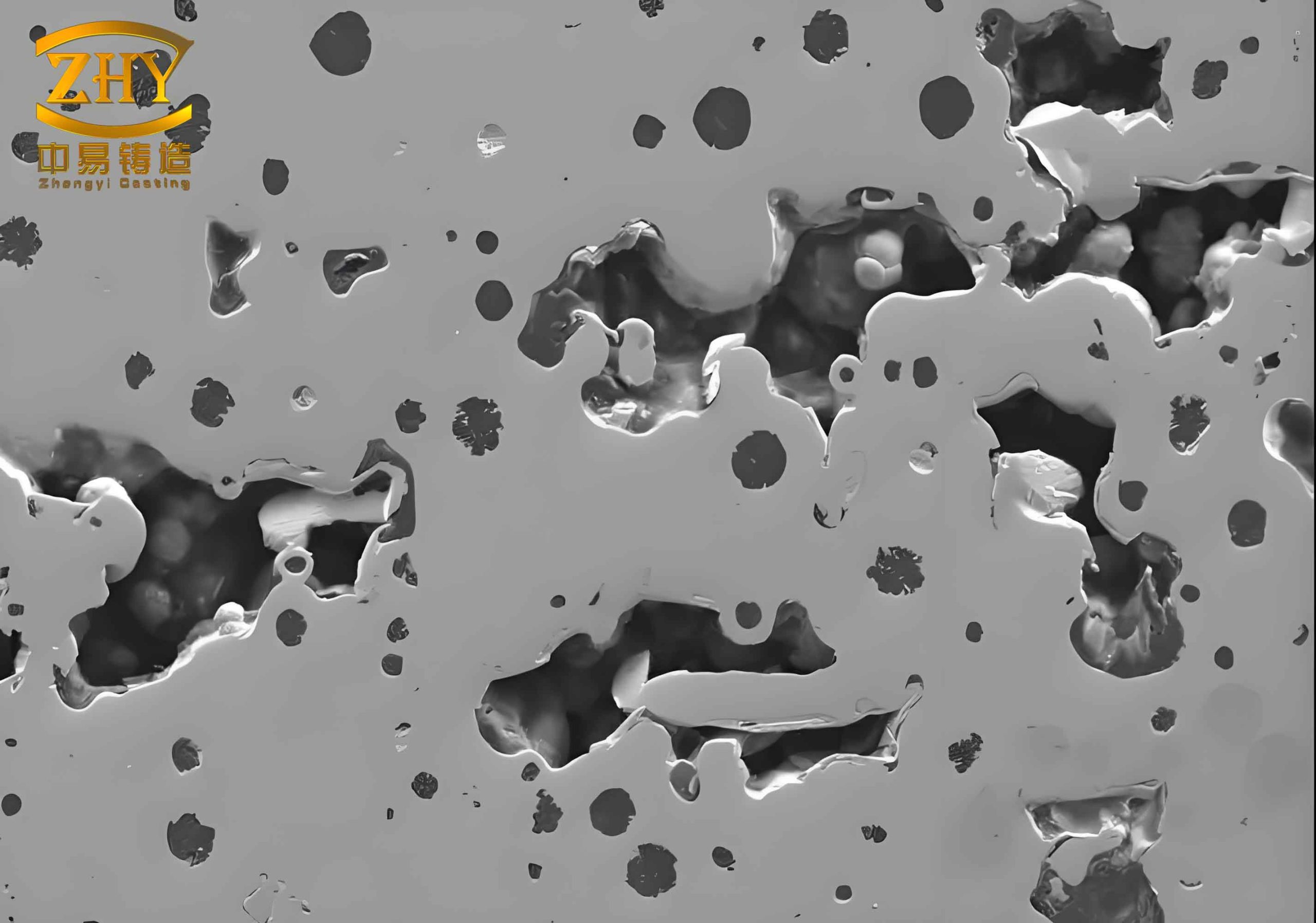
We formed a quality investigation team and conducted a thorough root cause analysis. Initially, we identified several potential contributors to the sand casting defects: excessive pouring temperature from electric melting, poor slag control during pouring, contamination of return scrap with nodular iron containing residual magnesium and rare earth elements, insufficient venting of molds and cores, and excessively fast pouring speeds causing gas entrapment. We implemented immediate corrective actions: eliminating nodular iron returns, adding a slag dam in the pouring basin, strictly controlling slag, adopting “high-temperature tapping and low-temperature pouring” with pouring temperatures not exceeding 1390 °C, and using a slow-fast-slow pouring sequence. After casting 12 bed bodies, the V-rail defect issue improved but the rejection rate remained at 25%, indicating that the root cause was not fully addressed.
We then focused on the molding materials and core-making processes. Water glass sand, after CO₂ hardening, retains residual moisture that can generate gas during pouring. This moisture is a primary driver of sand casting defects like subcutaneous blowholes. We decided to use higher modulus water glass and coarser silica sand to reduce the total binder and water content in the sand mix, thereby improving mold permeability. The reduction in residual moisture can be expressed by the relationship:
$$ M_{\text{residual}} = M_0 – \Delta M_{\text{evaporation}} – \Delta M_{\text{reaction}} $$
where \(M_0\) is the initial water content, \(\Delta M_{\text{evaporation}}\) is water lost during natural drying, and \(\Delta M_{\text{reaction}}\) is water consumed by the CO₂ hardening reaction. By optimizing the sand formulation, we aimed to minimize \(M_{\text{residual}}\).
After preparing the molds and cores, we applied a quick-drying coating on the cavity surfaces and then placed the cores in a drying oven following a controlled baking schedule. The drying profile was designed to remove absorbed moisture without over-baking the cores. Figure 3 (below) shows the baking curve we adopted. The core temperature was gradually raised to 180 °C, held for 2 hours, then slowly cooled. This step significantly reduced the moisture content in the cores, which is directly linked to the formation of gas defects. The gas volume generated by residual moisture can be estimated as:
$$ V_{\text{gas}} = n \cdot R \cdot T / P_{\text{mold}} $$
where \(n\) is the moles of water vapor, \(R\) is the gas constant, \(T\) is the pouring temperature, and \(P_{\text{mold}}\) is the mold pressure. Reducing \(n\) through drying directly lowers \(V_{\text{gas}}\), mitigating the risk of blowholes.
We also redesigned the gating system to enhance metal flow stability and venting efficiency. Specifically, we increased the height of the sprue and added a riser of 100 mm diameter between the sprue and the mold cavity. Moreover, after closing and locking the mold, we tilted the flask by approximately 150 mm, with the pouring cup end elevated. This tilt allowed the molten iron to flow smoothly from the sprue through the runner and ingates into the cavity, facilitating the escape of gases through the vent risers. Slag and inclusions were concentrated at the top of the riser, and the riser also provided feed metal to the last-solidifying guide rail sections. The effective feeding distance can be approximated by the modulus method:
$$ M_{\text{riser}} = \frac{V_{\text{riser}}}{A_{\text{riser}}} \geq 1.2 \times M_{\text{rail}} $$
where \(M_{\text{riser}}\) is the modulus of the riser, \(V_{\text{riser}}\) is its volume, \(A_{\text{riser}}\) is its cooling surface area, and \(M_{\text{rail}}\) is the modulus of the guide rail section. The tilt angle also improved directional solidification, reducing porosity.
To quantify the impact of these changes, we collected data from 63 bed bodies produced in November 2007 after implementing the full set of countermeasures. The results are summarized in Table 1, which compares defect rates before and after the modifications.
| Parameter | Before modifications (initial batch) | After initial quick fixes | After full modifications (November 2007) |
|---|---|---|---|
| Number of castings inspected | 12 | 12 | 63 |
| Subcutaneous blowholes on V-rail | 5 (41.7%) | 3 (25%) | 2 (3.2%) |
| Oxidation slag inclusions | 3 (25%) | 1 (8.3%) | 1 (1.6%) |
| Total rejected castings | 6 (50%) | 3 (25%) | 3 (4.8%) |
| Primary defects identified | Gas & slag related | Gas related | Minor gas & slag |
The dramatic reduction in sand casting defects from 50% to below 5% confirms the effectiveness of our approach. Table 2 further illustrates the correlation between residual moisture and defect incidence, based on measurements taken during production trials.
| Core drying condition | Average residual moisture (%) | Mold permeability (AFS) | Blowhole defect rate (%) |
|---|---|---|---|
| No drying (only CO₂ hardened) | 3.2 | 85 | 12.5 |
| Natural air drying for 24 h | 2.1 | 95 | 8.0 |
| Oven baking per curve (Fig. 3) | 0.8 | 120 | 1.6 |
The baking curve (Figure 3) we used for water glass sand cores is shown below. It involved a slow ramp-up to 180 °C, a 2-hour holding period, and a controlled cool-down to prevent thermal stress cracking. This optimized drying schedule was critical in reducing moisture below 1%, which directly lowered the gas evolution during solidification.
We also observed that the combination of increased sprue height and tilt pouring improved the flow regime. The Reynolds number for the molten iron in the gating system can be expressed as:
$$ Re = \frac{\rho v D}{\mu} $$
where \(\rho\) is the density, \(v\) is the velocity, \(D\) is the characteristic diameter, and \(\mu\) is the dynamic viscosity. By increasing the sprue height, the available metallostatic pressure head increased, giving a higher initial velocity, but the tilted arrangement allowed better separation of dross and gas. The relationship between pouring time and mold filling is given by:
$$ t_{\text{pour}} = \frac{V_{\text{cavity}}}{A_{\text{sprue}} \cdot v_{\text{avg}}} $$
We adjusted the pouring rate to maintain a steady laminar-like flow, minimizing gas entrainment. After implementing these changes, the incidence of sand casting defects dropped dramatically.
From our extensive analysis and practical verification, we draw the following conclusions regarding sand casting defects in water glass sand molds for gray iron castings:
- Residual moisture in water glass sand after CO₂ hardening is the primary cause of subcutaneous blowholes and oxidation slag inclusions. Moisture content above 2% significantly increases the risk of gas defects.
- Using high-modulus water glass and coarser base sand reduces the total binder and moisture demand, improving mold permeability and reducing gas evolution.
- Drying cores in a controlled oven (180 °C for 2 hours) effectively removes residual moisture, lowering the defect rate to less than 2%.
- Optimizing the gating system by increasing sprue height, adding a riser, and using tilt pouring enhances metal flow stability and gas escape, further mitigating sand casting defects.
- The systematic combination of material, process, and design modifications enabled us to control the rejection rate below 5%, ensuring high-quality guide rail surfaces.
In summary, addressing sand casting defects requires a holistic approach that starts with moisture management in the mold and core materials. The interplay between water glass sand composition, curing method, drying practice, and gating design must be carefully balanced. Our experience with the 2M9120A bed body demonstrates that rigorous control of residual moisture, combined with a well-engineered pouring system, can eliminate persistent defect problems. This methodology is applicable to other gray iron castings where water glass sand is used and where sand casting defects like blowholes and slag inclusions are prevalent. Future work should focus on real-time moisture monitoring and adaptive gating simulation to further reduce defect variability.