
In my extensive experience in the foundry industry, sand casting has proven to be a cornerstone metal forming technique, renowned for its cost-effectiveness and adaptability to intricate geometries. This method is pivotal in producing high-quality sand casting products for sectors like machinery, automotive, aerospace, and heavy industry. However, manufacturing complex structural components via sand casting presents significant challenges, particularly in controlling quality and optimizing processes. The advent of Computer-Aided Engineering (CAE) and casting simulation software has revolutionized this field, offering new avenues to enhance the design and production of sand casting products. This article delves into the sand casting process design for complex structural parts and the role of simulation analysis, drawing from practical insights to advance the manufacturing of sand casting products.
Sand casting products, especially those with complex shapes, require meticulous planning to avoid defects such as porosity, shrinkage, and misruns. The process involves creating a mold from sand, into which molten metal is poured. For complex structures, the design must account for factors like gating, risering, and cooling to ensure integrity. In my work, I have leveraged simulation tools to predict and mitigate issues, thereby improving the yield and performance of sand casting products. Below, I outline key aspects of process design and simulation, supported by tables and formulas to encapsulate best practices.
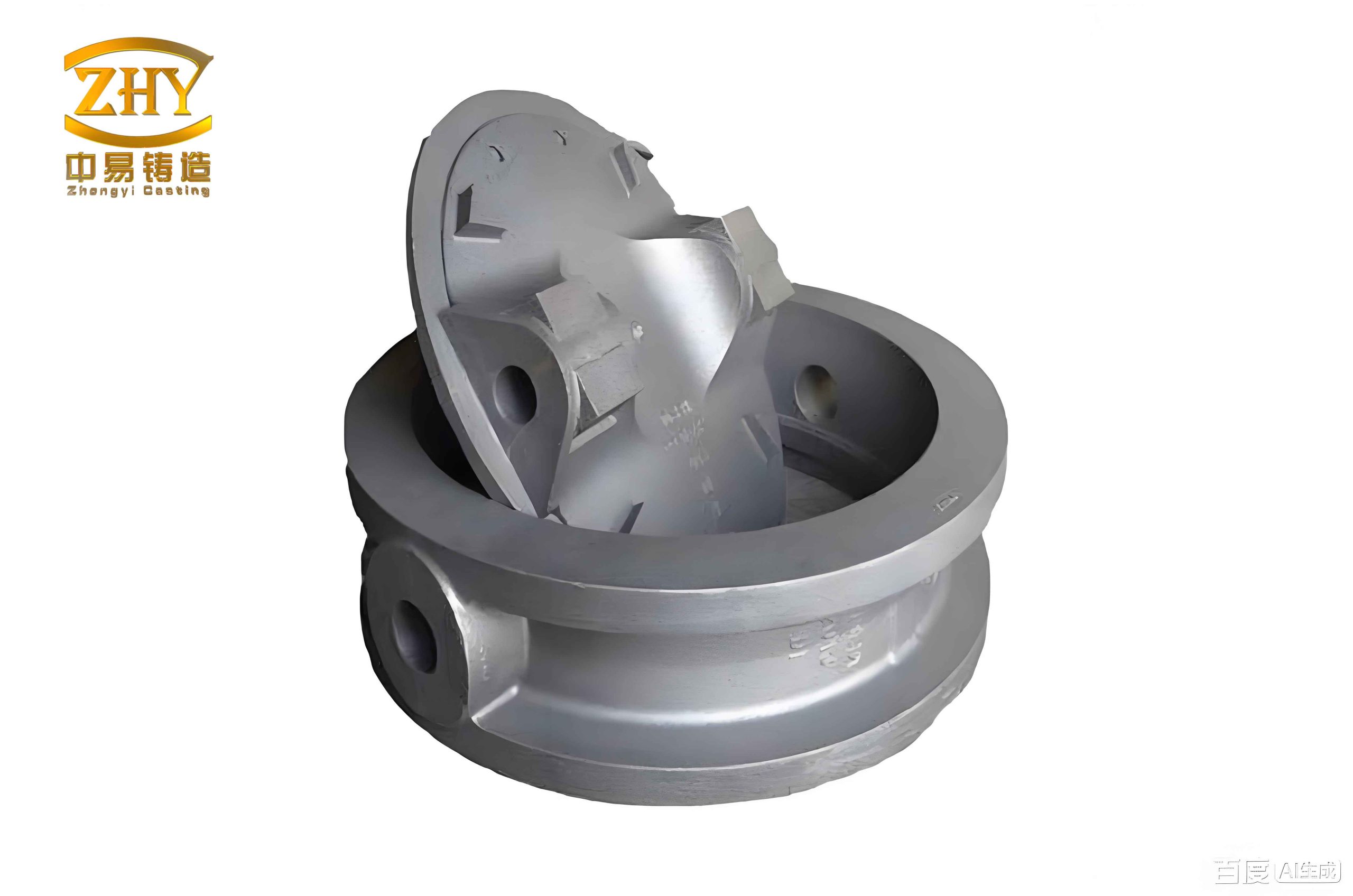
The foundation of successful sand casting products lies in thorough process design. This begins with casting process analysis, where material selection, tolerances, and shrinkage are critical. For instance, using furan resin-bonded sand enhances surface finish and densifies the microstructure of sand casting products. Tolerances must be chosen to balance functionality and machinability; common standards like CT11 for dimensional tolerance and MT10 for mass tolerance are applied, with typical mass tolerance set at ±4% of the weight. Shrinkage, a key parameter, is predetermined based on material properties; for HT250 cast iron, a shrinkage rate of 0.9% is often used to prevent cracks and distortions. This can be expressed mathematically as:
$$ S = \frac{V_l – V_s}{V_l} \times 100\% $$
where \( S \) is the shrinkage percentage, \( V_l \) is the liquid volume, and \( V_s \) is the solid volume. For HT250, \( S = 0.9\% \). Table 1 summarizes typical parameters for sand casting products design.
| Parameter | Value/Range | Remarks |
|---|---|---|
| Dimensional Tolerance Grade | CT11 | Allows for free contraction during cooling |
| Mass Tolerance Grade | MT10 | ±4% of weight, ensures consistency |
| Shrinkage Rate (HT250) | 0.9% | Prevents defects in sand casting products |
| Mold Material | Furan Resin Sand | Reduces surface defects |
Next, the selection of pouring position and parting plane is crucial for complex sand casting products. In my practice, orienting critical surfaces like dovetail guide faces downward leverages gravity to improve metal flow and reduce defects. This positioning facilitates filling of slender geometries and minimizes air entrapment and slag inclusion. The parting plane should be simple to ease mold assembly and disassembly, often aligned with the largest cross-section of the sand casting products. This decision impacts the crystallinity and efficiency of production, as improper orientation can lead to cold shuts or misruns.
Gating system design is another vital element for high-quality sand casting products. I typically employ a stepped inclined gating system, where inner gates are arranged in a阶梯式 (step-like) manner to control flow velocity and temperature distribution. This design promotes uniform filling and reduces turbulence, which can cause mold erosion and gas porosity. The gating ratio, often defined as \( A_c : A_r : A_g \) (where \( A_c \) is choke area, \( A_r \) is runner area, and \( A_g \) is gate area), is optimized to ensure laminar flow. For example, a common ratio for sand casting products is 1:2:4. Risers are placed at strategic locations, such as atop thick sections, to compensate for shrinkage and trap impurities. The size of a riser can be estimated using Chvorinov’s rule:
$$ t_s = k \left( \frac{V}{A} \right)^n $$
where \( t_s \) is solidification time, \( V \) is volume, \( A \) is surface area, and \( k \) and \( n \) are constants dependent on the material. This ensures adequate feeding for sand casting products. Table 2 outlines typical gating system parameters for complex structures.
| Component | Design Feature | Purpose in Sand Casting Products |
|---|---|---|
| Inner Gates | Stepped Inclined Form | Controls flow, reduces defects |
| Gating Ratio | 1:2:4 (Choke:Runner:Gate) | Ensures laminar metal flow |
| Risers | Top-Located, Multiple Units | Feeds shrinkage, traps slag |
| Pouring Temperature | 1350-1400°C for Cast Iron | Optimizes fluidity for sand casting products |
Moving to simulation analysis, I utilize tools like AnyCasting software to pre-validate designs for sand casting products. Preliminary simulation involves modeling the filling and solidification stages. Filling simulation reveals flow patterns, velocity fields, and potential defects like cold shuts or air pockets. The Navier-Stokes equations govern fluid flow:
$$ \rho \left( \frac{\partial \mathbf{u}}{\partial t} + \mathbf{u} \cdot \nabla \mathbf{u} \right) = -\nabla p + \mu \nabla^2 \mathbf{u} + \mathbf{f} $$
where \( \rho \) is density, \( \mathbf{u} \) is velocity vector, \( p \) is pressure, \( \mu \) is viscosity, and \( \mathbf{f} \) is body force. By solving these, I identify areas prone to turbulence in sand casting products. Solidification simulation, based on heat transfer equations, predicts temperature gradients and shrinkage porosity. The Fourier heat conduction equation is key:
$$ \frac{\partial T}{\partial t} = \alpha \nabla^2 T $$
where \( T \) is temperature, \( t \) is time, and \( \alpha \) is thermal diffusivity. This helps visualize thermal stresses and hot spots in sand casting products. Table 3 summarizes common simulation outputs and their implications.
| Simulation Phase | Key Outputs | Impact on Sand Casting Products |
|---|---|---|
| Filling | Flow Velocity, Air Entrapment | Prevents voids and misruns |
| Solidification | Temperature Profile, Solidification Time | Reduces shrinkage defects |
| Stress Analysis | Residual Stress Distribution | Minimizes cracking in sand casting products |
| Defect Prediction | Porosity, Cold Shut Locations | Guides design modifications |
Based on simulation results, I implement optimization measures to refine sand casting products. First, adjusting the gating system may involve repositioning inner gates or altering their cross-sectional areas to improve flow dynamics. For example, if simulation shows turbulence, I might increase the gate area to reduce velocity, using the continuity equation:
$$ Q = A \cdot v $$
where \( Q \) is flow rate, \( A \) is area, and \( v \) is velocity. Second, adding risers or enlarging existing ones enhances feeding; the riser volume \( V_r \) should satisfy:
$$ V_r \geq V_s \cdot \beta $$
where \( V_s \) is shrinkage volume and \( \beta \) is a safety factor (typically 1.2-1.5). This ensures adequate metal supply for sand casting products. Third, using chills accelerates cooling in thick sections, refining microstructure. The heat extraction rate can be modeled as:
$$ q = h \cdot A \cdot (T – T_{\text{env}}) $$
where \( q \) is heat flux, \( h \) is heat transfer coefficient, \( A \) is surface area, \( T \) is casting temperature, and \( T_{\text{env}} \) is environment temperature. Fourth, optimizing solidification sequence involves controlling cooling rates through mold materials or external cooling; directional solidification is often targeted to minimize defects in sand casting products. These measures are summarized in Table 4.
| Optimization Measure | Technical Approach | Benefit for Sand Casting Products |
|---|---|---|
| Gating Adjustment | Modify Gate Positions/Sizes | Improves flow, reduces turbulence |
| Riser Addition | Increase Number/Volume of Risers | Enhances feeding, minimizes porosity |
| Chill Application | Place Copper or Iron Chills | Controls cooling, refines grain structure |
| Solidification Control | Use Insulating Materials | Promotes directional solidification |
In my work, I have observed that iterative simulation and optimization significantly boost the quality of sand casting products. For instance, a case study on a complex gearbox housing showed that after simulation-driven modifications, defect rates dropped by 30%, and mechanical properties improved. This underscores the value of CAE in achieving robust sand casting products. The integration of artificial intelligence and machine learning promises further advancements, enabling automated parameter optimization for sand casting products.
To delve deeper into the thermodynamics of sand casting products, consider the solidification kinetics. The rate of phase change can be described by the Kolmogorov-Johnson-Mehl-Avrami (KJMA) equation:
$$ f(t) = 1 – \exp(-k t^n) $$
where \( f(t) \) is the fraction solidified, \( k \) is a rate constant, and \( n \) is the Avrami exponent. This helps predict microstructure evolution in sand casting products. Additionally, fluid flow during filling can be analyzed using Reynolds number (\( Re \)) to ensure laminar flow:
$$ Re = \frac{\rho v L}{\mu} $$
where \( L \) is characteristic length. For sand casting products, maintaining \( Re < 2000 \) is desirable to avoid turbulence. These formulas, combined with empirical data, form a comprehensive framework for designing sand casting products.
In conclusion, the marriage of traditional sand casting techniques with modern simulation tools has elevated the production of complex structural components. Through detailed process design and numerical analysis, we can overcome challenges and enhance the reliability of sand casting products. The future lies in smarter, data-driven approaches that will further optimize sand casting products for demanding applications. As I continue to explore this field, I am confident that sand casting products will remain indispensable in manufacturing, driven by continuous innovation and precision engineering.