
In our sand casting foundry practice, the high-performance zinc-based alloy ZA27 has emerged as a remarkable material for replacing traditional copper alloys. This alloy offers excellent melt fluidity, low casting temperature (around 540°C), minimal need for flux, and straightforward degassing operations. It can be processed in sand casting foundry, permanent mold casting, die casting, and continuous casting. The exceptional combination of mechanical properties and wear resistance makes ZA27 an ideal candidate for sliding bearings, thrust washers, flanged bushings, turbine parts, and various wear-resistant tooling. As a sand casting foundry dedicated to innovation, we have systematically investigated the casting process of ZA27, particularly focusing on the challenges associated with large-section castings, such as the formation of bottom shrinkage cavities (inverse shrinkage). This article summarizes our findings from extensive experiments and production trials in our sand casting foundry.
Chemical Composition and Melting Procedures
In our sand casting foundry, we adopt industrial-scale batch production using crucible furnaces. The raw materials are added in a specific sequence: first the aluminum-copper master alloy, then aluminum ingots, and finally zinc ingots. Magnesium is added using a bell-type plunger. After the melt reaches the predetermined temperature, degassing and slag removal are performed before pouring. The chemical composition of ZA27 used in our sand casting foundry is listed in Table 1.
| Element | Al | Cu | Mg | Fe | Zn |
|---|---|---|---|---|---|
| Content | 25.0–28.0 | 2.0–2.5 | 0.01–0.02 | ≤0.10 | Balance |
The melting temperature range is carefully controlled. For pouring in our sand casting foundry, we utilize single large gates, multiple risers with runners, insulating risers, and pressure gates, depending on the section size of the castings. Chills are also employed to accelerate solidification where needed.
Mechanical Properties of ZA27 vs. SAE660 Bronze
One of the main reasons for adopting ZA27 in our sand casting foundry is its superior mechanical performance compared to conventional tin bronze SAE660. Table 2 presents a direct comparison measured from samples produced in our foundry.
| Property | ZA27 | SAE660 |
|---|---|---|
| Tensile Strength (MPa) | 400–440 | 205–260 |
| Yield Strength (MPa) | 315–370 | 115–145 |
| Elongation (%) | 3–9 | 12–20 |
| Hardness (HB) | 110–130 | 60–70 |
| Impact Toughness (J) | 50±7 | ~8 |
From these data, it is evident that ZA27 offers nearly twice the tensile and yield strengths of SAE660, while maintaining a significantly higher hardness. Although its elongation is lower, the impact toughness is much greater, making ZA27 suitable for heavy-duty applications in our sand casting foundry.
Wear Test Results
Wear resistance is critical for bearing and bushing applications. In our sand casting foundry, we performed comparative wear tests on an AMSLER machine under sliding friction with lubrication. The rotation speed was 200 rpm, and the counterface material was 45# steel. Table 3 summarizes the cumulative wear and linear wear rates for ZA27 and ZQSn6-6-3 bronze.
| Specimen | Test No. | Time (h) | Cumulative wear (mg) | Linear wear (mg/m × 10−3) |
|---|---|---|---|---|
| ZA27 | 1 | 2 | 0.2 | 0.007 |
| 2 | 4 | 2.6 | 0.049 | |
| 3 | 2 | 3.2 | 0.242 | |
| 4 | 3 | 4.4 | 0.166 | |
| ZQSn6-6-3 | 1 | 2 | 7.2 | 0.272 |
| 2 | 4 | 8.8 | 0.166 |
The results clearly show that ZA27 exhibits significantly lower wear than the bronze alloy. In our sand casting foundry, this translates to longer service life for components cast from ZA27.
Sand Casting Foundry Process and the Challenge of Inverse Shrinkage
ZA27 has a wide solidification range (approximately 109°C), leading to a substantial density difference between the liquid and solid phases. Additionally, the surface tension of the liquid alloy contributes to the formation of bottom shrinkage cavities (inverse shrinkage) when the metal cools slowly. This defect is particularly problematic for large-section castings produced in our sand casting foundry. To understand and mitigate this issue, we have conducted extensive experimentation.
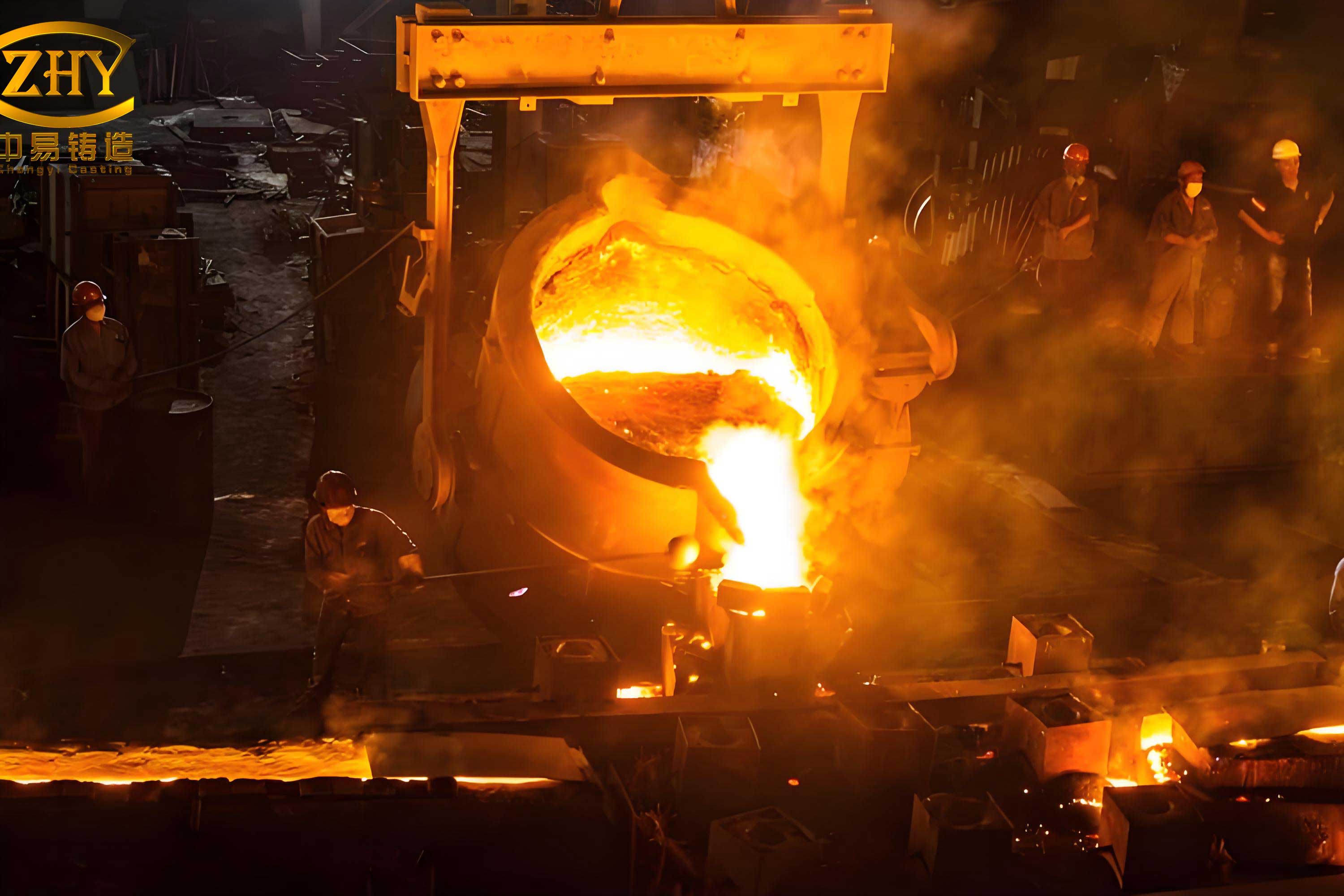
The solidification behavior of ZA27 in our sand casting foundry can be described as follows. During solidification, the primary aluminum-rich phase has a lower density than the remaining liquid (the density difference can be as much as 0.83 g/cm³). Consequently, the aluminum-rich dendrites float upward. Initially, the floating velocity can reach 5–21 mm/s. As solidification progresses and the dendrites become enriched in zinc, the viscosity of the interdendritic liquid increases, reducing the floating speed. When approximately 50% solid fraction is reached, dendrite movement is hindered, and at 70% solid fraction, floating ceases entirely. The solidification front proceeds from the top (higher melting point, Al-rich region) toward the bottom (Zn-rich region). The zinc-rich liquid collects at the bottom and solidifies last. During solidification shrinkage, the dendritic network draws the residual zinc-rich liquid into the interstices by capillary action (surface tension). However, because the liquid is trapped in the upper dendrite network, the bottom region ends up with insufficient feeding, resulting in shrinkage cavities or porosity at the bottom of the casting.
The solidification time in our sand casting foundry follows Chvorinov’s rule, which we express as:
$$ t = k \left( \frac{V}{A} \right)^2 $$
where t is the solidification time, V is the volume, A is the cooling surface area, and k is a mold constant. The modulus M = V/A is a key parameter for riser design. For effective feeding, the riser modulus must exceed that of the casting section by a factor of at least 1.2. In our sand casting foundry, we calculate the modulus for each section to ensure adequate compensation for shrinkage.
Another important factor is the cooling rate. Faster cooling reduces the time available for dendrite floating and minimizes the density segregation effect. The cooling rate in sand casting foundry can be enhanced by using chills (internal or external) and by carefully controlling the pouring temperature. The rate of heat extraction at the mold interface can be described by:
$$ q = h (T_m – T_0) $$
where q is the heat flux, h is the heat transfer coefficient (which depends on the mold material and interface conditions), T_m is the metal temperature, and T_0 is the mold temperature. In our sand casting foundry, we often use chill blocks made of steel or graphite to locally increase h.
Successful Countermeasures for Large-Section Castings in Sand Casting Foundry
Through extensive trials in our sand casting foundry, we have developed a set of effective measures to minimize or eliminate inverse shrinkage in large ZA27 castings:
- Orientation: Whenever possible, design the mold cavity so that critical surfaces (e.g., bearing surfaces) are positioned upward. This allows the last-solidifying region (bottom) to be a non-critical area or to be easily fed by a riser.
- Gating system: Use multiple ingates or a pressure gate to distribute the hot metal evenly and avoid local overheating. We adopt a ratio of cross-sectional areas: sprue:runner:ingate = 1:5:3 based on our sand casting foundry experience.
- Chills: Place metallic chills on the bottom or thick sections to accelerate solidification and reduce the temperature gradient that drives segregation.
- Insulating risers and sleeves: Employ insulating riser sleeves to keep the riser liquid hot longer, ensuring effective feeding at late stages of solidification.
- Side risers: Connect side risers directly to the thick sections requiring feeding. The riser should be placed as close as possible to the region that solidifies last.
- Riser modulus: Ensure that the riser modulus Mriser is at least 1.2 times the modulus of the section being fed:
$$ M_{riser} \geq 1.2 \times M_{section} $$ - Mold design: Increase the mold wall thickness or use materials with higher thermal conductivity (e.g., chromite sand) near heavy sections to promote directional solidification.
- Alloy modification: Perform a grain refinement or modification treatment to refine the primary phase and reduce the tendency for dendrite flotation.
- Pouring temperature: Keep the pouring temperature as low as possible (typically 540–560°C) to minimize the temperature difference and reduce the time for dendrite floating.
- Component design: Collaborate with designers to avoid abrupt section changes and to incorporate uniform wall thicknesses. Where heavy sections are unavoidable, design “casting holes” or cores to reduce section thickness and facilitate feeding.
In our sand casting foundry, we systematically tested these measures. Table 4 summarizes the effectiveness of different riser configurations for a typical heavy flange casting (section thickness 60 mm).
| Riser type | Riser modulus (cm) | Chill used? | Shrinkage defect (%) | Remarks |
|---|---|---|---|---|
| Single open top riser | 0.8 | No | 12.5 | Severe bottom shrinkage |
| Single open top riser | 1.2 | No | 8.0 | Reduced but still unacceptable |
| Insulating top riser | 1.2 | No | 5.5 | Moderate improvement |
| Side riser + chill | 1.4 | Yes | 1.0 | Near defect-free |
| Multiple side risers + chills | 1.5 | Yes | 0.2 | Excellent quality |
As shown, the combination of side risers with adequate modulus and chills yields the best results in our sand casting foundry. The linear shrinkage of ZA27 is about 1.3%, which is manageable for thin-walled castings (3–10 mm) even without special feeding, as long as chills are used. For thin sections, the cooling rate is naturally high, and dendrite floating is minimized.
Thermal Analysis and Solidification Simulation in Sand Casting Foundry
To further optimize our processes in the sand casting foundry, we have employed thermal analysis and numerical simulation. The latent heat of fusion for ZA27 is approximately:
$$ L_f = 110 \, \text{kJ/kg} $$
The specific heat of the solid and liquid are about cs = 0.48 kJ/(kg·K) and cl = 0.52 kJ/(kg·K), respectively. The density of the solid is around 5.0 g/cm³, while that of the liquid at pouring temperature is about 5.2 g/cm³. Using these data, we can estimate the amount of liquid needed to compensate for shrinkage. The volumetric shrinkage during solidification is:
$$ \beta = \frac{\rho_s – \rho_l}{\rho_l} \times 100\% \approx 3.85\% $$
This relatively large shrinkage requires careful feeding design. In our sand casting foundry, we apply the Niyama criterion to predict shrinkage porosity:
$$ N_y = \frac{\partial T}{\partial t} \cdot \frac{1}{\sqrt{(\partial T / \partial x)^2 + (\partial T / \partial y)^2 + (\partial T / \partial z)^2 }} $$
where Ny is the Niyama value. A low value (< 0.1 for aluminum alloys, but for zinc alloys we calibrate empirically) indicates high risk of microporosity. By adjusting the chill placement and riser size, we can achieve Niyama values above the critical threshold in all sections.
Conclusion
From our systematic research and production experience in the sand casting foundry, we draw the following conclusions:
- High-performance ZA27 zinc-based alloy is a cost-effective replacement for bronze and aluminum alloys in wear-resistant applications when processed under proper conditions in a sand casting foundry.
- Thin-walled ZA27 castings (3–10 mm thickness) can be produced reliably with simple sand casting foundry techniques, especially when chills are used.
- Large-section ZA27 castings are prone to bottom shrinkage (inverse shrinkage) due to the wide solidification range and density inversion. To achieve sound castings in our sand casting foundry, we must implement a combination of measures: proper gating system design (sprue:runner:ingate = 1:5:3), use of side risers with modulus >1.2 times the casting section modulus, application of chills to accelerate solidification, low pouring temperature (540–560°C), and alloy modification. These practices have proven effective in eliminating shrinkage defects and ensuring high quality.
- The Niyama criterion and modulus calculations are valuable tools for sand casting foundry engineers to optimize riser and chill placement. We recommend that each sand casting foundry develop its own calibration curves based on the specific alloy composition and mold conditions.
Our sand casting foundry continues to refine these parameters for even larger and more complex ZA27 components. The alloy’s excellent castability and mechanical properties, combined with the right sand casting foundry technology, make it a material of choice for modern bearing and wear applications.