
In the modern manufacturing landscape, the demand for lightweight and high-performance components in industries such as automotive, aerospace, and machinery has driven the adoption of aluminum-silicon alloys. These alloys offer an excellent combination of low density, good corrosion resistance, and mechanical properties, making them ideal for producing complex parts like reducer housings. As a process engineer specializing in foundry techniques, I have extensively worked on optimizing sand casting processes for such components. Sand casting products, particularly those made from Al-Si alloys, are critical in reducing overall weight while maintaining structural integrity. This article details my firsthand experience in designing a sand casting process for an Al-Si alloy reducer housing, utilizing cold core box technology and simulation-driven optimization to achieve defect-free castings.
The reducer housing in question is fabricated from ZAlSi7Mg0.3 Al-Si alloy, a common grade known for its castability and strength. This component measures 212 mm × 173 mm × 120 mm, with wall thicknesses ranging from 7 mm to 15 mm, classifying it as a medium-sized casting. Its geometry includes a central square cavity, through-holes on both ends, ribbed structures, and uneven thickness distributions, presenting typical challenges in sand casting products. The design necessitates careful consideration of mold filling, solidification patterns, and defect mitigation to ensure quality. My approach involved a comprehensive analysis of the housing’s structure, followed by systematic process design, numerical simulation, and experimental validation.
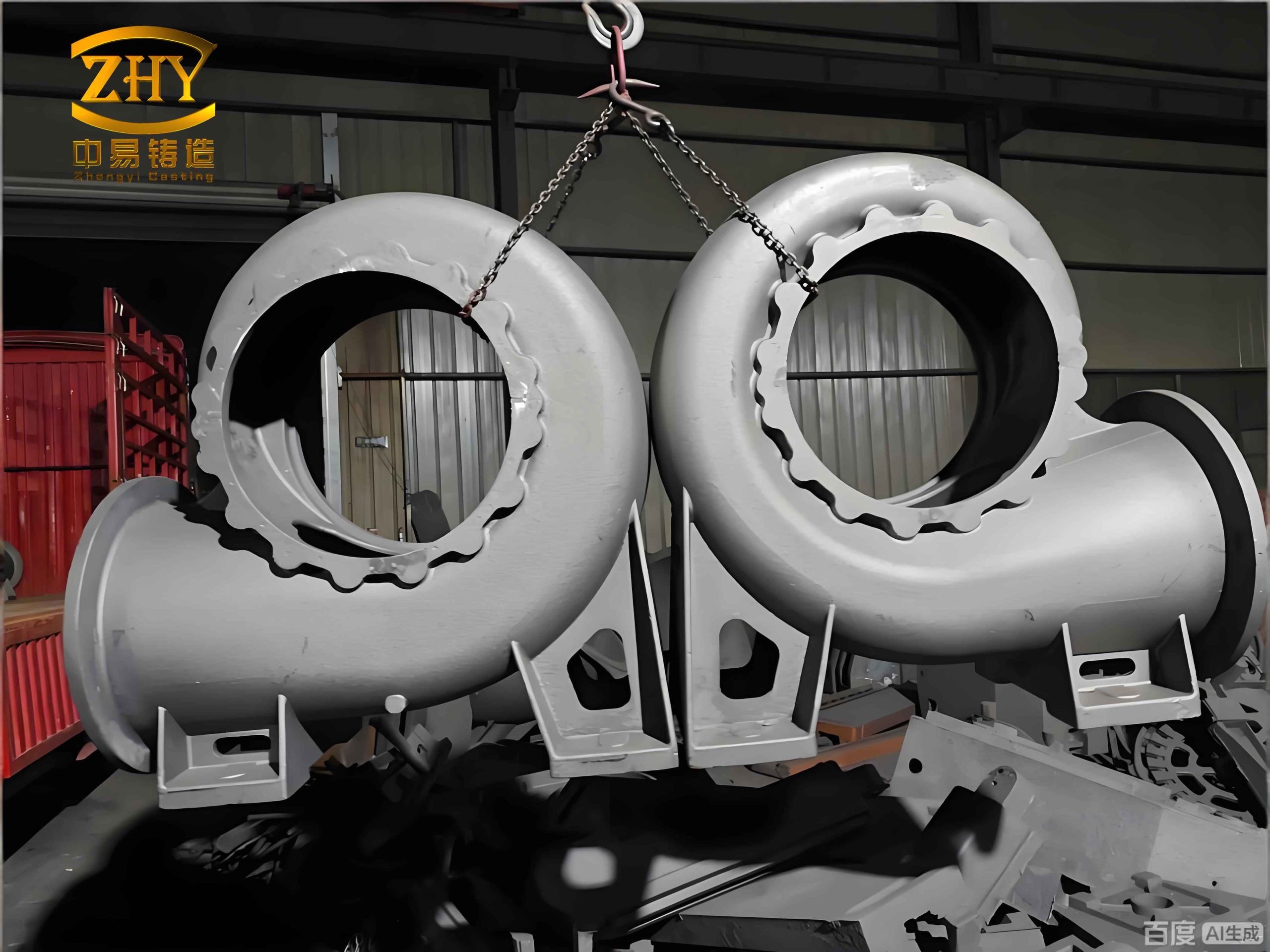
To begin, I evaluated the casting’s features, focusing on potential hot spots and shrinkage areas. The central cavity and through-holes are prone to defects due to slower cooling rates, while the ribbed sections may cause turbulence during filling. For small-batch production, I selected a cold core box sand casting process using phenolic urethane no-bake resin sand. This binder system offers fast curing, high dimensional accuracy, and good collapsibility, which are essential for intricate sand casting products. The mold was prepared manually, with alcohol-based coatings applied to cores to improve surface finish, and graphite powder used on parting surfaces to facilitate demolding.
The gating and risering system was designed to ensure smooth metal flow and adequate feeding. I opted for a bottom gating approach with two ingates positioned at the bottom of the front and rear ends of the housing. This design minimizes turbulence, reduces oxide inclusion, and allows slag to float to the top risers. The gating ratio was set as ΣFsprue : ΣFrunner : ΣFingate = 1 : 2 : 2, with dimensions summarized in Table 1. Filters were placed at the junction of the sprue and runner to trap impurities and moderate flow velocity, preventing sand erosion. Two large risers were placed on the top left and right ends to serve as feeders for shrinkage compensation and venting.
| Component | Cross-sectional Area (cm²) | Length (mm) | Width-to-Thickness Ratio |
|---|---|---|---|
| Sprue | 4.3 | 110 | N/A |
| Runner | 8.6 | 167 | N/A |
| Each Ingate | 4.3 | 80 | 3:1 |
The filling and solidification behaviors were analyzed using AnyCasting simulation software. After meshing the geometry and setting material properties, I simulated the process to identify potential defects. The results indicated stable filling, but the solidification sequence revealed late freezing in the central cavity and through-hole regions, leading to shrinkage porosity. This aligns with Chvorinov’s rule, where solidification time t is proportional to the square of the volume-to-surface area ratio:
$$ t = B \left( \frac{V}{A} \right)^2 $$
Here, B is the mold constant, V is the volume, and A is the surface area. Areas with higher V/A ratios, like the thick sections, solidify slower and are susceptible to shrinkage. To quantify this, I calculated the modulus M for critical zones:
$$ M = \frac{V}{A} $$
Table 2 lists the moduli for different regions, highlighting the central cavity as a hotspot.
| Section | Volume V (cm³) | Surface Area A (cm²) | Modulus M (cm) |
|---|---|---|---|
| Central Cavity | ≈150 | ≈200 | 0.75 |
| Through-hole Area | ≈80 | ≈120 | 0.67 |
| Ribbed End | ≈50 | ≈100 | 0.50 |
Based on the simulation, defect probability parameters showed high risk in the central cavity bottom and through-hole junctions. To address this, I incorporated chills at these locations, as depicted in Figure 5 of the original content. Chills act as heat sinks, accelerating cooling and promoting directional solidification toward the risers. The chill design considered material (cast iron) and size, with dimensions proportional to the hot spot modulus. The effectiveness of chills can be estimated using the heat transfer equation:
$$ Q = k \cdot A \cdot \Delta T \cdot t $$
where Q is heat extracted, k is thermal conductivity, A is contact area, ΔT is temperature difference, and t is time. By increasing A and k locally, chills reduce the solidification time in critical zones, thereby minimizing shrinkage.
I refined the simulation with chills added, and the results showed a significant improvement. The solidification sequence became more uniform, with the risers solidifying last to provide adequate feeding. Defect probability decreased below acceptable thresholds. This iterative design process underscores the value of simulation in optimizing sand casting products, reducing trial-and-error costs.
For actual production, I melted ZAlSi7Mg0.3 alloy ingots in a resistance furnace, maintaining a pouring temperature of 720°C ± 10°C. The mold was assembled with cores and chills placed as planned. After pouring, the casting was cooled, shaken out, and inspected. X-ray non-destructive testing confirmed no internal shrinkage or porosity in the housing; defects were confined to the risers, which were removed during machining. The final casting met all dimensional and quality standards, validating the process design.
To generalize this approach, I have developed a framework for designing sand casting processes for similar Al-Si alloy components. Key parameters include gating ratios, riser sizing, and chill placement. Table 3 summarizes optimal parameters for medium-sized sand casting products based on this case study.
| Parameter | Recommended Value | Notes |
|---|---|---|
| Gating Ratio (Sprue:Runner:Ingate) | 1:2:2 to 1:3:3 | Adjust for turbulence control |
| Pouring Temperature | 700–730°C | For ZAlSi7Mg0.3 alloy |
| Riser Size (Diameter) | 1.2–1.5 × Hot Spot Thickness | Ensure adequate feed volume |
| Chill Material | Cast Iron or Copper | High thermal conductivity |
| Simulation Software | AnyCasting or Equivalent | For defect prediction |
The success of this project highlights the importance of integrating traditional foundry knowledge with modern simulation tools. Sand casting products, especially those with complex geometries, benefit from such holistic design methods. Furthermore, the use of cold core box technology enhances dimensional accuracy and surface quality, which are critical for automotive applications. In my experience, continuous optimization of these parameters can yield consistent results across various sand casting products.
From a material science perspective, the ZAlSi7Mg0.3 alloy exhibits good fluidity and shrinkage characteristics, but its behavior during solidification must be carefully managed. The eutectic reaction in Al-Si systems can lead to microporosity if cooling rates are not controlled. The solid fraction f_s during solidification can be modeled using the Scheil equation:
$$ f_s = 1 – \left( \frac{T_f – T}{T_f – T_l} \right)^{1/(k-1)} $$
where T_f is the freezing temperature, T_l is the liquidus temperature, T is the current temperature, and k is the partition coefficient. This equation helps predict microstructure development and informs chill design to avoid defects.
In conclusion, the sand casting process for the Al-Si alloy reducer housing was successfully designed and validated. By employing cold core box molding, a bottom gating system, and simulation-guided chill placement, I achieved a defect-free casting that meets industry standards. This case study demonstrates the efficacy of combining empirical design principles with numerical analysis for producing high-quality sand casting products. Future work could explore alternative binder systems or advanced simulation features to further optimize the process for larger production runs. Ultimately, such methodologies contribute to the advancement of sand casting technology, enabling the manufacture of lightweight, durable components for demanding applications.