
The production of complex, medium-sized components like gearbox housings presents a significant challenge in foundry engineering, demanding a meticulous balance between geometrical integrity, mechanical properties, and cost-effectiveness. Among various manufacturing routes, sand castings remain a predominant choice due to their exceptional flexibility, ability to produce intricate internal cavities, and suitability for both batch and mass production at a relatively low cost. The inherent adaptability of sand castings allows for the economical fabrication of parts with non-uniform wall thicknesses, external ribs, bosses, and complex cores. However, the process is susceptible to defects such as shrinkage porosity, cavities, cold shuts, and gas entrapment, particularly in alloys with high solidification shrinkage like aluminum-silicon alloys. This article details the comprehensive process design, simulation-led analysis, and optimization for the sand casting of a gearbox lower body, demonstrating a methodology to achieve defect-free sand castings.
The gearbox body in question is a representative medium-thickness wall aluminum alloy component. Its material, AlSi7Mg0.3 (A356 equivalent), is favored for its good castability, corrosion resistance, and excellent strength-to-weight ratio after heat treatment. However, its relatively long solidification range and significant volumetric shrinkage (approximately 3.5-6%) make it prone to internal shrinkage defects if the casting process is not properly engineered. The first step in any robust casting design is a thorough analysis of the component itself. The part’s irregular external geometry, varying wall thickness (primarily 10-12mm), and a complex internal cavity structure with numerous ribs and bosses necessitate a strategic approach to pattern making, core assembly, and feeding system design.
The foundational stage of digital process design is the creation of an accurate 3D model. Utilizing CAD software, the gearbox body was modeled by constructing its external envelope through sketching and feature operations like extrusion and rotation. The complex internal surfaces were then defined using surface modeling techniques, such as curve networking, to faithfully represent the internal cavity. This digital twin is crucial not only for visualizing the part but also as the direct input for subsequent casting simulation and tooling design. A precise model ensures that all considerations for draft angles, machining allowances, and non-cored features (typically, holes under 20mm in diameter are not cast but machined later) are incorporated from the outset.
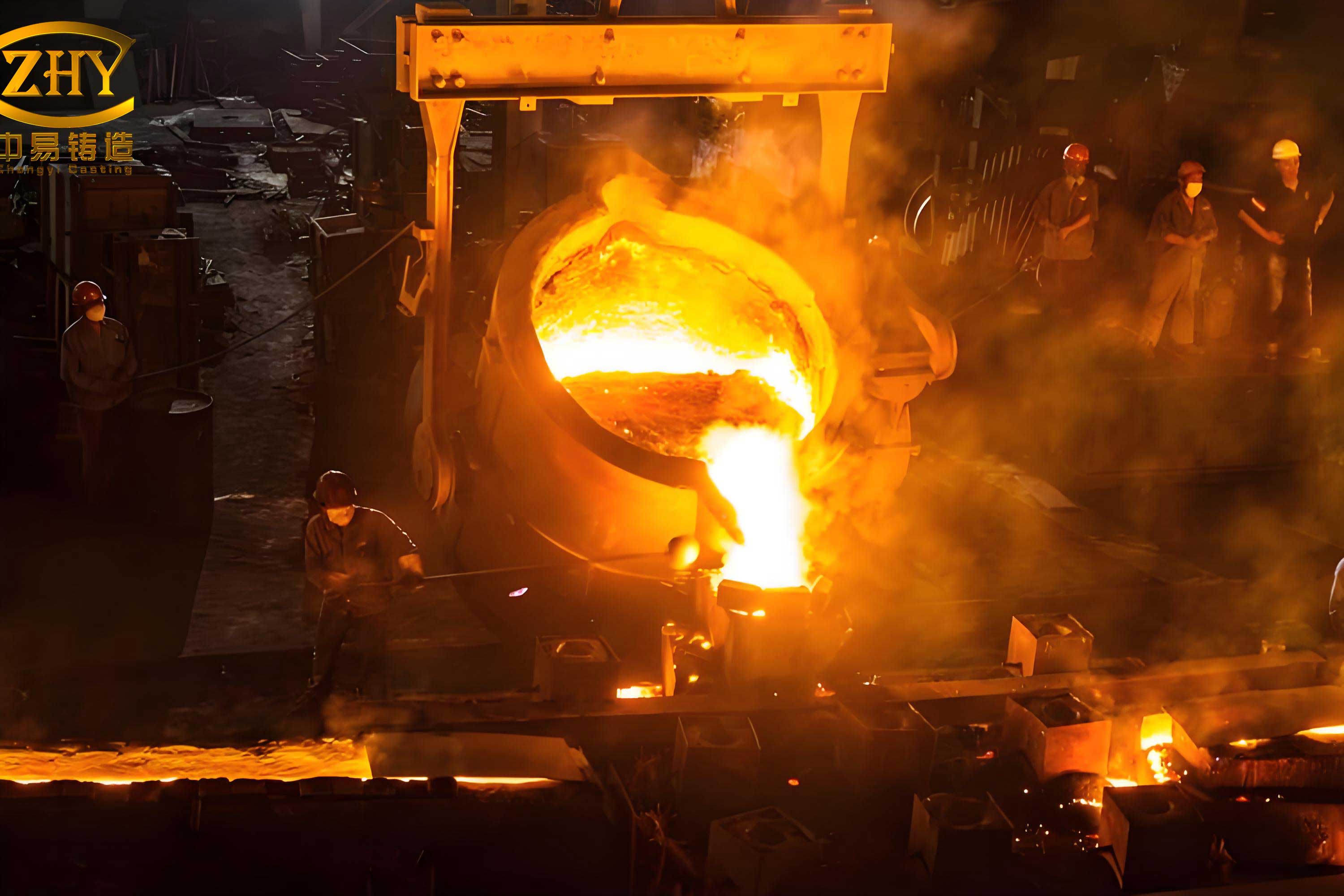
1. Foundry Process Selection and Molding Strategy
Given the part’s size, complexity, and batch production requirements, green sand molding was considered but ruled out in favor of a more precise and dimensionally stable method. The selected process was no-bake resin-bonded sand molding using a cold-box core assembly approach. This method involves manufacturing individual sand cores—each representing a segment of the mold cavity—using a cold-curing binder system (e.g., phenolic urethane) gassed with an amine vapor. These precision cores are then assembled into a complete mold without the need for a traditional flask.
The advantages of this cold-box precision core assembly for such sand castings are manifold. It eliminates flask costs and handling, provides excellent dimensional accuracy and surface finish, allows for complex internal geometries unachievable with simple split patterns, and significantly reduces waste sand due to the high reclaimability of the sand. The process flow for these engineered sand castings typically follows: pattern/core box creation -> sand mixing with resin -> core shooting and curing -> core finishing (coating, repairing) -> core assembly -> clamping -> pouring -> cooling -> shakeout -> cleaning -> inspection.
For the gearbox body, the mold was decomposed into several core pieces to facilitate manufacture and ensure proper venting and ejection. The parting line was strategically placed along the upper surface of a central rib on the front side of the casing, naturally dividing the mold into an upper and a lower section. Due to the undercuts presented by external ribs, a side core was designed. The intricate internal cavity required a large, complex main core. The final assembly sequence was: lower mold -> main internal core -> side core -> upper mold. This segmented approach is characteristic of advanced sand castings for complex components.
| Molding Method | Binder System | Dimensional Accuracy | Surface Finish | Suitability for Complex Cores | Typical Application |
|---|---|---|---|---|---|
| Green Sand | Clay-Water | Moderate | Moderate | Limited | High-volume, simpler parts |
| Cold-Box Core Assembly (No-Bake) | Resin (e.g., Phenolic Urethane) | High | Excellent | Excellent | Medium-batch, complex parts (as in this case) |
| Shell Molding | Thermosetting Resin | High | Very Good | Good | Precision castings, thin sections |
2. Gating and Feeding System Design
The design of the gating and feeding system is paramount for the quality of aluminum sand castings. Aluminum alloys have low density, high specific heat, and tend to oxidize and absorb hydrogen rapidly when molten. Therefore, the system must ensure a quiet, non-turbulent fill to minimize oxide film formation and gas entrainment, while also providing adequate feed metal to compensate for solidification shrinkage.
The gating system was designed as a pressurized system to promote a rapid, complete fill. It consisted of a pouring cup, a sprue, a runner, and two ingates. Ceramic foam filters were placed at two critical junctions: between the pouring cup and the sprue, and between the sprue and the runner. These filters are essential in sand castings for trapping oxides and slag, thereby reducing inclusion defects and calming the metal flow. The runner was placed at the parting plane and designed with a stepped profile to further dissipate flow energy. The ingates were connected to machining faces on the casting for easy removal post-casting.
The key parameter in gating design is the choke area, which is the smallest cross-sectional area in the system (typically the sprue exit or ingate) that controls the pouring time. The required choke area $A_{min}$ can be estimated using empirical formulas such as:
$$A_{min} = \frac{G}{K t \sqrt{H_p}}$$
where:
- $G$ is the total poured weight (kg),
- $K$ is a metal fluidity coefficient (for aluminum, ~0.9),
- $t$ is the desired pouring time (s),
- $H_p$ is the effective metallostatic pressure head (cm).
For this gearbox body, the calculated $A_{min}$ was approximately 4.1 cm². A sprue diameter of 25mm (area ≈ 4.9 cm²) was selected as the choke. Following standard gating ratios for aluminum sand castings of $A_{sprue} : A_{runner} : A_{ingates} = 1 : 2 : 2$, the dimensions for the runner and two ingates were derived accordingly. The pouring temperature was carefully selected to be between 700°C and 720°C. A higher temperature increases fluidity but also increases hydrogen solubility, oxidation, and grain size, degrading mechanical properties.
Feeding, or risering, is designed to provide a reservoir of liquid metal to feed shrinkage in the casting. The number, size, and location of risers are critical. For this component, risers were placed over the thickest sections (thermal hot spots) identified from the casting geometry. In areas where riser placement was impractical (e.g., isolated hot spots in the internal cavity), the use of chills—metal inserts placed in the sand mold—was planned to accelerate local solidification and directionalize feeding.
| Property/Parameter | Value/Range | Implication for Sand Casting Process Design |
|---|---|---|
| Liquidus Temperature | ~615°C | Determines minimum pouring temperature. |
| Solidus Temperature | ~555°C | Defines solidification range. |
| Solidification Shrinkage | ~3.5 – 6% | Primary driver for riser and chill design to prevent shrinkage porosity. |
| Fluidity | Good | Allows filling of thin sections but requires controlled gating to prevent turbulence. |
| Oxidation Tendency | High | Mandates use of filters and non-turbulent filling systems. |
| Hydrogen Solubility | High in liquid, low in solid | Risk of gas porosity; requires degassing and controlled solidification. |
3. Simulation-Driven Analysis and Optimization
Modern foundry practice heavily relies on numerical simulation to predict and eliminate defects before costly tooling is made. Using specialized casting simulation software (e.g., AnyCasting, MagmaSoft, ProCAST), the designed process can be virtually tested. The simulation solves the fundamental equations of fluid flow, heat transfer, and solidification, often incorporating models for defect prediction.
The initial simulation involved running a coupled filling and solidification analysis using the designed gating system and riser placement without chills. The filling sequence showed that the mold filled completely without cold shuts or misruns, validating the basic gating design. The metal flowed smoothly through the filters and runner, filling the cavity progressively from the ingates, with the risers filling last—a desirable outcome as it concentrates any entrapped slag in the risers.
The more critical analysis came from the solidification results. The temperature field evolution, as shown in the simulation snapshots, indicated that solidification progressed from the thinner outer walls towards the thicker internal sections and the risers. This is the desired directional solidification. However, the solidification time contour plot and the subsequent shrinkage prediction module revealed a critical issue: isolated regions within the complex internal cavity, acting as thermal hot spots, were the last to solidify. Because these regions were not effectively fed by the risers (due to geometrical isolation or interrupted feeding paths), the software predicted a high probability of macro- and micro-shrinkage (porosity) in these locations.
This is a common challenge in complex sand castings where geometry creates isolated thermal masses. The simulation provided precise coordinates for these defect-prone zones. The solution, as guided by the simulation, was to apply chills. Chills are typically made of copper, iron, or graphite and have a high thermal conductivity compared to sand. By placing them adjacent to the identified hot spots, they extract heat rapidly, effectively increasing the local solidification rate and altering the solidification sequence. This can turn an isolated hot spot into a directionally solidifying region fed by a riser or simply ensure it solidifies quickly enough that feeding is not required.
A second simulation was run with the chills incorporated into the virtual mold at the specified locations. The results demonstrated a dramatic improvement. The solidification sequence was modified, with the previously isolated hot spots now solidifying earlier. The shrinkage prediction model confirmed the elimination of the major shrinkage defects in the internal cavity. The risers themselves remained the last to solidify, confirming they were correctly sized and positioned to feed the main casting body.
| Step | Action | Simulation Output Analyzed | Problem Identified | Corrective Action | Result after Optimization |
|---|---|---|---|---|---|
| 1 | Initial Design Simulation | Filling sequence, Temperature fields, Solidification time, Shrinkage probability | Shrinkage porosity predicted in internal cavity hot spots. | N/A (Baseline) | Unacceptable defect prediction. |
| 2 | Iterative Optimization | Solidification profile of defect zones. | Isolated thermal centers not fed by risers. | Design and placement of external chills on specific mold/core faces. | Modified solidification sequence. |
| 3 | Final Design Validation | Solidification sequence, Shrinkage probability | N/A | N/A | Defect-free prediction; risers solidified last. |
The scientific principle behind this optimization can be linked to the thermal modulus and Chvorinov’s rule. The solidification time $t_s$ for a casting section is approximately proportional to the square of its volume-to-surface area ratio (modulus, $M$):
$$t_s \propto \left( \frac{V}{A} \right)^2 = M^2$$
By adding a chill, the effective surface area $A$ for that local region is increased (if the chill is conductive) or the heat extraction rate is drastically enhanced, thereby reducing its effective modulus $M_{eff}$ and solidification time $t_{s,eff}$. The goal is to ensure that the modulus of the riser $M_r$ is greater than the modulus of the casting section it feeds $M_c$, and that all sections solidify in a progressive order towards the riser:
$$M_r > M_c$$
The chills ensure that isolated sections with inherently high $M$ do not violate this order by reducing their $M_{eff}$.
4. Validated Process and Concluding Advantages
The final, optimized process for the aluminum gearbox body sand castings integrated all the designed elements: the cold-box resin sand core assembly for dimensional precision, the filtered, controlled-velocity gating system for clean metal delivery, the correctly sized risers for bulk feeding, and strategically placed chills to eliminate isolated shrinkage. This process was validated virtually by simulation, which predicted a sound casting.
The advantages of this systematic approach for producing high-integrity sand castings are clear:
- Defect Prevention: Simulation moves the trial-and-error process from the foundry floor to the computer, identifying and solving problems like shrinkage before any metal is poured, saving significant time and cost associated with scrap and rework.
- Optimized Yield: By accurately sizing risers and using chills only where needed, the amount of metal used in the feeding system is minimized, improving the yield (ratio of casting weight to total poured weight), a key economic factor.
- Process Understanding: The simulation provides deep insight into the thermal behavior of the casting, educating process engineers on the solidification characteristics of their specific part geometry and alloy.
- Quality Assurance: For critical components, having a simulation-based validated process provides a high degree of confidence in the quality and reliability of the final sand castings, which is essential for applications in automotive, aerospace, and machinery.
In conclusion, the successful production of complex aluminum alloy components via sand casting is not merely an art but a sophisticated engineering discipline. It requires a synergistic application of material science, thermal dynamics, and advanced digital tools. This case study on a gearbox body exemplifies a modern methodology: starting with a detailed CAD model and process design, followed by rigorous numerical simulation to predict and eliminate defects, culminating in a robust and repeatable foundry process. The enduring relevance of sand castings for medium-to-large, complex parts is thus reinforced by the integration of these advanced design and simulation technologies, ensuring they remain a competitive and reliable manufacturing solution.