
In my experience at the sand casting foundry where I have worked for many years, we have developed a robust sand casting process for large diesel engine cylinder liners. These liners are critical components made of low-alloy cast iron, typically produced either by centrifugal casting or by sand casting. While centrifugal casting yields fine internal structures and high metal utilization, it requires costly equipment and is often unsuitable for very large diameters. The sand casting foundry approach, on the other hand, offers great flexibility for single-piece or small-batch production of various sizes, provided key technical parameters are carefully controlled. In this article, I will share the detailed methodology we used for a large cylinder liner with a green casting inner diameter of φ920 mm, outer diameter of φ1070 mm, height of 1130 mm, and a total weight (including riser) of approximately 3.5 tons. Our sand casting foundry has successfully produced ten such liners with consistent quality, and I will present the technical data, formulas, and tables that summarize our process.
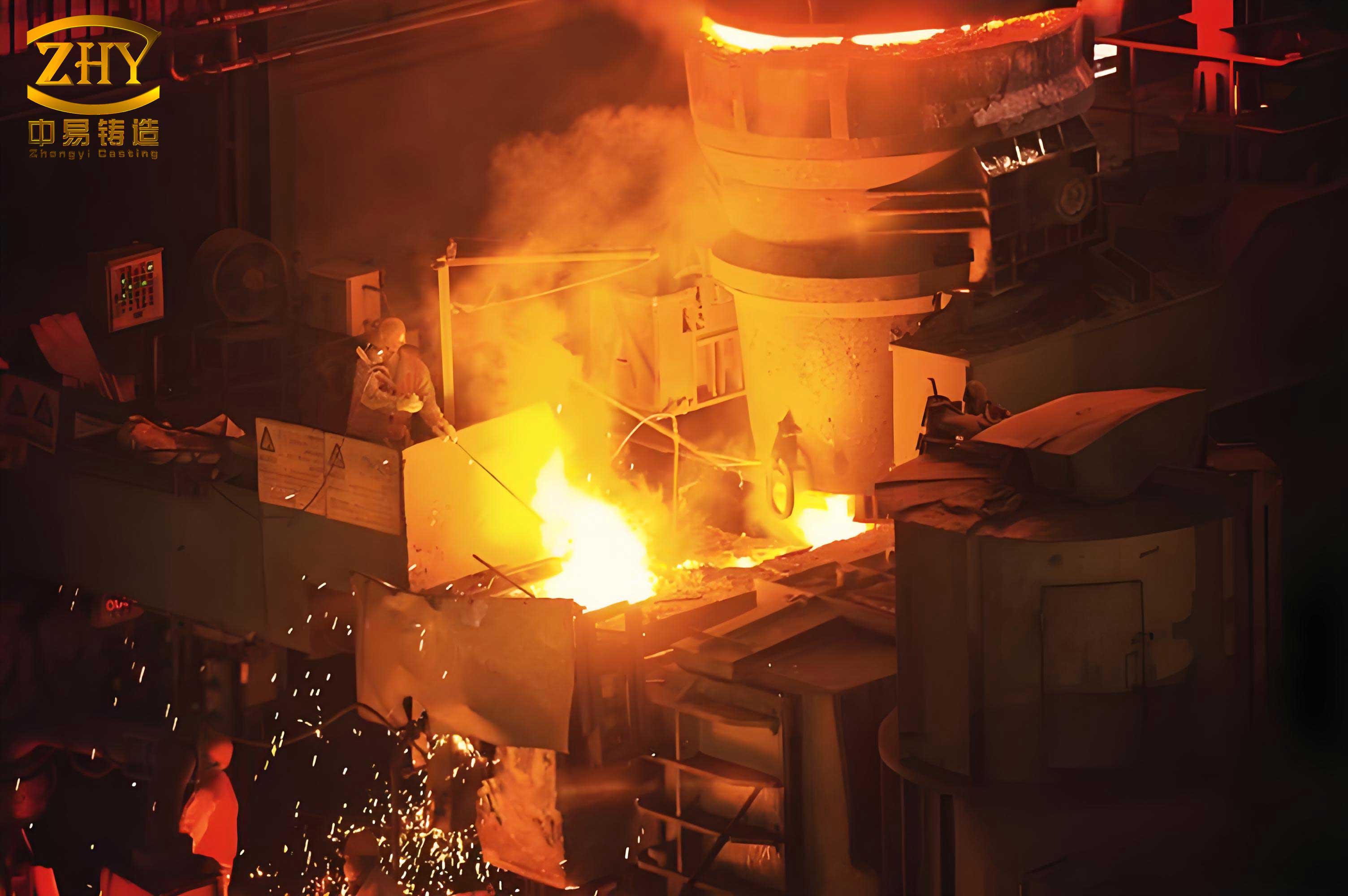
The following figure illustrates a typical sand casting setup used in our foundry for such components. The image shows a sand mold with a riser system, reflecting the vertical pouring arrangement we adopted.
Determination of Pouring Position and Mold Parting
The cylinder liner material was grade HT300 (nominal composition: C 2.8–3.2%, Si 1.5–2.0%, Mn 0.8–1.2%, Cr 0.3–0.5%, Mo 0.2–0.4%, Cu 0.8–1.2%, P ≤ 0.15%, S ≤ 0.12%). The required mechanical properties included a tensile strength ≥ 250 MPa, bending strength ≥ 450 MPa, hardness HB 210–250, and a microstructure consisting of pearlite matrix with medium flake graphite, no free cementite, and no porosity or slag defects. The inner surface of the liner (the combustion chamber zone) had to pass a hydraulic pressure test at 1.5 MPa, and other parts at 0.5 MPa.
We chose vertical pouring (with the thickest part upward) to facilitate feeding and the upward floatation of gas and slag. The liner’s working surface is thicker than the rest, so placing it upward minimized machining allowance and avoided the need for external chills. A ring-shaped riser was placed on top to ensure sound feeding. The mold parting plane was chosen horizontally, allowing easy pattern removal and core placement despite the liner’s height (over 1 meter).
Gating System Design and Formulas
We adopted a shower (rain) gating system, which is standard in our sand casting foundry for cylinder liners. This system promotes progressive solidification and slag removal. The total cross-sectional area of the ingates, denoted \(A_{g,\text{total}}\), was calculated using the empirical formula:
$$ A_{g,\text{total}} = k \sqrt{G} $$
where \(G\) is the casting weight (including riser) in kg, and \(k\) is an empirical coefficient that depends on the minimum wall thickness. For our liner, the minimum wall thickness was 45 mm, and we determined \(k = 0.8\) based on our foundry’s past experience. Thus, with \(G = 3500 \, \text{kg}\):
$$ A_{g,\text{total}} = 0.8 \times \sqrt{3500} \approx 0.8 \times 59.16 = 47.33 \, \text{cm}^2 $$
We then set the ratio of cross-sectional areas for ingate: runner: sprue as \(A_g : A_r : A_s = 1 : 1.2 : 1.5\). Therefore:
$$ A_r = 1.2 \times 47.33 \approx 56.8 \, \text{cm}^2 $$
$$ A_s = 1.5 \times 47.33 \approx 71.0 \, \text{cm}^2 $$
The ingate diameter was chosen from the range we typically use (φ8–12 mm) and based on the wall thickness. For a 45 mm minimum wall, we selected φ10 mm. Each ingate was a frustum shape (tapered from top to bottom) to avoid metal jetting. The runner was ring-shaped with a trapezoidal cross-section, and the sprue had a slight taper (larger at top).
Table 1 summarizes the final gating system dimensions we used.
| Component | Cross-sectional area (cm²) | Shape | Notes |
|---|---|---|---|
| Ingates (12 holes) | A_g = 47.3 (total) | Frustum, φ10–φ12 mm each | Equally spaced around riser |
| Ring runner | A_r = 56.8 | Trapezoidal: top 30 mm × 45 mm, bottom 25 mm × 40 mm | Encircles the mold top |
| Sprue | A_s = 71.0 | Circular, φ95 mm (top) to φ85 mm (bottom) | Height 200 mm |
Pattern Shrinkage, Machining Allowances, and Riser Design
We used the following shrinkage allowances based on our sand casting foundry’s standard tables for low-alloy iron:
- Radial direction: 1.5%
- Axial direction: 1.2%
Machining allowances were set at 8 mm on the outer surface and 6 mm on the inner surface. To promote directional solidification, we added a feeding taper (draft) to the inner and outer walls, making the wall thickness gradually thicker toward the riser. The riser itself was a ring-shaped top riser with a height equal to one-third of the liner height (about 380 mm). The taper of the riser cavity was extended from the liner’s feeding taper to ensure a smooth transition.
Sand and Core Sand Formulations
The quality of the mold and core is crucial in a sand casting foundry, especially for tall, heavy liners poured from the top. We used the following mixtures (by weight percentages). All raw materials were locally sourced.
| Component | Mold Sand | Core Sand |
|---|---|---|
| Qingdao Laoshan sand (fresh) | 45% | 40% |
| Shandong Rongcheng sand (fresh) | 20% | 20% |
| Rebonded sand (return sand) | 25% | 25% |
| Fire clay | 10% | 10% |
| Water | 5% (adjust to temper) | 6% (adjust to temper) |
| Coke powder (anthracite) | — | 4% |
| Wood flour (sawdust) | — | 1% |
The core sand also required high permeability because the central core is fully surrounded by molten iron. To enhance permeability, we placed a perforated steel pipe (with φ20 mm holes) in the core center, wrapped with several layers of straw rope, and then covered with core sand. The pipe diameter was 150 mm, and the straw rope was tightly wound around short steel pins welded to the pipe. The core was made using a half-pattern/half-sweep method, with dimensions matching the liner cavity.
For the coating, we used a water-based graphite wash:
| Ingredient | Amount |
|---|---|
| Graphite powder | 10 kg |
| Fire clay | 2 kg |
| Sugar syrup (molasses) | 1 kg |
| Water | To achieve brushing consistency (approx. 8–10 liters) |
The coating was milled for at least 4 hours to a paste, then diluted and stirred for another 4 hours before use.
Molding, Core Making, Drying, and Closing
Molding was performed using a two-part steel flask (each half 1600 mm × 1600 mm × 1500 mm) with a horizontal parting. The pattern was a half pattern for each half-mold. After ramming and stripping, the core was placed in the bottom mold. Before closing, we dried both the mold and core in a batch furnace:
- Natural air drying for 24 hours (to prevent cracking)
- Slow heating to 150°C, hold for 2 hours
- Raise to 300°C, hold for 4 hours
- Furnace cool to room temperature
After drying, the two halves of the mold were assembled horizontally. The central core was lowered and positioned accurately using alignment marks. The mold was then clamped with tie bolts and stood upright for pouring.
Melting and Pouring
The metal charge was melted in a 1.5-ton electric arc furnace and a 500-kg medium-frequency induction furnace simultaneously, due to equipment limitations. The total charge was 3.5 tons, split as 2 tons (arc) and 1.5 tons (induction). The chemical composition was adjusted to the target range. After slag removal and temperature adjustment to 1480°C, we tapped both furnaces into a single preheated ladle (capacity 4 tons). The final composition check showed:
| Element | C | Si | Mn | Cr | Mo | Cu | P | S |
|---|---|---|---|---|---|---|---|---|
| Target | 2.8–3.2 | 1.5–2.0 | 0.8–1.2 | 0.3–0.5 | 0.2–0.4 | 0.8–1.2 | ≤0.15 | ≤0.12 |
| Actual | 3.05 | 1.72 | 1.05 | 0.42 | 0.31 | 1.10 | 0.08 | 0.09 |
Inoculation was done in the ladle by adding 0.3% of ferrosilicon (75% Si) as the metal was poured into the ladle. The pouring temperature was carefully controlled between 1330°C and 1370°C. We used a large pouring cup with a plug at the bottom of the sprue to retain slag; after filling the cup to the brim, the plug was lifted to allow clean metal to enter.
Results and Quality Analysis
All ten cylinder liners cast in this sand casting foundry campaign passed the required mechanical tests. Test bars were cast separately from the same ladle, and hardness samples were taken from the riser root. The results are summarized in Table 5.
| Liner No. | Tensile Strength (MPa) | Bending Strength (MPa) | Hardness (HB) |
|---|---|---|---|
| 1 | 272 | 492 | 228 |
| 2 | 265 | 478 | 221 |
| 3 | 280 | 505 | 235 |
| 4 | 269 | 489 | 224 |
| 5 | 274 | 496 | 230 |
| 6 | 261 | 471 | 218 |
| 7 | 277 | 500 | 232 |
| 8 | 268 | 484 | 225 |
| 9 | 283 | 510 | 238 |
| 10 | 270 | 488 | 226 |
All values met the specifications (minimum 250 MPa tensile, 450 MPa bending, HB 210–250). Metallographic examination (taken from riser root) showed Type A flake graphite, medium length, 4–5% by area, and a matrix of fine pearlite (>95% pearlite) with no free cementite. The hydraulic pressure tests on all liners passed without leakage.
Defects were minimal: a single blowhole appeared on Liner No. 1, traced to insufficient drying after a local core repair. After we ensured thorough drying, no further blowholes occurred. Two liners exhibited minor scattered slag spots on the inner surface, but these were within acceptable limits and could be ground out. Overall, the quality was stable and repeatable.
Key Takeaways for the Sand Casting Foundry
From this production run, I learned several lessons that are applicable to any sand casting foundry dealing with tall, heavy cylinder liners:
- A properly designed shower gating system with a ring riser ensures sound feeding and minimizes defects.
- Core sand permeability is critical; the metal pipe with straw wrapping significantly improved gas venting.
- Slow, controlled drying of both mold and core prevents cracking and moisture-related defects.
- Pouring temperature in the range 1330–1370°C is optimal for this wall thickness; higher temperatures cause slag and lower temperatures risk gas entrapment.
- The sand casting foundry process, despite being traditional, can produce large liners with consistent quality when all parameters are meticulously controlled.
For cylinder liners with a total height below 2 meters and simple geometry, the sand casting foundry route remains a flexible, reliable, and cost-effective alternative to centrifugal casting, especially for low-volume or prototype orders. By applying the empirical formulas for gating area, the correct shrinkage allowances, and disciplined process control, any sand casting foundry can achieve excellent results.