
In the aerospace industry, the demand for lightweight components has driven extensive research into magnesium alloys, particularly for large complex shell castings. These shell castings are critical structural elements where high strength-to-weight ratio, damping capacity, and electromagnetic shielding are essential. However, manufacturing such shell castings via traditional casting methods often leads to defects like porosity, inclusions, and hot tearing due to complex geometries and thin-walled sections. In this study, I focus on the ZM5 magnesium alloy, widely used for shell castings, and employ numerical simulation to evaluate and optimize both sand casting and differential pressure casting processes. Using MAGMA software, I analyze temperature fields, flow fields, and solidification patterns to identify potential issues and propose solutions for enhancing the quality of these shell castings. The goal is to provide a comprehensive understanding of how process parameters influence the integrity of large complex shell castings, ultimately improving yield and reducing costs in aerospace applications.
The simulation approach is grounded in finite element analysis, where governing equations for heat transfer and fluid flow are solved. For temperature distribution, the heat conduction equation is applied:
$$ \frac{\partial T}{\partial t} = \alpha \nabla^2 T + \frac{Q}{\rho c_p} $$
where \( T \) is temperature, \( t \) is time, \( \alpha \) is thermal diffusivity, \( Q \) is heat source, \( \rho \) is density, and \( c_p \) is specific heat capacity. For fluid flow during mold filling, the Navier-Stokes equations are used:
$$ \rho \left( \frac{\partial \mathbf{u}}{\partial t} + \mathbf{u} \cdot \nabla \mathbf{u} \right) = -\nabla p + \mu \nabla^2 \mathbf{u} + \mathbf{f} $$
where \( \mathbf{u} \) is velocity vector, \( p \) is pressure, \( \mu \) is dynamic viscosity, and \( \mathbf{f} \) is body force. The solidification model incorporates the phase change using an enthalpy method, where the solid fraction \( f_s \) is computed as:
$$ f_s = \frac{T_L – T}{T_L – T_S} $$
with \( T_L \) as liquidus temperature and \( T_S \) as solidus temperature. These equations form the basis for simulating the behavior of molten ZM5 alloy in shell castings. The material properties and boundary conditions are derived from experimental data, as summarized in Table 1.
| Parameter | Value | Unit |
|---|---|---|
| Alloy Composition | ZM5 (Mg-Al-Zn) | – |
| Pouring Temperature | 690 | °C |
| Liquidus Temperature (\( T_L \)) | 600 | °C |
| Solidus Temperature (\( T_S \)) | 480 | °C |
| Specific Heat Capacity (\( c_p \)) | 1.0 | J·kg⁻¹·K⁻¹ |
| Density (\( \rho \)) | 1580 | kg/m³ |
| Heat Transfer Coefficient (Sand-Metal) | 480 | W/(m²·K) |
| Mold Temperature | 200 | °C |
| Resistance Coefficient | 1 | – |
For sand casting simulations, I designed a gating system with vertical sprue, horizontal runners, and side gates to fill the complex geometry of the shell castings. The mesh generation involved fine discretization to capture thin-walled features, with element sizes ranging from 2 mm to 10 mm. The initial conditions assumed a uniform mold temperature, and the filling was modeled as a transient process. The temperature field during filling revealed significant cooling in thin sections, leading to risks of cold shuts. For instance, at 75% fill, the top regions of the shell castings showed temperatures below 600°C, indicating poor fluidity. The solidification analysis further highlighted isolated hot spots near thick sections, which could result in shrinkage defects. To quantify this, I calculated the modulus \( M \) for different regions of the shell castings using:
$$ M = \frac{V}{A} $$
where \( V \) is volume and \( A \) is cooling surface area. Higher modulus values correspond to slower cooling and higher susceptibility to shrinkage. Table 2 compares modulus values for key areas of the shell castings.
| Region | Volume (cm³) | Surface Area (cm²) | Modulus (cm) |
|---|---|---|---|
| Bottom Plane | 1250 | 850 | 1.47 |
| Side Walls | 800 | 1200 | 0.67 |
| Rib Sections | 300 | 600 | 0.50 |
| Gate Junctions | 150 | 200 | 0.75 |
The low modulus in thin walls confirms rapid solidification, while higher modulus in the bottom plane necessitates effective feeding. In sand casting, the temperature gradient was insufficient for directional solidification, leading to porosity in the shell castings. The flow velocity analysis showed turbulence at gate entries, with velocities exceeding 1 m/s, which could entrain gases and form inclusions. This underscores the limitations of gravity-driven processes for such intricate shell castings.
To overcome these issues, I explored differential pressure casting for the shell castings. This method applies pressure to the molten metal, ensuring smoother filling and better feeding. The simulation parameters included a synchronized pressure of 500 kPa, lift and filling speeds of 35 mm/s, and a shelling time of 8 s. The gating system was simplified with four vertical side gates to promote bottom-up filling. The governing equation for pressure-assisted flow is modified as:
$$ \rho \frac{D \mathbf{u}}{D t} = -\nabla p + \mu \nabla^2 \mathbf{u} + \rho \mathbf{g} + \Delta P \delta(t) $$
where \( \Delta P \) is the applied pressure difference and \( \delta(t) \) is a time-dependent function. The simulation results demonstrated uniform flow fronts, with material tracers showing sequential filling from the bottom to the top of the shell castings. The temperature field remained more homogeneous, with minimal superheat loss. For example, at 50% fill, the temperature variation across the shell castings was within 20°C, compared to over 50°C in sand casting. The solidification pattern indicated a clearer directional progression, reducing isolated liquid pools. The effectiveness of differential pressure casting can be expressed by the feeding efficiency \( \eta \), defined as:
$$ \eta = \frac{V_{\text{feed}}}{V_{\text{shrinkage}}} \times 100\% $$
where \( V_{\text{feed}} \) is volume fed by gates and risers, and \( V_{\text{shrinkage}} \) is total shrinkage volume. For the shell castings, \( \eta \) increased from 65% in sand casting to 85% in differential pressure casting. Table 3 summarizes key performance metrics for both methods.
| Metric | Sand Casting | Differential Pressure Casting |
|---|---|---|
| Filling Time (s) | 30 | 21 |
| Max Flow Velocity (m/s) | 1.5 | 0.8 |
| Temperature Range at Fill (°C) | 550-690 | 620-690 |
| Solidification Time (s) | 1020 | 800 |
| Predicted Shrinkage Volume (cm³) | 45 | 15 |
| Feeding Efficiency (\( \eta \)) | 65% | 85% |
The differential pressure process significantly enhances the quality of shell castings by mitigating turbulence and improving thermal management. However, simulation also revealed that the gate junctions in the vertical side gates are prone to shrinkage due to contraction during solidification. To address this, I propose enlarging the gate dimensions by a factor \( k \), where \( k > 1 \), based on the shrinkage volume \( V_s \) estimated from:
$$ V_s = \beta V_c (1 – f_s) $$
where \( \beta \) is shrinkage coefficient (0.05 for ZM5), \( V_c \) is casting volume, and \( f_s \) is local solid fraction. For the shell castings, increasing gate cross-sectional area by 20% reduced \( V_s \) by 30% in simulations. Additionally, optimizing mold design by adding chills at hot spots and improving venting can further minimize defects. The heat extraction rate \( q \) from chills is given by:
$$ q = h_c A_c (T – T_m) $$
with \( h_c \) as chill heat transfer coefficient, \( A_c \) as chill area, \( T \) as metal temperature, and \( T_m \) as chill initial temperature. Integrating these measures ensures robust production of high-integrity shell castings.
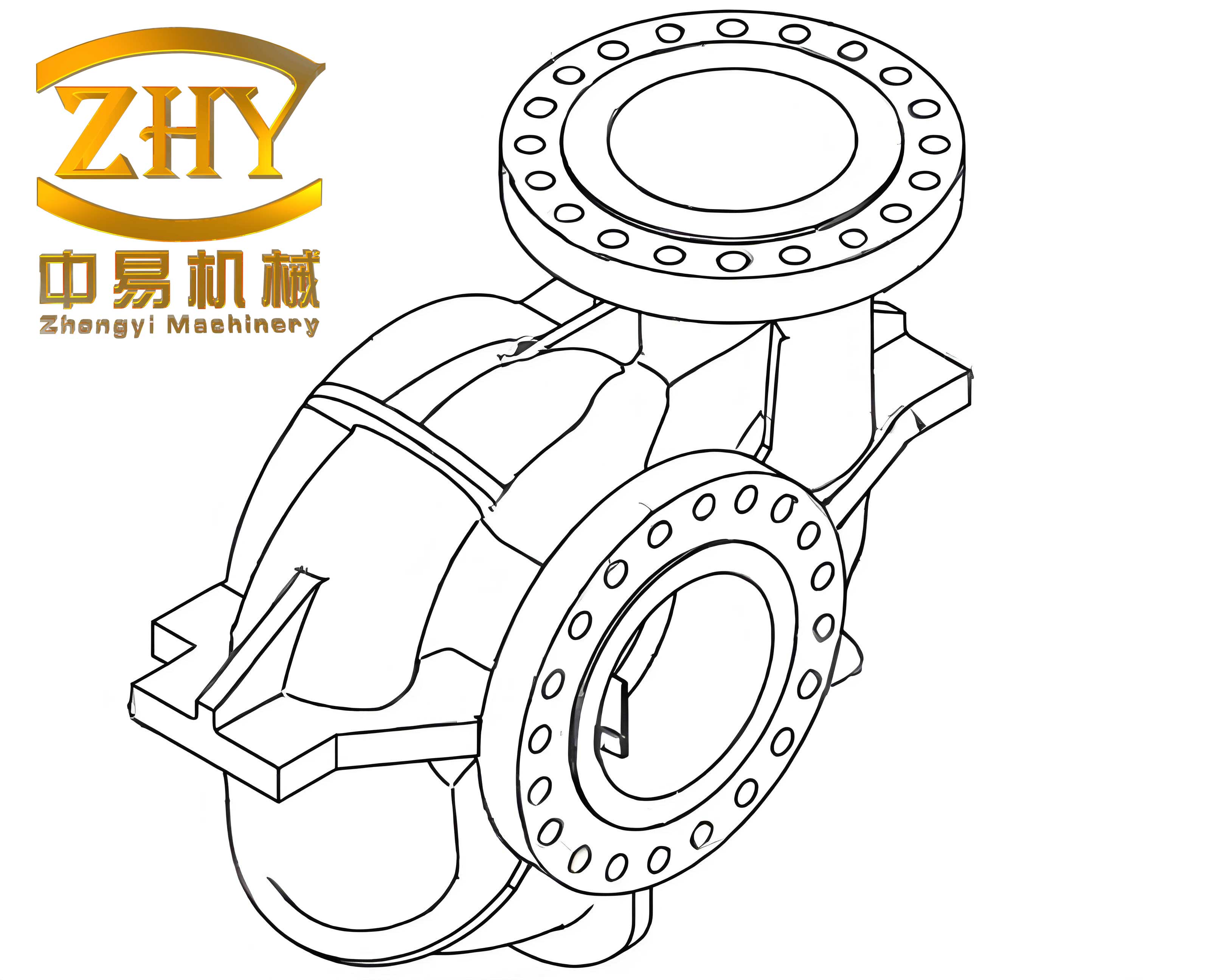
In conclusion, this study demonstrates the value of numerical simulation in optimizing casting processes for large complex magnesium alloy shell castings. Through detailed analysis of temperature and flow fields, I have shown that differential pressure casting offers superior uniformity and defect control compared to sand casting for these shell castings. Key findings include the importance of gate design in preventing shrinkage and the role of modulus analysis in identifying critical regions. The formulas and tables provided offer a quantitative framework for process improvement. Future work should involve experimental validation of these simulations to refine parameters further. Ultimately, adopting such simulation-driven approaches can significantly enhance the manufacturability and performance of shell castings in aerospace applications, contributing to lightweighting goals and operational efficiency.