
In the realm of advanced metallurgy, the production of heavy-section ductile iron casting with superior low-temperature toughness represents a significant technical challenge. My extensive work focuses on the QT350-22AL grade, specifically for components like conical supports used in demanding applications such as wind power equipment. This ductile iron casting must maintain exceptional mechanical properties, including high elongation and impact energy at temperatures as low as -40°C, while overcoming issues inherent to thick sections, such as graphite flotation, degeneration, and shrinkage. Through rigorous research and practical implementation, I have developed a robust smelting process that ensures consistent quality. This article details my methodology, emphasizing the critical role of compositional control, temperature management, and innovative treatment techniques in producing reliable heavy-section ductile iron casting.
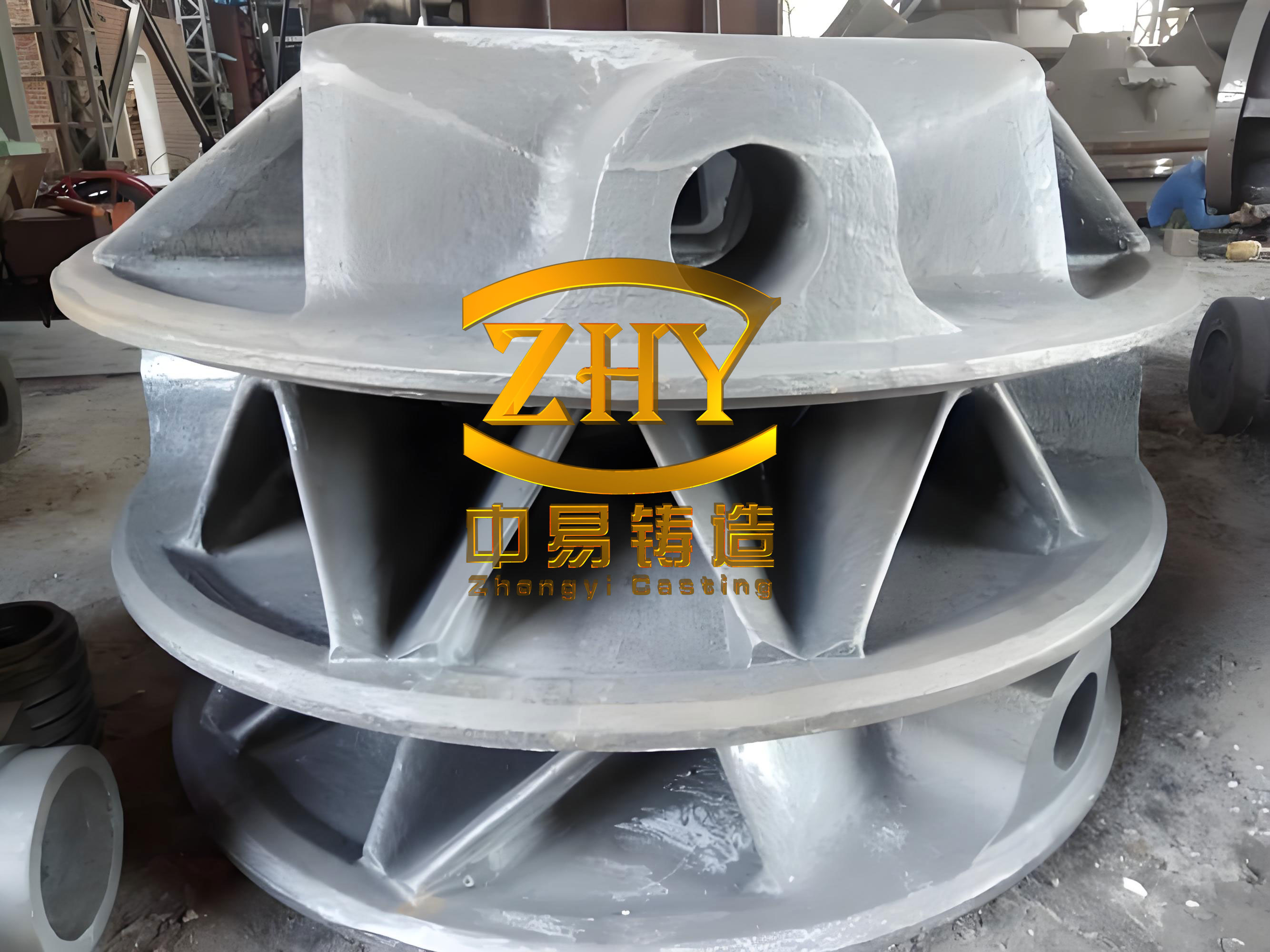
The foundation of any high-performance ductile iron casting lies in precise chemical composition control. For QT350-22AL, each element must be carefully balanced to achieve the desired matrix structure—primarily ferrite—and graphite morphology. Carbon, for instance, is pivotal for promoting graphitization, enhancing fluidity, and reducing shrinkage tendencies. My target range for final carbon content is 3.5% to 4.0%. Silicon, while a strong graphitizer, must be limited to prevent embrittlement and minimize the risk of chunky graphite in heavy sections. I maintain the final silicon content between 1.7% and 2.0%. Manganese and phosphorus are harmful due to segregation and carbide formation; thus, I keep manganese below 0.2% and phosphorus under 0.04%. Sulfur is controlled below 0.02% in the base iron to facilitate effective nodulization. Antimony, in trace amounts (below 0.008%), helps refine graphite and suppress degeneration. Lastly, residual magnesium and rare earths are crucial for spheroidization but must be optimized to avoid defects; I aim for 0.03–0.05% Mg and 0.01–0.03% RE. The table below summarizes my compositional ranges for the base and treated iron in producing this ductile iron casting.
| Element | Base Iron (wt.%) | Treated Iron (wt.%) | Rationale |
|---|---|---|---|
| C | 3.8–4.1 | 3.5–4.0 | Promotes graphitization, fluidity, and reduces shrinkage. |
| Si | 0.7–1.2 | 1.7–2.0 | Controlled to ensure ferrite formation and minimize brittle. |
| Mn | ≤0.2 | ≤0.2 | Low levels prevent carbide segregation and embrittlement. |
| P | ≤0.04 | ≤0.04 | Minimized to avoid phosphide eutectics. |
| S | ≤0.02 | ≤0.02 | Low base sulfur aids nodulization. |
| Sb | — | ≤0.008 | Trace addition refines graphite and inhibits degeneration. |
| Mgres | — | 0.03–0.05 | Ensures spheroidization without excessive white. |
| REres | 0.01–0.03 | 0.01–0.03 | Combats fading and supports nodulization. |
Temperature control is equally vital in the smelting process for ductile iron casting. I employ a strategy of superheating and holding to eliminate genetic graphite imperfections and reduce oxide inclusions. The base iron is first adjusted at 1360–1400°C, then superheated to 1500–1540°C. This high temperature dissolves coarse graphite and enhances nucleation potential. For spheroidization, I use an innovative ladle-to-ladle transfer method: the iron is cooled to 1400–1450°C in a transfer ladle before being poured into the treatment ladle for nodulizing. This approach, which I term “inverted ladle spheroidization,” precisely controls the reaction temperature and rapidly cools the melt, preserving innate nuclei. The pouring temperature is maintained at 1330–1370°C to balance fluidity and solidification characteristics. The thermal dynamics can be described by an empirical relation for effective nucleation rate $N_{eff}$ as a function of superheating temperature $T_s$ and cooling rate $R_c$:
$$N_{eff} = k_1 \cdot e^{-E_a/(R \cdot T_s)} + k_2 \cdot R_c^{1/2}$$
where $k_1$ and $k_2$ are material constants, $E_a$ is the activation energy for nucleation, and $R$ is the gas constant. This formula underscores how my temperature protocol maximizes graphite sites in the ductile iron casting.
Raw material selection is tailored for high-purity inputs. I use low-impurity Q10 pig iron with minimal trace elements (Ti, V < 0.1%), added late in the melt to reduce nucleus loss. Steel scrap is low-manganese punchings, charged early, and supplemented with graphite-based carburizer to increase carbonaceous nuclei. Returns are from cleaned ductile iron casting risers, added mid-melt. Ferrosilicon (75% Si) is used for final silicon adjustment. This combination ensures a clean, nucleation-friendly base for the ductile iron casting.
The heart of my process lies in the spheroidization and inoculation treatments. For heavy-section ductile iron casting, I combine light and heavy rare-earth spheroidizers in a 1:1 ratio, with a total addition of 0.9–1.3%. This blend leverages the quick reaction of light REs and the fading resistance of heavy REs, ensuring stable nodulization throughout the thick sections. The inoculation is performed multiple times to enhance graphite count and roundness. I use a Ba-containing inoculant (2–4% Ba, 5–15 mm) in three stages: 0.2–0.4% in the transfer ladle (first inoculation), 0.3–0.6% in the treatment ladle during spheroidization (second inoculation), and 0.05–0.15% in the pouring ladle (third inoculation). Additionally, a Ce-based instant inoculant (0.5–1.5 mm, 0.05–0.2%) is added during pouring via a feeder. This multi-stage inoculation dramatically increases effective nuclei, as modeled by the graphite ball number density $N_g$:
$$N_g = N_0 + \sum_{i=1}^{n} \Delta N_i \cdot \exp(-\lambda_i t_i)$$
where $N_0$ is the base nuclei count, $\Delta N_i$ is the nuclei added per inoculation stage, $\lambda_i$ is the fading coefficient for that stage, and $t_i$ is the time interval. My practice minimizes fading through rapid processing. The table below outlines the treatment parameters for this ductile iron casting.
| Treatment Stage | Material | Addition (wt.%) | Purpose |
|---|---|---|---|
| Spheroidization | Light RE + Heavy RE mix | 0.9–1.3 | Ensures spherical graphite formation and resists fading. |
| 1st Inoculation | Ba-inoculant (5–15 mm) | 0.2–0.4 | Provides initial nuclei during transfer. |
| 2nd Inoculation | Ba-inoculant (5–15 mm) | 0.3–0.6 | Boosts nuclei post-spheroidization. |
| 3rd Inoculation | Ba-inoculant (5–15 mm) | 0.05–0.15 | Maintains nuclei in pouring ladle. |
| Instant Inoculation | Ce-inoculant (0.5–1.5 mm) | 0.05–0.2 | Enhances late-stage nucleation during pouring. |
The effectiveness of this process is evident in the produced ductile iron casting. I evaluate properties using attached 70 mm test blocks from the thick sections. Microstructural analysis reveals fine, round graphite balls (ASTM grade 2) uniformly dispersed in a fine ferrite matrix (≈95% ferrite, ≈5% pearlite), with no signs of degeneration or flotation. Mechanically, the ductile iron casting exceeds standard requirements. The table below compiles data from multiple casts, demonstrating consistency. Key formulas relate the microstructure to properties: for example, the yield strength $\sigma_y$ can be approximated by a Hall-Petch type relation for ferritic ductile iron casting:
$$\sigma_y = \sigma_0 + k_y \cdot d^{-1/2} + \beta \cdot V_f^{1/3}$$
where $\sigma_0$ is the lattice friction stress, $k_y$ is a constant, $d$ is the ferrite grain size, $\beta$ is a factor for graphite dispersion, and $V_f$ is the graphite volume fraction. My process yields fine $d$ and optimal $V_f$, leading to high toughness. The low-temperature impact energy $KV_{-40}$ correlates with graphite morphology and matrix purity, modeled as:
$$KV_{-40} = A \cdot (N_g)^{1/2} \cdot \exp(-B \cdot [\text{Mn+Si}] )$$
where $A$ and $B$ are constants, and $[\text{Mn+Si}]$ represents embrittling elements. My low Mn and controlled Si ensure high impact values.
| Sample ID | Tensile Strength (MPa) | Yield Strength (MPa) | Elongation (%) | Hardness (HBW) | Avg. Impact Energy at -40°C (J) | Graphite Grade (ASTM) | Ferrite (%) |
|---|---|---|---|---|---|---|---|
| 1 | 425 | 275 | 16.5 | 129 | 13.8 | 2 | 95 |
| 2 | 415 | 270 | 16.0 | 129 | 13.2 | 2 | 95 |
| 3 | 435 | 285 | 15.0 | 143 | 12.1 | 2 | 95 |
| 4 | 425 | 275 | 16.5 | 143 | 12.5 | 2 | 95 |
| 5 | 430 | 280 | 16.0 | 143 | 13.1 | 2 | 95 |
| 6 | 405 | 265 | 16.5 | 143 | 13.7 | 2 | 95 |
| 7 | 415 | 270 | 17.5 | 143 | 12.8 | 2 | 95 |
| 8 | 410 | 265 | 16.0 | 143 | 14.1 | 2 | 95 |
| 9 | 410 | 265 | 15.5 | 129 | 13.6 | 2 | 95 |
| 10 | 410 | 265 | 16.0 | 129 | 13.5 | 2 | 95 |
The data shows tensile strengths of 370–430 MPa, yield strengths of 250–320 MPa, elongations of 15–18.5%, and impact energies of 12–14 J at -40°C, all meeting and surpassing specifications for ductile iron casting. This consistency stems from the integrated approach: composition control, temperature management, and multi-stage treatment. Furthermore, the inverted ladle spheroidization reduces temperature differentials, while the combined RE spheroidizers and multi-inoculation create abundant nucleation sites, preventing graphite degeneration in heavy sections—a common pitfall in ductile iron casting production.
In summary, my first-hand experience demonstrates that producing QT350-22AL heavy-section low-temperature ductile iron casting is achievable through a meticulously designed smelting process. Key innovations include the inverted ladle technique for precise temperature control, the synergistic use of light and heavy rare-earth spheroidizers, and a multi-stage inoculation regimen that maximizes graphite nucleation. These elements, coupled with strict compositional limits, ensure a fine ferritic matrix with spherical graphite, yielding superior low-temperature toughness and mechanical properties. This methodology not only addresses the challenges of thick sections but also provides a reproducible framework for high-quality ductile iron casting in critical applications. Future work could explore real-time monitoring systems to further optimize parameters, but the current process stands as a reliable solution for advanced ductile iron casting production.