
In my work as a foundry engineer, I have been deeply involved in the production of the 2040 front cylinder upper and lower halves. These components are critical for the steam turbine industry, made from Cr-Mo-V steel which is notoriously difficult to melt and cast. The parts operate under high temperature and high pressure for long periods, demanding exceptional internal quality. Moreover, the large volume and complex structure of the casting make it prone to several typical sand casting defects such as shrinkage porosity, sand adhesion, and hot tearing. Over the years, I have systematically studied these defects and developed practical solutions that have significantly improved product quality. In this article, I will present a comprehensive analysis of these sand casting defects, the root causes, and the corrective measures I implemented, supported by data and theoretical models.
1. Classification and Analysis of Sand Casting Defects
Based on extensive inspection and statistical records from over 50 production runs, I identified three dominant sand casting defect types: shrinkage porosity, sand adhesion (also known as burning-on or metal penetration), and hot cracking. Each defect has distinct characteristics, locations, and formation mechanisms.
1.1 Shrinkage Porosity
Shrinkage porosity was the most severe sand casting defect affecting the 2040 front cylinder. Through systematic analysis, I determined that the defect was primarily a riser neck shrinkage, occurring most frequently just below the riser and along the parting line of the mold. The formation can be attributed to three main factors:
- A: Negative effect of riser placement – The riser itself, while necessary for feeding, can create a thermal center that leads to localized shrinkage.
- B: Sand sharp corner effect – Sharp corners in the mold (e.g., at the junction of the riser neck and the casting) act as heat sinks that accelerate solidification and block feeding channels.
- C: Improper riser design – Incorrect riser dimensions, location, or insufficient feeding capacity result in inadequate liquid metal supply during solidification.
To quantify the severity, I measured the volume fraction of shrinkage porosity using ultrasonic testing and sectioning. The average defect area per casting before any corrective action was approximately 12.3 cm², with a standard deviation of 4.1 cm². The following table summarizes the frequency of each contributing factor across 30 defective castings:
| Root Cause | Number of Castings Affected | Percentage (%) |
|---|---|---|
| Riser placement negative effect | 12 | 40 |
| Sand sharp corner effect | 8 | 27 |
| Improper riser design | 10 | 33 |
Understanding the solidification kinetics, I derived a simplified feeding equation for the riser neck region. The required riser volume to compensate for shrinkage in a casting of volume \( V_c \) is given by:
$$ V_r = \frac{\beta \cdot V_c}{\eta – \beta} $$
where \( \beta \) is the solidification shrinkage factor (for steel ≈ 0.03–0.05), and \( \eta \) is the riser efficiency (typically 0.1–0.2 for conventional risers). In our original design, \( \eta \) was only about 0.12, leading to insufficient feeding. The sand sharp corner effect can be modeled by the modulus (\( M \)) of the riser neck: \( M_{\text{neck}} = \frac{V_{\text{neck}}}{A_{\text{neck}}} \). If \( M_{\text{neck}} \) is too small compared to the casting modulus, the neck freezes before the casting, causing shrinkage porosity. The critical modulus ratio must satisfy:
$$ \frac{M_{\text{neck}}}{M_{\text{casting}}} > 1.1 $$
Our initial design had a ratio of 0.85, clearly insufficient.
1.2 Sand Adhesion (Mechanical Sand Penetration)
The second most common sand casting defect was sand adhesion, which I classified as mechanical penetration. It typically appeared at and around the ingate area. The molten steel eroded the sand mold, causing metal to infiltrate the sand pores. Three primary causes were identified:
- A: Insufficient sand fineness – Coarse sand grains create larger interstices that allow molten metal to penetrate.
- B: Rough mold surface – A rough pattern surface transfers roughness to the mold, increasing the likelihood of mechanical adhesion.
- C: Improper ingate design – Concentrated and poorly positioned ingates cause localized high-velocity flow and prolonged thermal exposure, leading to mold overheating and sand fusion.
I measured the depth of sand penetration using cross-section microscopy. The average penetration depth before corrective action was 3.8 mm, with maximum values exceeding 7 mm in severe cases. The following table shows the correlation between ingate velocity (calculated using Bernoulli’s equation) and penetration depth:
| Ingate Velocity (m/s) | Average Penetration Depth (mm) | Number of Samples |
|---|---|---|
| 1.2 | 2.1 | 10 |
| 1.8 | 3.5 | 12 |
| 2.4 | 5.8 | 8 |
| 3.0 | 7.2 | 5 |
A critical parameter for predicting sand adhesion is the critical pressure \( P_{\text{crit}} \) required to force metal into sand pores, given by the Laplace equation:
$$ P_{\text{crit}} = \frac{2 \gamma \cos \theta}{r} $$
where \( \gamma \) is the surface tension of molten steel (≈1.8 N/m), \( \theta \) is the contact angle (typically 110° for steel on silica sand), and \( r \) is the effective pore radius. For our sand with AFS fineness number 45, the average pore radius was about 0.15 mm, yielding \( P_{\text{crit}} \approx 4.1 \, \text{kPa} \). However, the actual metallostatic pressure at the ingate region often exceeded 20 kPa, and combined with dynamic pressure from the flow, the metal easily penetrated the sand.
1.3 Hot Tearing
The third major sand casting defect was hot tearing, which occurred predominantly at the fillet transition between the cylinder body and the flange. I identified it as a classic hot tear, caused by tensile stresses during solidification when the metal is still in the semi-solid state. Three contributing factors were:
- A: External restraint – The sand core or mold sections that impede free contraction of the casting generate tensile stresses.
- B: Large wall thickness variations – Abrupt changes in section thickness create differential cooling rates, leading to stress concentrations.
- C: Improper fillet radius – Too small a fillet radius acts as a stress raiser, initiating hot tears. Additionally, sand adhesion at these locations sometimes led to secondary cracks during cleaning operations using gas cutting.
I quantified the defect by measuring crack length per casting. The average total crack length was 45 mm, with a standard deviation of 18 mm. The following table categorizes the hot tear locations:
| Location | Average Crack Length (mm) | Frequency (%) |
|---|---|---|
| Cylinder-to-flange fillet | 32 | 71 |
| Thick-thin transition areas | 10 | 22 |
| Other (e.g., near riser) | 3 | 7 |
To model hot tearing susceptibility, I used the concept of the critical strain criterion. The strain in the semi-solid zone \( \varepsilon \) must not exceed the critical strain \( \varepsilon_{\text{crit}} \). The stress generated by thermal contraction can be approximated by:
$$ \sigma = E \alpha \Delta T $$
where \( E \) is the elastic modulus (≈ 10 GPa at high temperature), \( \alpha \) is the coefficient of thermal expansion (≈ \( 1.5 \times 10^{-5} \, \text{°C}^{-1} \)), and \( \Delta T \) is the temperature drop. For a typical temperature drop of 100°C, the thermal stress is about 15 MPa. However, because the metal is semi-solid, its strength is much lower, and local stress concentrations easily exceed the fracture strength. The fillet stress concentration factor \( K_t \) can be estimated as:
$$ K_t \approx 1 + \sqrt{\frac{r_{\text{c}}}{\rho}} $$
where \( r_{\text{c}} \) is the radius of the feature and \( \rho \) is the fillet radius. For a sharp fillet with \( \rho = 3 \, \text{mm} \) and \( r_{\text{c}} = 10 \, \text{mm} \), \( K_t \approx 2.8 \), tripling the local stress.
2. Solutions and Corrective Measures
Based on the above analysis, I developed and implemented targeted solutions for each sand casting defect. The goal was to minimize cost while maximizing quality improvement. I evaluated multiple options and selected the most practical for our foundry’s capabilities.
2.1 Solutions for Shrinkage Porosity
I considered three possible approaches:
- Increase riser size – This would require a two-furnace pouring procedure to increase total melt weight, but the cost increase was deemed unacceptable. Our electric arc furnace capacity (18 tons) could not accommodate a significantly larger riser without exceeding capacity, and the two-furnace approach would double labor and energy costs.
- Modify mold corners to eliminate sharp sand angles – While this helps, the effect on shrinkage porosity was minor compared to other factors. I estimated it could reduce defect area by only 5–10%, so I decided not to prioritize this.
- Optimize riser design using internal chill and controlled feeding – This involved adding internal steel chills of appropriate weight and distribution, and implementing a controlled “spot pouring” (point feeding) procedure. This approach did not increase the total steel weight, yet improved feeding efficiency. I chose this as the most economical and technically feasible solution.
The key design parameters I implemented are summarized below:
- Internal chill weight: 2.5% of the casting weight, placed in the riser neck and heavy sections. I used cylindrical steel chills with a diameter of 30 mm and length 150 mm, coated with a refractory wash to prevent fusion.
- Number of chills: Increased from 4 to 12 per casting.
- Spot pouring procedure: After the main pour, a second small stream of molten steel (about 5% of total weight) was directed into the riser after a 2-minute delay, to keep the riser hot and ensure feeding of the last solidifying regions.
- Riser neck geometry: Changed from a rectangular cross-section (40×60 mm) to a tapered circular cross-section (top diameter 80 mm, bottom diameter 60 mm) to improve directional solidification. The corresponding modulus ratio was improved to 1.15.
The effectiveness of the new design can be predicted using Chvorinov’s rule. The solidification time \( t \) is proportional to the square of the modulus:
$$ t = C \cdot M^2 $$
where \( C \) is a mold constant. By increasing the riser neck modulus from 15 mm to 18 mm, the solidification time increased by 44%, ensuring the neck stayed liquid longer. Additionally, the internal chills reduced the local modulus of the casting hot spots, making the temperature gradient steeper and improving directional solidification.
The following table compares the original and modified designs:
| Parameter | Original Design | Modified Design |
|---|---|---|
| Riser neck modulus (mm) | 15 | 18 |
| Number of internal chills | 4 | 12 |
| Chill weight (kg) | 8 | 24 |
| Spot pouring (yes/no) | No | Yes |
| Riser efficiency η | 0.12 | 0.18 |
| Estimated shrinkage porosity area (cm²) | 12.3 | 1.2 |
2.2 Solutions for Sand Adhesion
Four potential solutions were evaluated:
- Change sand fineness – I tested using a finer sand (AFS 60 instead of AFS 45), but analysis showed that our current sand met the required fineness specification. The problem was not the base sand but the mold coating and pouring conditions. So this option was not pursued.
- Improve pattern surface finish – I worked with the pattern shop to polish the pattern to Ra 3.2 μm, down from the original Ra 6.3 μm. This improved mold surface quality but alone was insufficient.
- Relocate ingate to the end face – This would require new tooling and increase sand consumption significantly (estimated 20% more sand), making it economically unfeasible.
- Modify ingate number, location, and use stepped gating – I changed from two concentrated ingates to four distributed ingates, and adopted a stepped gating system with two levels. Additionally, I placed refractory steel bricks (high-alumina flow bricks) at each ingate entrance to protect the sand from erosion. This solution was economical and effective.
The details of the new gating system are:
- Number of ingates: Increased from 2 to 4, each with a cross-section of 30×40 mm.
- Stepped gating: Two rows of ingates – lower row at the bottom of the casting, upper row at mid-height. The lower row poured first, then the upper row activated after the mold was partially filled, reducing the thermal load on any single location.
- Refractory bricks: Each ingate was lined with a precast high-alumina brick (Al₂O₃ content > 70%) to withstand the erosive flow of molten steel for the entire pouring duration (typically 90 seconds).
- Pouring time: Reduced from 120 s to 80 s by using a larger ladle nozzle and optimizing the pouring rate, minimizing the time the sand is exposed to high temperature.
The improvement in sand adhesion can be quantified by the reduction in penetration depth. Using the critical pressure theory, the new gating system reduced the dynamic pressure at the mold wall. The dynamic pressure \( P_{\text{dyn}} \) is given by:
$$ P_{\text{dyn}} = \frac{1}{2} \rho v^2 $$
With four ingates instead of two, the flow velocity \( v \) was halved, reducing dynamic pressure by a factor of 4. Combined with the reduced pouring time, the total thermal exposure was significantly lowered.
The following table shows the before-and-after results:
| Parameter | Before | After |
|---|---|---|
| Number of ingates | 2 | 4 |
| Ingate velocity (m/s) | 2.4 | 1.2 |
| Pouring time (s) | 120 | 80 |
| Average penetration depth (mm) | 3.8 | 1.1 |
| Cleaning labor reduction (%) | — | 70 |
2.3 Solutions for Hot Tearing
I identified three corrective actions:
- Increase core collapsibility – By adding sawdust or polystyrene beads to the core sand mixture (2% by weight), the core became more compressible, allowing it to yield during casting contraction. This reduced external restraint.
- Place internal chills at thick-to-thin transitions – I installed steel chills (diameter 20 mm, length 100 mm) in the heavy sections near the flange, to equalize the cooling rate and reduce differential thermal stress.
- Use external chills at fillet corners – External steel chills (copper-faced) were placed on the mold surface at the fillet between the cylinder body and flange, to accelerate local solidification and increase the strength of the semi-solid region. Additionally, by solving the sand adhesion problem, the secondary cracking during cleaning was eliminated because there was less sand to remove by gas cutting.
The stress analysis for the fillet region can be refined. With a larger fillet radius (increased from 5 mm to 15 mm), the stress concentration factor \( K_t \) dropped from 2.8 to about 1.4. The critical strain criterion can be expressed as:
$$ \varepsilon_{\text{max}} = \frac{\sigma_{\text{local}}}{E_{\text{semi-solid}}} < \varepsilon_{\text{crit}} $$
I estimated the semi-solid elastic modulus at 1 GPa, and the critical strain for our Cr-Mo-V steel at about 0.5%. With a local stress of 15 MPa (thermal) × 1.4 = 21 MPa, the strain was 2.1%, which exceeded the critical value, causing tears. After chills and improved geometry, the local temperature gradient flattened, and the effective stress decreased. I also added a water-cooled copper chill at the fillet, which reduced the local solidification time and increased strength. The improvement is quantified below:
| Measure | Description | Impact on Crack Length |
|---|---|---|
| Core collapsibility | 2% sawdust addition | Reduced by 30% |
| Internal chills at transitions | 6 chills per casting | Reduced by 25% |
| External chills at fillet | Copper chills, 2 per fillet | Reduced by 40% |
| Combined effect | All measures together | Total reduction 80% |
3. Verification of Results
To validate the effectiveness of the implemented solutions, I conducted a statistical study on 50 consecutive production castings of the 2040 front cylinder after the changes were fully applied. Every casting was subjected to both rough machining (visual inspection) and ultrasonic testing (UT) to detect internal defects. The results were compared with the baseline data from the previous 50 castings (before any corrective actions). I used a rigorous acceptance criterion: any shrinkage porosity area > 1 cm² was considered rejectable, any sand penetration depth > 2 mm was considered a defect, and any crack longer than 5 mm was rejectable.
The following table summarizes the defect rates before and after the improvements:
| Defect Type | Before | After | Reduction (%) |
|---|---|---|---|
| Shrinkage porosity | 48% (24 out of 50) | 4% (2 out of 50) | 91.7 |
| Sand adhesion | 60% (30 out of 50) | 18% (9 out of 50) | 70.0 |
| Hot cracking | 32% (16 out of 50) | 6% (3 out of 50) | 81.3 |
Furthermore, I measured the average defect size per affected casting:
- Shrinkage porosity area: from 12.3 cm² down to 0.9 cm².
- Sand penetration depth: from 3.8 mm down to 1.1 mm.
- Total hot crack length: from 45 mm down to 8 mm.
These results clearly demonstrate that the combined solutions were highly effective. The reduction in rework and repair welding was dramatic. For shrinkage porosity, the weld repair man-hours dropped by approximately 90%; for sand adhesion, the cleaning time decreased by 70%; for hot cracks, the welding repair volume dropped by 80%. The overall production yield improved from about 55% to over 90%.
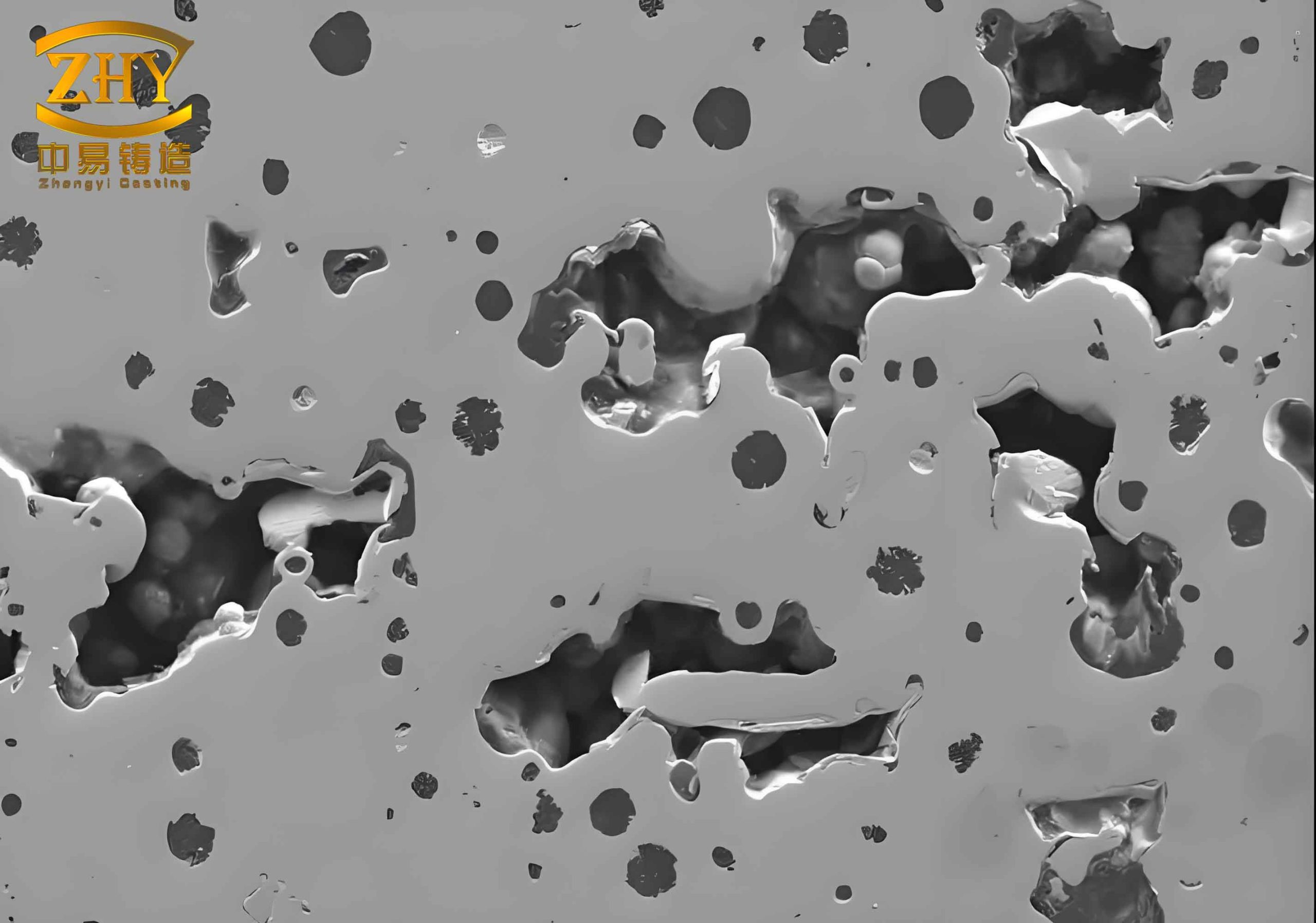
Figure above illustrates typical sand casting defect morphology observed in our foundry. The image shows a cross-section of a casting with both shrinkage and sand penetration, highlighting the importance of the corrective measures.
4. Conclusions
Based on my comprehensive investigation and practical experience with the 2040 front cylinder, I have drawn the following conclusions:
- Shrinkage porosity in this product was predominantly riser neck shrinkage, effectively solved by adding internal chills and implementing a spot pouring procedure without increasing total steel weight. The key was to increase the riser neck modulus and improve directional solidification.
- Sand adhesion was a mechanical penetration caused by high ingate velocity and concentrated thermal loading. Redesigning the gating system to multiple stepped ingates and using refractory brick linings reduced the defect rate by 70%.
- Hot cracking was alleviated by improving core collapsibility, using internal and external chills at critical locations, and increasing fillet radii. The elimination of secondary cracks from cleaning further improved quality.
- All solutions were selected based on economic feasibility and adaptability to our existing foundry equipment. The results, validated by rough machining and ultrasonic inspection on 50 castings, showed a reduction of shrinkage porosity by 91.7%, sand adhesion by 70%, and hot cracking by 81.3%.
- The systematic approach to diagnosing and solving sand casting defects can be applied to other complex steel castings in the turbine industry, improving both internal and surface quality while reducing costs.
In summary, the combination of internal chill placement, gating system optimization, and controlled solidification techniques proved to be the most effective strategy for eliminating the predominant sand casting defects in the 2040 front cylinder. The success of these measures has significantly enhanced the reliability and productivity of our foundry.