
In my extensive experience with foundry operations, the persistent issue of casting holes has been a significant challenge, particularly in complex components like the 4DA1 diesel engine cylinder block. This engine, designed to meet Euro III emission standards, is a critical power unit for vehicles such as the Ruifeng and Shuailing models. The cylinder block casting, produced by our affiliated foundry, involves intricate geometries that push the limits of conventional sand casting processes. Despite numerous process optimizations that improved yield rates initially, casting holes—specifically sand inclusions—emerged as the predominant defect, accounting for over 20% of scrap over a six-month period. This high rejection rate not only escalated production costs but also threatened supply chain stability. Therefore, identifying the root cause of these casting holes and implementing effective controls became a paramount objective for enhancing product quality and profitability.
The manifestation of casting holes followed a distinct pattern, which provided crucial clues for diagnosis. Upon cleaning after casting, these defects were predominantly located on the upper surface of the cylinder block. After machining, however, casting holes frequently appeared on the walls between cylinder bores, constituting approximately 73.8% of machining-related scrap. This spatial consistency suggested a systematic origin rather than random process variations. Common factors leading to such casting holes include inadequate strength of sand cores or molds, excessive molten iron temperature causing surface erosion, poor venting leading to trapped impurities, and residual loose sand in the cavity. Despite rigorous adjustments to process parameters—such as modifying sand strength, optimizing pouring temperatures, and enhancing cleaning protocols—the incidence of casting holes remained stubbornly high. This prompted a deeper investigation beyond conventional wisdom, focusing on potential contaminants introduced during core assembly.
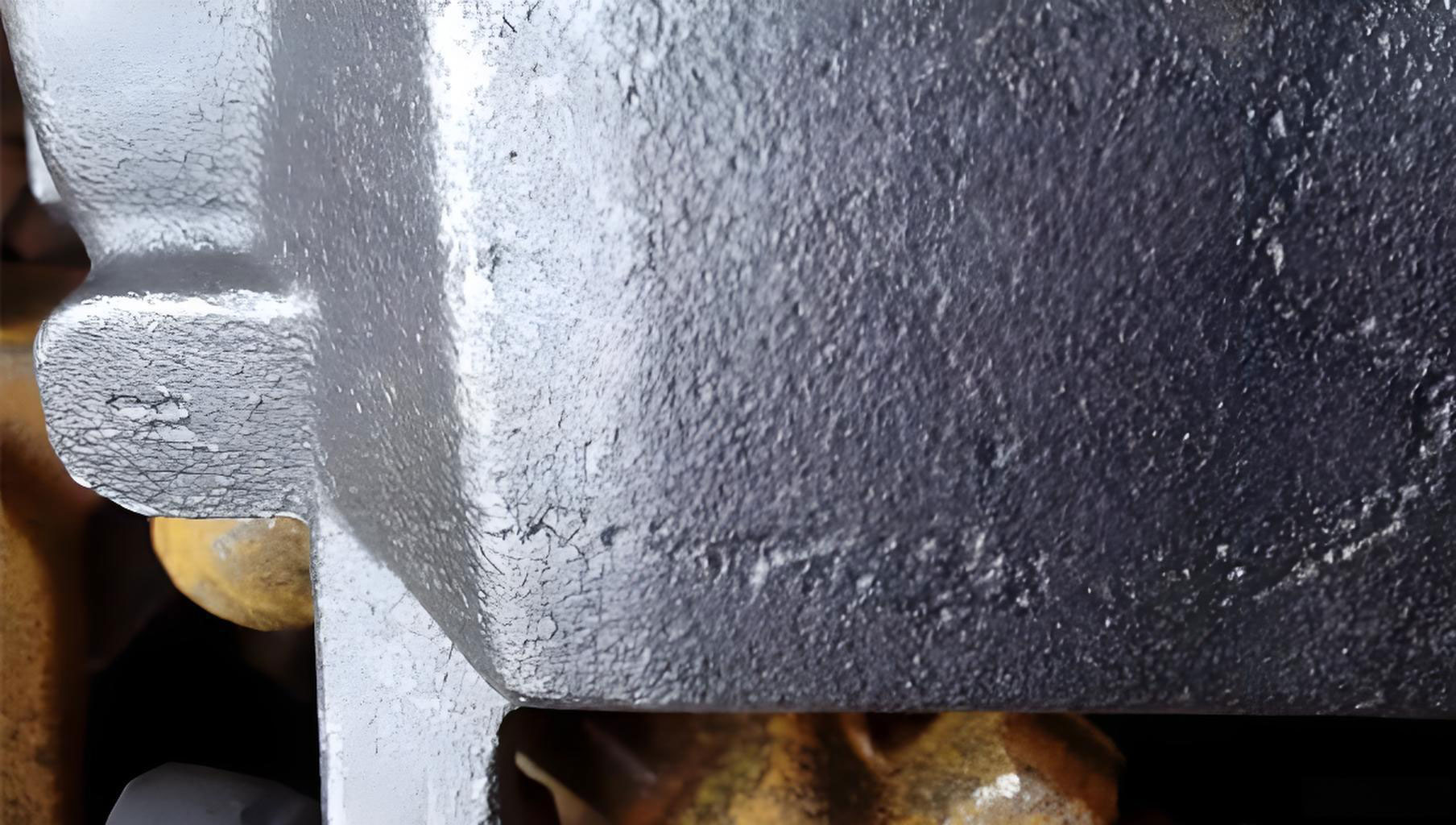
To pinpoint the source of these casting holes, we conducted a meticulous analysis of inclusions extracted from defective areas. Sampling was performed from the cylinder bore walls, where machining exposed subsurface defects. Under microscopic examination, the morphology of the inclusions was compared to reference samples of burned coating and base sand. The inclusions closely resembled the residual structure of the coating after burnout, characterized by a fused, glassy appearance rich in siliceous material, whereas burned sand exhibited a more granular and porous texture. This visual evidence strongly indicated that the casting holes originated from coating material rather than core sand. To corroborate this, we designed a controlled experiment using a single mold with two cavities: one core assembly was coated as per standard practice, while the other was left uncoated. After pouring and inspection, the coated specimen exhibited numerous casting holes on the upper surface and bore walls, whereas the uncoated one, though suffering from severe metal penetration, showed no signs of such holes. This stark contrast confirmed that the coating was a primary contributor to the defect.
Further validation involved scanning electron microscopy (SEM) and energy-dispersive X-ray spectroscopy (EDS) on inclusions from the upper surface defects. The EDS analysis revealed significant compositional differences: inclusion sites showed high silicon content, consistent with the coating formulation, while adjacent areas had lower silicon levels typical of the base iron. The results can be summarized in the following table, highlighting the elemental contrasts:
| Element | Inclusion Site | Adjacent Iron Matrix |
|---|---|---|
| Si | 45.2% | 2.1% |
| Fe | 32.5% | 94.3% |
| Al | 12.8% | 0.5% |
| O | 9.5% | 3.1% |
The high silicon and aluminum concentrations align with typical refractory coatings used to prevent burn-on. The detachment mechanism likely involves thermal and mechanical forces during pouring. When molten iron at temperatures exceeding 1,300°C contacts coated surfaces, the coating may spall due to differential thermal expansion or inadequate adhesion. The probability of coating detachment can be modeled using a stress-based criterion. The thermal stress $\sigma_t$ induced in the coating layer is given by:
$$ \sigma_t = E_c \cdot \alpha_c \cdot \Delta T $$
where $E_c$ is the coating’s Young’s modulus, $\alpha_c$ is its coefficient of thermal expansion, and $\Delta T$ is the temperature gradient. If $\sigma_t$ exceeds the adhesive strength $\tau_a$ at the interface, detachment occurs, leading to particles that entrain in the flow. These particles then disperse through the cavity, settling in areas like the upper surfaces or inter-bore walls, ultimately forming casting holes upon solidification. The fluid dynamics of molten iron can be described by the Navier-Stokes equations, but for simplicity, the entrapment likelihood correlates with flow velocity $v$ and particle size $d_p$. Empirical data from our trials suggested that particles larger than 100 µm tend to settle in low-velocity zones, such as the upper mold regions, directly contributing to casting holes.
To trace the precise source of coating fragments, we dissected several core assemblies after the coating process but before pouring. This revealed a critical detail: core-supports, which are metallic inserts used to reinforce sand cores, were extensively coated during the dipping operation because they were pre-attached to the water jacket cores. At the junctions between core-supports and the sand core, excessive coating accumulated, forming thick, vulnerable layers. During pouring, the molten iron melts the core-supports (typically made of low-carbon steel), and the high-temperature exposure causes the overlying coating to strip off. The detached coating fragments are then carried by the iron stream, seeding casting holes throughout the cavity. The following table outlines the key factors identified in this failure mode:
| Factor | Description | Impact on Casting Holes |
|---|---|---|
| Coating on Core-Supports | Direct application during dipping | High: Primary source of inclusions |
| Coating Accumulation at Junctions | Excess buildup at core-support interfaces | High: Creates fragile, detachable masses |
| Molten Iron Temperature | Typically 1,350–1,400°C | Moderate: Accelerates coating spallation |
| Flow Turbulence | High velocity during filling | Moderate: Disperses particles widely |
| Core-Support Melting | Metallic supports melt upon contact | High: Releases coated surfaces into melt |
Based on these insights, we formulated corrective actions focused on eliminating coating contamination on core-supports. The revised core assembly process involved modifying the water jacket core design to include three access openings at the core-support locations. After coating the sand cores via dipping, the core-supports are inserted into these openings and secured, thereby avoiding any contact with the coating bath. The openings are then sealed with additional core sand to prevent iron leakage. This design ensures that core-supports remain free of coating, drastically reducing the source of inclusions. Additionally, we intensified controls during core setting to minimize loose sand contamination, which could otherwise introduce alternative sources of casting holes.
The effectiveness of these modifications was evaluated over a three-month production trial. Defect rates were monitored daily, with statistical analysis confirming a substantial reduction. The incidence of casting holes on the upper surface dropped to negligible levels, while machining-revealed holes in cylinder bores decreased from over 20% to below 3%. The improvement can be visualized through a comparative summary:
| Defect Type | Pre-Improvement Rate (%) | Post-Improvement Rate (%) | Reduction (%) |
|---|---|---|---|
| Upper Surface Casting Holes | 18.5 | 0.8 | 95.7 |
| Cylinder Bore Casting Holes (Machining) | 22.3 | 2.7 | 87.9 |
| Overall Scrap Due to Casting Holes | 20.4 | 1.8 | 91.2 |
The reduction in casting holes not only enhanced quality but also yielded significant cost savings. By minimizing scrap, we reduced raw material waste and reprocessing expenses. The process stability now allows for predictable production outputs, reinforcing supply chain reliability. To generalize the findings, the relationship between coating detachment and casting holes formation can be expressed through a dimensionless number, the Coating Spallation Index (CSI), defined as:
$$ CSI = \frac{\rho_c \cdot v^2 \cdot A_c}{\tau_a \cdot d_p} $$
where $\rho_c$ is coating density, $v$ is molten iron velocity at the interface, $A_c$ is coated area, $\tau_a$ is adhesive strength, and $d_p$ is particle diameter. Higher CSI values indicate greater risk of casting holes. Our improved process reduces $A_c$ (by eliminating coating on core-supports) and increases $\tau_a$ (via better sealing), thereby lowering CSI below a critical threshold of 0.5, derived from empirical calibration.
In conclusion, the pervasive issue of casting holes in 4DA1 cylinder blocks was traced to coating detachment from core-supports during pouring. Through systematic analysis involving microscopic examination, spectroscopic techniques, and controlled experiments, we identified the exact failure mechanism. The implemented solution—redesigning the core assembly to prevent coating contamination—proved highly effective, slashing defect rates to less than 3%. This case underscores the importance of scrutinizing auxiliary materials like coatings in foundry processes, as they can become inadvertent sources of casting holes. Continuous monitoring and refinement of such details are essential for achieving near-zero defect targets in high-volume casting production. Future work may explore advanced coating formulations with higher adhesion or alternative core-support materials to further mitigate risks of casting holes.