
In my extensive experience with lost foam casting, addressing defects such as sand and slag inclusions is paramount for enhancing product quality and operational efficiency. These defects not only compromise the integrity of castings but also escalate production costs due to rework and scrap. This article delves into a systematic analysis of the root causes of sand and slag inclusions in lost foam casting, presenting comprehensive solutions grounded in first-hand experimentation and process optimization. The focus will be on two critical aspects: the formulation and application of coatings, and the bonding process of foam patterns. Throughout this discussion, the term ‘lost foam casting’ will be reiterated to emphasize the context and specificity of the techniques involved. I will employ tables and mathematical formulations to succinctly summarize key data and principles, facilitating a deeper understanding of the corrective measures.
The prevalence of sand inclusions in lost foam casting often stems from inadequate process control during pattern assembly, coating, and pouring. Through meticulous observation and analysis in our foundry, I have identified several primary contributors. Firstly, loose sand on the pouring cup surface, resulting from insufficient compaction, can be entrained into the mold cavity during metal pouring. Secondly, an improperly designed pouring cup can generate excessive turbulence and冲刷力 (washing force) on the sprue, eroding the coating layer and allowing molding sand to infiltrate the cavity. This冲刷力 can be conceptually related to the dynamic pressure of the liquid metal. A simplified expression for the force per unit area exerted on the sprue wall can be derived from Bernoulli’s principle and fluid momentum:
$$ P_d = \frac{1}{2} \rho v^2 $$
where $P_d$ is the dynamic pressure, $\rho$ is the liquid metal density, and $v$ is the flow velocity at the point of impact. Higher $v$ due to poor gating design increases $P_d$, thereby raising the risk of coating erosion.
Thirdly, a coating layer on the sprue that is too thin lacks the necessary resistance to thermal and mechanical stress. We found that ensuring a minimum thickness is crucial. Fourthly, the use of low-strength paper tape for sealing joints after hot-gluing patterns is a significant vulnerability; it burns out instantly upon metal contact, creating gaps for sand ingress. Finally, inappropriate hanging methods for coated patterns and sprues during drying lead to numerous areas requiring repair before molding. Incomplete or thin repairs directly result in sand inclusion defects.
| Cause Category | Specific Cause | Defect Mechanism |
|---|---|---|
| Pouring System Preparation | Loose sand on pouring cup; poor compaction | Direct entrainment of sand into metal stream |
| Gating Design | Unsuitable pouring cup/sprue design | High dynamic pressure ($P_d$) erodes sprue coating |
| Coating Application | Insufficient sprue coating thickness | Inadequate resistance to thermal/mechanical冲刷 |
| Pattern Bonding | Use of weak paper tape for joint sealing | Tape burnout creates sand ingress pathways |
| Handling & Repair | Poor handling leading to excessive repair needs | Incomplete repairs leave coating breaches |
Slag inclusions in lost foam casting, on the other hand, primarily originate from furnace or ladle operations and sometimes from coating-metal reactions. Our team’s brainstorming sessions concluded with several key reasons. Firstly, incomplete slag removal from the ladle prior to pouring is a direct source. Secondly, during the pouring process, continued slag formation in the ladle, if not timely raked, allows slag to flow into the mold with the metal stream. The rate of slag entrainment can be influenced by factors such as pouring height and turbulence. Thirdly, and more subtly, the coating composition itself can be a contributor. Excessive or inappropriate refractory materials in the coating may react with the molten metal to form compounds, preliminarily identified as silicates. This reaction can be generalized as:
$$ \text{Metal Oxide} + \text{SiO}_2 (\text{from coating}) \rightarrow \text{Metal Silicate} $$
These reaction products can become entrapped as slag inclusions within the casting.
The solution to these pervasive defects in lost foam casting required a dual-pronged approach targeting both the coating system and the pattern bonding process. The coating in lost foam casting serves multiple vital functions: it must support and protect the foam pattern, prevent metal penetration into the sand, absorb pyrolysis products, allow decomposition gases to permeate, maintain cavity integrity after pattern vaporization, and moderate heat transfer. Therefore, an optimal coating for lost foam casting must possess sufficient refractoriness, mechanical strength, appropriate thermal properties, controlled permeability, good applicability, and chemical inertness towards the foam.
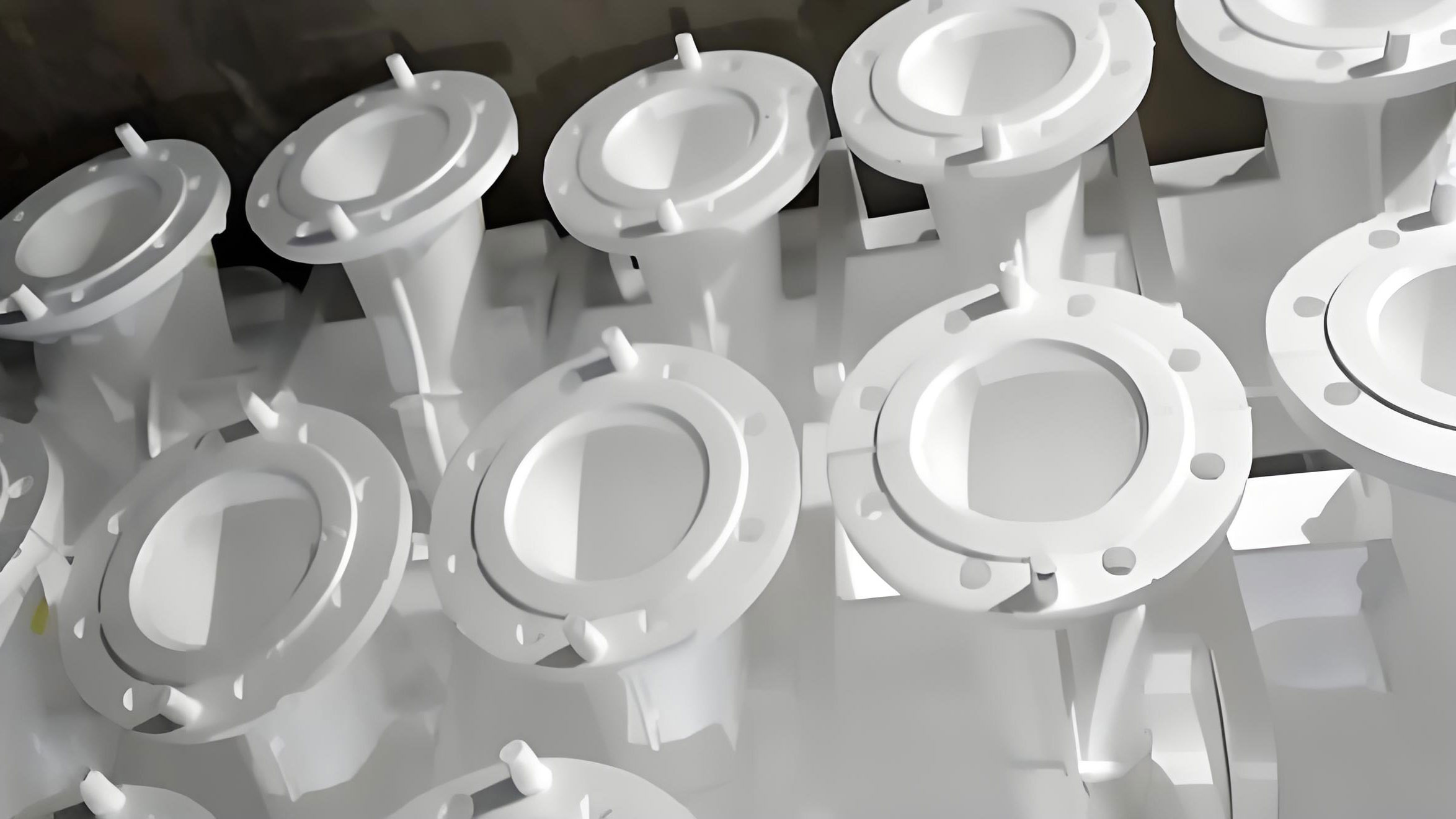
The formulation of a lost foam casting coating is a science in itself. It typically consists of several key components, as detailed in the table below. Our adjustments focused on the precise ratios of these components to enhance performance specifically against inclusion defects.
| Component | Primary Examples | Function & Desired Properties | Typical Adjusted Range (Weight % in Water-based Slurry) |
|---|---|---|---|
| Refractory Aggregate (骨料) | Zircon flour, alumina, quartz, bauxite, magnesite, olivine, graphite, talc | Provides high-temperature resistance, defines coating structure and permeability. Particle size distribution is critical for packing density. | 60-75% (Solid content basis). For steel castings, zircon content was increased to >40% of aggregate for better slag resistance. |
| Suspension Agent | Sodium bentonite, activated bentonite, CMC, PVA, PVB (for alcohol-based) | Imparts thixotropy, prevents settling, ensures uniform slurry consistency. Affects viscosity ($\eta$). | 1.5-3.0% (Bentonite + CMC combination). Optimized to maintain a viscosity $\eta$ between 30-50 Poise as per Brookfield viscometer. |
| Binder | Molasses, lignosulfonate, latex, synthetic resins | Enhances green and dry strength of coating layer, improves adhesion to foam. Contributes to post-drying strength $\sigma_s$. | 2-5% (e.g., Guilin No.5 composite binder). Adjusted to achieve a dry strength $\sigma_s > 0.8$ MPa. |
| Dispersing Medium | Water (water-based), ethanol, isopropanol (alcohol-based) | Carrier for solid components; affects drying rate and application properties. | Balance (20-35% of total slurry weight). Controlled for specific gravity of 1.7-1.9 g/cm³. |
| Additives | Biocides (e.g., sodium benzoate), antifoam agents, wetting agents | Prevents spoilage, improves bubble release, enhances substrate wetting. | 0.1-0.5% as required. |
The mixing process for the water-based coating was rigorously standardized to ensure homogeneity and property consistency, which is vital for successful lost foam casting. The optimized procedure is as follows: 1) Add 100 kg of water to the mixer and start agitation. 2) Gradually add the composite binder (e.g., Guilin No.5) to prevent lump formation. 3) Simultaneously, add pre-hydrated bentonite slurry and mix for 30 minutes to fully develop viscosity. The development of viscosity over time $t$ can be modeled approximately as $\eta(t) = \eta_{\infty}(1 – e^{-kt})$ for a first-order approach, where $\eta_{\infty}$ is the final viscosity and $k$ is a rate constant dependent on shear and composition. 4) Introduce the refractory aggregates in batches, ensuring each batch is fully incorporated before adding the next. The total mixing time for this phase is 2-3 hours to achieve a smooth, lump-free slurry. The final slurry viscosity is critical and is checked with a flow cup or viscometer before use. If the viscosity is too high, it is adjusted by adding small amounts of water under continuous stirring. The relationship between coating thickness ($\delta$), slurry viscosity ($\eta$), and the number of coating layers ($n$) applied can be approximated for planning purposes:
$$ \delta \approx n \cdot \alpha \cdot \left( \frac{\eta}{\rho g} \right)^{\beta} $$
where $\alpha$ and $\beta$ are empirical constants related to application method (dipping, brushing), $\rho$ is slurry density, and $g$ is gravity. For brushing, we target $\delta_{casting} \approx 1.0$ mm (2 layers) and $\delta_{sprue} \approx 1.5$ mm (3 layers).
Concurrently, we overhauled the white model (foam pattern) bonding and preparation process in our lost foam casting operations. The revised protocol emphasizes precision and care at every step: 1) Coating must be applied uniformly via brushing or dipping, avoiding both overly thick areas and uncoated spots. Uniformity ensures consistent permeability $K$, which is crucial for gas escape and is given by Darcy’s law for flow through a porous medium: $$ Q = \frac{K A \Delta P}{\mu L} $$ where $Q$ is gas flow rate, $A$ is area, $\Delta P$ is pressure differential, $\mu$ is gas viscosity, and $L$ is coating thickness. 2) After drying, the coated pattern must be inspected thoroughly. Any areas with coating cracks or spalls are carefully repaired with a brush-on slurry of the same composition and then re-dried. 3) During assembly for gating system attachment, patterns must be handled gently to prevent coating damage. At joints where sprues are to be attached, the coating must be completely scraped off to ensure direct foam-to-foam contact for a strong glue bond. 4) The joint sealing method was revolutionized. We abandoned the use of paper tape entirely. Instead, after hot-gluing the sprue to the pattern, the joint seam is meticulously painted with a high-refractory alcohol-based slurry (a “paste coat”). This slurry, upon drying, forms a strong, refractory bridge that withstands the initial thermal shock of pouring without immediate burnout, effectively sealing the gap against sand ingress. 5) Strict thickness control was implemented: casting coating at ~1.0 mm (2 coats), sprue coating at ~1.5 mm (3 coats). 6) A mandatory procedural step was added: before pouring each ladle, slag must be aggressively removed using a slag coagulant (e.g., based on calcium aluminate).
| Process Step | Key Action/Parameter | Target Value/Range | Rationale & Impact on Defects |
|---|---|---|---|
| Coating Application | Uniformity; Number of layers | Casting: 2 layers; Sprue: 3 layers. Visual and gauge check for uniformity. | Ensures consistent barrier strength and permeability; prevents local weak spots for sand ingress. |
| Coating Drying & Repair | Drying temperature & time; Repair protocol | 40-50°C for 4-8 hrs; 100% inspection and repair of defects. | Prevents cracks from rapid drying; eliminates potential failure points in the coating layer. |
| Pattern Handling | Handling procedure during assembly | ‘Light-touch’ policy; use of supportive fixtures. | Minimizes mechanical damage to the dry coating, reducing need for repair. |
| Joint Sealing | Sealing material and method | Alcohol-based refractory slurry painted over glued joints. | Provides a high-temperature resistant seal, directly addressing a major sand inclusion cause. |
| Coating Thickness | Final dry thickness measurement | Casting: 0.9-1.1 mm; Sprue: 1.4-1.6 mm. | Optimizes the balance between strength, permeability, and resistance to metal冲刷. |
| Ladle Treatment | Slag removal before pouring | Mandatory use of slag coagulant and raking for each ladle. | Directly reduces the primary external source of slag inclusions. |
The implementation of these tailored measures in our lost foam casting production line yielded significant improvements. We conducted a statistical process control study over a batch of 500 castings produced before and after the changes. The key performance indicator was the defect rate due to sand and slag inclusions. The results demonstrated a marked reduction. The yield of sound castings increased by approximately 3 percentage points, a substantial gain in high-volume lost foam casting operations. This translated directly into lower production costs per unit and a significant decrease in expenses related to defect welding repair and scrap handling. The improved surface quality and internal soundness also enhanced the market competitiveness of our castings. The success of this project underscores the importance of a holistic, data-driven approach to problem-solving in lost foam casting, where interactions between materials, processes, and design are complex.
In conclusion, tackling sand and slag inclusions in lost foam casting is a challenging endeavor that demands a comprehensive and root-cause-based methodology. The defects are multifaceted, often interlinked, and require simultaneous interventions in different process domains. Our journey involved a thorough defect analysis, leading to targeted actions in two core areas: the scientific adjustment of the lost foam casting coating formulation—optimizing the ratios of refractories, binders, and suspension agents—and the meticulous revision of the white model bonding and handling protocol. The integration of quantitative checks, such as coating thickness control and viscosity monitoring, with qualitative procedural disciplines, like gentle handling and mandatory ladle slag removal, created a robust defense against these inclusions. The lost foam casting process, with its unique advantages, can only realize its full potential when such details are rigorously managed. Continuous monitoring, ongoing training of personnel, and a willingness to adapt based on production feedback are essential for sustaining these gains. This project remains a cornerstone of our quality improvement program in lost foam casting, and the lessons learned continue to inform our approach to other casting defects, always guided by scientific principles and a respect for the objective laws governing materials and processes.