
In the production of small and thin-walled ductile iron castings, the occurrence of shrinkage-related defects such as dispersed shrinkage porosity (microshrinkage) and surface sinks or depressions (draws) presents a persistent and significant challenge. These defects directly impact the pressure tightness, mechanical integrity, and cosmetic quality of the final components. The inherent characteristics of ductile cast iron, combined with the geometric constraints of small castings, make conventional feeding solutions like large risers or extensive chilling often impractical or economically unviable due to low yield. Therefore, a fundamental understanding of the metallurgical and solidification principles governing these defects is essential for developing effective countermeasures. This article delves into the root causes—primarily focusing on solidification mode and the role of silicon—and presents actionable solutions centered on chemistry control and the application of specialized nodularizing agents.
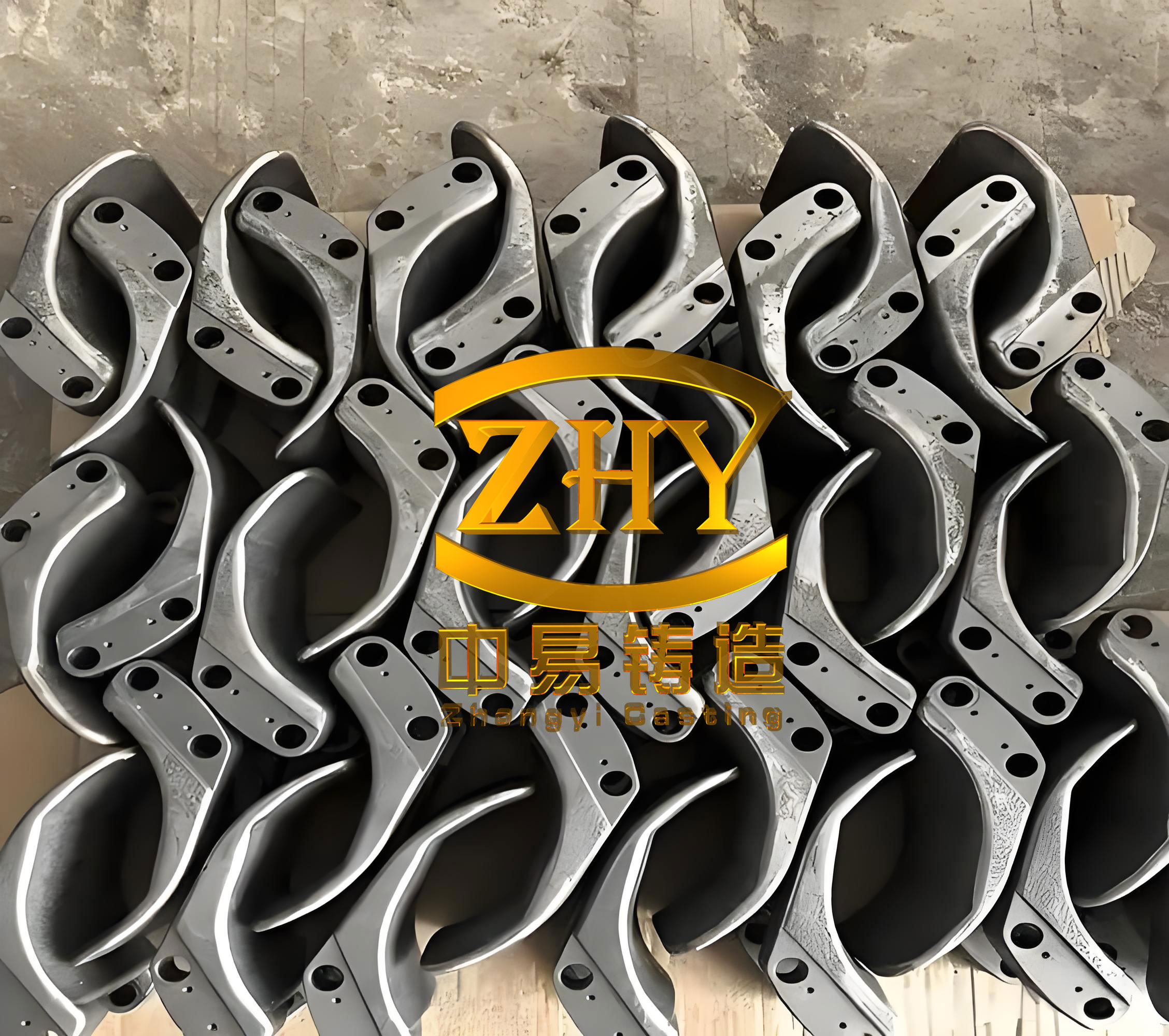
ductile cast iron derives its superior properties from the spherical graphite nodules within its matrix. However, this very graphite formation dictates a unique solidification behavior that is central to the feeding problem. Unlike white iron or steels that solidify with a well-defined, advancing solidus front (directional or skin-forming solidification), ductile cast iron undergoes a pasty or mushy solidification. In this mode, a network of solid austenite dendrites forms throughout the casting section early on, creating a semi-solid slurry in which the graphite nodules grow. This results in a long-lasting, weak solid shell with low mechanical strength during the critical feeding period.
The consequence of this pasty solidification is a small temperature gradient across the casting section. There is no clear, hot liquid channel leading back to a riser. When liquid and solidification contraction occurs, the voids form in a dispersed, inter-dendritic manner rather than concentrating in a single hot spot. These voids constitute shrinkage porosity. Furthermore, if a partially solidified shell encloses a volume where a vacuum or low pressure develops, and the shell’s strength is insufficient to resist atmospheric pressure, the surface will collapse inward, creating a surface sink. This defect is typically smooth, replicating the mold surface finish, and distinguishes itself from a blowhole by its location at thermal centers or hot spots.
The tendency towards this pasty solidification and the severity of the dispersed shrinkage are profoundly influenced by the solidification range of the iron alloy. The solidification range is the temperature interval between the liquidus (where solidification begins) and the solidus (where it completes). A wider range means the casting spends more time in a vulnerable, semi-solid state.
The width of this eutectic solidification range for ductile cast iron is not fixed; it is heavily modified by alloying elements. The most influential element in standard grades is silicon. Silicon significantly widens the temperature range over which the eutectic reaction (liquid → austenite + graphite) occurs. This relationship can be conceptually summarized. While the exact calculation is complex, the influence of silicon (Si) and carbon (C) on the critical temperatures can be approximated. The carbon equivalent (CE), which indicates the combined effect of C and Si on the eutectic point, is given by:
$$ CE = \%C + \frac{\%Si}{3} $$
A higher CE generally lowers the eutectic temperature. More precisely, silicon increases the temperature difference between the start and end of stable eutectic freezing (austenite-graphite). A wider interval directly promotes a more pasty solidification mode. The effect of key elements on the eutectic solidification process is summarized in the table below:
| Element | Effect on Eutectic Range | Consequence for Shrinkage |
|---|---|---|
| Silicon (Si) | Strongly Widens | Increases tendency for porosity & sinks |
| Carbon (C) | Moderately Widens (but primarily increases graphitization) | Can increase porosity if range widens too much, but provides expansion |
| Manganese (Mn) | Narrows | Can reduce porosity tendency, but promotes carbides |
| Phosphorus (P) | Widens | Increases porosity tendency sharply |
| Cerium (Ce) in Nodularizer | Can widen effective range via early graphitization | May increase porosity |
| Lanthanum (La) in Nodularizer | Promotes late graphitization | Decreases porosity |
Beyond widening the solidification range, silicon plays a second, equally critical role. It is a powerful graphitizer and increases the activity of carbon in the melt. In the context of ductile cast iron solidification, high silicon content promotes the early nucleation and growth of graphite nodules during the initial stages of eutectic reaction, while much of the casting is still liquid or slushy.
This early graphite expansion is largely ineffective for feeding because the interconnected liquid channels and the open gates/riser necks allow the expanded volume to simply push liquid metal back into the gating system. It is “lost expansion.” Consequently, by the time the casting reaches the final stage of solidification—where isolated liquid pools are surrounded by a rigid austenite-graphite skeleton and effective feeding is crucial—the reservoir of carbon available for late-stage graphite precipitation is diminished. The graphitization expansion pressure $P_{exp}$ available at this critical juncture can be conceptually related to the rate of graphite formation:
$$ P_{exp}(t) \propto \frac{dG}{dt} $$
where $dG/dt$ is the rate of graphite growth at time $t$ during solidification. If a large fraction of $G_{total}$ forms early ($t_{early}$), the rate $dG/dt$ at the final stage ($t_{late}$) is low, resulting in insufficient $P_{exp}(t_{late})$ to compensate for the volumetric contraction of the isolated liquid, leading to shrinkage porosity or a sink. Therefore, high silicon content exacerbates shrinkage problems in two synergistic ways: by promoting a long, pasty freezing range and by shifting graphite expansion to the less useful early stage of solidification.
Given the limitations of geometrical feeding methods for small castings, the solution must be fundamentally metallurgical. The strategy is twofold: (1) Optimize the base chemistry, particularly silicon content, to control the solidification range and graphite precipitation timing, and (2) Employ a nodularizing agent that specifically promotes a favorable graphite nucleation sequence.
Controlling the silicon content is the first and most direct lever. Foundries producing low-grade, thin-wall ductile cast iron castings often increase silicon significantly (e.g., to 2.9-3.3%) to suppress chill (carbides) and ensure high ferrite content for required ductility (e.g., QT450-10). While effective for those goals, this practice inadvertently maximizes the shrinkage defect tendency. A more balanced approach is recommended: for small-to-medium section castings prone to shrinkage, aim for a lower silicon content, typically in the range of 2.5% to 2.8%, while compensating with a higher carbon content to maintain the desired carbon equivalent for microstructure control. The guiding principle is “high carbon, low silicon” within the specification limits. Carbon contributes to the vital expansion in the late stages without as severely widening the solidification range as silicon does. The target is to narrow the effective freezing range and reserve more graphitization potential for the final stage of solidification.
The second, highly effective strategy is the use of a lanthanum-based nodularizer. The choice of rare earth element in the nodularizer (typically Cerium-Ce or Lanthanum-La) has a profound impact on the solidification sequence of ductile cast iron. Traditional cerium-bearing alloys tend to promote strong, early nucleation. This results in a high count of relatively uniform-sized graphite nodules that form predominantly during the initial eutectic stage. As explained, this early expansion is wasted.
In contrast, a pure lanthanum-based nodularizer modifies the nucleation kinetics. It delays the onset of massive graphite nucleation. The resulting microstructure is characterized by a bimodal distribution: a population of larger nodules that form earlier and a very large number of extremely fine nodules that nucleate and grow late in the solidification process, precisely within the last isolated liquid pools. This delayed graphitization generates expansion pressure exactly where and when it is needed most—inside the isolated, contracting regions. The expansion pressure from this late-stage nodule growth can be modeled as counteracting the shrinkage pressure $P_{sh}$:
$$ P_{exp}(late) \approx – P_{sh} = – \frac{\beta V_{liq}}{K} $$
where $\beta$ is the volumetric shrinkage coefficient of the liquid, $V_{liq}$ is the volume of the isolated liquid pool, and $K$ is a compressibility factor. The lanthanum-induced fine nodules increase the effective $P_{exp}(late)$, helping to balance the equation and eliminate the void. Therefore, for castings where geometry and process restrict feeding, switching to a pure lanthanum nodularizer is often the most powerful single change to eliminate shrinkage porosity and surface sinks.
It is crucial to distinguish this from merely increasing graphite nodule count. Excessive inoculation or the use of elements like bismuth to dramatically increase nodule count often produces a high count of uniformly small nodules, most of which form in the early-middle stages. This “aesthetically pleasing” uniform microstructure does not provide the late-expansion benefit and can even worsen shrinkage by further exhausting carbon early in the process. The beneficial effect is uniquely tied to the specific time-distribution of graphite formation induced by lanthanum.
The following table summarizes the problem causes and the corresponding solution strategies for preventing shrinkage in small ductile cast iron castings:
| Problem Root Cause | Mechanism | Corrective Strategy | Expected Outcome |
|---|---|---|---|
| Pasty/Mushy Solidification | Low temperature gradient, weak solid shell, dispersed voids. | Promote more directional solidification where possible (chills, molding media). Use La nodularizer. | Reduces dispersion of shrinkage, consolidates it for easier feeding. |
| Wide Solidification Range | Prolonged semi-solid state, increased porosity tendency. | Lower Si content. Minimize P. Control CE with higher C, lower Si. | Narrows freezing range, shortens vulnerable period. |
| Early Graphite Expansion | Expansion wasted while gates are open; less expansion left for final feeding. | Use pure La-based nodularizer. Avoid over-inoculation. | Shifts significant graphitization to late stage, providing effective internal feeding pressure. |
| High Silicon for Ferritizing | Widens range & promotes early graphitization (see above). | Accept minimal Si for required properties. Use La nodularizer to aid ferritization. | Maintains mechanical properties while drastically reducing shrinkage risk. |
Practical examples from production underscore the effectiveness of these principles. In one case involving thin-walled QT450-10 castings produced in shell molds, persistent shrinkage porosity was observed. The initial chemistry featured a silicon content at the upper limit (approx. 3.1%). The solution was to recalibrate the chemistry toward a lower silicon (2.7%), higher carbon (3.7%) balance while maintaining a similar carbon equivalent. This single change eliminated the shrinkage defect, demonstrating that the silicon level was the primary driver.
In another instance, a foundry producing small ductile iron pipe fittings and flanges solved surface sink issues through improved gating and silicon control. However, machining often revealed subsurface shrinkage at specific junctions. The implementation of a pure lanthanum cored-wire for nodularization was the final step. This change targeted the internal feeding mechanism, and the subsurface shrinkage was completely eliminated, validating the critical role of late-stage graphitization promoted by lanthanum in ductile cast iron.
In conclusion, solving shrinkage porosity and sink defects in small ductile cast iron castings requires moving beyond traditional feeding rules. The core of the problem lies in the solidification characteristics inherent to the material. A wide eutectic freezing range, primarily driven by high silicon content, promotes a pasty mode that disperses shrinkage. More importantly, the timing of graphite expansion is paramount. Effective solutions are metallurgically focused: first, by carefully controlling the base iron chemistry to a “high-carbon, low-silicon” paradigm to manage the solidification range; and second, by employing pure lanthanum-based nodularizing agents to delay a significant portion of graphite nucleation and growth to the final stages of solidification. This combination maximizes the useful expansion pressure within isolated liquid pools, enabling internal self-feeding that compensates for contraction where risers and chills cannot. This fundamental approach provides a robust and practical methodology for producing sound, high-quality small ductile cast iron castings.