
In the manufacturing of heavy industrial machinery, the production of pressure-tight, water-cooled cast iron parts represents a significant technical challenge. My extensive experience in a foundry setting has been particularly defined by the struggle to produce leak-proof castings for critical applications, such as the socket bushings (often referred to as spherical or ball sockets) used to support the trunnion shafts in cement rotary kilns. These components are not just structural; they contain intricate internal waterways for cooling. A leak here is not a minor defect—it is a critical failure that compromises equipment function, safety, and reliability. For years, our production was plagued by an unacceptable scrap rate exceeding 30% due to water leakage, alongside a persistent stream of customer complaints regarding repaired and sub-par cast iron parts in the field. This situation demanded a fundamental re-examination of our entire casting process. The following is a detailed, first-person account of the systematic analysis undertaken to diagnose the root causes and the comprehensive engineering solutions implemented to solve the chronic leakage problem in these essential cast iron parts.
1. Defining the Problem and Its Scope
The socket bushings in question are medium-to-large cast iron parts, typically made from Grade HT200 gray iron, with weights ranging from 200 kg to over 1.5 tonnes. Their function necessitates a complex internal cavity to form the cooling water jacket, which is created using a sand core. After machining, each casting undergoes a pressure test to verify the integrity of these waterways. Failure during this test, manifested as seepage or outright leakage, was the primary failure mode. The financial impact was severe, but the damage to production schedules and technical reputation was even more costly. The problem was not sporadic; it was systemic, indicating flaws embedded in the standard operating procedure for these cast iron parts.
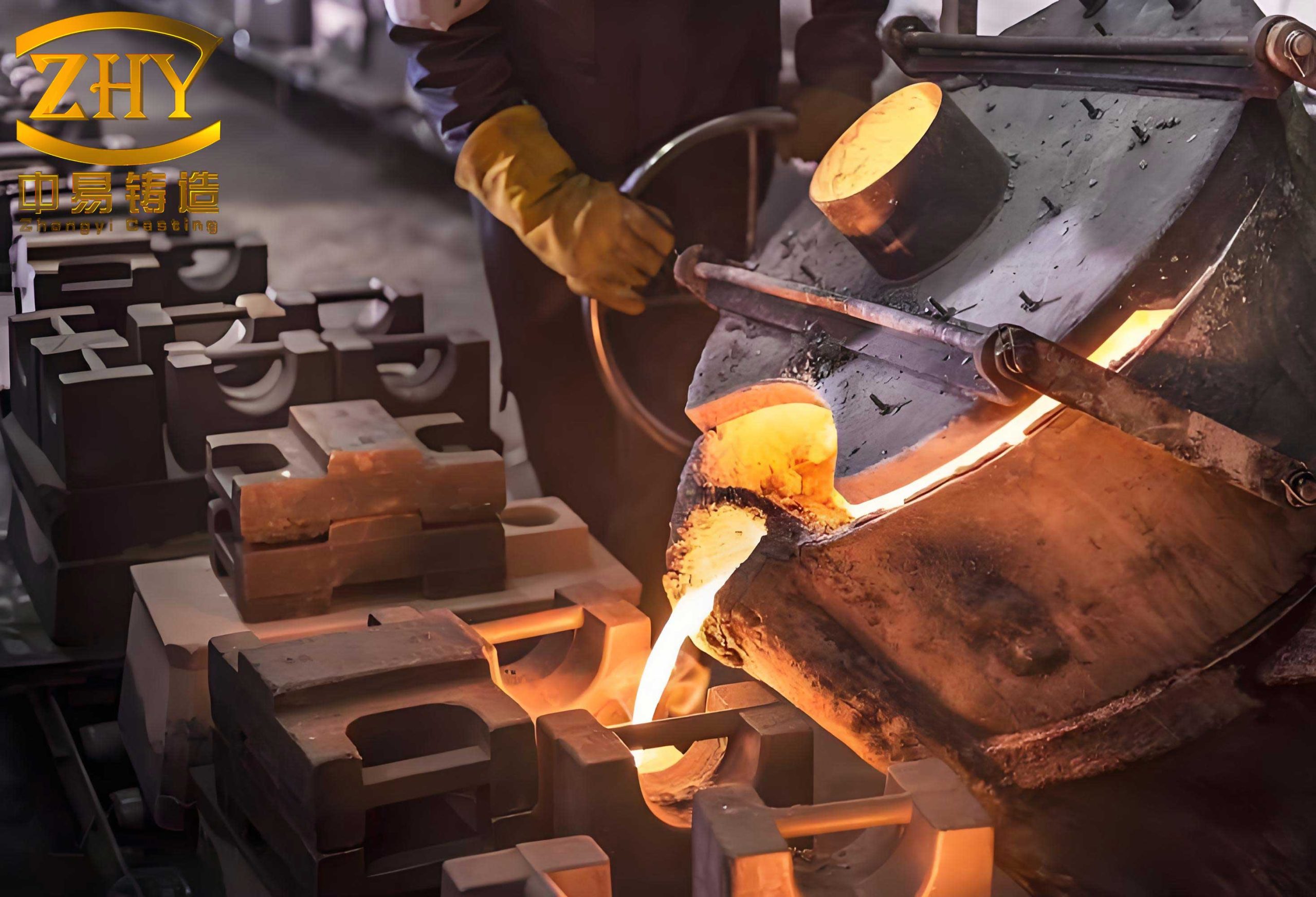
2. A Multi-Faceted Root Cause Analysis
Initial inspection of failed castings pointed to specific leakage paths. A thorough investigation revealed that the issue was not monolithic but a confluence of three major interrelated factors: core support methodology, gating and feeding system design, and metallurgical control.
2.1 The Core Support (Chaplet) Failure Mechanism
The traditional method for positioning and securing the heavy internal sand core utilized solid, 6mm diameter tin-plated mild steel rods as chaplets. The prevailing assumption was that these would partially fuse or create a metallurgical bond with the iron. However, thermal analysis proved this assumption false. The typical pouring temperature for HT200 iron is in the range of 1350°C to 1390°C. The melting point of mild steel is approximately 1550°C. Therefore, the steel rods do not melt; they remain solid. The thermal contraction differential between the solidifying iron and the steel rod creates a microscopic gap or a poorly bonded interface along the entire length of the rod. This gap forms a direct conduit for water under pressure. The leakage path can be conceptualized as a capillary network. The pressure difference ($\Delta P$) driving leakage through such a gap can be related to its geometry by a simplified form of the Hagen-Poiseuille equation for flow through a narrow channel:
$$ Q \propto \frac{w \cdot h^3 \cdot \Delta P}{12 \cdot \mu \cdot L} $$
where $Q$ is the flow rate, $w$ is the width of the gap, $h$ is its thickness (gap height), $L$ is the length of the path (rod length), and $\mu$ is the dynamic viscosity of water. Even a minute, discontinuous gap ($h$) greatly increases susceptibility to leakage, as the flow rate is proportional to the cube of the gap height.
2.2 Deficiencies in the Gating and Feeding System
The original casting layout employed a simple gating system with only four feeding risers. This design was inadequate for two key reasons related to the quality of the final cast iron parts:
1. Entrapped Gas and Slag Inclusions: The system lacked effective mechanisms to trap non-metallic inclusions (slag) or to provide dedicated, high-permeability vents for the rapid escape of gases generated from the sand core and mold. Gases from resin binders in the core, if not evacuated, become trapped at the metal-core interface, forming subsurface blowholes. These are prime sites for leakage paths upon machining. Similarly, slag trapped in the cavity can create discontinuous, porous regions.
2. Thermal Gradients and Solidification: The placement and number of risers failed to establish a controlled, directional solidification pattern towards the thermal center of the casting. Uncontrolled solidification can lead to micro-shrinkage porosity, a network of tiny cavities that are highly interconnected and permeable. According to Chvorinov’s rule, solidification time $t$ is proportional to the square of the volume-to-surface area ratio $(V/A)^2$:
$$ t = k \left( \frac{V}{A} \right)^^2 $$
Areas with a high $V/A$ ratio (like junctions) are hot spots that solidify last and are prone to shrinkage porosity if not adequately fed. The original riser configuration did not effectively address these hot spots in the complex geometry of the water jacket core.
2.3 Metallurgical and Process Control Variables
The third pillar of the problem lay in the base iron quality and process stability:
- Low Pouring Temperature: Inconsistent and often low pouring temperatures (near the lower limit of 1350°C) resulted in poor fluidity. This increased the viscosity of the iron, hindering its ability to fill thin sections of the mold cavity completely and replicate the mold surface finely, potentially worsening micro-leakage paths.
- Untreated Melt Chemistry: The iron was used in its base, un-inoculated state. Inoculation is a late-stage addition that promotes the formation of a fine, uniform type A graphite structure within a pearlitic matrix. Without it, graphite flake size can be larger and less uniform, and the matrix may contain ferrite, reducing overall density and pressure tightness.
- Mold and Core Gas Generation: The sand binder systems (especially in cores) generate large volumes of gas when contacted by hot metal. Without adequate venting from the mold itself, this gas is forced into the solidifying metal.
The interaction of these factors can be summarized in the following table, mapping causes to physical defects and final failure mode:
| Root Cause Category | Specific Flaw | Resulting Defect in Cast Iron Parts | Contribution to Leakage |
|---|---|---|---|
| Core Support | Solid steel chaplets | Mechanical gap at chaplet-iron interface | Direct, continuous leakage channel |
| Gating/Feeding Design | Inadequate venting | Subsurface blowholes, pinholes | Interconnected porosity network |
| Poor slag trapping & feeding | Slag inclusions, micro-shrinkage | Discontinuous, permeable zones | |
| Metallurgical/Process | Low pouring temperature | Poor mold filling, rough surface | Increased susceptibility to micro-leaks |
| No inoculation | Coarse graphite, non-pearlitic matrix | Lower density, reduced pressure tightness | |
| High gas generation | Gas porosity at interface | See “blowholes” above |
3. The Integrated Solution Strategy
Solving the leakage problem required a holistic, multi-pronged approach targeting all identified root causes simultaneously. The modifications were not just incremental changes but a redesign of the process for manufacturing these critical cast iron parts.
3.1 Revolutionary Change in Core Fixation: From Rigid Rods to Fusible Wires
The most critical change was the complete elimination of solid steel chaplets. They were replaced with 8-gauge (approximately 4mm diameter) black iron wire. The principle is one of controlled fusibility. The wire has a lower carbon equivalent and smaller mass than the solid rod, lowering its effective melting point. The goal was to time its melting through careful control of the thermal input:
- Stage 1 (Filling): During mold filling, the iron wire must remain solid enough to perform its function of positioning and supporting the core against flotation.
- Stage 2 (Post-Filling): Once the mold is completely filled, the latent heat in the large volume of surrounding liquid iron raises the temperature of the wire. The wire then melts and diffuses into the iron pool, dissolving completely.
The thermal energy balance for a wire segment can be approximated by considering the heat required to raise it to its melting point and then melt it, versus the heat transferred from the surrounding iron. For a wire of diameter $d_w$, length $L_w$, density $\rho_w$, specific heat $C_{p,w}$, and latent heat of fusion $L_f$, the total energy $E_{melt}$ needed is:
$$ E_{melt} = \frac{\pi d_w^2}{4} L_w \rho_w \left[ C_{p,w} (T_{melt} – T_{initial}) + L_f \right] $$
This energy must be supplied by the surrounding iron via convective heat transfer before the iron itself solidifies. By selecting a wire with appropriate properties (8-gauge iron) and ensuring a sufficiently high and consistent iron temperature, we engineered the process to guarantee this fusion, thereby eliminating the guaranteed leakage path present with solid rods.
3.2 Redesign of the Gating and Feeding System
The layout of the mold was completely revised with principles of hydraulic and thermal control in mind:
- Increased Riser Count and Strategic Placement: The number of feeding risers was increased from four to six. These were strategically positioned to promote directional solidification from the extremities of the casting back towards the risers, ensuring the water-jacket cavity region remained fed with liquid iron for the longest time to compensate for shrinkage.
- Addition of Slag Traps (Flow-Offs): Two dedicated slag traps were added at the farthest point from the main ingates, opposite the pouring cup. This utilizes the principle that slag, being less dense, will float and travel the longest distance with the metal flow, collecting in these blind pockets instead of being swept into the main cavity. The effectiveness of a trap can be related to the flow velocity; a sudden enlargement in the flow area reduces velocity and allows buoyant particles to separate, governed by Stokes’ law.
- Enhanced Venting: Permeability of the mold assembly was increased, and vent channels were explicitly designed to allow gases from the core to escape directly to the atmosphere rather than into the metal.
3.3 Metallurgical and Process Optimization
To support the mechanical and design changes, the iron chemistry and handling were refined:
- Controlled Low Carbon Equivalent (CE): The charge makeup was adjusted to target a slightly lower CE to promote a pearlitic matrix and finer graphite formation. The Carbon Equivalent is calculated as: $$ CE = \%C + \frac{\%Si + \%P}{3} $$ A lower CE increases the fraction of primary austenite, leading to a finer eutectic cell structure upon solidification.
- Manganese Adjustment: Manganese content was controlled to around 0.8% to stabilize pearlite and increase strength.
- Temperature Management: Furnace and ladle pre-heating practices were improved. The target pouring temperature range was raised and strictly controlled to 1380°C – 1400°C. This ensured excellent fluidity (critical for thin-wall sections of the water jacket) and provided the necessary superheat to guarantee the fusion of the iron wire chaplets. The fluidity length $L_f$ is exponentially related to superheat: $$ L_f \propto \exp\left(\frac{-Q}{R(T_{pour} – T_{liquidus})}\right) $$ where $Q$ is an activation energy and $R$ is the gas constant.
- Inoculation: A late-stream inoculation treatment was introduced using a FeSi-based inoculant. This created a multitude of nucleation sites for graphite, resulting in a uniform, fine type A graphite distribution in a predominantly pearlitic matrix, significantly enhancing the pressure tightness and mechanical properties of the finished cast iron parts.
The new, optimized process parameters are contrasted with the old ones below:
| Process Parameter | Old Method | New, Optimized Method | Impact on Cast Iron Parts Quality |
|---|---|---|---|
| Core Support | 6mm Solid Steel Rods | 8-Gauge Fusible Iron Wire | Eliminates mechanical leakage interface. |
| Riser Number | 4 | 6 | Improves feeding, reduces shrinkage porosity. |
| Slag Control | None | 2 Dedicated Slag Traps | Removes inclusions from critical cavity areas. |
| Pouring Temp. | 1350°C – 1390°C | 1380°C – 1400°C (min.) | Ensures fluidity and wire fusion. |
| Inoculation | None | FeSi Late-Stream Treatment | Refines graphite, improves density & tightness. |
| Key Mn Level | Variable | Controlled ~0.8% | Promotes pearlitic, strong matrix. |
4. Results and Long-Term Performance
The implementation of this integrated solution package yielded transformative results. Over a multi-year period following the changes, the production of over 1000 socket bushings of various sizes was tracked.
Quality Leap: The scrap rate due to water leakage plummeted from over 30% to a mere 0.4% (4 pieces out of 1000+). Pressure testing became a formality of verification rather than a stressful screening process. The need for risky and often unreliable welding repairs was virtually eliminated.
Economic Impact: The financial saving was direct and substantial. For a production volume of approximately 700 tonnes of these cast iron parts, avoiding the previous 30% scrap rate meant saving 210 tonnes of castings from being scrapped. At a conservative internal cost, this represented annual savings well into six figures. More importantly, it eliminated the massive hidden costs of delayed assembly, expedited shipping, and field service for repairs.
Reputational Recovery: Customer complaints regarding leaking socket bushings ceased. The reliability of the machinery was restored, reinforcing trust in the manufacturing quality of all our heavy-duty cast iron parts.
5. Conclusion and Broader Implications
The journey to solve the leakage problem in these critical water-cooled cast iron parts was a powerful lesson in systems thinking. It demonstrated that a chronic quality issue is rarely due to a single cause but is the symptom of multiple, interacting process deficiencies. The successful resolution hinged on:
- Rejecting Tradition with Science: Replacing the “standard” solid chaplet with a fusible wire was a paradigm shift, directly attacking the primary leakage path through fundamental thermal principles.
- Holistic Design: Treating the mold as an integrated hydraulic and thermal system, optimizing it for clean metal flow, effective slag removal, gas venting, and controlled solidification.
- Metallurgical Precision: Recognizing that the inherent properties of the iron matrix are foundational to leak-tightness and controlling chemistry, temperature, and nucleation to achieve a dense, homogeneous microstructure.
The principles derived from this experience—fusible core supports for critical cavities, proactive gas and slag management, and tight metallurgical control—are not limited to socket bushings. They form a robust framework for producing any complex, pressure-tight cast iron parts, from pump housings and valve bodies to hydraulic manifolds. The solution underscores that in foundry engineering, significant gains in quality and reliability are achieved not by chance but through a deliberate, analytical, and integrated approach to process design and control.