
In my experience as a casting engineer, the pursuit of high-integrity aluminum components for automotive and aerospace applications has driven significant innovation in metal forming processes. Among these, squeeze casting stands out as a technique that bridges the gap between conventional high-pressure die casting and gravity casting, offering a unique combination of dense microstructure and excellent mechanical properties. However, the widespread adoption of squeeze casting has been hampered by a recurring issue: the prevalence of various metal casting defects when process parameters are not meticulously controlled. This article, drawn from extensive practical and theoretical investigation, aims to elucidate the fundamental principles of squeeze casting and provide a detailed analysis of the root causes for its associated metal casting defects. I will emphasize the critical interplay between process dynamics and defect formation, offering insights and quantitative models to guide successful implementation.
The core principle of squeeze casting, as I understand and have applied it, involves the controlled filling of a die cavity with molten metal at a relatively low velocity, followed by the application of intense pressure during solidification. Unlike turbulent high-pressure die casting, the goal here is laminar flow. The metal is pushed into the die with a large volumetric flow rate but at a speed typically between 0.5 to 3 m/s. This minimizes air entrapment and oxide formation during filling. The decisive moment occurs immediately after the cavity is completely filled. Within a timeframe of 50 to 150 milliseconds, the pressure on the metal must be rapidly increased—or “squeezed”—to a high specific pressure, often in the range of 60 to 100 MPa. This instantaneous pressurization forces the metal to replicate the die surface with high fidelity and, most importantly, suppresses the formation of shrinkage porosity and gas-related voids by feeding the solidifying metal under extreme pressure. The entire process can be conceptually summarized by two key equations governing flow and pressure.
The velocity of the metal at the ingate, a critical parameter for avoiding turbulence, is determined by the piston motion in the shot sleeve or chamber:
$$ V_1 = \frac{S_0 \cdot V_0}{S_1} $$
where \( V_1 \) is the metal velocity at the ingate, \( S_0 \) is the cross-sectional area of the shot sleeve piston, \( V_0 \) is the piston velocity, and \( S_1 \) is the cross-sectional area of the ingate. The nominal specific casting pressure, often used for machine specification, is given by:
$$ P_0 = \frac{F_0}{S_0} $$
where \( P_0 \) is the nominal specific pressure and \( F_0 \) is the maximum force exerted by the machine’s main cylinder. However, I must stress that the most critical factor is not this nominal pressure, but the actual effective pressure at the farthest and most vulnerable sections of the casting at the moment of their solidification. A significant pressure drop occurs due to friction, geometrical constraints, and, crucially, the premature solidification of narrow sections that can block pressure transmission.
The characteristics of an ideal squeeze casting process are distinct. It is best suited for components with moderate to thick sections, typically between 10 to 50 mm, and of limited overall size to ensure effective pressure transmission. The ingate must be large and is strategically placed at the thickest section of the part, acting as a pressure-feeding source. The use of a release agent, rather than an insulating coating, results in very high cooling rates—often 3 to 5 times that of gravity permanent mold casting (approximately 300–400 °C/s). This rapid cooling, combined with the high pressure, yields a very fine-grained structure with superior mechanical properties, particularly elongation, and allows the casting to be subsequently heat-treated.
| Parameter | Symbol | Typical Range | Influence on Metal Casting Defects |
|---|---|---|---|
| Piston Velocity | \( V_0 \) | 0.05 – 1.5 m/s | Controls filling turbulence; too high causes air entrapment. |
| Ingate Metal Velocity | \( V_1 \) | 0.5 – 3.0 m/s | Ensures laminar fill; too low may cause cold shuts. |
| Nominal Specific Pressure | \( P_0 \) | 60 – 100 MPa | Target for suppression of shrinkage defects. |
| Pressurization Delay Time | \( t_d \) | < 150 ms | Critical for effective feeding; delay leads to shrinkage and gas defects. |
| Shot Sleeve Diameter | \( D_0 \) | Design-dependent | Directly affects \( P_0 \) and \( V_1 \); improper size leads to pressure loss. |
Despite its theoretical advantages, the production floor often reveals a different story, marked by persistent metal casting defects. The most common issues I have encountered are surface blisters, cold shuts, shrinkage cracks, and internal porosity. Each of these metal casting defects is intimately tied to a deviation from the fundamental squeeze casting principle, particularly the loss of effective pressure or improper timing.
Surface blisters, often appearing as small raised bumps on the casting surface, are a particularly vexing metal casting defect. A common misconception is that they are solely caused by entrapped air from turbulent filling. While that can be a factor, in squeeze casting with its slower fill, the primary source is often the decomposition of the organic compounds in the die release agent. When molten metal at approximately 600–700 °C contacts the die surface coated with release agent (containing oils, waxes, and emulsifiers), these compounds rapidly vaporize and decompose. If the actual pressure at the metal-meniscus interface at that exact moment is low—because the intensification phase has not yet begun or pressure has been lost over a long flow path—these gases can infiltrate the still-soft surface layer of the casting. This forms subsurface bubbles that expand and become visible blisters, especially during subsequent heat treatment. The condition for blister formation can be conceptually framed as a pressure imbalance:
$$ P_{\text{gas}} > P_{\text{metal}} + \sigma / r $$
where \( P_{\text{gas}} \) is the pressure of the decomposing agent gases, \( P_{\text{metal}} \) is the local metal pressure, \( \sigma \) is the surface tension, and \( r \) is the pore radius. If the local metal pressure is insufficient, the gas pressure dominates and forms a blister. Therefore, this metal casting defect is fundamentally a pressure-dependent phenomenon.
Cold shuts, another common metal casting defect, manifest as seams or folds on the casting surface where two fluid fronts meet but fail to fuse completely. In squeeze casting, this is rarely due to excessively low metal temperature alone. More frequently, it results from the metal fronts meeting with insufficient kinetic energy and, again, under inadequate pressure. As the metal flows through thin sections over long distances, its temperature drops, and viscosity increases. When two such sluggish streams converge, they require significant pressure to weld together metallurgically. If the actual effective pressure at that remote location is minimal, the oxide films on the streams are not broken, and a cold shut—a clear metal casting defect—is formed. The driving force for fusion is the applied pressure, which must overcome the viscous resistance and oxide barrier.
The third major category of metal casting defects in squeeze casting relates directly to solidification shrinkage: namely, shrinkage porosity and hot tears (or shrinkage cracks). These defects occur when the feeding of liquid metal to compensate for volumetric contraction during solidification is interrupted. Even with the nominal high pressure \( P_0 \), if the pressure transmission path is blocked by prematurely solidified sections (like thin ribs or webs), isolated liquid pools will solidify under near-atmospheric pressure, leading to micro-shrinkage. In more severe cases, particularly in regions with high thermal stress concentration, the lack of liquid feed pressure can lead to the formation of shrinkage cracks. This is a tensile failure of the partially solidified mush when it is pulled apart by solidification contraction stress that is not compensated by incoming liquid. The condition for avoiding this metal casting defect can be expressed by ensuring the pressure gradient across the mushy zone is sufficient to drive feeding:
$$ \nabla P \geq \frac{\mu}{K} v_L $$
where \( \nabla P \) is the pressure gradient, \( \mu \) is the liquid viscosity, \( K \) is the permeability of the mushy zone, and \( v_L \) is the feeding velocity required. If the applied pressure at the ingate cannot sustain this gradient to the solidifying region, shrinkage defects form.
| Metal Casting Defect | Typical Appearance | Primary Root Cause | Key Pressure-Related Factor |
|---|---|---|---|
| Surface Blister | Subsurface bubble breaking surface | Decomposing die lubricant gases | Local metal pressure \( P_{\text{metal}} \) too low at die-metal interface during fill/pressurization. |
| Cold Shut | Visible seam or fold on surface | Poor fusion of meeting metal streams | Insufficient kinetic energy and pressure at confluence point to break oxide films. |
| Shrinkage Porosity | Internal or near-surface spongy holes | Inadequate feeding during solidification | Effective feeding pressure \( P_{\text{effective}} \) at solidification front drops to near zero. |
| Shrinkage Crack (Hot Tear) | Intergranular crack in stress-concentration zone | Tensile stress in mushy zone exceeding strength | Lack of liquid pressure to compensate contraction stress; \( \nabla P \) insufficient. |
My analysis of numerous production failures, particularly in components like motorcycle wheels, consistently points to a systemic issue: the drastic decay of specific pressure from the shot sleeve to the extremities of the casting. For a wheel cast from the center hub, the metal must travel through thin spokes to reach the rim. The spokes solidify quickly, acting as a barrier that isolates the rim from the pressure source. If the machine’s intensification system is slow—taking several seconds to reach full pressure instead of the required fraction of a second—the rim solidifies under negligible pressure. This scenario perfectly combines the conditions for both blister and cold shut formation, explaining why these metal casting defects cluster in the rim area. Conversely, if the wheel is gated from the rim, the hub becomes the vulnerable area, suffering from the same metal casting defects due to pressure loss over distance.
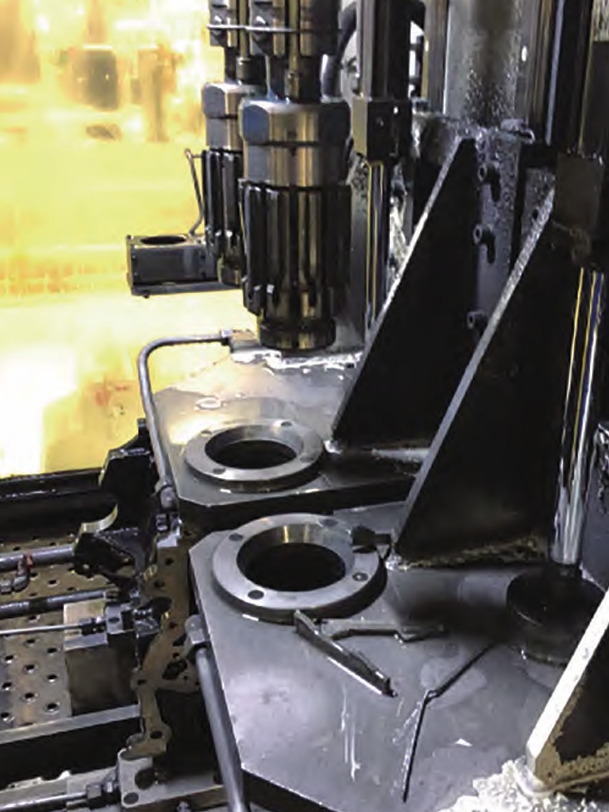
To mitigate these pervasive metal casting defects, the design of the pressure transmission system itself must be optimized. A critical element is the shot sleeve or pressure chamber design. A conventional straight sleeve can lead to significant heat loss and premature solidification of a thick skin around the piston, severely hindering pressure transmission. Based on my work, I recommend and have successfully implemented a modified chamber design with an integrated “feeder head” or enlargement at the top. This design serves multiple functions: it acts as a reservoir for the cooler, solidified metal skin and any lubricant residue from the piston, preventing them from being pushed into the casting; it helps maintain a central liquid channel for longer, ensuring that hydraulic pressure from the piston is transmitted efficiently to the casting cavity; and it allows for the use of a slightly smaller piston diameter for the same casting volume, thereby increasing the nominal specific pressure \( P_0 \) for a given machine force \( F_0 \). The pressure transmission efficiency \( \eta_P \) of such a system can be conceptually higher:
$$ \eta_P = \frac{P_{\text{casting, far}}}{P_0} $$
where a well-designed chamber with a feeder head aims to maximize \( \eta_P \), bringing the actual pressure at the far end of the casting \( P_{\text{casting, far}} \) closer to the nominal pressure \( P_0 \).
Furthermore, the machine capability is paramount. Many failures stem from using modified hydraulic presses that lack true instantaneous intensification. A proper squeeze casting machine must have a fast-response intensification system, often using accumulators, that can sense cavity fill (via a pressure switch or position sensor) and ramp the main cylinder pressure to its maximum within 100-200 ms. The time-pressure profile is as important as the peak pressure value. A delay \( t_d \) in pressurization allows the metal temperature to drop and thin sections to solidify, sealing off pressure paths and directly leading to the metal casting defects discussed. The required intensification rate \( \dot{P} \) can be estimated:
$$ \dot{P} = \frac{P_0 – P_{\text{fill}}}{t_d} $$
where \( P_{\text{fill}} \) is the pressure at the moment of complete fill, and \( t_d \) is the allowed delay. This rate must be very high, often requiring specialized hydraulic circuits.
Material selection also interacts with defect formation. While common casting alloys like A356 or ADC12 are used, their solidification ranges and hot tear susceptibilities differ. A long freezing range alloy might be more prone to dispersed microporosity if pressure is marginally low, while a short freezing range alloy might be more susceptible to hot tearing in constrained sections. Therefore, process optimization to eliminate metal casting defects must be alloy-specific. The famous Niyama criterion for predicting shrinkage porosity, often used in simulation, can be adapted to include the applied pressure term:
$$ G / \sqrt{\dot{T}} \geq C \cdot \frac{1}{\sqrt{P_{\text{applied}}}} $$
where \( G \) is the temperature gradient, \( \dot{T} \) is the cooling rate, \( C \) is a constant, and \( P_{\text{applied}} \) is the local applied pressure. This illustrates how increasing pressure directly shifts the condition away from defect formation.
In conclusion, the successful implementation of squeeze casting hinges on a deep understanding of its core principle: controlled laminar filling followed by instantaneous, high-magnitude pressurization. The majority of metal casting defects encountered—surface blisters, cold shuts, shrinkage porosity, and hot tears—are not random occurrences but direct consequences of violating this principle, primarily through inadequate or ill-timed effective pressure at the solidification front. Each metal casting defect has a pressure-related mechanism, whether it is failing to suppress gas invasion from die lubricants, failing to fuse metal streams, or failing to feed shrinkage. To combat these metal casting defects, a systems approach is necessary, encompassing optimal shot chamber design to maintain a liquid pressure column, machine modifications to guarantee rapid intensification, and careful gating to minimize pressure transmission distance. By rigorously applying these principles, squeeze casting can reliably produce high-integrity, heat-treatable castings virtually free from these debilitating metal casting defects, fulfilling its promise as a premier net-shape forming technology for critical applications.