
In the field of mechanical engineering, the production of reducer housings plays a critical role in ensuring the performance and durability of machinery. As a key component, reducer housings require high dimensional accuracy, excellent surface quality, and robust internal structures to support gears and bearings. Traditional casting methods often face challenges such as porosity, inclusions, and inefficiencies. In this context, lost foam casting has emerged as an advanced technique that addresses these issues. This process involves using foam patterns that vaporize under negative pressure, allowing molten metal to fill the mold precisely. In this article, I will explore the principles, applications, and impacts of lost foam casting in reducer housing production, incorporating tables and formulas to summarize key aspects. The term “lost foam casting” will be frequently highlighted to emphasize its relevance.
The lost foam casting process operates on the principle of applying negative pressure above the mold to rapidly decompose the foam pattern during metal pouring. This eliminates the need for complex sand molds and reduces defects like gas holes and shrinkage. The basic mechanism can be described by the pressure differential equation: $$\Delta P = P_{\text{atm}} – P_{\text{vacuum}}$$ where $\Delta P$ is the pressure difference driving the foam decomposition, $P_{\text{atm}}$ is atmospheric pressure, and $P_{\text{vacuum}}$ is the vacuum pressure applied. This equation illustrates how negative pressure enhances mold filling and reduces voids. A key advantage of lost foam casting is its ability to achieve near-net-shape casting, minimizing machining allowances and improving material utilization. Compared to conventional sand casting, lost foam casting offers shorter production cycles and higher efficiency, making it suitable for mass production. For instance, the foam pattern, typically made of expandable polystyrene (EPS), decomposes into gaseous products that are evacuated, ensuring a clean casting surface. The table below summarizes the main characteristics of lost foam casting:
| Feature | Description | Impact on Casting |
|---|---|---|
| Negative Pressure Application | Vacuum is applied to remove air from the mold cavity. | Reduces porosity and improves surface finish. |
| Foam Pattern Decomposition | EPS pattern vaporizes upon contact with molten metal. | Enables precise mold filling and dimensional accuracy. |
| No Riser Required | Eliminates the need for feeding systems like risers. | Lowers material waste and production cost. |
| Process Efficiency | Automation-friendly with quick cycle times. | Increases productivity for high-volume orders. |
When comparing lost foam casting to other methods, such as sand casting or investment casting, the benefits become evident. For example, the absence of binders and core-making steps in lost foam casting reduces environmental pollution and simplifies the workflow. The heat transfer during foam decomposition can be modeled using the Fourier heat equation: $$\frac{\partial T}{\partial t} = \alpha \nabla^2 T$$ where $T$ is temperature, $t$ is time, and $\alpha$ is thermal diffusivity. This governs how the foam pattern absorbs heat and decomposes uniformly. Overall, lost foam casting stands out for its ability to produce complex geometries with minimal post-processing, which is crucial for reducer housings that often feature intricate internal passages.
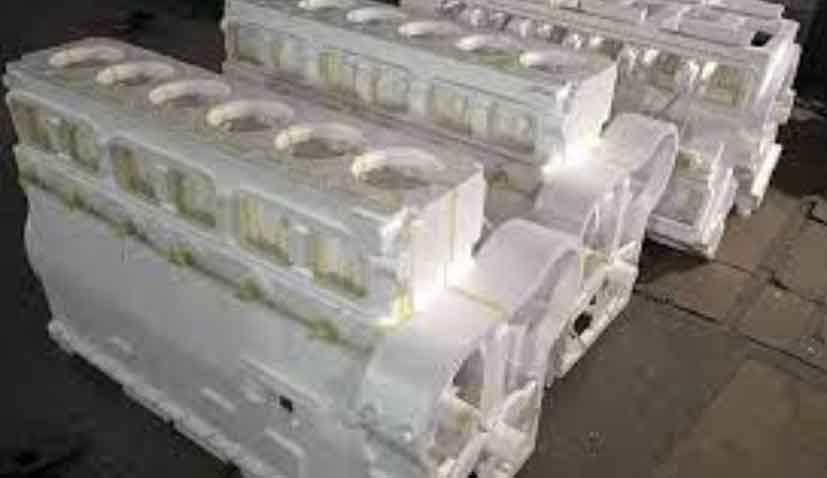
In reducer housing production, the structural requirements demand high precision and strength. Reducer housings typically consist of hollow cylindrical or conical shapes with internal mounts for gears and bearings. The application of lost foam casting begins with mold design, where computer-aided design (CAD) software is used to create patterns that match the housing geometry. The foam patterns are then fabricated, often through molding processes that expand EPS beads into the desired shape. During casting, the pattern is coated with a refractory material to enhance stability and prevent metal penetration. The coated pattern is placed in a flask, and unbonded sand is compacted around it. Negative pressure is applied via vacuum pumps, and molten metal—such as cast iron or aluminum alloys—is poured. The foam decomposes, and the metal takes its place, resulting in a precise casting. Key parameters must be controlled to optimize the lost foam casting process for reducer housings. These include pouring temperature, pouring rate, and vacuum level, as summarized in the table below:
| Parameter | Optimal Range | Effect on Quality | Mathematical Relation |
|---|---|---|---|
| Pouring Temperature | 700–750°C for aluminum; 1350–1400°C for cast iron | Influences fluidity and solidification structure; too high causes oxidation, too low leads to misruns. | $$T_p = T_m + \Delta T_{\text{superheat}}$$ where $T_m$ is melting point. |
| Pouring Rate | 0.5–2.0 kg/s | Affects mold filling and defect formation; slow rate may cause cold shuts, fast rate can entrap gas. | $$Q = \frac{m}{\rho t}$$ where $Q$ is volumetric flow rate, $m$ is mass, $\rho$ is density, $t$ is time. |
| Vacuum Pressure | 0.04–0.06 MPa | Ensures complete foam decomposition and reduces porosity; insufficient vacuum leads to residual foam. | $$P_{\text{vac}} = P_{\text{atm}} – \rho g h$$ where $h$ is head height of metal. |
The impact of lost foam casting on reducer housing quality is profound. By minimizing gas entrapment and inclusions, the process enhances the density and mechanical properties of the castings. For instance, the yield strength $\sigma_y$ and fatigue life $N_f$ can be improved, as described by the relation: $$\sigma_y = \sigma_0 + k d^{-1/2}$$ where $\sigma_0$ is the base strength, $k$ is a material constant, and $d$ is the grain size refined through controlled solidification. Additionally, the absence of risers reduces machining allowances, leading to cost savings and shorter lead times. In terms of production efficiency, lost foam casting eliminates the need for core-making and mold assembly, cutting down the overall cycle time by up to 30% compared to sand casting. The automation potential further boosts throughput, making it ideal for large-scale orders. From an economic perspective, the reduction in material waste and energy consumption lowers the total cost per unit. Environmental benefits include decreased emissions and waste generation, as the sand used in lost foam casting can be recycled, and the foam patterns are less harmful than traditional binders.
Despite its advantages, lost foam casting faces challenges in reducer housing production. One major issue is mold sealing; any leakage can compromise the vacuum and lead to defects. To address this, I recommend improving mold design with high-precision machining and using sealing materials that withstand thermal cycles. Another problem is the cost and environmental impact of foam patterns. Research into biodegradable foams, such as those derived from starch-based polymers, can mitigate this. Additionally, controlling process parameters requires sophisticated monitoring systems. Implementing sensors for real-time feedback on temperature and pressure can enhance consistency. The table below outlines common problems and solutions:
| Problem | Cause | Solution | Expected Outcome |
|---|---|---|---|
| Mold Leakage | Poor sealing or wear in mold components. | Use of advanced gaskets and regular maintenance. | Stable vacuum pressure and reduced defect rate. |
| Foam Pattern Cost | High material and fabrication expenses. | Develop eco-friendly, low-cost alternatives. | Lower production cost and environmental footprint. |
| Parameter Variability | Inconsistent pouring or vacuum conditions. | Automate control with PLC systems. | Improved repeatability and quality assurance. |
The future of lost foam casting in reducer housing production is promising, driven by technological advancements. In terms of technology, innovations in 3D printing of foam patterns allow for rapid prototyping and customization. The integration of artificial intelligence for process optimization can further enhance quality control. Market trends indicate growing demand for lightweight and high-performance components, which aligns with the strengths of lost foam casting. For example, the global push for energy-efficient machinery favors processes that reduce weight and improve durability. Environmentally, regulations on emissions and waste are pushing manufacturers to adopt greener methods. Lost foam casting, with its potential for using recyclable materials and reducing energy consumption, fits well into circular economy models. The evolution of this process can be modeled using growth equations, such as: $$A(t) = A_0 e^{kt}$$ where $A(t)$ is the adoption rate of lost foam casting over time $t$, $A_0$ is the initial adoption, and $k$ is the growth constant influenced by technological and regulatory factors.
In conclusion, the application of lost foam casting in reducer housing production offers significant benefits in quality, efficiency, and sustainability. By leveraging negative pressure and foam decomposition, this process achieves high-precision castings with minimal defects. However, challenges like mold sealing and material costs require ongoing research and development. As technology progresses, lost foam casting is poised to become a dominant method in the casting industry, particularly for complex components like reducer housings. The repeated emphasis on “lost foam casting” throughout this discussion underscores its transformative potential, and I believe that with continued innovation, it will play a crucial role in advancing manufacturing practices worldwide.