
In the production of critical components like piston rings, especially for demanding applications such as motorcycles, the shift towards nodular (ductile) iron presents a significant technological challenge. My experience has shown that while the material offers superior mechanical properties, its inherent solidification behavior makes it exceptionally prone to a range of casting defects. These defects, including subsurface pinholes, shrinkage porosity, slag inclusions, and inverse chill, critically undermine the performance and reliability of the final product. This article synthesizes my findings and the practical measures developed to mitigate these issues, focusing on the underlying mechanisms and actionable process controls.
The fundamental challenge lies in the unique solidification characteristic of nodular iron, often described as a “pasty” or “mushy” mode. Unlike gray iron, which solidifies in a more directional manner, nodular iron undergoes eutectic solidification over a much wider temperature range. After inoculation and treatment, graphite nodules begin to form within the liquid. As the temperature drops into the eutectic range, an austenite shell encapsulates each graphite nodule. Carbon must now diffuse through this solid shell for the nodule to grow, a process considerably slower than diffusion in liquid. This leads to a scenario where a vast number of graphite-austenite eutectic cells nucleate simultaneously throughout the casting cross-section. Long before the surface is completely solid, the interior is already a interconnected network of solidifying cells, trapping isolated liquid pools. This “pasty” state prematurely blocks channels for liquid feeding and gas escape, which is the root cause of its pronounced susceptibility to various casting defects. A comparison of cooling curves clearly illustrates this: gray iron shows a distinct, relatively flat eutectic plateau, while nodular iron exhibits a prolonged, sloping temperature drop with no clear endpoint, indicative of its broad solidification range.
1. Subsurface Pinholes (Blowholes)
This is one of the most prevalent and troublesome casting defects in nodular iron casting. The pinholes typically appear just beneath the casting surface (0.1–1.0 mm) and are exposed during machining. They are spherical or elongated and primarily consist of hydrogen gas.
Formation Mechanism:
The formation is a complex physico-chemical process involving gas from both internal and external sources. Key reactions involve magnesium, a vital element for nodularization:
- Internal Hydrogen: Originates from moisture in charge materials, rusty scrap steel, or improperly dried ladles, treatment alloys, and furnace linings. Water decomposes at high temperatures: $$ \text{H}_2\text{O} \rightarrow 2\text{H} + \text{O} $$
- External Hydrogen (Mold-Metal Reaction): This is critical. During pouring, magnesium vapor reacts with moisture in the green sand mold:
$$ \text{Mg} + \text{H}_2\text{O} \rightarrow \text{MgO} + \text{H}_2 $$
Magnesium also acts as a catalyst for the reaction between carbon and water:
$$ \text{C} + \text{H}_2\text{O} \rightarrow \text{CO} + \text{H}_2 $$ - Oxide Film Barrier: Magnesium promotes the formation of a dense, superficial oxide film on the iron melt. This film increases the interfacial pressure at the mold-metal boundary, hindering the escape of evolved gases. As the surface layer solidifies, the trapped hydrogen forms subsurface pinholes.
Preventive Process Measures:
Combating this casting defect requires a multi-pronged approach targeting gas sources and escape conditions.
| Process Parameter | Target/Control Range | Rationale & Effect |
|---|---|---|
| Mold Sand Moisture | Cylinder Casting: 3.8–4.2% Individual Ring: ≤4.5% |
Minimizes the amount of moisture available for the mold-metal reaction, directly reducing hydrogen generation. |
| Mold Sand Permeability | >90 units (Cylinder) >80 units (Ring) |
Provides easier pathways for generated gases to escape through the mold before being trapped by the solidifying metal. |
| Material & Tool Drying | Alloys, ladles, linings baked >600°C | Eliminates inherent moisture, preventing internal hydrogen introduction. |
| Residual Mg Content | 0.03–0.05% (minimum for nodularity) | Higher Mg raises the oxide film formation temperature, worsening gas entrapment. Minimizing residual Mg within the nodularization window is crucial. |
| Pouring Temperature | ≥ 1380°C | A high temperature lowers melt viscosity, extends liquid state duration for gas floatation, and is often below the oxide film formation temperature for lower-Mg melts. |
| Gating System Design | Open, non-turbulent filling | Reduces melt oxidation and agglomeration of the oxide film, facilitating calm mold filling. |
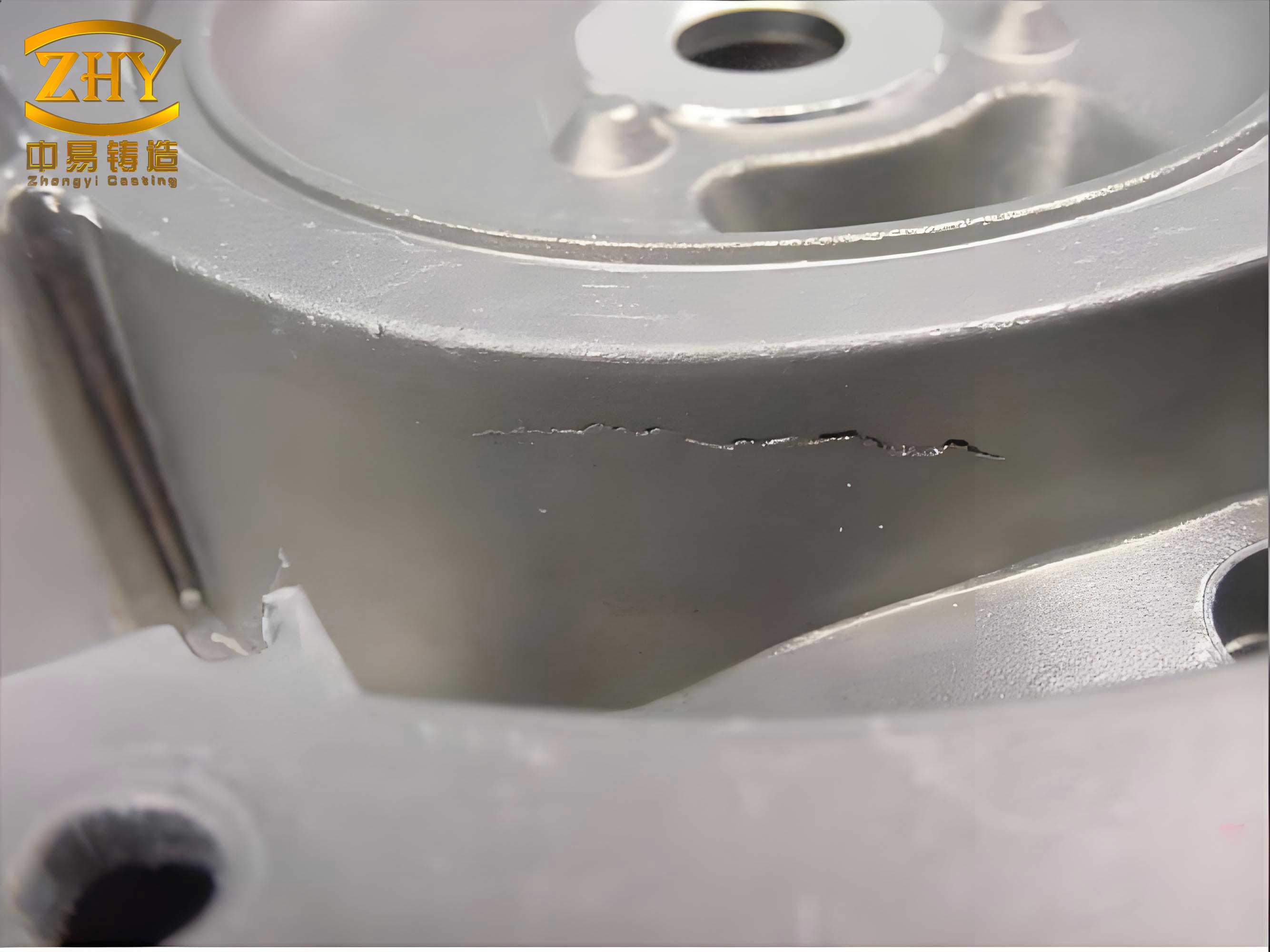
2. Shrinkage Porosity
This casting defect manifests as dispersed, interconnected micro-porosity, often found in the thermal centers of castings. It is a direct consequence of the pasty solidification mode hindering effective feeding.
Formation Mechanism:
The volumetric changes during solidification are: Liquid Contraction → Graphite Expansion (Eutectic) → Secondary (Post-Eutectic) Contraction. In nodular iron, when the expanding graphite-austenite cells impinge on each other, they generate an internal expansion pressure. If the mold has insufficient rigidity, the mold wall yields, causing the casting to swell outward. This enlarges the microscopic gaps between the cells. Crucially, by this late stage in solidification, the channels between these isolated liquid pools are already blocked. The graphite expansion can no longer compensate for the secondary contraction occurring in these isolated regions, resulting in shrinkage porosity. The lack of a sound, rigid skin during the entire solidification process is the enabling factor for this defect.
Preventive Process Measures:
The strategy shifts from relying on external feeders (ineffective in pasty solidification) to promoting internal self-feeding via controlled expansion.
| Process Parameter | Target/Control Range | Rationale & Effect |
|---|---|---|
| Mold Hardness / Rigidity | Machine Molding: 85-90 units Hand Molding: >75 units (proper ramming) |
Creates a rigid mold wall that resists the expansion pressure, forcing it inward to compress and feed the still-solidifying interior liquid pools (self-feeding). |
| Effective Inoculation | Strong, late inoculation (e.g., Stream inoculation) | Increases graphite nodule count, promoting a more uniform and earlier onset of graphite expansion to counteract contraction forces. |
| Residual Mg & Rare Earth (RE) | Minimize within specification limits | High levels of these elements can promote carbides and reduce the amount of graphite precipitated, thereby reducing the beneficial expansion effect. |
| Pouring Temperature | Optimized high temperature (~1380-1420°C) | Brings more sensible heat, delays solidification start, allowing better temperature gradient management and longer time for liquid flow within the dendrite network. |
| Chemical Composition (C.E.) | Hyper-eutectic (C.E. ~ 4.5-4.7) | Promotes earlier and more abundant graphite precipitation during solidification, enhancing the expansion phase. |
3. Slag Inclusions (Dross)
These casting defects appear as non-metallic, often macroscopic, imperfections on or near the casting surface. They are complex mixtures of oxides, sulfides, and silicates.
Formation Mechanism:
Slag primarily forms from post-treatment reactions and re-oxidation:
- Primary Slag: During treatment, Mg and RE react violently with sulfur and oxygen in the melt, forming MgS, MgO, RE-oxides, and complex silicates (e.g., $2\text{Mg} + \text{SiO}_2 \rightarrow 2\text{MgO} + \text{Si}$ forming Mg-silicates). If not thoroughly skimmed, this slag is entrained.
- Secondary (Oxide Film) Slag: The reactive Mg creates a viscous, continuous oxide film on the melt surface. During transfer, pouring, and turbulence in the mold, this film breaks into fragments. Being less dense, they float up, collecting at the casting surface. They also act as scavengers, adsorbing fine sulfide particles suspended in the melt.
Preventive Process Measures:
Control focuses on minimizing slag formation and promoting its removal before mold filling.
| Process Parameter | Target/Control Range | Rationale & Effect |
|---|---|---|
| Base Iron Sulfur Content | As low as possible (<0.02% ideal) | Reduces the amount of MgS formed during treatment, decreasing the volume of primary slag. |
| Residual Mg Content | Minimized | Reduces the tendency to form a high-temperature, tenacious oxide film. |
| Controlled Rare Earth (RE) | Optimum level (e.g., 0.01-0.02%) | RE can lower the surface oxide film formation temperature, making it less stable and more easily separated. Excess RE harms graphite morphology. |
| Pouring Temperature | High (>1380°C) | Keeps the slag/molten oxides more fluid, improving their ability to coalesce and float to the surface for removal. A cooler melt thickens the oxide film. |
| Fluxing (Covering Agent) | Addition of ~0.2% Cryolite ($\text{Na}_3\text{AlF}_6$) | Cryolite dissolves and fluxes the complex magnesium silicate slag, reducing its adherence and surface tension, making skimming more effective and reducing secondary oxidation. |
| Pouring Practice | Quiet, rapid pour; use of tea-pot spout ladles | Minimizes turbulence and fresh surface exposure to air, reducing oxide film generation and entrainment. |
4. Inverse Chill
This less common but detrimental casting defect appears as a region of chilled (carbidic) white iron in the thermal center of a casting, while the edges are mottled or gray. It contradicts the normal solidification pattern.
Formation Mechanism:
Inverse chill is linked to microsegregation and the depletion of graphitizing elements in the last-to-freeze liquid. During the prolonged pasty solidification, elements like silicon and carbon are preferentially incorporated into the austenite shells and graphite nodules. The residual liquid in the intercellular regions becomes enriched in carbide-promoting elements (e.g., manganese, chromium) and depleted in graphitizers. If the cooling rate in the center is sufficiently high (due to the casting geometry or mold conditions), this enriched liquid solidifies as carbides (cementite, $ \text{Fe}_3\text{C} $), forming the hard, brittle inverse chill structure. Excessive residual magnesium, which is a potent carbide stabilizer, exacerbates this tendency.
Preventive Process Measures:
The goal is to promote uniform graphitization and prevent the formation of stable carbides in the last solidifying areas.
- Minimize Residual Magnesium: This is the single most important factor. Keeping Mg at the lower limit of the acceptable range reduces its carbide-stabilizing effect in the segregated liquid.
- Strong, Effective Inoculation: A potent inoculant (e.g., containing Ca, Ba, Sr) added late in the process ensures a high count of graphitizing sites, counteracting the chilling tendency of the segregated liquid.
- Control of Alloying Elements: Limit the use of strong carbide stabilizers (Mn, Cr, V). Use copper or tin for pearlite promotion instead of excessive manganese.
- Optimize Cooling Rate: For thin-section castings like piston rings, modifying mold properties (sand type, additives) to slightly delay cooling in the thermal center can allow time for graphite to form instead of carbides. However, this must be balanced against the risk of other defects like shrinkage.
- Higher Pouring Temperature: As with other defects, a higher temperature can help reduce undercooling and provide more time for diffusion, mitigating segregation severity.
Conclusion: An Integrated Process Philosophy
Preventing casting defects in nodular iron piston rings is not about addressing each flaw in isolation but implementing a coherent, integrated process philosophy that acknowledges the material’s pasty solidification nature. The key takeaways from my work are:
- Master the Melt Chemistry and Treatment: Strict control over base sulfur, and minimizing residual magnesium and rare earths within the functional window, is the cornerstone for reducing the propensity for pinholes, slag, and inverse chill.
- Embrace the Power of the Mold: A rigid, high-hardness mold is not optional; it is essential for transforming the graphite expansion from a cause of swelling into a mechanism for internal self-feeding, thereby combating shrinkage porosity.
- Respect the Oxide Film: Recognize that the magnesium-induced oxide film is a central player in several casting defects. Process parameters like pouring temperature and Mg content must be managed to control its formation and behavior.
- Thermal Management is Critical: A consistently high pouring temperature (~1380°C and above) is a universal ally. It facilitates degassing, improves slag floatation, reduces undercooling, and supports feeding.
- Vigilance in Foundry Hygiene: Meticulous drying of all materials and tools, coupled with effective slag skimming and non-turbulent pouring practices, eliminates controllable sources of gas and inclusions.
By systematically applying these interconnected process measures, the inherent challenges posed by the pasty solidification of nodular iron can be successfully managed. This enables the reliable production of high-integrity piston rings where the excellent intrinsic properties of the material are fully realized in the casting, free from debilitating casting defects.