
In today’s competitive global market, the manufacturing of steel castings faces significant challenges, including overcapacity, rising raw material costs, and stringent environmental regulations. As a participant in this industry, we have explored various methods to reduce costs and enhance efficiency, ensuring our survival and growth. This article delves into practical approaches we have implemented, focusing on cost accounting, process streamlining, virtual manufacturing, weld repair reduction, and improvements in casting processes. The goal is to share insights that can help other steel castings manufacturers navigate these turbulent times while maintaining quality and customer satisfaction.
The production of steel castings involves numerous steps, from design and molding to melting, pouring, heat treatment, and finishing. Each stage presents opportunities for optimization. By adopting a holistic view, we can identify inefficiencies and implement changes that yield substantial benefits. Below, we discuss key areas where cost savings and efficiency gains can be achieved, supported by data, formulas, and tables to illustrate our points.
Effective Cost Accounting in Steel Castings Production
Cost control is paramount in steel castings manufacturing, as it directly impacts profitability. We transitioned from hourly-based cost accounting to a tonnage-based standard cost system. This shift allows for more accurate prediction of order costs and better alignment with actual expenses. The standard cost for steel castings can be expressed as:
$$ \text{Standard Cost} = \text{Direct Materials} + \text{Direct Labor} + \text{Manufacturing Overhead} $$
Where Direct Materials include items like steel scrap, alloys, and sand; Direct Labor covers wages for operators; and Manufacturing Overhead encompasses utilities, equipment depreciation, and indirect labor. By breaking down costs per ton for each process, we can monitor variances and take corrective actions. For example, Table 1 shows a comparison of standard vs. actual costs for a typical steel casting product.
| Cost Component | Standard Cost per Ton ($) | Actual Cost per Ton ($) | Variance ($) |
|---|---|---|---|
| Direct Materials | 1200 | 1250 | +50 |
| Direct Labor | 300 | 280 | -20 |
| Manufacturing Overhead | 500 | 520 | +20 |
| Total | 2000 | 2050 | +50 |
This granular approach enables us to pinpoint areas where costs exceed standards, such as material waste or inefficient labor usage. By continuously updating the Bill of Materials (BOM) based on real-time data, we ensure that standard costs reflect current market conditions, reducing surprises in profit margins. Moreover, integrating activity-based costing for specific steel castings processes, like molding or heat treatment, provides deeper insights into resource consumption.
Streamlining Production Processes for Steel Castings
The traditional production of steel castings involves over 50 steps, leading to potential delays and increased costs. We focused on consolidating and eliminating non-value-added activities. For instance, the post-casting cleanup process—which includes grinding, non-destructive testing (NDT), defect removal, and welding—was previously handled by separate teams, causing frequent handling and transportation. By forming integrated cells where multi-skilled workers perform all these tasks, we reduced movement and improved workflow. This change can be modeled using Little’s Law to assess cycle time reduction:
$$ \text{Cycle Time} = \frac{\text{Work-in-Process Inventory}}{\text{Throughput Rate}} $$
With fewer handoffs, the Work-in-Process Inventory decreases, thereby shortening the cycle time. Table 2 illustrates the time savings achieved through process integration for a batch of steel castings.
| Process Step | Time Before Integration (hours) | Time After Integration (hours) | Time Saved (hours) |
|---|---|---|---|
| Grinding | 10 | 8 | 2 |
| NDT Inspection | 6 | 5 | 1 |
| Defect Welding | 12 | 10 | 2 |
| Total per Batch | 28 | 23 | 5 |
Such streamlining not only cuts labor costs but also accelerates delivery times, enhancing customer satisfaction for steel castings orders. Additionally, we adopted lean manufacturing principles like 5S and value stream mapping to identify further waste in steel castings production lines.
Leveraging Virtual Manufacturing Technology for Steel Castings
Virtual manufacturing has revolutionized the design and optimization of steel castings. By using simulation software like MAGMASOFT or ProCAST, we can predict defects such as shrinkage, porosity, and hot tears before physical production. This reduces trial-and-error costs and shortens development cycles. The governing equations for solidification simulation include the heat transfer equation:
$$ \rho C_p \frac{\partial T}{\partial t} = \nabla \cdot (k \nabla T) + Q $$
Where \( \rho \) is density, \( C_p \) is specific heat, \( T \) is temperature, \( t \) is time, \( k \) is thermal conductivity, and \( Q \) is the heat source term. By inputting parameters for steel castings geometry and material properties, we optimize gating and riser designs to minimize defects. For example, a simulation might show that modifying riser size reduces shrinkage volume by 30%, directly lowering weld repair needs. Table 3 summarizes benefits observed from virtual manufacturing in steel castings projects.
| Project | Defect Rate Before Simulation (%) | Defect Rate After Simulation (%) | Cost Savings ($) |
|---|---|---|---|
| Steel Casting A | 15 | 5 | 50,000 |
| Steel Casting B | 20 | 8 | 75,000 |
| Steel Casting C | 12 | 4 | 40,000 |
Beyond defect prediction, virtual reality tools allow for ergonomic assessments of molding processes, ensuring worker safety and efficiency. Integrating these technologies into our routine has made steel castings production more robust and less reliant on empirical methods.
Reducing Weld Repair Rate in Steel Castings
Weld repair is a significant cost driver in steel castings manufacturing, as it involves additional materials, labor, and time. We defined weld repair rate as:
$$ \text{Weld Repair Rate} = \frac{\text{Volume of Weld Metal Used (dm}^3\text{)}}{\text{Weight of Steel Castings (ton)}} $$
By targeting a reduction in this rate, we achieve dual benefits of cost savings and quality improvement. Strategies include enhancing molding accuracy, optimizing pouring parameters, and implementing real-time quality checks. For instance, improving sand compaction reduces surface defects, thereby lowering weld volume. Assuming an annual production of 10,000 tons of steel castings, a decrease in weld repair rate by 0.1 dm³/ton yields substantial savings:
$$ \text{Savings} = 10,000 \times 0.1 \times \text{Cost per dm}^3 \text{ of Weld Metal} $$
If the cost per dm³ is $50, then annual savings amount to $50,000. We also introduced automated inspection systems to detect defects early, preventing extensive rework. Table 4 shows trends in weld repair rates for different steel castings grades over time.
| Steel Castings Grade | Weld Repair Rate (2019, dm³/ton) | Weld Repair Rate (2020, dm³/ton) | Weld Repair Rate (2021, dm³/ton) |
|---|---|---|---|
| Carbon Steel | 0.5 | 0.4 | 0.3 |
| Low-Alloy Steel | 0.7 | 0.6 | 0.5 |
| High-Alloy Steel | 1.0 | 0.9 | 0.8 |
Continuous monitoring and root cause analysis help sustain these improvements, making steel castings more reliable and less costly to produce.
Innovations in Steel Castings Manufacturing Processes
The production of steel castings offers numerous avenues for innovation, from molding techniques to heat treatment. We have implemented several changes that collectively boost efficiency and cut expenses.
Molding and Forming Improvements
Choosing the right molding method is crucial for cost-effective steel castings. We experimented with various approaches like sweep molding, frame molding, and 3D-printed sand cores, depending on part geometry and batch size. For example, using reusable patterns or modular molds reduces material consumption. The sand-to-metal ratio is a key metric:
$$ \text{Sand-to-Metal Ratio} = \frac{\text{Weight of Sand Used}}{\text{Weight of Steel Castings Produced}} $$
By designing molds to minimize sand volume—through techniques like one-box multi-casting or inserting voids—we lowered this ratio from 8:1 to 5:1, saving on sand, binders, and disposal costs. Additionally, employing universal tooling for similar steel castings families standardizes processes and reduces setup times.
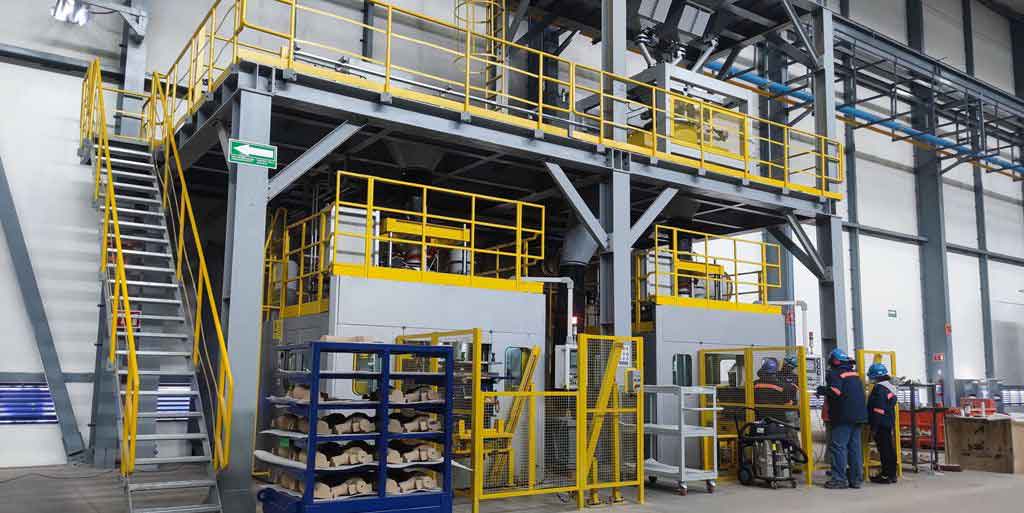
This image illustrates advanced equipment used in modern steel castings production, highlighting the integration of automation and precision.
Integrated Knockout and Cutting
Traditionally, steel castings cool slowly in molds, tying up resources. We adopted high-temperature knockout, where castings are removed at 250–450°C, followed by controlled cooling in pits or furnaces. This reduces mold occupancy time and allows for direct cutting of risers without preheating, saving energy. The energy savings can be calculated as:
$$ \text{Energy Saved} = \text{Number of Castings} \times \text{Preheating Energy per Casting} $$
For gas preheating, if each steel casting requires 50 kWh, eliminating this step for 1000 castings saves 50,000 kWh annually. We also introduced semi-automatic cutting machines for flat surfaces, reducing manual labor and improving cut quality. Table 5 compares old and new methods for steel castings processing.
| Aspect | Traditional Method | Improved Method | Efficiency Gain (%) |
|---|---|---|---|
| Knockout Temperature | Ambient | 300°C | 40 |
| Cutting Time per Casting | 2 hours | 1.5 hours | 25 |
| Energy Consumption | High | Low | 30 |
These changes accelerate throughput and reduce operational costs for steel castings.
Heat Treatment Optimization
Heat treatment is energy-intensive but essential for achieving desired mechanical properties in steel castings. We upgraded to regenerative gas furnaces, which recover waste heat and improve thermal efficiency from 55% to 70%. The energy savings can be expressed as:
$$ \text{Fuel Savings} = \text{Original Fuel Use} \times \left(1 – \frac{\text{Old Efficiency}}{\text{New Efficiency}}\right) $$
If original fuel use is 1000 GJ, savings amount to 150 GJ. Moreover, we refined process parameters, such as reducing soaking times based on material thickness. For carbon steel castings, we applied zero-holding time during normalizing, relying on the equation:
$$ \text{Soaking Time} = k \times \text{Thickness} $$
Where \( k \) is reduced from 2–2.5 min/mm to 1–1.5 min/mm for many steel castings, without compromising quality. This shortens cycle times and lowers energy consumption. Table 6 shows performance data for different heat treatment regimes for steel castings.
| Steel Castings Type | Old Soaking Time (hours) | New Soaking Time (hours) | Energy Reduction (%) |
|---|---|---|---|
| Carbon Steel | 4 | 2 | 30 |
| Low-Alloy Steel | 6 | 4 | 25 |
| High-Alloy Steel | 8 | 6 | 20 |
By combining furnace upgrades with optimized schedules, we achieve consistent results for steel castings while curbing costs.
Conclusion
In summary, the journey to reduce costs and improve efficiency in steel castings manufacturing is multifaceted, requiring attention to accounting, processes, technology, and quality. Our experiences demonstrate that through precise cost measurement, process integration, virtual simulations, weld repair minimization, and innovative manufacturing techniques, significant gains are possible. The steel castings industry must continue to evolve, embracing digital tools and lean practices to remain competitive. By sharing these insights, we hope to contribute to the broader community of steel castings producers, fostering resilience and growth in an challenging market environment.
Moving forward, we plan to explore advanced analytics and IoT-enabled monitoring for real-time optimization of steel castings production lines. The focus will remain on delivering high-quality steel castings efficiently, meeting customer demands, and sustaining profitability. As the industry consolidates, those who adapt swiftly will thrive, and we are committed to being at the forefront of this transformation.