
In the field of wear-resistant materials, high-chromium white cast iron stands out due to its exceptional performance against abrasive environments. However, as a brittle material, its production and processing pose significant challenges, limiting its widespread application. Through extensive research, it has been established that the optimal microstructure for maximizing both wear resistance and toughness in white cast iron consists of a martensitic matrix with discontinuous, blocky or rod-like eutectic carbides and finely dispersed secondary carbides. Achieving this microstructure, especially in complex or thick-section castings, requires precise control over chemical composition and heat treatment. In this article, I will delve into the fundamental principles for strengthening high-chromium white cast iron, focusing on how alloying elements and thermal processes influence carbide morphology, distribution, and matrix constitution.
The performance of white cast iron is heavily dictated by the type, amount, and morphology of carbides present. In iron-chromium-carbon systems, the carbide phase evolves with chromium content. When chromium is below 5%, the eutectic white cast iron microstructure comprises a ledeburitic structure with M3C-type carbides embedded in a pearlitic matrix. These M3C carbides have a relatively low hardness, around 1200–1600 HV, and form a continuous network, leading to high brittleness. For high-chromium white cast iron, such continuous carbides are undesirable. As chromium increases between 5% and 10%, the carbides become a mixture of M3C and M7C3, often appearing as a network with reduced continuity. When chromium exceeds 12%, the carbides transition entirely to M7C3, which exhibits a discontinuous, blocky or fibrous morphology under microscopy. This M7C3 carbide has a higher hardness, approximately 1500–1800 HV, and its discontinuous nature significantly enhances the toughness of the white cast iron. At chromium levels above 20%, carbides may include M23C6, but these are not harder than M7C3, making M7C3 the preferred phase for high-chromium white cast iron.
The volume fraction of carbides in eutectic white cast iron is typically around 30%, but this varies with composition. The eutectic carbon content shifts leftward with increasing chromium. For instance, at 15% Cr, the eutectic carbon content is approximately 3.6%. This relationship can be expressed by the formula: $$C_e = 4.3 – 0.05 \times Cr$$ where \(C_e\) is the eutectic carbon percentage and \(Cr\) is the chromium percentage. If the carbon content exceeds \(C_e\), primary carbides appear, further embrittling the white cast iron. In high-stress abrasive wear conditions, carbide volume should be kept below 30% to maintain adequate toughness, while for low-impact applications like pump impellers, near-eutectic compositions can be used for higher hardness and better castability.
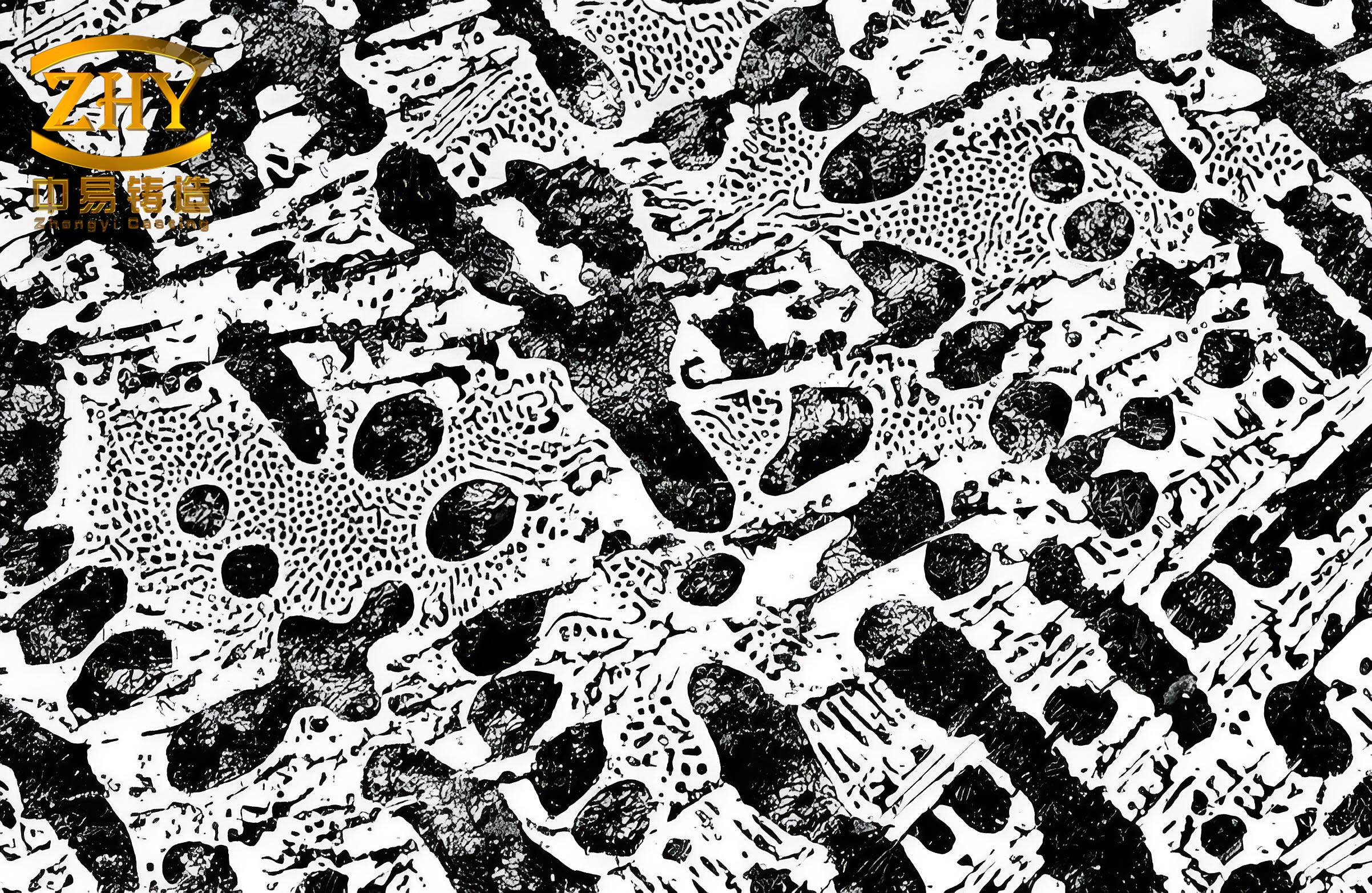
The matrix microstructure plays a crucial role in the wear resistance of white cast iron. While carbides provide hardness, the matrix supports them and resists abrasion. A martensitic matrix, with hardness around 600–900 HV, is ideal for most applications as it minimizes scratching and undercutting of carbides. In contrast, a pearlitic matrix (200–400 HV) wears easily, leading to premature carbide exposure and spalling. For white cast iron subjected to high-impact loads, an austenitic matrix (300–500 HV) is beneficial due to its work-hardening ability, which can transform austenite to martensite during service, enhancing wear resistance. Thus, suppressing pearlite formation is essential, whether the white cast iron is used in the as-cast condition or after heat treatment.
Chemical composition is the primary lever for controlling both carbide characteristics and matrix constitution. The key elements include carbon, chromium, silicon, manganese, molybdenum, nickel, copper, and vanadium. Their effects are summarized in the table below, which outlines their roles in carbide formation, hardenability enhancement, and austenite stabilization.
| Element | Effect on White Cast Iron | Typical Range (%) |
|---|---|---|
| Carbon (C) | Increases carbide volume and hardness; reduces hardenability; critical for eutectic control. | 2.0–3.6 |
| Chromium (Cr) | Promotes M7C3 carbides; improves corrosion and heat resistance; moderate hardenability effect. | 12–30 |
| Silicon (Si) | Reduces hardenability; raises Ms temperature; often limited due to ferrochromium additions. | < 1.0 |
| Manganese (Mn) | Enhances hardenability; stabilizes austenite; excessive amounts increase retained austenite. | 0.5–1.5 |
| Molybdenum (Mo) | Strong hardenability enhancer; forms carbides; effective in thick sections. | 0.5–3.0 |
| Nickel (Ni) | Increases hardenability and austenite stability; expensive, often replaced by copper. | 0–1.5 |
| Copper (Cu) | Improves hardenability and stabilizes austenite; synergistic with molybdenum. | 0.5–1.5 |
| Vanadium (V) | Refines microstructure; forms hard VC carbides; raises Ms temperature. | 0–0.5 |
Carbon and chromium are the most influential for carbide control. The volume fraction of M7C3 carbides, \(V_c\), can be estimated using: $$V_c = 12.33 \times C + 0.55 \times Cr – 15.2$$ where \(C\) and \(Cr\) are in weight percentages. This formula helps in designing white cast iron compositions to achieve desired carbide amounts. For matrix control, elements like molybdenum, manganese, and copper are added to enhance hardenability, preventing pearlite formation during cooling. Silicon, while generally detrimental to hardenability, can be beneficial in moderate amounts by increasing the martensite start temperature, \(M_s\), which aids in obtaining a martensitic matrix without excessive alloying.
In as-cast white cast iron, the goal is to achieve a matrix of martensite or austenite-martensite without pearlite. This requires that the white cast iron has sufficient hardenability to avoid pearlite transformation and that the \(M_s\) temperature is above room temperature to allow martensite formation. Alloying elements must be balanced: “under-alloying” leads to pearlite, while “over-alloying” wastes expensive elements and may retain too much austenite. For instance, a white cast iron with 15% Cr, 3% C, 1% Mo, and 0.5% Cu can often yield a martensitic matrix in thin sections. If the as-cast matrix is austenitic, a high-temperature tempering at 450–550°C can destabilize it, promoting secondary carbide precipitation and transforming austenite to martensite. The hardness change after such treatment is illustrated in the following table, showing how tempering adjusts matrix constitution in white cast iron.
| White Cast Iron Composition (%) | As-Cast Hardness (HRC) | Retained Austenite (%) | Tempering Temperature (°C) | Hardness After Tempering (HRC) |
|---|---|---|---|---|
| C: 3.0, Cr: 15, Mo: 1.5, Cu: 0.8 | 52 | 25 | 500 | 58 |
| C: 2.8, Cr: 20, Mo: 2.0, Cu: 1.0 | 50 | 30 | 480 | 57 |
| C: 3.2, Cr: 18, Mo: 1.0, Cu: 0.5 | 55 | 20 | 520 | 60 |
Heat treatment is pivotal for white cast iron intended for use after processing. The common approach is destabilization heat treatment, where the white cast iron is heated to 950–1050°C to precipitate secondary carbides from the austenite, reducing its carbon and chromium content. This lowers austenite stability, raises \(M_s\), and upon air cooling, promotes martensite formation. The holding time depends on section thickness and copper content; for white cast iron with over 1% Cu, holding times of 2–4 hours may be necessary. To avoid cracking, heating rates should be controlled below 100°C/h, and cooling should be uniform. If retained austenite exceeds 20%, a subsequent tempering at 200–300°C can further transform it to martensite and relieve stresses. For machinability, white cast iron can be annealed by heating to 850–950°C, holding, and slow cooling to soften the matrix to 35–45 HRC.
Selecting the optimal composition for white cast iron requires considering the casting’s section thickness and cooling rate. The half-cooling time, \(t_{1/2}\), defined as the time to cool from the austenitizing temperature to halfway between that temperature and room temperature, is a useful metric. For sand-cast white iron, \(t_{1/2}\) relates to wall thickness, \(d\) (in mm), as shown in the table below. This data helps correlate casting geometry with cooling behavior.
| Wall Thickness, \(d\) (mm) | Half-Cooling Time, \(t_{1/2}\) (s) in Sand Mold |
|---|---|
| 25 | 180 |
| 50 | 720 |
| 75 | 1620 |
| 100 | 2880 |
For air cooling after austenitization, the half-cooling time for round bars of diameter \(D\) (mm) can be approximated. To design compositions that avoid pearlite, empirical formulas predict the earliest time for pearlite transformation, \(t_p\), based on composition. For example, for white cast iron austenitized at 1000°C for 1 hour, one such formula is: $$t_p = 10^{(0.012 \times Cr + 0.025 \times Mo + 0.035 \times Ni – 0.045 \times C – 1.2)}$$ where elements are in weight percentages. If the actual half-cooling time is less than \(t_p\), pearlite formation is avoided, ensuring a martensitic matrix. Let’s consider an example: a white cast iron with C: 3.0%, Cr: 15%, Mo: 1.0%, and wall thickness 50 mm. From the table, \(t_{1/2} = 720\) s. Calculating \(t_p\): $$t_p = 10^{(0.012 \times 15 + 0.025 \times 1.0 + 0.035 \times 0 – 0.045 \times 3.0 – 1.2)} = 10^{(0.18 + 0.025 – 0.135 – 1.2)} = 10^{-1.13} \approx 74 \text{ s}$$ Since \(t_{1/2} = 720\) s > \(t_p = 74\) s, pearlite may form, indicating that more hardenability enhancers like molybdenum are needed. This illustrates how compositional adjustments in white cast iron can be guided by quantitative analysis.
For thick-section white cast iron castings, recommended compositions vary depending on whether the iron is used as-cast or after heat treatment. The table below provides guidelines, emphasizing the higher alloy content required for as-cast applications to suppress pearlite.
| Element (%) | As-Cast (No Pearlite) | Heat-Treated (After Normalizing) |
|---|---|---|
| C | 2.8–3.2 | 2.5–3.0 |
| Cr | 15–20 | 12–18 |
| Mo | 1.5–3.0 | 0.5–1.5 |
| Cu | 0.8–1.5 | 0–0.8 |
| Mn | 0.5–1.0 | 0.5–1.0 |
| Si | < 0.8 | < 1.0 |
In conclusion, the strengthening of high-chromium white cast iron hinges on a synergistic approach to composition and heat treatment. By targeting M7C3 carbides in a martensitic matrix, one can achieve an optimal balance of wear resistance and toughness. Carbon and chromium dictate carbide characteristics, while elements like molybdenum, copper, and vanadium govern matrix hardenability and stability. Heat treatments, such as destabilization and tempering, enable microstructural refinement. Through calculations of half-cooling times and pearlite transformation kinetics, compositions can be tailored for specific casting geometries. This comprehensive understanding allows for the effective utilization of white cast iron in demanding abrasive environments, pushing the boundaries of its performance. The ongoing evolution in white cast iron technology continues to address challenges in processing and application, ensuring its role as a cornerstone in wear-resistant materials.
Throughout this discussion, the term white cast iron has been emphasized to underscore its centrality in wear-resistant alloys. From carbide control to matrix optimization, every aspect of white cast iron design contributes to its enduring utility. As research advances, further refinements in white cast iron compositions and treatments will undoubtedly expand its capabilities, solidifying its position in industrial applications.