
In the field of heavy machinery, the demand for components that can withstand extreme loads and stresses is ever-present. Among these, large gear rings for mining ball mills represent a significant challenge for foundry engineers. My extensive experience in ductile iron casting has shown that producing such thick-section components with high and uniform hardness is a complex task that requires meticulous control over every stage of the process, from metallurgical design to final heat treatment. This article delves into the comprehensive strategy required to successfully manufacture high-hardness, thick-section ductile iron castings, using a large gear ring as a case study. The goal is not only to meet stringent specifications but to achieve exceptional consistency in properties across massive cross-sections, where cooling rates vary dramatically.
The primary challenge with thick-section ductile iron castings, typically defined by wall thicknesses exceeding 100 mm, lies in combating the inherent slow solidification and cooling. This slow cooling can lead to several detrimental effects: graphite flotation, where graphite nodules rise to the upper sections of the casting; carbide formation due to inadequate inoculation fading; severe segregation of alloying elements; and ultimately, a degradation of mechanical properties, particularly a decrease in hardness and tensile strength, often accompanied by low nodule count and poor nodularity. The objective for critical components like gear rings is to achieve a predominantly pearlitic matrix with a hardness often specified above 300 HB, while maintaining good ductility and uniform microstructure throughout the entire cross-section, which can vary by over 130 mm in thickness.
Component Requirements and Technical Challenges
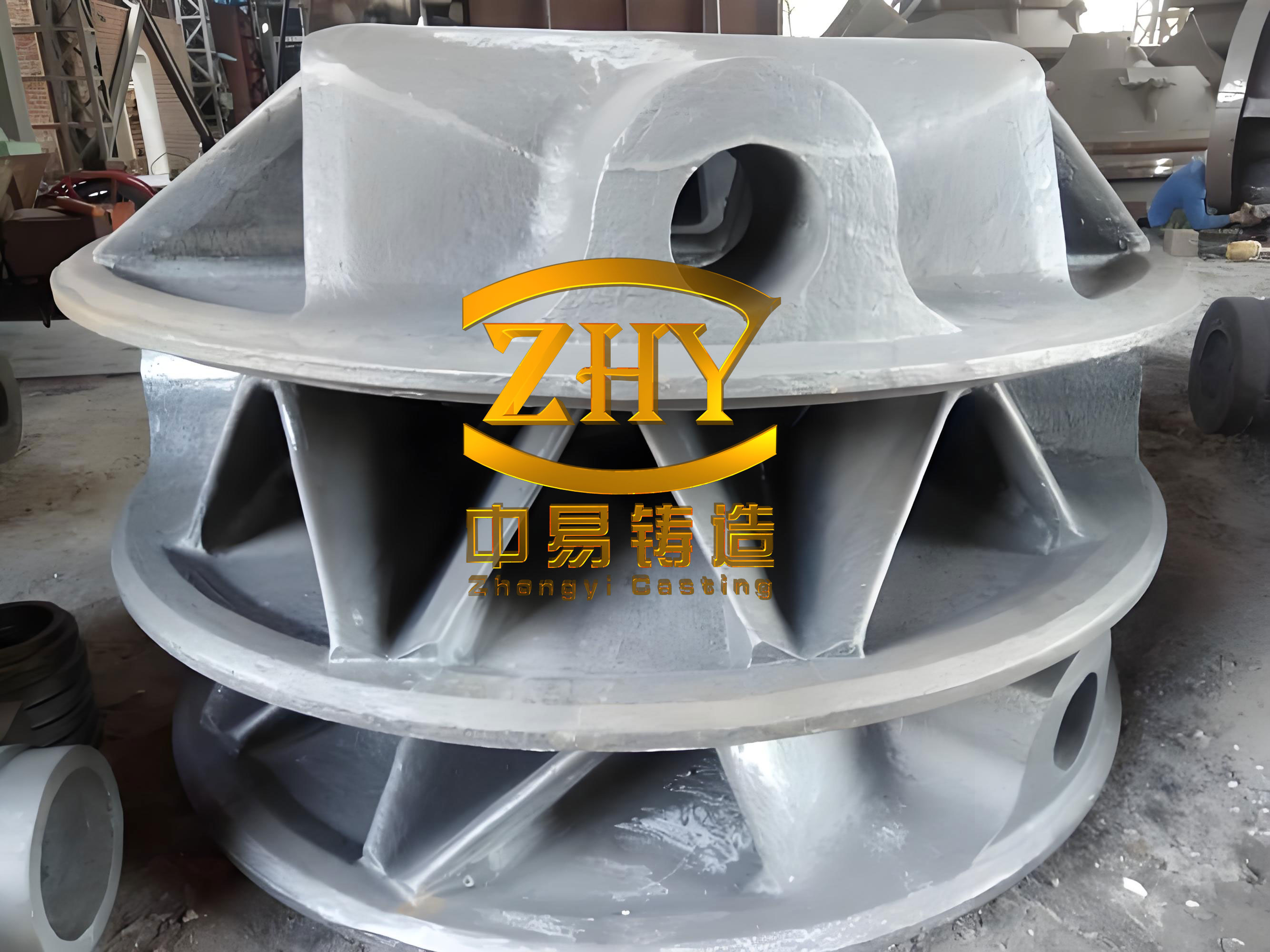
The subject component is a large gear ring for a mining ball mill. The casting features a complex geometry with substantial variations in wall thickness. The nominal wall thickness ranges from 150 to 200 mm, with certain sections, such as the gear root or hub areas, reaching a maximum thickness exceeding 300 mm. The sheer mass and section size place this component firmly in the category of heavy, thick-section ductile iron castings.
The material specification demanded a high-strength grade, akin to EN-GJS-800-2. The technical requirements are rigorous, focusing on both mechanical properties and metallurgical quality. Key specifications derived from the attached test block (70 mm thick) and the casting本体 are summarized below:
| Property / Feature | Requirement (Attached Test Block) | Target (Casting Body) |
|---|---|---|
| Tensile Strength, Rm | ≥ 800 MPa | — |
| Elongation, A | ≥ 1 % | — |
| Hardness, HBW | 248 – 352 | 300 – 340 |
| Pearlite Content | ≥ 95 % | ≥ 95 % |
| Nodularity | ≥ 90 % | ≥ 90 % |
| Graphite Size (Grade) | 5 – 7 | 5 – 7 |
Achieving a body hardness above 300 HB with a variation of less than 20 HB points across such a thick, variable-section ductile iron casting is the core challenge. It necessitates a holistic approach combining alloy design, optimized founding practice, and precise heat treatment.
Foundry Practice: Gating, Feeding, and Solidification Control
The success of a thick-section ductile iron casting begins with a robust casting process design. For the gear ring, a resin sand mold was employed. The gating system was designed as a pressurized type to ensure rapid and tranquil filling, minimizing turbulence and oxide formation. The choke area was placed in the sprue to promote a non-turbulent flow. The gating ratio was carefully calculated to achieve a controlled fill. Riser placement is critical; exothermic sleeves were used on side risers positioned at the gear face and on smaller risers on the inner ring to effectively feed the thick sections. Strategic use of steel chills was essential to locally increase the cooling rate in specific heavy areas, promoting directional solidification towards the risers and eliminating internal shrinkage. Computer solidification simulation was a vital tool in validating this design, confirming that shrinkage porosity was successfully confined to the risers, ensuring soundness in the casting body.
The Heart of the Matter: Alloy Design for Thick Sections
The chemical composition is the most critical factor in determining the final microstructure and properties of a ductile iron casting, especially for thick sections. The design philosophy revolves around achieving a fully pearlitic matrix with fine, uniformly distributed graphite nodules, while minimizing element segregation and undesirable phases.
The carbon equivalent (CE) must be controlled to avoid graphite flotation. A lower CE is preferred for thick sections. The aim is to keep the final carbon content moderate and adjust silicon for inoculation potency without excessively raising CE.
$$ CE = \%C + 0.33(\%Si) + 0.33(\%P) $$
The target range for CE was set at 4.2-4.4%, with a carbon content of 3.5-3.6% and a final silicon content (after inoculation) of 2.1-2.3%.
Manganese, a pearlite promoter, is kept very low (≤0.20%) because in thick-section ductile iron castings, its positive segregation tendency at cell boundaries can lead to the formation of brittle carbides and intercellular carbides (“inverse chill”), severely impairing toughness and ductility.
Since a high pearlite fraction (≥95%) and high hardness are required, alloying elements that promote pearlite formation and hardenability are essential. The selection and balance of these elements are paramount:
| Element | Target Range (wt.%) | Primary Role in Thick-Section Ductile Iron | Considerations & Mechanism |
|---|---|---|---|
| Copper (Cu) | 1.0 – 1.3 | Pearlite promoter, mild hardenability enhancer. | Exhibits negative segregation (enriches in austenite dendrites). It is a mild graphite stabilizer during eutectic solidification but strongly promotes pearlite during eutectoid transformation. Its effect is uniform and温和. |
| Nickel (Ni) | 0.7 – 0.9 | Reduces section sensitivity, enhances hardenability. | Also exhibits negative segregation. It refines pearlite, improves uniformity of microstructure across thick sections, and significantly increases hardness after heat treatment. It counteracts some of the microstructural inhomogeneity caused by other segregating elements like Mo. |
| Molybdenum (Mo) | 0.4 – 0.5 | Powerful hardenability agent, pearlite stabilizer. | Exhibits strong positive segregation (enriches in last-to-freeze areas, i.e., cell boundaries). It is a potent carbide former. In controlled amounts (<0.6%), it effectively increases hardenability and pearlite content without forming excessive stable carbides. It refines the eutectic cell structure. |
| Tin (Sn) | 0.05 – 0.07 | Strong pearlite promoter. | Very effective in small amounts. It segregates to the graphite/austenite interface, hindering carbon diffusion and thus strongly suppressing ferrite formation. Its addition must be precise, as excess Sn (>0.1%) can degrade graphite morphology. |
The synergistic effect of Cu, Ni, Mo, and Sn is crucial. While Cu and Sn are potent pearlite formers, Mo and Ni provide the necessary hardenability to ensure that even the slow-cooling core of this thick-section ductile iron casting transforms to pearlite during subsequent heat treatment, rather than ending up with ferritic areas. The combination helps achieve the desired high and uniform hardness.
Melting, Treatment, and Pouring
The charge consisted of 60% high-purity pig iron and 40% low-residual steel scrap. The base iron was melted in a medium-frequency induction furnace. Carbon was adjusted using high-quality graphite recarburizers. Alloying elements (Cu, Mo, FeSn) were added to the furnace or the treatment ladle well before tapping to ensure complete dissolution and homogenization.
The nodularizing treatment was performed using the sandwich method in a preheated ladle. A FeSiMg alloy with rare earths was placed in the bottom of the treatment ladle, covered with a pre-inoculant (Si-Ba type), and then topped with clean steel punchings. The treatment reaction was controlled by covering the ladle and allowing for a calm, efficient magnesium recovery. Post-inoculation was carried out during tapping using a FeSi alloy. A final, crucial step was stream inoculation during pouring, employing fine FeSi granules. This late inoculation is vital for thick-section ductile iron castings to counteract inoculation fade that occurs during the long solidification time, thereby preventing chill and promoting a high nodule count. The pouring temperature was tightly controlled around 1320°C to ensure fluidity while minimizing thermal stress.
The Transformation Key: Heat Treatment Process
For a thick-section ductile iron casting with this alloy design, the as-cast state typically will not meet the high pearlite and hardness requirements uniformly, especially in the core. A full austenitizing heat treatment (normalizing) followed by tempering is essential. The heat treatment cycle must be designed considering the massive section size to ensure temperature uniformity throughout the casting.
The developed process involved:
- Heating to Austenitizing Temperature: A slow heating rate is used to avoid thermal cracking. The casting was heated to 940°C and held for a sufficient time (6+ hours) to ensure complete austenitization and homogenization of carbon throughout the massive sections.
- Normalizing (Air Quenching): The casting was removed from the furnace and cooled in still air. For a thick-section ductile iron casting, even air cooling represents a significant quench rate due to the large thermal mass. The combination of alloying elements (Mo, Ni, Cu) provides the hardenability to transform the austenite to a fine, fully pearlitic structure, or potentially a mixture of fine pearlite and some bainite, rather than coarse pearlite or ferrite.
- Tempering (Stress Relieving): Following normalizing, the casting was tempered at 560°C for 6 hours. This step relieves the residual stresses induced during cooling, slightly softens the matrix to improve toughness, and stabilizes the microstructure.
The cooling rate after austenitizing ($\dot{T}_{air}$) is a critical parameter that, in conjunction with the alloy’s hardenability, determines the final matrix structure. The hardenability can be conceptually related to a critical cooling rate to avoid ferrite formation, which is lowered by the added alloys.
$$ \text{Desired Matrix} = f(\text{Chemistry}, \dot{T}_{air}, \text{Section Size}) $$
For this specific thick-section ductile iron casting, the chosen cycle successfully promoted a near-complete, fine pearlitic transformation.
Results and Analysis: Achieving Specification and Uniformity
The effectiveness of the entire production chain was validated through rigorous testing of both the attached test blocks and the casting body itself.
As-Cast State (Test Block): The as-cast microstructure showed a mixed matrix of approximately 65% pearlite and 35% ferrite, with good nodularity (92%). The tensile strength was around 565 MPa with 3.3% elongation. The body hardness was in the 250-265 HB range, confirming the need for heat treatment to boost hardness and pearlite content.
After Heat Treatment: The transformation was remarkable. The attached test block exhibited properties exceeding requirements:
| Property | Result (Test Block) | Requirement Met? |
|---|---|---|
| Tensile Strength | 962 MPa | Yes (≥800 MPa) |
| Elongation | 1.4 % | Yes (≥1 %) |
| Hardness | 345 HB | Yes (248-352 HB) |
| Nodularity | 100 % | Yes (≥90%) |
| Pearlite Content | >98 % | Yes (≥95%) |
The microstructure revealed fine, well-distributed graphite nodules (size grade 6) in a matrix of very fine, dense pearlite. The pearlite lamellar spacing was so fine it was difficult to resolve at 1000x magnification, indicating a high transformation driving force during cooling.
Casting Body Uniformity: The ultimate test was the hardness survey across multiple locations on the actual gear ring casting, covering both thinner (≈150 mm) and thicker (≈280 mm) sections. The results demonstrated outstanding uniformity:
| Location | Hardness (HBW) | Nodularity (%) | Pearlite (%) |
|---|---|---|---|
| #1 (Thin Zone) | 323 | 100 | 95 |
| #2 | 316 | 100 | 95 |
| #3 (Thick Zone) | 330 | 100 | 95 |
| #4 | 320 | 100 | 95 |
| #5 | 315 | 100 | 95 |
| #6 | 326 | 100 | 95 |
| #7 | 314 | 100 | 95 |
| #8 | 311 | 100 | 95 |
| #9 | 320 | 100 | 95 |
The hardness values ranged from 311 to 330 HBW, with a total spread of only 19 HB points. This exceptional consistency, achieved across a section thickness variation of 136 mm, is a direct consequence of the balanced alloy design (particularly Ni and Mo) and the controlled normalizing process. Ultrasonic testing confirmed the internal soundness of the ductile iron casting, free from significant shrinkage or inclusions.
Discussion: The Synergy of Elements and Process
The successful production of this high-hardness, thick-section ductile iron casting hinges on understanding and leveraging metallurgical principles. The low Mn content prevented intercellular carbide networks. The combination of Cu and Sn provided a strong, reliable base for pearlite formation throughout the matrix. The role of Mo and Ni was to control hardenability and section sensitivity. Their opposing segregation tendencies—Mo enriching boundaries, Ni enriching dendrite cores—helped create a more uniform transformation response during cooling. The normalizing treatment then provided the necessary thermal driving force to transform the austenitized structure into the desired high-hardness matrix uniformly.
The final hardness ($H$) can be conceptualized as a function of the pearlite fraction ($F_P$), its fineness, and the solid solution strengthening from alloying elements in ferrite:
$$ H \approx H_{base} + \alpha \cdot F_P + \beta \cdot (\text{Si, Cu, Ni, Sn…}) $$
where $H_{base}$ is the hardness of ferrite, and $\alpha$ and $\beta$ are coefficients related to pearlite hardness and solid solution potency, respectively. The process achieved a high $F_P$ (≈0.95-1.0) with a fine interlamellar spacing, maximizing the $\alpha \cdot F_P$ term.
Conclusion
Producing thick-section ductile iron castings with high and uniform hardness is an achievable goal through a systematic, integrated approach. The key takeaways are:
- Targeted Alloy Design: A low-carbon equivalent base, minimal Mn, and a balanced combination of pearlite-promoting (Cu, Sn) and hardenability-enhancing (Mo, Ni) elements are essential to counteract slow-cooling effects and ensure a consistent microstructure.
- Robust Foundry Practice: Effective mold design with proper chilling and feeding, coupled with well-controlled melting, late-stream inoculation, and clean metal handling, is fundamental to achieving sound castings with good graphite morphology.
- Precise Heat Treatment: A full normalizing and tempering cycle is typically necessary to transform the as-cast matrix into a uniformly high-hardness, predominantly pearlitic structure. The cycle must account for the casting’s massive size.
The demonstrated process for the large gear ring resulted in a ductile iron casting with a body hardness consistently above 310 HB and a variation of less than 20 HB across significant thickness variations. The microstructure was characterized by excellent graphite nodularity and a dense, fine pearlitic matrix, fully meeting the demanding requirements for heavy-duty mining applications. This methodology provides a reliable framework for tackling other challenging thick-section ductile iron casting projects.