
In my research, I investigated the lost wax casting process, also known as investment casting, for manufacturing thin-wall magnesium alloy components. Magnesium alloys are renowned for their low density, high specific strength and stiffness, excellent vibration damping, radiation resistance, and machinability, making them ideal for applications in automotive, aerospace, telecommunications, and electronics industries. Traditional methods like die casting and sand casting have limitations, such as poor surface finish, low dimensional accuracy, and defects like porosity and shrinkage, especially for complex, thin-walled structures. Therefore, I explored silica sol-based lost wax casting as a superior alternative to achieve high precision and surface quality.
The lost wax casting process involves creating a wax pattern, coating it with ceramic shells, melting out the wax, and pouring molten metal into the cavity. This method is particularly suitable for intricate geometries and thin sections. In this study, I designed a process tailored for a magnesium alloy component with walls as thin as 2 mm and localized thick sections up to 15 mm, overall dimensions of 200 mm × 200 mm × 200 mm, and internal deep groove structures. My goal was to optimize the process parameters using computer simulations and experimental trials to control oxidation slag, enhance dimensional accuracy, and improve mechanical properties.
I began by selecting the material according to the ZM5 magnesium alloy standard GB/T1177-1995. The chemical composition is summarized in Table 1. This alloy primarily consists of aluminum and zinc, with magnesium as the base, offering a balance of castability and performance.
| Element | Zn | Al | Mn | Mg | Impurities (max) |
|---|---|---|---|---|---|
| Content | 0.20–0.80 | 7.50–9.00 | 0.15–0.50 | Balance | 0.50 |
For the lost wax casting process, I developed a gating system design to ensure proper filling and solidification. The component was positioned with thinner sections at the bottom of the浇注 system to facilitate mold filling, while thicker sections were placed at the top with risers for effective feeding. A ceramic filter was integrated into the浇注 system to trap inclusions and reduce slag. To validate this design, I employed computational fluid dynamics (CFD) simulations using Flow3D software. The simulation modeled the filling and solidification processes without filters initially, allowing me to adjust parameters like pouring temperature and mold preheat. The results indicated that with a mold temperature of 400°C and a magnesium alloy pouring temperature of at least 700°C, complete filling could be achieved, and thermal gradients during solidification were均匀, supporting the feasibility of the gating design.
The simulation involved solving the Navier-Stokes equations for fluid flow and energy equations for heat transfer. For instance, the filling process can be described by the continuity and momentum equations: $$ \frac{\partial \rho}{\partial t} + \nabla \cdot (\rho \mathbf{v}) = 0 $$ and $$ \rho \left( \frac{\partial \mathbf{v}}{\partial t} + \mathbf{v} \cdot \nabla \mathbf{v} \right) = -\nabla p + \mu \nabla^2 \mathbf{v} + \mathbf{f}_b $$ where $\rho$ is density, $\mathbf{v}$ is velocity, $p$ is pressure, $\mu$ is viscosity, and $\mathbf{f}_b$ represents body forces. The solidification analysis used Fourier’s heat conduction law: $$ \frac{\partial T}{\partial t} = \alpha \nabla^2 T $$ with $T$ as temperature and $\alpha$ as thermal diffusivity. These simulations helped optimize the lost wax casting parameters before physical trials.
Next, I prepared the ceramic shells for the lost wax casting process. The shell-building materials and procedures are detailed in Table 2. Silica sol was used as the binder, with layers of alumina and mullite applied to create a robust shell. Boracic acid was added to the primary coatings to mitigate magnesium oxidation during pouring, enhancing process safety and cast quality.
| Layer Type | Material | Particle Size | Binder | Drying Conditions | Special Additives |
|---|---|---|---|---|---|
| Primary | White Alumina | 325 mesh | Silica Sol | 24±2°C, 50-60% RH, ≥4 h | 0.5% Boracic Acid |
| Transition | Mullite | 270 mesh | Silica Sol | 24±2°C, 40-60% RH, ≥6 h | 0.5% Boracic Acid |
| Reinforcement | Mullite | 270 mesh | Silica Sol | 24±2°C, 40-60% RH, ≥8 h | None |
After shell construction, dewaxing was performed using steam at 0.5–0.6 MPa for 10–12 minutes, followed by a resting period over 10 hours. The shells were then fired according to a specific temperature profile: heating to 200°C for 2 hours, then to 400°C for 2 hours, and finally to 850°C for 2 hours, with controlled cooling to 400°C for pouring. This firing process ensures shell strength and removes residual wax. For comparison, I also prepared sand molds using furan resin-bonded sand with additives like sulfur and boric acid to prevent magnesium燃烧, but these molds were not fired and only briefly flame-dried before pouring.
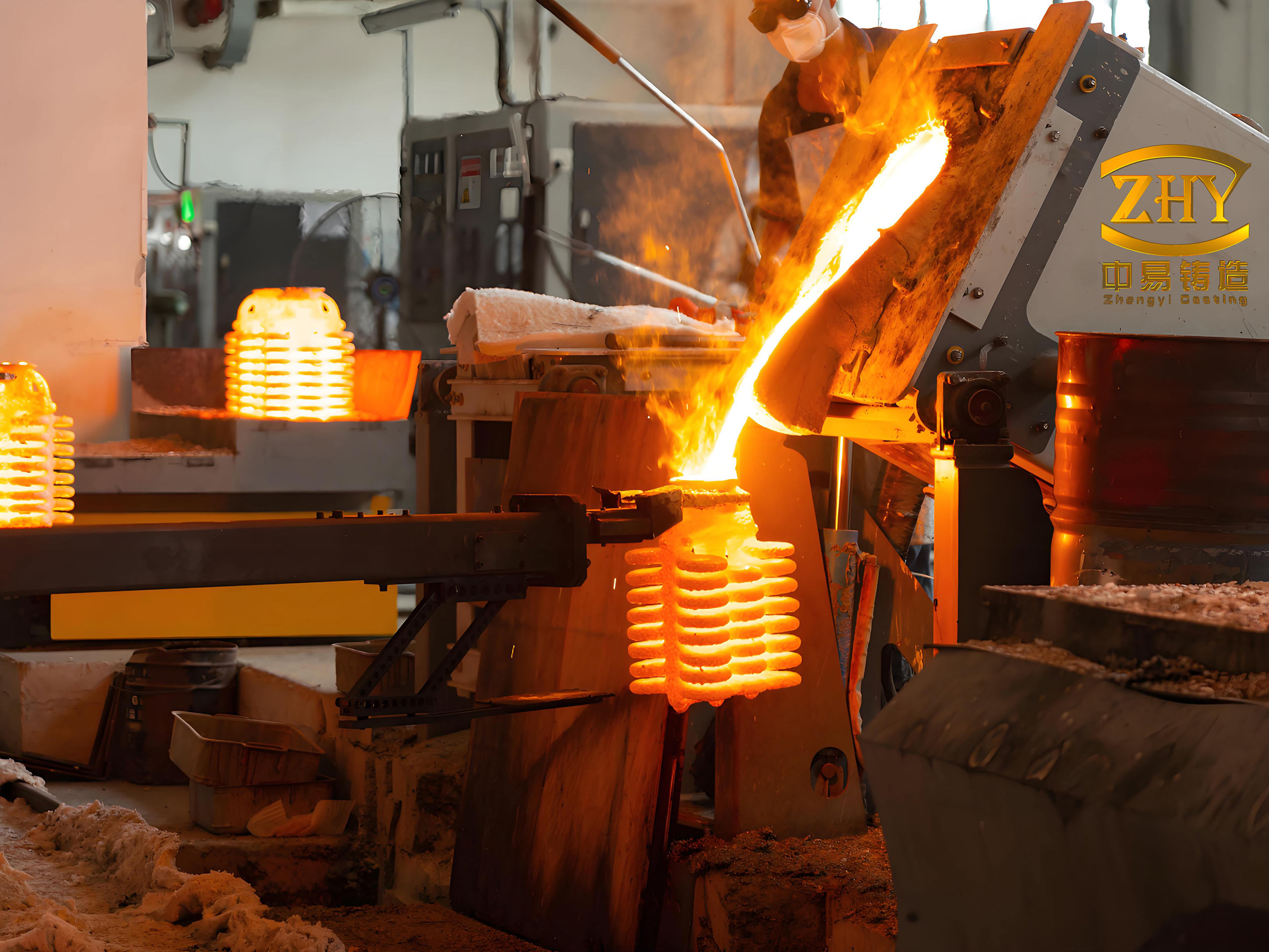
The melting and pouring parameters for both lost wax casting and sand casting are summarized in Table 3. The magnesium alloy was melted in a protective atmosphere, refined with hexachloroethane, and modified with RJ-2 flux to improve fluidity and reduce oxidation. Pouring temperatures were set based on simulation results and practical considerations.
| Process | Refining Temp. (°C) | Modification Temp. (°C) | Mold Temp. (°C) | Pouring Temp. (°C) | Hexachloroethane (%) | RJ-2 Flux (%) |
|---|---|---|---|---|---|---|
| Lost Wax Casting | 750 | 750 | 300 | 750 | 0.2 | 0.5 |
| Sand Casting | 750 | 750 | Room Temp. | 730 | 0.2 | 0.5 |
I conducted four trial runs for the lost wax casting process to evaluate铸件 quality. The castings were inspected for internal and external defects. The ceramic filter effectively captured slag, as observed in the浇注 system, minimizing inclusions in the final component. Non-destructive testing via X-ray and fluorescent inspection revealed that the internal quality met the HB7780-2005 Class II standards, with no significant porosity or shrinkage. The surface finish was measured using profilometry, showing values of Ra 3.2–6.3 μm for lost wax castings, compared to Ra 6.3–12.5 μm for sand castings. This improvement is attributed to the precise wax patterns and smooth ceramic shells in lost wax casting.
Dimensional accuracy was assessed by measuring 35 critical dimensions on the castings. The results, presented in Table 4, indicate that lost wax casting achieved CT6 grade accuracy according to ISO casting tolerance standards, with an out-of-tolerance rate of 11.4%, while sand casting only reached CT8 grade with a 22.9% out-of-tolerance rate. The superior accuracy in lost wax casting stems from the stable ceramic molds that replicate wax patterns faithfully, unlike sand molds which can distort during handling and pouring.
| Casting Process | Dimensional Accuracy Grade | Number of Measured Dimensions | Out-of-Tolerance Count | Out-of-Tolerance Rate (%) | Surface Roughness Ra (μm) |
|---|---|---|---|---|---|
| Lost Wax Casting | CT6 | 35 | 3 | 11.4 | 3.2–6.3 |
| Sand Casting | CT8 | 35 | 8 | 22.9 | 6.3–12.5 |
Mechanical properties were evaluated using tensile test bars cast alongside the components and subjected to T6 heat treatment (solution treatment and aging). The results are shown in Table 5. Lost wax cast specimens exhibited a tensile strength of 230 MPa and an elongation of 3.0%, while sand cast specimens showed 245 MPa and 3.5%, respectively. Although the lost wax casting values are slightly lower, they still comply with industry standards. The difference can be explained by the slower solidification in lost wax casting due to preheated molds, leading to coarser microstructures, as observed in metallographic analysis. The grain size can be related to solidification rate via the equation: $$ d = k \cdot (G \cdot v)^{-n} $$ where $d$ is grain diameter, $k$ and $n$ are constants, $G$ is temperature gradient, and $v$ is growth velocity. In lost wax casting, lower $G$ and $v$ result in larger grains, potentially reducing strength.
| Casting Process | Tensile Strength (MPa) | Elongation (%) | Hardness (HBS) |
|---|---|---|---|
| Lost Wax Casting | 230 | 3.0 | Not Measured |
| Sand Casting | 245 | 3.5 | Not Measured |
In the discussion, I analyzed key factors influencing the lost wax casting process. The use of ceramic filters and boracic acid additives in shell coatings proved effective in controlling slag and oxidation. The filters act as barriers, capturing inclusions based on Stokes’ law: $$ v_t = \frac{2 (\rho_p – \rho_f) g r^2}{9 \mu} $$ where $v_t$ is terminal velocity, $\rho_p$ and $\rho_f$ are particle and fluid densities, $g$ is gravity, $r$ is particle radius, and $\mu$ is viscosity. This ensures cleaner metal flow. The dimensional precision in lost wax casting is superior due to the minimal mold wall movement and high pattern fidelity. However, the trade-off is a slight reduction in mechanical properties, which I attribute to thermal conditions. To optimize further, I propose adjusting mold preheat temperatures or employing chilling techniques to refine microstructure. For instance, the solidification time can be estimated using Chvorinov’s rule: $$ t = B \left( \frac{V}{A} \right)^2 $$ where $t$ is solidification time, $V$ is volume, $A$ is surface area, and $B$ is a mold constant. By manipulating $B$ through mold materials, faster cooling can be achieved.
My research underscores the advantages of lost wax casting for thin-wall magnesium alloys. This process, through careful design and simulation, enables the production of complex components with high accuracy and surface finish. Future work could focus on enhancing mechanical properties via process modifications, such as controlled cooling rates or alloy modifications. In conclusion, the lost wax casting method is a viable and efficient approach for manufacturing premium-quality magnesium alloy parts, offering significant improvements over traditional sand casting in terms of dimensional control and surface integrity. The repeated application of lost wax casting in this study demonstrates its versatility and effectiveness for advanced manufacturing challenges.