
In the field of mineral processing, ball mills are indispensable equipment for grinding ores into fine powders. As a researcher focused on advancing wear-resistant materials, I have long been intrigued by the challenge of improving the durability and cost-effectiveness of mill liners. Traditionally, high-manganese steel has been widely used for these liners due to its good toughness and work-hardening capability. However, my investigations and industry reports indicate that under the conditions typical in ball mills, the work-hardening effect of high-manganese steel is often insufficient, leading to limited wear resistance. The hardened layer is shallow, with hardness dropping rapidly beneath the surface, which compromises longevity. On the other hand, high-chromium cast iron offers superior wear resistance owing to its high volume of hard eutectic carbides. Yet, the high cost associated with alloying elements like chromium, molybdenum, and nickel makes it less economical for widespread adoption. This economic constraint has driven my exploration into alternative materials that balance performance and affordability.
My attention turned to tungsten alloy white cast iron, a material known for its excellent abrasion resistance. Historically, tungsten alloy white cast iron relied on pure tungsten or ferro-tungsten as alloying sources, which elevated production costs. To address this, I pioneered the use of tungsten-slag ferro-alloy, a by-product from tungsten smelting, as the primary alloying agent. This approach not only reduces material expenses but also promotes resource recycling. The tungsten-slag ferro-alloy contains valuable elements such as tungsten, manganese, niobium, tantalum, and titanium, contributing to the hardening and microstructural refinement of the cast iron. However, like many white cast irons, the base tungsten alloy white cast iron tends to form continuous networks of eutectic carbides, which can embrittle the material. To enhance its toughness and wear performance, I investigated the possibility of modification using rare earth (RE) elements. This study details my comprehensive research on the effects of RE modification on the microstructure, mechanical properties, and wear resistance of this innovative tungsten alloy white cast iron, with a focus on its application as mill liners.
The core of my methodology involved designing a series of experiments to systematically evaluate the impact of rare earth addition. The base composition of the tungsten alloy white cast iron was formulated to be cost-effective while ensuring adequate hardness and strength. The chemical composition, in weight percent, is summarized in Table 1. Notably, the tungsten content was derived entirely from the tungsten-slag ferro-alloy, which typically analyses as shown in Table 2. This strategic use of industrial by-product is a key innovation in producing economical white cast iron.
| Element | Carbon (C) | Silicon (Si) | Manganese (Mn) | Tungsten (W)* | Others |
|---|---|---|---|---|---|
| Range | 2.5 – 3.5 | 0.6 – 1.2 | 0.8 – 1.6 | 0.3 – 0.7 (from slag) | Nb, Ta, Ti traces |
*Tungsten content is based on the contribution from the tungsten-slag ferro-alloy.
| Element | W | Mn | Nb | Ta | Ti | C | S | Fe |
|---|---|---|---|---|---|---|---|---|
| Range | 4.5 – 8.5 | 13 – 15 | 0.5 – 0.8 | 0.05 – 0.15 | 0.12 – 0.15 | 5.5 – 6.5 | 0.15 – 0.45 | Balance |
Melting was conducted in a 50 kg medium-frequency induction furnace with an acid lining. The charge materials included pig iron, steel scrap, ferrosilicon, ferromanganese, and the crucial tungsten-slag ferro-alloy. After reaching a superheating temperature of 1500–1550°C, the molten iron was tapped into a preheated ladle. For modification, I employed a包头1# rare earth ferrosilicon alloy (approximately 40.3% RE, 27.4% Si, balance Fe) as the modifier. The RE addition was varied to study its influence, with specific amounts and the resulting residual RE content detailed in Table 3. The modification process involved the ladle inoculation method: crushed and dried RE ferrosilicon pieces (less than 5 mm) were placed at the bottom of the ladle, and the molten iron was poured onto them. Following thorough stirring and slag removal, the melt was poured into dry sand molds at a temperature of 1320–1360°C to produce standard test specimens (22 mm × 22 mm × 115 mm for as-cast structure and subsequent processing).
| Sample Designation | RE Addition (wt.%) | Residual RE Content (wt.%) |
|---|---|---|
| W0 (Unmodified) | 0 | 0 |
| W1 | 0.6 | 0.058 |
| W2 | 1.2 | 0.120 |
| W3 | 1.8 | 0.177 |
All cast specimens underwent a standard heat treatment to optimize their microstructure and properties. The heat treatment cycle consisted of austenitizing at 950–980°C for 2 hours followed by air cooling (normalizing), and then tempering at 250–300°C for 4 hours followed by air cooling. This treatment aimed to relieve casting stresses and stabilize the matrix.
The evaluation of mechanical properties was central to my analysis. Impact toughness was measured using a Charpy-type impact tester with a 147 N hammer, a span of 70 mm, and unnotched specimens of dimensions 20 mm × 20 mm × 110 mm. The reported values are the average of three tests. Hardness was determined on polished samples using a Rockwell hardness tester (HRC scale), with the average taken from five indentations. To assess wear resistance, I conducted dynamic impact abrasion tests on an MLD-10 machine. Test samples (10 mm × 10 mm × 30 mm) were subjected to impact against a hardened 40Cr steel counterface (58.7 HRC) in the presence of quartz sand abrasive (0.5–1.5 mm size) flowing at 1 kg/min. The test parameters were an impact frequency of 150 cycles/min and an impact energy of 3 J. Each test ran for 3000 impacts after a 5-minute run-in period. Weight loss was measured using a precision analytical balance. The relative wear resistance, denoted by β, was calculated to normalize the data:
$$\beta = \frac{W_s}{W_t}$$
where \(W_s\) is the weight loss of the standard sample (normalized 20# steel) and \(W_t\) is the weight loss of the test tungsten alloy white cast iron sample. A higher β indicates better wear resistance.
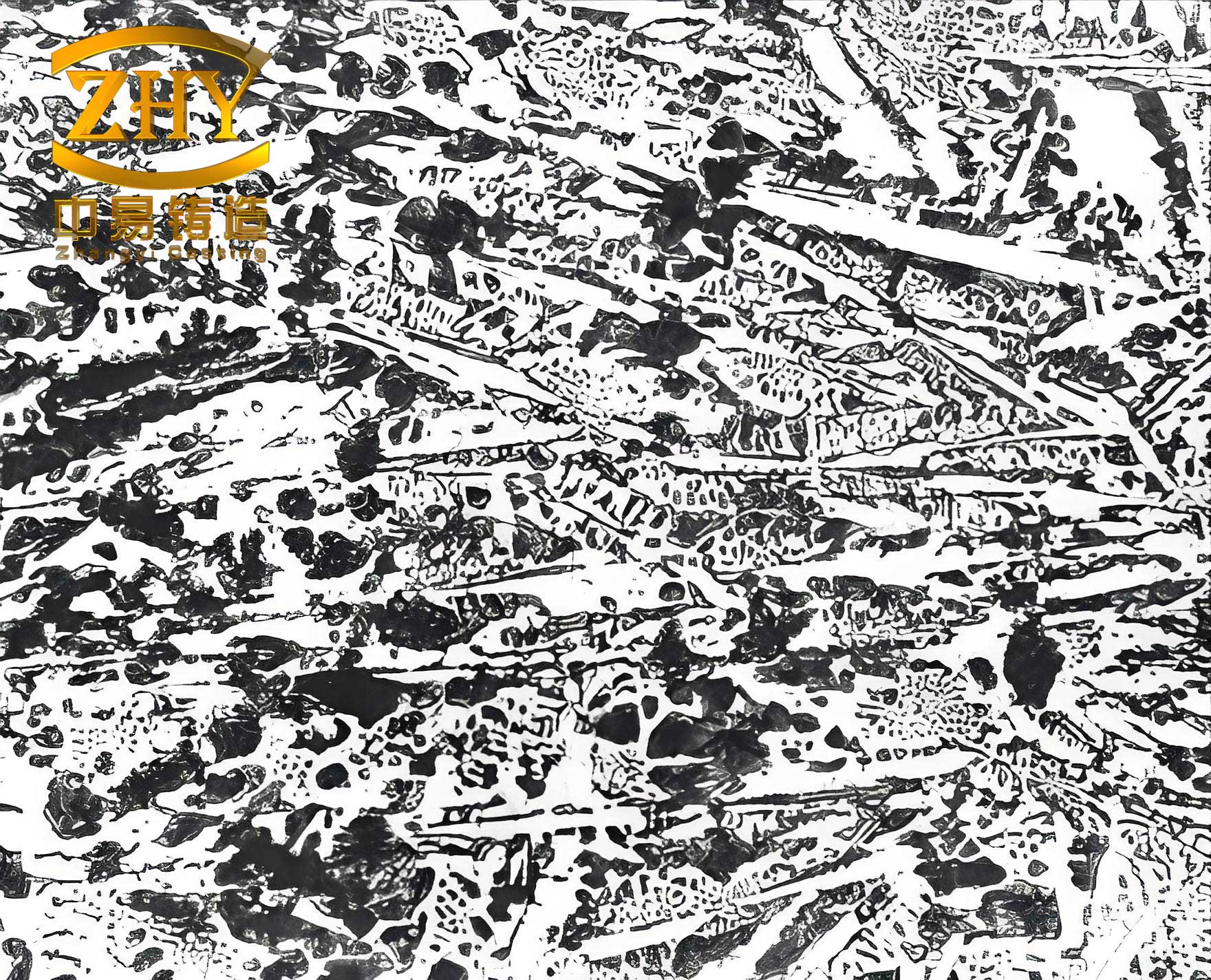
My microstructural analysis revealed profound changes induced by rare earth modification. In the unmodified tungsten alloy white cast iron (sample W0), the eutectic carbides formed a continuous, interconnected network throughout the matrix, which is typical for many unmodified white cast irons and often detrimental to toughness. Upon RE addition, a remarkable transformation occurred. As the residual RE content increased, the carbide morphology evolved from a continuous network to a broken or disconnected network, and further towards isolated blocky particles. To quantify this change, I employed image analysis to measure the shape factor of the carbides, defined as the total perimeter (P) of carbides divided by their total area (A) in a given micrograph. For a constant volume fraction, a higher P/A ratio signifies a more discrete, less interconnected carbide structure. The results are tabulated in Table 4.
| Sample | Total Perimeter, P (μm) | Total Area, A (μm²) | Shape Factor, P/A (μm⁻¹) |
|---|---|---|---|
| W0 | 566841.40 | 2214363.18 | 0.26 |
| W1 | 726195.82 | 2197608.25 | 0.33 |
| W2 | 787213.06 | 2243007.69 | 0.35 |
| W3 | 798438.51 | 2220594.35 | 0.36 |
The increasing P/A ratio clearly demonstrates that RE modification promotes carbide fragmentation and isolation. Furthermore, RE addition resulted in a noticeable grain refinement of the matrix. These microstructural alterations are primarily attributed to the role of rare earth elements as strong deoxidizers and desulfurizers, which purify the melt and modify the solidification process. Rare earth elements also adsorb at the growing interface of carbides, altering their growth kinetics and leading to a more refined and isolated morphology. This improved carbide distribution is critical for enhancing the toughness of white cast iron.
The mechanical properties of the tungsten alloy white cast iron were significantly influenced by RE modification. As shown in Figure 1 (data summarized in Table 5), the hardness of the white cast iron remained relatively stable across different RE levels, fluctuating within a narrow range. This indicates that the primary hardening constituents—the carbides—retained their intrinsic hardness, and RE modification did not substantially alter the overall volume fraction of hard phases. However, the impact on toughness was dramatic. The impact toughness, a key indicator of resistance to fracture under shock loading, increased markedly with optimal RE addition. Sample W2, with 0.120% residual RE, exhibited the peak impact toughness, representing an improvement of approximately 37.6% over the unmodified white cast iron. This enhancement is a direct consequence of the transition from a continuous carbide network to a broken network, which hinders crack propagation. When a crack initiates, it encounters isolated carbide blocks rather than a continuous brittle path, thereby absorbing more energy before failure. Interestingly, excessive RE addition (sample W3) led to a slight decline in toughness. I attribute this to the increased inclusion content from RE compounds, which might act as stress concentrators and weaken grain boundaries, offsetting the benefits of carbide modification.
| Sample | Hardness (HRC) | Impact Toughness (J/cm²) | % Increase in Toughness vs. W0 |
|---|---|---|---|
| W0 | 58.2 | 4.8 | 0.0 |
| W1 | 58.5 | 5.9 | 22.9 |
| W2 | 58.8 | 6.6 | 37.6 |
| W3 | 58.0 | 6.1 | 27.1 |
The wear resistance results were equally compelling. Figure 2 and Table 6 present the relative wear resistance (β) of the modified tungsten alloy white cast iron samples, alongside reference values for commercial high-chromium cast iron and nickel-hard cast iron. The unmodified tungsten alloy white cast iron already possessed decent wear resistance, but RE modification elevated it substantially. Sample W2 showed the best performance, with a relative wear resistance about 35.4% higher than the unmodified version. This improvement stems from the synergistic effect of maintained high hardness and enhanced toughness. Under repetitive impact-abrasion, a material with isolated carbides experiences less severe carbide fracture and spalling. The tougher matrix better supports the hard carbides, preventing their premature removal from the surface. Consequently, the surface remains intact and resistant to abrasion for a longer period. Notably, the wear resistance of the optimally modified tungsten alloy white cast iron surpassed that of nickel-hard cast iron and approached the level of high-chromium cast iron, a benchmark for abrasion-resistant white cast irons.
| Material | Relative Wear Resistance (β) | Notes |
|---|---|---|
| Unmodified Tungsten Alloy White Cast Iron (W0) | 1.00 (Baseline) | Normalized to W0 for comparison |
| RE Modified Tungsten Alloy White Cast Iron (W2) | 1.354 | 35.4% improvement over W0 |
| High-Chromium Cast Iron (Reference) | ~1.40 | Typical commercial grade |
| Nickel-Hard Cast Iron (Reference) | ~1.20 | Type IV, for comparison |
To understand the wear mechanism in a more quantitative manner, I considered a simplified model for material loss during abrasion. The volume loss \(\Delta V\) can be related to the applied load \(L\), sliding distance \(S\), and material properties. For materials with hard carbides in a metallic matrix, an approximate relation is often used:
$$\Delta V \propto \frac{L \cdot S}{H \cdot K_{IC}^n}$$
where \(H\) is the hardness and \(K_{IC}\) is the fracture toughness. The exponent \(n\) depends on the wear mode. In impact-abrasion, both hardness and toughness are critical. My results show that RE modification increased toughness (\(K_{IC}\) effectively) while maintaining hardness (\(H\)), leading to a reduction in \(\Delta V\), which aligns with the observed increase in β. This formula, though simplified, helps rationalize why the modified white cast iron performs better.
The successful laboratory results prompted me to oversee field trials in industrial ball mills. Liner plates made from the optimally modified tungsten alloy white cast iron (composition corresponding to sample W2) were installed in a Ø1.5 m × 2.1 m ball mill for cylinder liners and a Ø3.6 m × 4.0 m ball mill for end liners. Over an extended operational period, these liners demonstrated exceptional performance. They operated safely and reliably with no instances of fracture or catastrophic failure—a common concern with brittle white cast irons. The service life was directly compared with traditional liners. The modified tungsten alloy white cast iron liners lasted as long as high-chromium cast iron liners, and their lifespan was 100% to 150% longer than that of high-manganese steel liners. This dramatic increase in service life translates to reduced downtime and maintenance costs.
From an economic perspective, the use of tungsten-slag ferro-alloy as the primary alloying source is a game-changer. A detailed cost analysis is presented in Table 7. The production cost per ton for this modified tungsten alloy white cast iron is close to that of high-manganese steel and approximately 30–40% lower than that of high-chromium cast iron. This cost advantage, combined with superior or comparable performance, makes this material highly attractive for mining and cement industries seeking to optimize their grinding operations.
| Material | Estimated Production Cost (Monetary Units) | Relative Cost (%) | Key Cost Drivers |
|---|---|---|---|
| High-Manganese Steel | 100 (Baseline) | 100 | Alloy steel scrap, manganese |
| High-Chromium Cast Iron | 155 – 165 | 155 – 165 | High-cost ferro-chrome, molybdenum, nickel |
| RE Modified Tungsten Alloy White Cast Iron | 105 – 110 | 105 – 110 | Pig iron, steel scrap, low-cost tungsten-slag ferro-alloy, RE ferrosilicon |
Furthermore, the utilization of tungsten-slag, an industrial waste product, aligns with principles of sustainable manufacturing and circular economy. It provides a valuable outlet for a material that would otherwise require disposal, reducing environmental impact and adding economic value to a waste stream. This aspect underscores the broader significance of developing such advanced white cast iron materials.
In conclusion, my research establishes that rare earth modification is a highly effective technique for enhancing the performance of tungsten alloy white cast iron. By adding an optimal amount of rare earth (around 1.2% addition, yielding ~0.12% residual RE), the microstructure of the white cast iron is transformed: the detrimental continuous carbide network is broken into a discontinuous, isolated morphology. This microstructural refinement leads to a significant improvement in impact toughness (up by ~37.6%) without compromising the inherent hardness of the white cast iron. Consequently, the wear resistance under impact-abrasion conditions is boosted by over 35%, bringing it to a level comparable with premium high-chromium cast iron. The strategic use of low-cost tungsten-slag ferro-alloy makes this high-performance white cast iron economically viable, with production costs similar to conventional high-manganese steel. Field applications in ball mill liners have confirmed its reliability, safety, and extended service life. This work not only presents a superior material for demanding wear applications but also demonstrates a successful pathway for valorizing industrial by-products in the development of advanced white cast iron alloys. Future work could explore the synergistic effects of other modifiers or heat treatment variations to further push the boundaries of this versatile class of white cast iron materials.