
In my research, I focus on the development and optimization of multi-alloying high chromium white cast iron, a material renowned for its exceptional wear resistance and mechanical properties. White cast iron, particularly the high chromium variant, has found widespread applications in industries such as metallurgy, building materials, power generation, and coal mining due to its superior performance. However, the high cost associated with alloying elements like chromium and molybdenum necessitates compositional adjustments and tailored heat treatments to maintain or enhance properties while reducing expenses. This study delves into the design of chemical composition, the effects of various heat treatment processes on microstructure and mechanical properties, and the machinability of this advanced white cast iron. Through systematic experimentation, I aim to provide insights that can broaden the applicability of high chromium white cast iron in demanding environments.
The fundamental appeal of high chromium white cast iron lies in its unique microstructure, which combines hard carbides with a tough matrix. In this multi-alloying approach, I incorporate elements such as copper, nickel, vanadium, titanium, boron, and niobium alongside chromium and molybdenum to refine the microstructure and improve overall performance. The primary goal is to achieve a balance between cost-effectiveness and properties like hardness, impact toughness, and wear resistance. This white cast iron variant is poised to partially replace more expensive alloys like Cr15Mo3 white cast iron, offering a competitive edge in industrial applications.
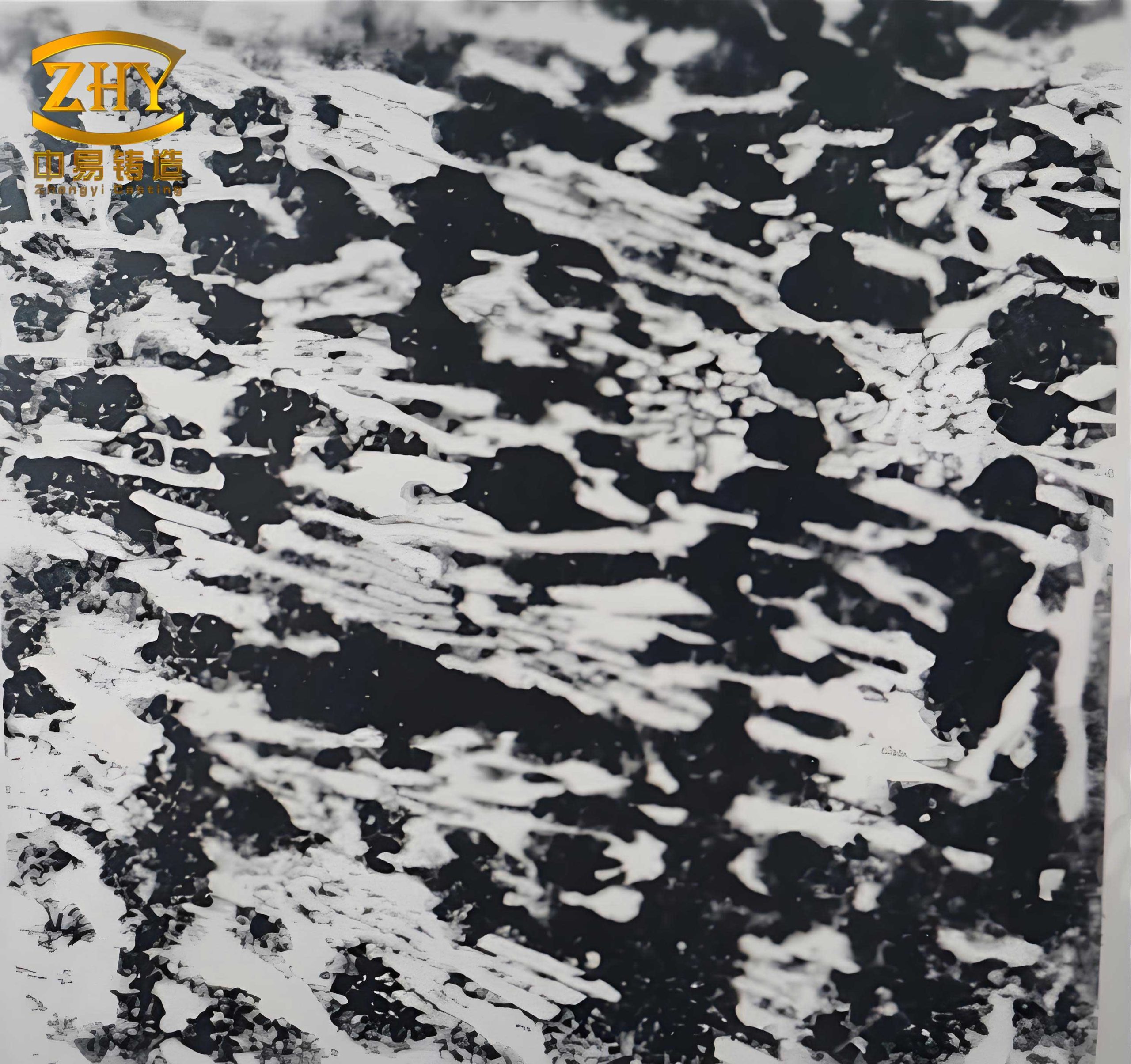
Designing the chemical composition of multi-alloying high chromium white cast iron is critical for achieving desired properties. The key elements and their roles are summarized in Table 1. Chromium is pivotal in determining carbide type and distribution; at levels between 10% and 20%, it promotes the formation of (Fe, Cr)7C3 carbides, which are harder and more wear-resistant than other carbide types. Carbon content influences the volume fraction of carbides, and the Cr/C ratio is optimized around 5 to ensure optimal carbide morphology. Silicon, manganese, molybdenum, copper, vanadium, and titanium are added in specific ranges to enhance hardenability, refine grains, and improve wear resistance without significantly increasing costs.
| Element | Range (%) | Primary Function | Effect on White Cast Iron |
|---|---|---|---|
| Carbon (C) | 2.2–2.8 | Controls carbide volume | Increases hardness and wear resistance; affects machinability |
| Chromium (Cr) | 11.0–14.0 | Determines carbide type | Promotes (Fe, Cr)7C3 carbides; enhances corrosion and wear resistance |
| Silicon (Si) | 0.6–0.9 | Improves solidification | Refines microstructure; moderate graphite promotion |
| Manganese (Mn) | 0.4–0.8 | Enhances hardenability | Supports carbide formation; increases hardness |
| Molybdenum (Mo) | 0.1–0.2 | Boosts淬透性 | Improves depth of hardening; adds wear-resistant phases |
| Copper (Cu) | 0.2–0.5 | Strengthens matrix | Precipitation hardening; refines grains |
| Vanadium (V) | 0.1–0.4 | Refines carbides | Improves carbide morphology; enhances toughness |
| Titanium (Ti) | Trace | Grain refinement | Reduces grain size; improves mechanical properties |
The relationship between carbide type and carbon-chromium content can be expressed using phase diagrams. For high chromium white cast iron, the formation of (Fe, Cr)7C3 carbides is favored when the Cr/C ratio is between 4 and 6. This can be modeled as:
$$ \text{Cr/C} = 5 \pm 1 \quad \text{for optimal (Fe, Cr)}_7\text{C}_3 \text{ formation} $$
Additionally, the volume fraction of carbides (K) in white cast iron can be estimated from carbon and chromium content using an empirical formula:
$$ K = (11.3 \times C + 0.5 \times Cr – 13.4)\% $$
where C and Cr are in weight percent. This formula highlights the synergistic effect of carbon and chromium on carbide formation in white cast iron.
In my experimental approach, I melted the multi-alloying high chromium white cast iron in a medium-frequency induction furnace. The molten metal was poured into 12 sets of specimens with dimensions 20 mm × 20 mm × 110 mm, each set comprising four specimens from the same heat. After casting, the specimens were divided into four groups (A, B, C, D) to undergo different heat treatment processes, ensuring each group contained specimens from all 12 heats with identical compositions. The heat treatment regimes were as follows:
- Group A: As-cast condition (no heat treatment).
- Group B: Softening annealing—heated to 950°C, held for 3 hours, slowly cooled to 800°C, held for 3 hours, then furnace-cooled to 250°C and air-cooled.
- Group C: Softening annealing followed by quenching and tempering—same annealing as Group B, then heated to 950°C for 3 hours and air-cooled (quenching), followed by tempering at 200°C for 4 hours and air-cooled.
- Group D: Quenching and tempering directly from as-cast state—heated to 950°C for 3 hours and air-cooled, then tempered at 200°C for 4 hours and air-cooled.
All heat treatments were conducted in a box-type electric furnace. After treatment, I evaluated the mechanical properties, including impact toughness (aK) using a JB30A impact tester per GB3180-82 standard, and hardness (HRC) using a Rockwell hardness tester. Microstructural analysis was performed with an XJG-04 metallographic microscope and an HXD-1000A microhardness tester. The chemical composition of each specimen was verified, as shown in Table 2.
| Specimen No. | C | Si | Mn | Cr | Cu | Mo | V | Ti |
|---|---|---|---|---|---|---|---|---|
| 1 | 2.24 | 0.89 | 0.79 | 11.80 | 0.34 | 0.12 | 0.12 | Trace |
| 2 | 2.72 | 0.84 | 0.62 | 13.14 | 0.28 | 0.12 | 0.15 | Trace |
| 3 | 2.58 | 0.78 | 0.41 | 11.03 | 0.49 | 0.18 | 0.15 | Trace |
| 4 | 2.38 | 0.70 | 0.38 | 11.39 | 0.45 | 0.17 | 0.15 | Trace |
| 5 | 2.58 | 0.96 | 0.63 | 14.30 | 0.45 | 0.14 | 0.12 | Trace |
| 6 | 2.07 | 0.61 | 0.42 | 10.48 | 0.36 | 0.18 | 0.09 | Trace |
| 7 | 2.83 | 0.78 | 0.52 | 12.64 | 0.32 | 0.10 | 0.16 | Trace |
| 8 | 2.24 | 0.70 | 0.66 | 10.89 | 0.15 | 0.10 | 0.11 | Trace |
| 9 | 2.22 | 0.74 | 0.41 | 11.39 | 0.26 | 0.14 | 0.24 | Trace |
| 10 | 2.40 | 0.81 | 0.43 | 11.89 | 0.42 | 0.15 | 0.12 | Trace |
| 11 | 1.63 | 0.81 | 0.45 | 11.21 | 0.25 | 0.19 | 0.15 | Trace |
| 12 | 2.23 | 0.70 | 0.43 | 12.17 | 0.33 | 0.16 | 0.15 | Trace |
The mechanical properties of the white cast iron specimens are summarized in Table 3 for impact toughness and Table 4 for hardness. The data reveal significant variations in both properties across different heat treatment conditions, underscoring the importance of thermal processing for multi-alloying high chromium white cast iron.
| Specimen No. | Group A (As-cast) | Group B (Annealed) | Group C (Annealed + Quenched + Tempered) | Group D (Quenched + Tempered) |
|---|---|---|---|---|
| 1 | 7.91 | 4.54 | 15.33 | 12.80 |
| 2 | 9.82 | 4.56 | 16.44 | 11.90 |
| 3 | 16.35 | 8.12 | 12.59 | 9.09 |
| 4 | 11.64 | 5.35 | 8.22 | 10.73 |
| 5 | 10.68 | 5.15 | 10.76 | 12.13 |
| 6 | 13.90 | 10.73 | 10.74 | 8.78 |
| 7 | 9.84 | 8.83 | 7.67 | 11.81 |
| 8 | 5.90 | 12.02 | 14.79 | 13.76 |
| 9 | 14.94 | 9.34 | 17.37 | 13.60 |
| 10 | 14.15 | 6.84 | 9.03 | 15.36 |
| 11 | 10.92 | 13.57 | 10.85 | 9.52 |
| 12 | 11.50 | 10.69 | 13.13 | 12.42 |
| Average | 11.40 | 8.31 | 12.24 | 11.83 |
| Specimen No. | Group A (As-cast) | Group B (Annealed) | Group C (Annealed + Quenched + Tempered) | Group D (Quenched + Tempered) |
|---|---|---|---|---|
| 1 | 52.0 | 32.0 | 57.0 | 63.0 |
| 2 | 54.5 | 33.0 | 63.0 | 66.0 |
| 3 | 47.5 | 31.0 | 58.5 | 66.5 |
| 4 | 44.0 | 31.5 | 61.5 | 64.0 |
| 5 | 58.0 | 34.0 | 62.0 | 65.0 |
| 6 | 56.0 | 27.5 | 63.0 | 66.0 |
| 7 | 57.5 | 34.0 | 59.0 | 63.0 |
| 8 | 53.5 | 26.0 | 58.0 | 62.0 |
| 9 | 44.0 | 26.0 | 63.0 | 64.0 |
| 10 | 45.0 | 33.0 | 60.0 | 66.0 |
| 11 | 38.0 | 21.5 | 45.3 | 48.0 |
| 12 | 47.0 | 35.5 | 60.5 | 64.0 |
| Average | 49.75 | 30.4 | 59.2 | 63.1 |
Analyzing the results, I observe that the as-cast white cast iron (Group A) exhibits considerable scatter in both impact toughness and hardness, with averages of 11.40 J/cm² and 49.75 HRC, respectively. This variability stems from microstructural inhomogeneities, such as segregation and irregular carbide distributions, inherent in the casting process. Therefore, I conclude that multi-alloying high chromium white cast iron should not be used directly in the as-cast state for critical applications unless precise casting controls are implemented.
Softening annealing (Group B) significantly reduces hardness to an average of 30.4 HRC, improving machinability, but at the cost of impact toughness, which drops by approximately 30-60% compared to the as-cast condition. This trade-off must be considered during machining operations to avoid brittle fracture. The annealed microstructure consists of eutectic carbides and spheroidized pearlite, which facilitates cutting but compromises toughness.
Group C specimens, subjected to softening annealing followed by quenching and tempering, achieve the highest average impact toughness (12.24 J/cm²) among all groups, coupled with a hardness of 59.2 HRC. This dual heat treatment homogenizes the microstructure through two austenitization cycles, reducing偏析 and enhancing toughness. In contrast, Group D specimens (quenched and tempered directly from as-cast) exhibit the highest average hardness (63.1 HRC) with slightly lower impact toughness (11.83 J/cm²). The microstructure in both Groups C and D comprises eutectic (Fe, Cr)7C3 carbides embedded in a martensitic matrix with dispersed secondary carbides, contributing to superior wear resistance.
The relationship between carbide volume and mechanical properties in white cast iron can be quantified. For a fixed Cr/C ratio, impact toughness decreases with increasing carbide volume fraction, while hardness increases. This inverse correlation is critical for designing white cast iron for specific applications. I derived a linear regression model to describe the hardness of annealed white cast iron as a function of carbon content:
$$ \text{HRC} = 5.2362 + 10.4742 \times C(\%) $$
where C is the carbon content in weight percent. The correlation coefficient (T) is 0.8776, indicating a strong linear relationship. This equation underscores the dominant role of carbon in determining the machinability of high chromium white cast iron after softening annealing.
Microstructural analysis reveals diverse as-cast structures, including “ledeburite [(Fe, Cr)7C3 + pearlite] + austenite,” “ledeburite + austenite,” and “ledeburite + pearlite.” Specimens with austenitic matrices tend to have higher impact toughness, while those with pearlitic bases show lower toughness. After heat treatments, the microstructure evolves to a more uniform distribution of carbides in a martensitic matrix, as seen in Groups C and D. The morphology of carbides—whether blocky, worm-like, or interconnected—also influences properties; for instance, well-dispersed carbides enhance toughness by reducing stress concentrations.
Machinability of multi-alloying high chromium white cast iron is primarily governed by carbon and chromium content. Under constant chromium levels, carbon content dictates hardness after annealing, as shown in the linear equation above. For optimal machinability, I recommend a carbon range of 2.4% to 2.8%, which balances ease of cutting with adequate wear resistance. Chromium affects machinability indirectly by altering carbide morphology; at levels above 12%, carbides become more compact, mitigating adverse effects on machining. The addition of vanadium and titanium further refines carbides, improving machinability and overall performance of white cast iron.
In practical terms, this multi-alloying high chromium white cast iron demonstrates hardness comparable to high-carbon variants like “15-3HC” white cast iron but with better machinability similar to low-carbon “15-3LC” types. This makes it suitable for applications involving impact and abrasive wear, such as in mining equipment or cement machinery. The cost reduction achieved by optimizing alloying elements, particularly by lowering molybdenum and incorporating copper, enhances its economic viability without sacrificing key properties.
To summarize, my findings on multi-alloying high chromium white cast iron lead to several key conclusions. First, this white cast iron should not be used in the as-cast state due to inconsistent mechanical properties; heat treatment is essential for reliability. Second, the combination of softening annealing, quenching, and tempering yields the highest impact toughness, while direct quenching and tempering provides the highest hardness, making the latter ideal for wear-resistant components. Third, machinability is strongly linked to carbon content, with the derived linear equation serving as a useful guide for material selection. Fourth, the Cr/C ratio should be maintained around 5 to ensure optimal carbide formation and balanced properties. Finally, this advanced white cast iron offers a promising alternative to traditional high-cost alloys, expanding its use in demanding industrial environments.
Future work could explore the effects of additional alloying elements or alternative heat treatment cycles on the performance of white cast iron. Moreover, field trials in real-world applications would validate the laboratory findings and further optimize this material for specific conditions. The versatility and adaptability of high chromium white cast iron continue to drive innovation in抗磨 materials science.