
In the automotive industry, the demand for high-performance and cost-effective components has driven extensive research into advanced manufacturing techniques. Among these, nodular cast iron, also known as ductile iron, has emerged as a critical material due to its exceptional combination of strength, ductility, and castability. Specifically, camshafts made from nodular cast iron offer superior wear resistance and fatigue life compared to traditional materials. However, the inherent “mushy zone” solidification behavior of nodular cast iron often leads to defects such as shrinkage porosity and voids along the central axis of camshafts, compromising their structural integrity. To address these challenges, this study explores the application of shell mold casting for producing QT700-3 grade nodular cast iron camshafts, leveraging computational simulations and optimized process parameters to enhance quality and performance.
The primary motivation for investigating shell mold casting stems from its potential to overcome limitations associated with other methods like iron mold coated sand casting. While iron mold processes provide high rigidity, they involve significant initial investment, susceptibility to deformation under thermal cycling, and lack of interchangeability for different camshaft designs. Shell mold casting, with its resin-coated sand molds, offers a flexible and economical alternative, capable of producing complex geometries with fine surface finishes. This research aims to develop a robust shell mold casting process that ensures the mechanical properties and microstructural requirements of QT700-3 nodular cast iron are met, thereby expanding the production options for automotive manufacturers. Throughout this work, the term “nodular cast iron” will be emphasized to underscore the material’s unique graphite morphology, which is pivotal to its performance.
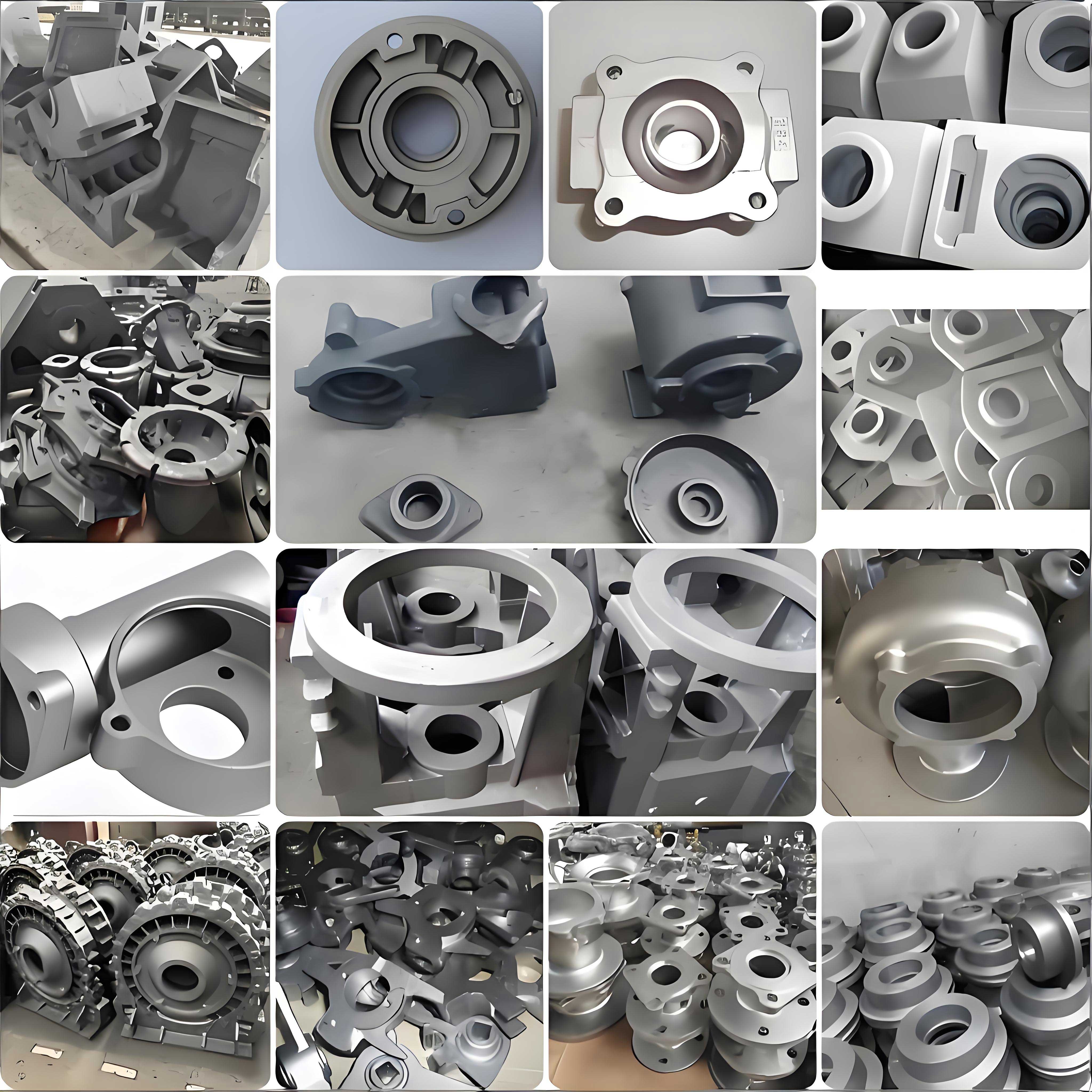
To achieve this, we conducted a comprehensive experimental and numerical analysis. The process began with the design of the casting layout, utilizing a one-mold-two-cavity configuration to maximize production efficiency while maintaining consistency. The gating system was designed as semi-closed, with the choke section at the ingate to minimize turbulence and slag inclusion. Critical to this study was the use of FLOW-3D CAST software for CAE numerical simulation, which allowed us to predict defect formation during filling and solidification. The simulation parameters included material properties for nodular cast iron, such as density variations from liquid to solid states, specific heat, and thermal conductivity, all essential for accurate modeling of the casting process. For instance, the heat transfer equation governing solidification can be expressed as: $$ \rho C_p \frac{\partial T}{\partial t} = \nabla \cdot (k \nabla T) + L \frac{\partial f_s}{\partial t} $$ where \( \rho \) is density, \( C_p \) is specific heat, \( T \) is temperature, \( t \) is time, \( k \) is thermal conductivity, \( L \) is latent heat, and \( f_s \) is solid fraction. This equation highlights the complex thermal dynamics involved in nodular cast iron solidification, which directly influences defect formation.
The shell mold thickness was strategically varied based on simulation insights. Typically, shell molds for nodular cast iron components range from 18 mm to 22 mm, but to enhance cooling rates in thicker sections prone to shrinkage, we reduced the thickness to 14 mm at the coarse shaft segments, while maintaining 18 mm elsewhere. This adjustment aimed to mitigate isolated liquid pockets that form during late-stage solidification, a common issue in nodular cast iron due to its wide freezing range. The shell mold preparation involved coated sand with specific properties, as summarized in Table 1, ensuring low gas evolution and adequate strength to withstand metal pressure. The curing process was optimized at temperatures between 190°C and 210°C for 100–120 seconds, resulting in a fully cured mold with a reddish-brown surface, indicative of proper resin activation.
| Property | Value |
|---|---|
| Grain Size | 70/140 mesh |
| Tensile Strength at Room Temperature | 5.0 MPa |
| Hot Tensile Strength | ≥2.5 MPa |
| Bending Strength at Room Temperature | ≥10 MPa |
| Gas Evolution at 850°C | ≤16.5 mL/g |
Melting and treatment processes were meticulously controlled to achieve the desired nodular cast iron microstructure. The base charge consisted of low-manganese steel scrap, with carbon adjusted using low-sulfur, low-nitrogen graphite-based carburizers. The chemical composition was tailored to promote a pearlitic matrix with sufficient ferrite for ductility, as outlined in Table 2. Copper was added in higher amounts compared to conventional iron mold processes to stabilize pearlite, given the slower cooling rates in shell mold casting. The nodularizing treatment employed rare-earth magnesium ferrosilicon at 1.3–1.5% of the melt weight, while inoculation used a silicon-calcium-barium alloy in three stages: ladle, stream during tapping, and during pouring. This multi-stage inoculation is crucial for enhancing graphite nucleation in nodular cast iron, leading to a finer and more uniform graphite distribution. The pouring temperature was maintained between 1,380°C and 1,420°C to ensure fluidity while minimizing gas dissolution.
| Element | Range |
|---|---|
| Carbon (C) | 3.7–3.9 |
| Silicon (Si) | 2.2–2.6 |
| Manganese (Mn) | 0.5–0.7 |
| Phosphorus (P) | ≤0.06 |
| Sulfur (S) | ≤0.05 |
| Copper (Cu) | 0.8–0.9 |
The microstructural analysis revealed significant insights into the behavior of nodular cast iron under shell mold conditions. Graphite morphology was examined at both cam and shaft sections, showing spheroidal graphite with high nodularity grades (2-1 level). The cam areas exhibited a graphite count of approximately 656 nodules/mm², sized at 6-7 grade, whereas the shaft sections had around 300 nodules/mm², sized at 5-7 grade. This disparity is attributed to faster cooling in thinner cam regions, which increases undercooling and promotes graphite nucleation. The relationship between cooling rate (\( R \)) and graphite nodule count (\( N \)) can be approximated by: $$ N = A \cdot R^n $$ where \( A \) and \( n \) are material constants. For nodular cast iron, higher cooling rates generally lead to finer graphite, enhancing mechanical properties. The matrix structure consisted of 85–95% pearlite and 5–15% ferrite, with no free cementite or phosphide eutectic, meeting the QT700-3 specifications. The pearlite content was higher in shaft areas due to slower cooling, which allows for greater carbon diffusion and pearlite formation, as described by the Avrami equation for phase transformation: $$ f = 1 – \exp(-k t^m) $$ where \( f \) is transformed fraction, \( k \) is rate constant, \( t \) is time, and \( m \) is an exponent dependent on nucleation and growth mechanisms.
Mechanical properties were evaluated through tensile testing of separately cast Y-block samples. The results, compiled in Table 3, demonstrate that the shell mold casting process consistently achieved tensile strengths above 700 MPa and elongations exceeding 3%, fulfilling the QT700-3 grade requirements. The enhanced copper addition played a vital role in strengthening the pearlitic matrix, compensating for the reduced cooling rate inherent in shell molds. This underscores the importance of alloy design in nodular cast iron production, where elements like copper inhibit ferrite formation and promote pearlite stability. The tensile strength (\( \sigma_t \)) of nodular cast iron can be correlated with microstructural parameters using empirical models, such as: $$ \sigma_t = \sigma_0 + K_d \cdot d^{-1/2} + K_f \cdot V_f $$ where \( \sigma_0 \) is base strength, \( d \) is graphite nodule diameter, \( V_f \) is ferrite volume fraction, and \( K_d \), \( K_f \) are constants. In this study, the fine graphite and controlled ferrite content contributed to the high performance.
| Sample ID | Tensile Strength (MPa) | Elongation (%) | Ferrite (%) | Pearlite (%) | Graphite Nodule Count (nodules/mm²) | Graphite Size Grade |
|---|---|---|---|---|---|---|
| 1 | 750 | 3.1 | 10 | 90 | 528 | 6-7 |
| 2 | 715 | 3.2 | 10 | 90 | 687 | 6-7 |
| 3 | 720 | 3.4 | 10 | 85 | 752 | 6-7 |
| 4 | 735 | 3.3 | 10 | 85 | 670 | 6-7 |
| 5 | 795 | 3.2 | 5 | 95 | 425 | 5-7 |
| 6 | 813 | 3.15 | 5 | 95 | 455 | 5-7 |
Defect analysis formed a crucial part of this investigation, with shrinkage porosity being the primary concern in nodular cast iron components. The CAE simulations predicted isolated liquid zones in thick shaft sections, leading to shrinkage cavities if not addressed. By reducing shell thickness at these locations, we increased the local cooling rate, thereby shortening the solidification time and improving feedability. The solidification time (\( t_s \)) can be estimated using Chvorinov’s rule: $$ t_s = B \left( \frac{V}{A} \right)^2 $$ where \( B \) is a mold constant, \( V \) is volume, and \( A \) is surface area. Decreasing shell thickness effectively reduces the \( V/A \) ratio, accelerating solidification. Other defects, such as gas holes and sand inclusions, were mitigated by using low-gas evolution coated sand, ensuring complete mold curing, and implementing effective slag trapping and filtration during pouring. For instance, the gas formation potential (\( G \)) during casting can be modeled as: $$ G = \int_0^t \phi(T) \, dt $$ where \( \phi(T) \) is gas evolution rate as a function of temperature. By minimizing \( G \) through material selection, we reduced porosity risks.
Furthermore, surface defects like folds and wrinkles were minimized by optimizing pouring parameters. Increasing the carbon equivalent improved fluidity, while higher pouring temperatures enhanced mold filling capability. The Reynolds number (\( Re \)) for molten nodular cast iron flow can be expressed as: $$ Re = \frac{\rho v D}{\mu} $$ where \( v \) is velocity, \( D \) is characteristic diameter, and \( \mu \) is dynamic viscosity. Maintaining a turbulent-free flow (low \( Re \)) through proper gating design reduced oxide formation and surface imperfections. These measures collectively ensured the production of sound camshafts with minimal post-casting rework.
In conclusion, this study successfully demonstrates the feasibility of shell mold casting for high-strength QT700-3 nodular cast iron camshafts. The key findings highlight that a one-mold-two-cavity layout with a semi-closed gating system, combined with variable shell thicknesses (14 mm at thick sections and 18 mm elsewhere), effectively prevents shrinkage defects along the central axis. The microstructural analysis confirms that nodular cast iron produced via this method exhibits fine, uniformly distributed graphite nodules and a pearlite-dominated matrix, meeting stringent automotive standards. Enhanced copper additions and rigorous inoculation treatments are essential to compensate for slower cooling rates, ensuring consistent mechanical properties. Future work could explore the integration of real-time monitoring systems to further optimize process parameters for nodular cast iron applications. Overall, shell mold casting presents a viable and economical alternative for manufacturing complex nodular cast iron components, contributing to the advancement of foundry technologies.