
In the production of spheroidal graphite cast iron, maintaining consistent mechanical properties is a critical challenge. One significant issue that often arises is the formation of a surface deterioration layer, commonly referred to as a “degenerated layer,” which consists of flake or vermicular graphite near the casting surface. This layer severely compromises fatigue strength and service life, posing substantial safety risks in industrial applications. The presence of such deterioration is particularly problematic in spheroidal graphite cast iron components used in high-stress environments, such as automotive or railway parts. In this study, we investigate three primary factors influencing the depth and characteristics of the surface deterioration layer in spheroidal graphite cast iron: sulfur content from molding materials, environmental humidity effects on sand molds, and casting design along with process parameters. Our aim is to provide quantitative insights and practical guidelines to mitigate this issue, thereby enhancing the reliability and performance of spheroidal graphite cast iron castings.
The formation of the deterioration layer is primarily attributed to the depletion of effective residual magnesium at the casting surface. Magnesium is crucial for promoting graphite spheroidization in spheroidal graphite cast iron. When sulfur-bearing compounds from molding materials decompose at high temperatures, they release sulfur gases that react with magnesium in the molten iron, reducing its availability and leading to graphite degeneration. Similarly, moisture absorption by sand molds can introduce hydrogen or oxygen, further exacerbating the problem. Additionally, turbulent flow during mold filling can entrain air or gases, contributing to localized deterioration. Understanding these mechanisms is essential for optimizing casting processes. In this article, we present experimental results from controlled studies, analyze data using statistical models, and propose strategies to minimize surface deterioration in spheroidal graphite cast iron components.
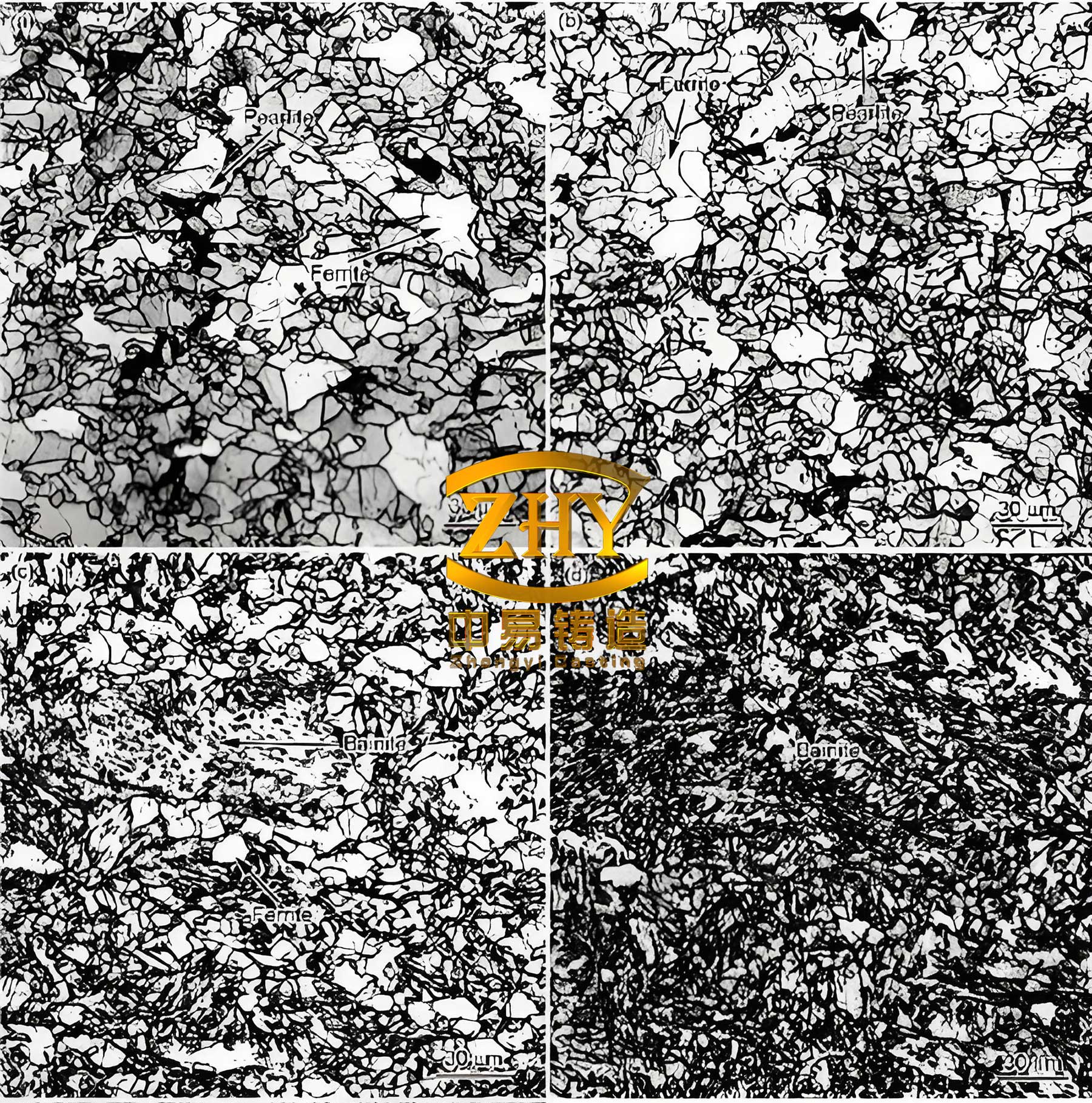
Our research methodology involved a series of experiments designed to isolate and quantify the effects of each factor. We used a standard spheroidal graphite cast iron grade equivalent to QT450-10, with controlled chemical composition as shown in Table 1. Melting was conducted in a medium-frequency induction furnace, and pouring temperatures were maintained within a narrow range to ensure consistency. The molding materials included呋喃树脂砂 (furan resin sand) and phenolic resin-coated sand, both common in industrial practices. For each experiment, we prepared multiple test samples, conducted metallographic analysis, and measured deterioration layer depths using optical microscopy. The results are presented with tables and mathematical models to elucidate the relationships.
| Element | Control Range (wt.%) |
|---|---|
| C | 3.60–3.80 |
| Si | 2.70–2.90 |
| Mn | 0.20–0.30 |
| S | ≤0.15 |
| P | ≤0.25 |
| Mg | 0.03–0.05 |
| RE | 0.5–0.7 |
The first experiment focused on the impact of sulfur content from coatings on the surface deterioration layer. We prepared alcohol-based alumina coatings with varying sulfur additions, using pure sulfur powder (99% purity) at mass fractions of 0%, 0.5%, 1.0%, and 1.5%. These coatings were applied to Y-block sand molds made from furan resin sand, with a resin content of 1% by sand weight and a curing agent (p-toluene sulfonic acid) at 30–60% of resin weight. To prevent sulfur loss during drying, the coated molds were naturally dried and then oven-dried. Each configuration was poured with spheroidal graphite cast iron at 1,400 °C ± 10 °C, and three samples per group were analyzed. The deterioration layer depth was measured at the mid-section of each sample, with results summarized in Table 2.
| Coating Type | Max Depth (mm) | Min Depth (mm) | Average Depth (mm) | Standard Deviation (mm) |
|---|---|---|---|---|
| No coating | 2.3 | 1.2 | 1.7 | 0.45 |
| 0.5% S coating | 3.1 | 2.3 | 2.7 | 0.35 |
| 1.0% S coating | 4.2 | 2.7 | 3.5 | 0.60 |
| 1.5% S coating | 7.0 | 2.5 | 3.6 | 1.80 |
The data indicate a clear correlation between sulfur content and deterioration layer depth. As sulfur increases, the average depth rises, but more notably, the variability (standard deviation) also increases, suggesting uneven sulfur penetration or reaction kinetics. We modeled this relationship using a linear regression, where the deterioration layer depth \( d \) (in mm) is a function of sulfur content \( S \) (in wt.%):
$$ d = \alpha + \beta S + \epsilon $$
For our data, the estimated parameters are \( \alpha = 1.65 \) and \( \beta = 1.40 \), with an \( R^2 \) value of 0.89, indicating a strong positive trend. However, the non-uniformity at higher sulfur levels implies additional factors, such as local temperature gradients or gas diffusion barriers. The use of coatings without sulfur effectively reduced the depth, highlighting the importance of low-sulfur molding materials in producing high-quality spheroidal graphite cast iron.
To further explore the sulfur effect, we consider the reaction kinetics between sulfur and magnesium at the mold-metal interface. The rate of magnesium depletion can be described by a diffusion-controlled model:
$$ \frac{\partial [Mg]}{\partial t} = D \nabla^2 [Mg] – k [S] $$
where \( [Mg] \) is the magnesium concentration, \( D \) is the diffusion coefficient, \( [S] \) is the sulfur concentration, and \( k \) is the reaction rate constant. This equation suggests that higher sulfur concentrations accelerate magnesium loss, leading to deeper deterioration layers. In practice, applying a barrier coating can reduce \( [S] \) at the interface, thereby mitigating the effect. Our findings align with prior studies on spheroidal graphite cast iron, emphasizing the need for stringent control of sulfur in foundry consumables.
The second experiment examined the influence of environmental humidity on the surface deterioration layer. We used phenolic resin-coated sand molds (shell molds) produced via a shooting process at 0.5 MPa pressure, cured at 250 °C ± 20 °C for 100 seconds. These molds were initially dried at 200 °C for 2 hours to eliminate residual moisture. Then, they were exposed to a high-humidity environment (95% relative humidity at 30 °C) for varying durations: 0 hours (dry), 12 hours, 24 hours, and 36 hours. After exposure, spheroidal graphite cast iron was poured into the molds, and the resulting samples were analyzed for surface deterioration. The results are presented in Table 3.
| Exposure Time (hours) | Max Depth (mm) | Min Depth (mm) | Average Depth (mm) | Standard Deviation (mm) |
|---|---|---|---|---|
| 0 (dry) | 0 | 0 | 0 | 0 |
| 12 | 0.27 | 0.25 | 0.26 | 0.01 |
| 24 | 0.7 | 0.25 | 0.48 | 0.18 |
| 36 | 1.5 | 1.2 | 1.35 | 0.12 |
Unlike the sulfur-induced deterioration, the humidity-related deterioration layer showed relatively uniform thickness, as indicated by low standard deviations for longer exposures. This uniformity suggests a consistent mechanism, such as uniform moisture absorption across the mold surface. The depth increased progressively with exposure time, following a saturating exponential trend:
$$ d(t) = d_{\infty} (1 – e^{-t/\tau}) $$
where \( d(t) \) is the depth at time \( t \), \( d_{\infty} \) is the asymptotic depth, and \( \tau \) is the time constant. Fitting our data yields \( d_{\infty} \approx 1.4 \) mm and \( \tau \approx 20 \) hours. This model implies that moisture absorption reaches equilibrium over time, and the deterioration depth stabilizes. For spheroidal graphite cast iron production, it is advisable to limit mold storage in humid conditions to less than 24 hours to minimize this effect.
The role of moisture in promoting deterioration can be explained by the formation of hydrogen or steam at the mold-metal interface. Water vapor may react with magnesium or carbon in the iron, leading to decarburization or magnesium oxide formation. The reaction can be represented as:
$$ \text{H}_2\text{O} + \text{Mg} \rightarrow \text{MgO} + \text{H}_2 $$
This consumes effective magnesium, similar to sulfur, but with different diffusion characteristics. The uniformity of the layer suggests that moisture penetration is homogeneous, unlike sulfur gases that may localize due to thermal gradients. Therefore, controlling environmental humidity and using moisture-resistant coatings are key strategies for improving spheroidal graphite cast iron quality.
The third experiment addressed casting design and process parameters, inspired by a case study of a spheroidal graphite cast iron component (QT500-7 grade) used in braking systems. This part experienced fatigue failures at specific locations, and metallurgical analysis revealed through-thickness deterioration layers, as shown in the macro image. We simulated the filling and solidification processes using computational fluid dynamics (CFD) to identify root causes. The simulation indicated turbulent flow and molten iron impingement at the failure sites, where front-end streams converged. This turbulence likely entrapped air or gases, leading to localized magnesium depletion.
To quantify the effect, we designed a test casting with intentional flow convergence and compared it to a modified design featuring a bottom-gating system. The results are summarized in Table 4. The original design showed deterioration depths up to 5 mm, often penetrating the entire section, while the modified design reduced depths to below 1 mm. This highlights the critical role of gating design in spheroidal graphite cast iron casting.
| Casting Design | Flow Characteristics | Max Deterioration Depth (mm) | Remarks |
|---|---|---|---|
| Original (top-gating) | Turbulent, front-end convergence | 5.0 | Penetrating layer observed |
| Modified (bottom-gating) | Laminar, no convergence | 0.8 | Superficial layer only |
The mechanism here involves gas entrainment and rapid cooling at the convergence zone. Entrained air introduces oxygen, which reacts with magnesium, while turbulence disrupts the thermal field, affecting solidification kinetics. We can model the effective magnesium loss due to entrainment as:
$$ \Delta [Mg] = \int_{0}^{t_c} k_g [O] \, dt $$
where \( \Delta [Mg] \) is the magnesium loss, \( k_g \) is a gas-reaction constant, \( [O] \) is oxygen concentration, and \( t_c \) is the contact time. Longer \( t_c \) or higher \( [O] \) leads to greater deterioration. Therefore, designing gating systems to minimize turbulence and avoid flow convergence is essential for spheroidal graphite cast iron integrity.
In addition to gating, other process parameters like pouring temperature and mold coating influence deterioration. Higher pouring temperatures can increase sulfur or moisture reactivity, but also improve fluidity, which may reduce entrainment. We conducted a supplemental experiment varying pouring temperature from 1,350 °C to 1,450 °C, with results indicating an optimal range around 1,400 °C for minimal deterioration. This trade-off can be expressed with a cost function:
$$ C(T) = \alpha e^{-\beta T} + \gamma T $$
where \( C \) is the deterioration depth, \( T \) is temperature, and \( \alpha, \beta, \gamma \) are constants. Minimizing \( C \) requires balancing reactivity and fluidity.
Beyond experimental results, we discuss broader implications for the foundry industry. Spheroidal graphite cast iron is widely used in sectors like automotive, aerospace, and heavy machinery due to its excellent ductility and strength. However, surface deterioration remains a persistent quality issue, often detected only through destructive testing. Non-destructive evaluation methods, such as ultrasonic testing or eddy current, could be developed based on our findings to assess deterioration layers in situ. Furthermore, advanced molding materials with low sulfur and moisture absorption should be promoted for critical spheroidal graphite cast iron components.
Our study also touches on the economic aspects. Reducing deterioration layers can decrease scrap rates and post-processing costs, enhancing overall profitability. For instance, if deterioration depth exceeds 2 mm in a 10 mm thick casting, the part may require machining or be rejected, adding significant expense. By implementing our recommendations—such as using sulfur-free coatings, controlling mold storage humidity, and optimizing gating design—foundries can achieve more consistent spheroidal graphite cast iron quality.
In conclusion, the surface deterioration layer in spheroidal graphite cast iron is influenced by multiple interacting factors. Sulfur content from molding materials directly increases deterioration depth and variability, with a linear relationship quantified in our experiments. Environmental humidity causes gradual and uniform deterioration, modeled well by an exponential saturation curve. Casting design and process parameters, particularly flow convergence and gas entrainment, can lead to severe, penetrating deterioration layers. To mitigate these issues, we recommend: (1) using low-sulfur coatings and binders in mold production, (2) limiting mold exposure to high humidity environments to less than 24 hours, and (3) designing gating systems to ensure laminar flow and avoid molten iron impingement. These strategies will help maintain effective residual magnesium at the casting surface, ensuring the superior mechanical properties that make spheroidal graphite cast iron a material of choice for demanding applications.
Future work could explore synergistic effects between factors, such as combined sulfur and humidity exposure, or develop predictive models using machine learning. Additionally, real-time monitoring of mold conditions and automated process adjustments could further enhance spheroidal graphite cast iron quality control. As the industry moves towards smarter manufacturing, integrating our findings into digital twins or IoT-based systems could revolutionize spheroidal graphite cast iron production, making it more efficient and reliable.
Throughout this research, we have emphasized the importance of a holistic approach to quality assurance in spheroidal graphite cast iron casting. By understanding and controlling the key variables identified here, manufacturers can produce components with consistent performance, ultimately contributing to safer and more durable products. The insights gained from this study not only advance the scientific knowledge of spheroidal graphite cast iron metallurgy but also provide actionable guidelines for industrial practice, ensuring that spheroidal graphite cast iron continues to meet the evolving demands of modern engineering.