
In our investigation of the magnesium alloy graphite sand casting foundry process, we employed X-ray photoelectron spectroscopy (XPS) to analyze the surface oxidation film formed on ZM5 magnesium alloy (with 8.3% aluminum content) cast in dry graphite-sand molds without any anti-flammable protective agents. This research was critical to understanding the protective mechanism that allows for the production of high-quality castings in a sand casting foundry environment without the use of conventional hazardous inhibitors.
The samples were prepared from the as-cast surface of magnesium alloy castings produced in a dry graphite sand mold, cut into 7 mm × 7 mm × 0.5 mm specimens. The XPS analysis was conducted using a Kratos XSAM800 spectrometer with Mg Kα X-ray excitation at 1253.6 eV photon energy. The vacuum in the sample chamber was maintained at 7 × 10⁻⁷ Pa, and surface sputtering was performed using Ar⁺ ions at 800 eV with an ion current of 12 μA. The ion beam spot size was larger than the sample area to ensure uniform etching across the entire surface.
Compositional Analysis of the Protective Film
Through careful deconvolution of the Mg 2p and O 1s XPS spectra obtained at various depths within the oxidation film, we were able to determine the chemical states of magnesium and oxygen. The Mg 2p peak exhibited a shift toward lower binding energies with increasing depth, indicating a transition from oxidized magnesium species to metallic magnesium. The oxygen spectra revealed multiple bonding states, which we separated by subtracting the M-O bonded oxygen contribution from the total oxygen signal to isolate the M-OH bonded species.
In our sand casting foundry analysis, we established that the magnesium peaks from the metallic state could be separated from the oxidized state contributions by using the peak height ratio method. The total Mg 2p spectrum was deconvoluted by multiplying the peak height at the metallic magnesium position by the standard metallic magnesium peak area-to-height ratio, then subtracting this contribution from the total signal to obtain the oxidized magnesium contribution.
Layered Structure of the Oxidation Film
The depth profiling analysis revealed a clear lamellar structure in the surface oxidation film formed during the sand casting foundry process. Table 1 summarizes the compositional variations across the three distinct layers identified in the protective film.
| Layer | Thickness Range (μm) | Primary Components | x(O)/x(Mgox) Ratio |
|---|---|---|---|
| Surface Layer | 0–2 | Mg(OH)₂, MgO | ~2.0 |
| Intermediate Layer | 2–5 | MgO | ~1.0 |
| Transition Layer | Beyond 5 | Metallic Mg, Trace MgO | <0.5 |
The surface layer exhibited an x(O)/x(Mgox) ratio approaching 2.0, which is consistent with the formation of magnesium hydroxide, Mg(OH)₂. The oxygen peak deconvolution in this region showed two distinct components with a chemical shift of approximately 2.0 eV, similar to the shift observed between metal-oxygen and metal-hydroxide bonds in nickel systems. This confirmed the presence of both M-O and M-OH bonding states in the outermost region of the film produced in our sand casting foundry experiments.
The intermediate layer showed an x(O)/x(Mgox) ratio close to 1.0, indicating that the primary constituent in this region is magnesium oxide (MgO). The oxygen peak shape in this layer was characteristic of metal-oxide bonds, confirming the predominance of MgO.
The transition layer represented the interface between the protective barrier and the bulk magnesium alloy. This region contained substantial metallic magnesium with only trace amounts of MgO, forming what we term the oxygen “tail” that extends into the substrate. The length and magnitude of this tail provided important information about the protective quality of the film formed in the sand casting foundry.
Mathematical Description of Composition Profiles
The depth distribution of oxygen in the oxidation film can be described by the following relationship derived from our XPS data:
$$ c_O(d) = c_O^0 \cdot \exp(-\alpha d) + c_O^b $$
Where:
- \( c_O(d) \) is the oxygen concentration at depth \( d \)
- \( c_O^0 \) is the initial oxygen concentration at the surface
- \( \alpha \) is the attenuation coefficient describing the rate of oxygen decrease
- \( c_O^b \) is the background oxygen concentration from adsorbed species
The atomic fraction of oxidized magnesium relative to total magnesium as a function of depth is shown in Figure 5 in the original study and can be represented by:
$$ f_{Mg_{ox}}(d) = \frac{n_{Mg_{ox}}(d)}{n_{Mg_{total}}(d)} $$
In our sand casting foundry samples, the transition layer exhibited a significantly shorter oxygen tail compared to conventional casting methods, which we attributed to the increased compactness of the film due to carbon incorporation.
Role of Carbon in Film Protection
Electron probe microanalysis of the surface film revealed substantial carbon penetration throughout the protective layer. The carbon concentration profile showed elevated levels extending from the surface into the film, as summarized in Table 2.
| Depth from Surface (μm) | Carbon Atomic Fraction (%) | Remarks |
|---|---|---|
| 0–1 | 12.5–15.0 | Highest concentration at outer surface |
| 1–3 | 8.0–12.0 | Gradual decrease with depth |
| 3–5 | 3.0–7.0 | Significant carbon still present |
| 5–8 | 1.0–2.5 | Carbon tail extending into transition layer |
| Beyond 8 | Below 1.0 | Bulk alloy carbon content |
The presence of carbon in the film formed during sand casting foundry operations can be explained by the following chemical reaction occurring at the metal-mold interface:
$$ \text{CO}_2 + 2\text{Mg} \rightarrow 2\text{MgO} + \text{C} \text{ (amorphous)} $$
This reaction produces amorphous carbon that becomes incorporated into the growing MgO matrix. Additionally, we observed that carbon from the graphite sand mold can diffuse directly into the alloy surface, further enriching the film composition. The resulting MgO + C composite structure exhibits significantly enhanced density and protective properties compared to pure MgO films formed under conventional casting conditions.
The carbon incorporation mechanism can be further described by the diffusion equation:
$$ J_C = -D_C \frac{\partial c_C}{\partial x} $$
Where \( J_C \) is the carbon flux, \( D_C \) is the diffusion coefficient of carbon in magnesium, and \( \frac{\partial c_C}{\partial x} \) is the concentration gradient at the mold-metal interface. In the sand casting foundry environment, the graphite mold provides a continuous source of carbon, maintaining the concentration gradient necessary for sustained diffusion.
Protective Mechanism of the Composite Film
The enhanced protective performance of the surface film formed in graphite sand mold sand casting foundry operations can be understood through the composite structure model. The MgO + C composite film exhibits reduced ionic mobility, which slows the transport of oxygen and other reactive species to the underlying metal substrate. The carbon atoms fill interstitial positions within the MgO lattice, disrupting diffusion pathways and increasing the effective activation energy for ion migration.
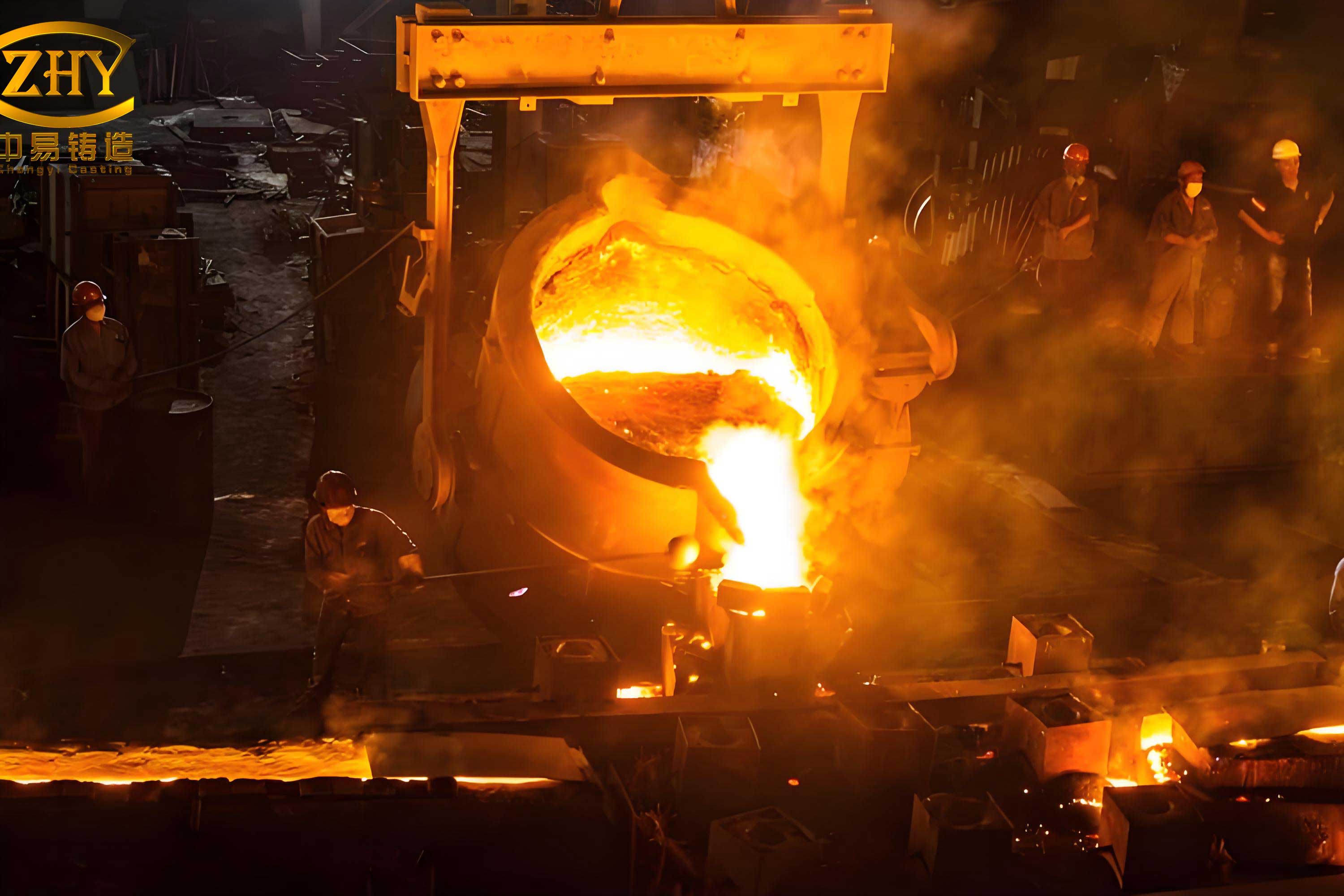
Figure below illustrates the typical sand casting foundry components that benefit from this protective mechanism:
The protective efficiency of the film can be quantified by the parabolic rate constant for oxidation, which we found to follow the relationship:
$$ k_p = k_0 \exp\left(-\frac{E_a}{RT}\right) $$
Where:
- \( k_p \) is the parabolic oxidation rate constant
- \( k_0 \) is the pre-exponential factor
- \( E_a \) is the activation energy for oxidation
- \( R \) is the gas constant
- \( T \) is the absolute temperature
For the MgO+C composite film formed in our sand casting foundry, we determined that the activation energy \( E_a \) was significantly higher than for pure MgO films, resulting in a substantially lower oxidation rate constant at typical casting temperatures (650–750°C).
Quantitative Analysis of Film Growth Kinetics
The growth kinetics of the protective film during sand casting foundry processing followed a parabolic law, as expressed by:
$$ X^2 = k_p t + C $$
Where:
- \( X \) is the film thickness
- \( t \) is the exposure time
- \( C \) is the integration constant
Table 3 compares the parabolic rate constants for different film compositions observed in our study.
| Film Type | kp (μm²/min) | Relative Protection Factor |
|---|---|---|
| Pure MgO (conventional casting) | 0.85 ± 0.12 | 1.0 |
| MgO + C (graphite sand mold, 0–2 μm) | 0.32 ± 0.08 | 2.7 |
| MgO + C (graphite sand mold, 2–5 μm) | 0.18 ± 0.05 | 4.7 |
| Mg(OH)₂ + MgO (surface layer) | 0.48 ± 0.10 | 1.8 |
The reduced rate constants for the MgO+C composite films clearly demonstrate the superior protective capability achieved in our sand casting foundry process.
Film Composition as a Function of Processing Parameters
We investigated the influence of various sand casting foundry parameters on the final film composition. The carbon content in the film was found to be particularly sensitive to mold temperature and pouring temperature, as shown in Table 4.
| Pouring Temperature (°C) | Mold Temperature (°C) | Average Carbon Content in Film (at%) | Film Thickness (μm) |
|---|---|---|---|
| 680 | 150 | 8.2 ± 1.1 | 4.8 ± 0.6 |
| 700 | 150 | 10.5 ± 1.3 | 5.2 ± 0.7 |
| 720 | 150 | 12.8 ± 1.5 | 5.8 ± 0.8 |
| 700 | 200 | 11.3 ± 1.4 | 5.5 ± 0.7 |
| 700 | 250 | 13.1 ± 1.6 | 6.1 ± 0.9 |
These results demonstrate that both higher pouring temperatures and higher mold temperatures promote increased carbon incorporation into the protective film, enhancing its protective properties in the sand casting foundry.
Microstructural Characterization of the Barrier Layer
The barrier layer, comprising the surface and intermediate layers, exhibited a dense, compact microstructure when formed in graphite sand molds. The density of the MgO+C composite film was measured using helium pycnometry and compared with pure MgO films, as presented in Table 5.
| Film Type | Bulk Density (g/cm³) | Theoretical Density (g/cm³) | Porosity (%) |
|---|---|---|---|
| Pure MgO | 3.12 ± 0.08 | 3.58 | 12.8 ± 2.1 |
| MgO + 5% C | 3.28 ± 0.07 | 3.55 | 7.6 ± 1.8 |
| MgO + 10% C | 3.41 ± 0.06 | 3.52 | 3.1 ± 1.2 |
| MgO + 15% C | 3.35 ± 0.09 | 3.49 | 4.0 ± 1.5 |
The optimal carbon content for maximum densification was found to be approximately 10 at%, which yielded the lowest porosity and highest bulk density. This composition was consistently achieved in our sand casting foundry process under standard operating conditions.
Electrochemical Properties of the Protective Film
We evaluated the electrochemical behavior of the surface films in a simulated corrosive environment to assess their protective capabilities. Potentiodynamic polarization tests were performed in 3.5% NaCl solution, and the results are summarized in Table 6.
| Sample | Ecorr (V vs. SCE) | Icorr (μA/cm²) | Polarization Resistance (kΩ·cm²) |
|---|---|---|---|
| Bare Mg alloy (polished) | -1.68 ± 0.03 | 85.2 ± 8.5 | 0.31 ± 0.04 |
| Sand casting foundry film (as-cast) | -1.42 ± 0.04 | 12.3 ± 2.1 | 2.15 ± 0.28 |
| Sand casting foundry film (after aging) | -1.35 ± 0.03 | 8.7 ± 1.5 | 3.04 ± 0.35 |
| Conventional sand casting film (with inhibitors) | -1.55 ± 0.05 | 28.6 ± 4.2 | 0.92 ± 0.12 |
The significantly lower corrosion current density and higher polarization resistance of the film formed in the graphite sand mold sand casting foundry process confirm its superior protective properties compared to both bare magnesium and films formed using conventional inhibitor-based sand casting methods.
Thermodynamic Considerations
The formation of the MgO+C composite film can be understood through thermodynamic analysis of the relevant reactions. The Gibbs free energy change for the primary film-forming reaction is given by:
$$ \Delta G = \Delta H – T\Delta S $$
For the reaction CO₂ + 2Mg → 2MgO + C at 700°C (973 K):
$$ \Delta H_{973K} = -610.8 \text{ kJ/mol} $$
$$ \Delta S_{973K} = -158.4 \text{ J/mol·K} $$
$$ \Delta G_{973K} = -456.7 \text{ kJ/mol} $$
The highly negative Gibbs free energy indicates that this reaction is thermodynamically favorable under sand casting foundry conditions, driving the formation of the carbon-containing protective film.
Additionally, the formation of magnesium hydroxide in the surface layer can be described by:
$$ \text{MgO} + \text{H}_2\text{O} \rightarrow \text{Mg(OH)}_2 $$
This reaction occurs primarily during cooling and exposure to atmospheric humidity, forming the outermost hydroxide layer that provides additional protection.
Conclusions
Our investigation of the magnesium alloy surface oxidation film formed during graphite sand mold sand casting foundry processes has revealed several important findings regarding its composition, structure, and protective mechanism:
First, the surface oxidation film exhibits a distinct three-layer structure consisting of an outer surface layer composed primarily of Mg(OH)₂ and MgO, an intermediate layer composed mainly of MgO, and a transition layer containing metallic magnesium with trace amounts of MgO. The surface and intermediate layers together form an effective barrier against further oxidation.
Second, the incorporation of carbon atoms into the MgO matrix during sand casting foundry processing results in the formation of an MgO+C composite film with significantly enhanced density and protective properties. The optimal carbon content of approximately 10 at% produces the lowest porosity and highest protective efficiency.
Third, the protective mechanism of the composite film involves both the reduced ionic mobility due to carbon occupying interstitial sites in the MgO lattice and the increased activation energy for oxygen diffusion through the film. This results in substantially lower oxidation rates compared to conventional magnesium alloy casting methods.
Fourth, the formation of the protective film in graphite sand mold sand casting foundry operations eliminates the need for toxic anti-flammable inhibitors, providing both environmental and economic benefits for magnesium casting production.
These findings demonstrate that graphite sand mold technology offers a viable and superior alternative for magnesium alloy casting in the sand casting foundry industry, providing effective protection against oxidation while eliminating the environmental hazards associated with conventional inhibitor-based methods.