
The production of high-integrity spheroidal graphite cast iron components is paramount across demanding industries such as automotive, wind energy, and heavy machinery. A persistent and critical challenge in resin-bonded sand casting processes is the formation of a subsurface layer with degenerated graphite morphology. This defect, often manifesting as dark spots upon machining, is characterized by the presence of flake, vermicular, exploded, or undercooled graphite within a surface layer typically 1-3 mm thick, as opposed to the desired well-formed spheroids. The degradation of graphite morphology in this near-surface region directly compromises mechanical properties, leading to non-uniform hardness, reduced fatigue strength, and accelerated tool wear during machining, ultimately risking component failure and economic loss.
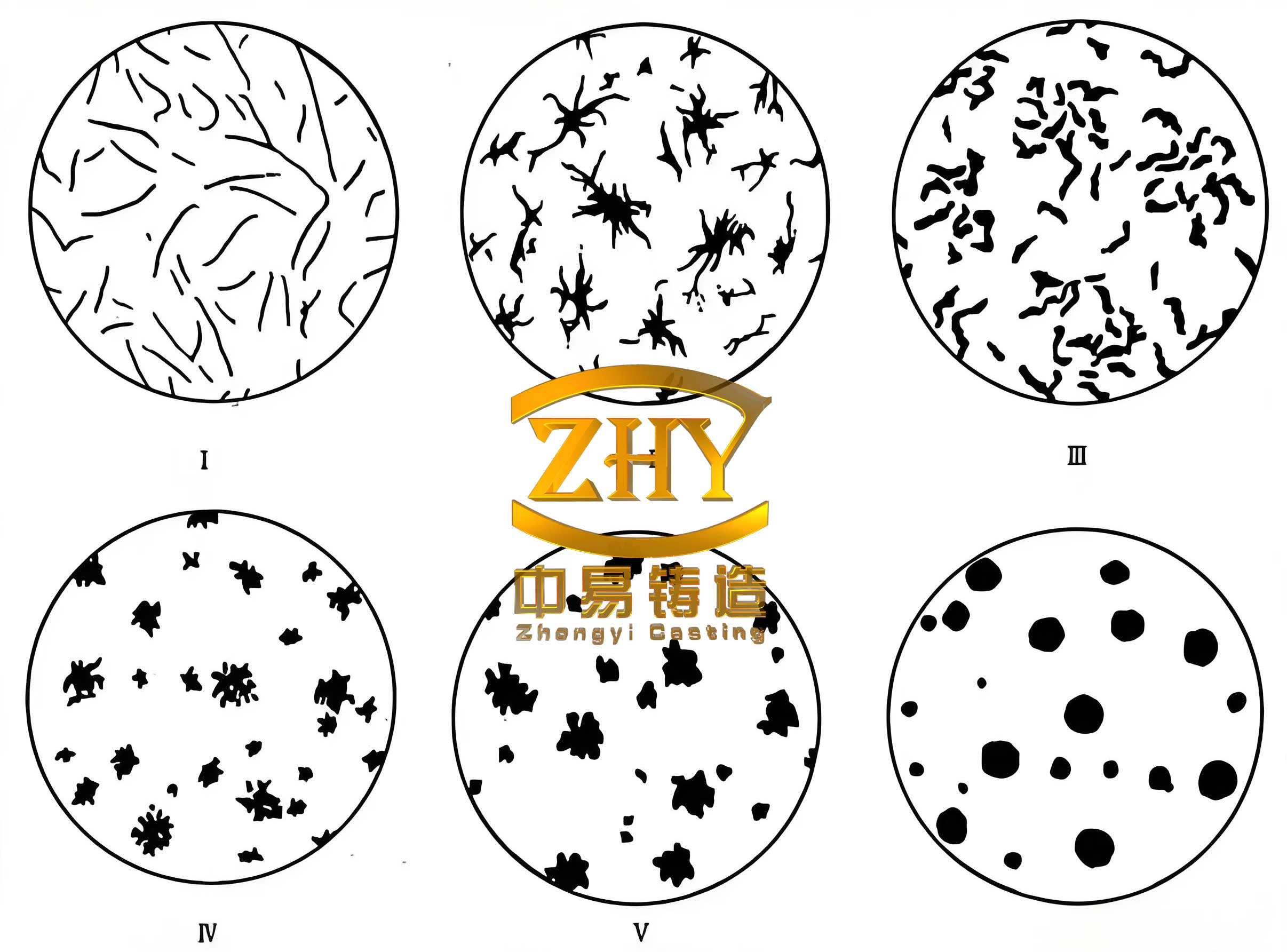
The core mechanism underlying this defect is the localized depletion of active spheroidizing elements, primarily magnesium (Mg) and, in some cases, rare earths (RE), at the metal-mold interface. In the context of furan resin-bonded molds using acid-catalyzed curing systems, sulfur (S) emerges as the principal deleterious element. During the pouring of high-temperature molten spheroidal graphite cast iron, the thermal decomposition of the binder system—specifically, the sulfonic acid-based curing agent—releases sulfur-bearing gases (e.g., SO2). These gases permeate through the coating layer and react with the residual Mg in the iron at the casting surface. This reaction forms stable sulfides such as MgS, effectively scavenging the Mg necessary to maintain graphite spheroidization, as described by the reaction:
$$ [Mg]_{(in\ Fe)} + [S]_{(from\ mold)} \rightarrow (MgS)_{(slag/inclusion)} $$
Consequently, the effective magnesium content, \( w(Mg)_{eff} \), at the surface falls below the critical threshold required for spheroidization, leading to the precipitation of non-spheroidal graphite forms during solidification. The depth of this affected layer is governed by the diffusion kinetics of sulfur into the metal and the counter-diffusion or consumption of magnesium. This paper provides a detailed, first-principles analysis of the factors influencing this phenomenon and synthesizes robust mitigation strategies.
1. Primary Influencing Factors and Experimental Correlations
The severity of the surface spheroidization deterioration in spheroidal graphite cast iron is a multivariate function. The following factors have been systematically investigated.
1.1 Core Binder System: The Role of Curing Agent Sulfur Content
The type and sulfur content of the curing agent used for the furan resin are the most significant factors. Conventional sulfonic acid curing agents (e.g., benzene sulfonic acid) have high sulfur potential. Low-sulfur or sulfur-free alternatives significantly reduce the source term in the aforementioned reaction.
Quantitative Effect: Experiments comparing standard and low-S curing agents, under identical casting conditions, reveal a dramatic reduction in the defective layer thickness. The relationship can be expressed as an exponential decay function of the effective surface sulfur concentration, \( C_S^{surface} \):
$$ d_{defect} \propto k \cdot e^{\alpha \cdot C_S^{surface}} $$
where \( d_{defect} \) is the defective layer thickness, \( k \) and \( \alpha \) are process-dependent constants, and \( C_S^{surface} \) is directly related to the curing agent’s S-content.
| Curing Agent Type | Coating Type | Avg. Defect Layer Thickness (mm) | Graphite Morphology Description |
|---|---|---|---|
| Standard (High-S) | Standard Zirconia | 2.7 | Flake/Vermicular layer ~2.5-3.1mm |
| Spheroidizer-Containing | 2.1 | Improved, but layer present (0.5-1.0mm) | |
| Si-Mg Alloy | 1.5 | Markedly improved, thin layer (0-0.3mm) | |
| Low-Sulfur | Standard Zirconia | 1.5 | Reduced layer (~1.2-1.8mm) |
| Spheroidizer-Containing | 0.7 | Very thin, sporadic layer | |
| Si-Mg Alloy | ~0.1 | Near-complete elimination, full spheroids |
1.2 Protective Barrier: The Function of the Mold Coating
The coating applied to the mold face serves as a critical barrier. Its efficacy is determined by its impermeability to sulfur gases and its potential to provide a local supplement of spheroidizing elements.
- Standard Refractory Coatings: Provide limited physical barrier but do not counteract sulfur ingress chemically.
- Coatings Containing Spheroidizing Alloys: These incorporate small amounts of Fe-Si-Mg alloys. They act as a sacrificial source of Mg, partially compensating for the Mg consumed by sulfur reaction at the interface.
- Si-Mg Alloy-Rich Coatings: Represent the most effective solution. They create a localized high-Mg microenvironment at the metal-mold interface, effectively shifting the thermodynamic equilibrium to maintain \( w(Mg)_{eff} \) above the critical level. The improvement is synergistic with low-S binders.
1.3 Solidification Dynamics: Cooling Rate Effects
The local cooling rate profoundly impacts the kinetics of the Mg-S reaction. A faster cooling rate reduces the time available for the interfacial reaction and sulfur diffusion.
Chill Effect: Placement of chills adjacent to the casting surface drastically increases the solidification rate. Metallographic examination shows:
| Location Relative to Chill | Estimated Cooling Rate | Defect Layer Thickness (mm) | Observation |
|---|---|---|---|
| Directly at Chill Face | Very High | 0 | Fully spheroidized graphite at surface |
| 3 cm from Chill | High | ~1.0 | Very thin, intermittent degenerated layer |
| 10 cm from Chill | Moderate | ~2.0 | Pronounced layer of flake/vermicular graphite |
| 50 cm from Chill (No Chill) | Slow | 2.5-3.0 | Thick, consistent degenerated layer |
Section Thickness Effect: Similarly, thin sections cool faster than thick sections, leading to a clear correlation:
$$ d_{defect} \propto \sqrt{t_{solid}} \approx \beta \cdot V/A^{-n} $$
where \( t_{solid} \) is the local solidification time, \( V/A \) is the volume-to-surface area ratio (modulus), and \( \beta \) and \( n \) are constants. Thicker sections (higher modulus) allow prolonged reaction times, resulting in deeper Mg depletion zones and thicker defective layers in the spheroidal graphite cast iron.
1.4 Sand Reclamation and Contamination: The Issue of Returned Sand
The repeated use of reclaimed sand without adequate purification leads to the accumulation of sulfur and other low-melting-point elements (e.g., sodium, potassium) from broken-down binder systems. This increases the bulk sulfur concentration in the molding sand, exacerbating the surface reaction issue.
| Molding Sand Composition | Curing Agent | Coating | Defect Layer Thickness (mm) |
|---|---|---|---|
| 100% New Sand | Standard | Standard | 1.5 |
| High-Return Sand (>80%) | Standard | Standard | 2.8 |
| High-Return Sand (>80%) | Standard | Si-Mg Alloy | 0.5 |
| High-Return Sand (>80%) | Low-S | Si-Mg Alloy | 0.5 |
| 100% New Sand | Low-S | Si-Mg Alloy | 0 (Virtually Eliminated) |
The data indicates that while high-quality coatings can mitigate the effect of contaminated sand, the combination of new sand, a low-sulfur binder, and an active coating provides the most robust defense against surface degradation in spheroidal graphite cast iron.
2. Extended Analysis and Synergistic Mitigation Framework
Beyond the primary factors, a holistic understanding requires considering secondary interactions and process optimization.
2.1 Thermodynamic and Kinetic Modeling of the Interface
The process can be modeled as a diffusion-controlled reaction. Fick’s second law describes sulfur ingress, while magnesium depletion is governed by a moving boundary condition due to reaction. The depth of the affected zone, \( \delta \), can be approximated by:
$$ \delta = \sqrt{D_{eff} \cdot t_{react}} $$
where \( D_{eff} \) is an effective diffusion coefficient for sulfur in the boundary layer and \( t_{react} \) is the effective reaction time at elevated temperature. Strategies aim to minimize \( D_{eff} \) (via coatings) and \( t_{react} \) (via rapid cooling). The critical magnesium content for spheroidization, \( Mg_{crit} \), must satisfy:
$$ [Mg]_{initial} – \int_0^{t_{react}} k_r \cdot [S]_{interface} \cdot dt > Mg_{crit} $$
where \( k_r \) is the reaction rate constant. Using a low-S binder reduces \( [S]_{interface} \), a chill reduces \( t_{react} \), and an Mg-bearing coating provides a local increase in \( [Mg]_{initial} \).
2.2 Complementary Process Controls for Spheroidal Graphite Cast Iron
To support the mold-side solutions, melt processing parameters must be optimized:
- Targeted Residual Magnesium: For castings prone to this defect, especially thick-sectioned ones, slightly increasing the target residual magnesium content in the ladle can provide a larger “buffer” against surface depletion. However, this must be balanced against the risk of increased carbides or dross formation.
- Inoculation Practice: Effective late-stage inoculation ensures a high nodule count, which can slightly improve graphite morphology stability but cannot compensate for severe Mg depletion.
- Sand Properties: Maintaining low moisture and acidic pH in the furan sand minimizes unexpected gas generation and potential secondary sulfur sources.
- Sand Regeneration: Implementing thermal or advanced mechanical regeneration for returned sand is crucial to control the cumulative sulfur level below a critical threshold (e.g., <0.1% S).
2.3 Decision Framework for Defect Prevention
The choice of mitigation strategy depends on casting geometry, quality requirements, and cost. The following matrix provides a guideline:
| Casting Feature (Risk Level) | Recommended Primary Action | Supporting Actions | Expected Outcome |
|---|---|---|---|
| Thin wall, general use (Low) | Standard binder/coating may suffice | Control return sand quality | Acceptable; minor risk |
| Thick wall, stressed (High) | Mandatory: Low-S Binder + Active (Si-Mg) Coating | Use chills where possible; consider slight Mg increase | Defect elimination |
| High-recycled sand system (Med-High) | Mandatory: Active (Si-Mg) Coating | Upgrade to low-S binder; improve sand regeneration | Significant reduction |
| Critical, machined surfaces (Very High) | Combination: New/Low-S Sand + Low-S Binder + Active Coating + Chills | Optimize Mg residual; strict process control | Consistent, defect-free surface |
3. Conclusions and Industrial Implications
Surface spheroidization deterioration in furan resin sand cast spheroidal graphite cast iron is a predictable and controllable phenomenon rooted in the interfacial reaction between residual magnesium and sulfur originating from the mold materials. The key conclusions are:
- Sulfur Source Control is Paramount: The single most effective measure is the adoption of low-sulfur or sulfur-free curing agents for the furan resin binder. This directly minimizes the driving force for magnesium depletion.
- Active Coatings are Highly Effective: The application of mold coatings enriched with spheroidizing elements, particularly Si-Mg alloys, provides a powerful local countermeasure. They act as a supplemental magnesium source at the critical metal-mold interface, effectively neutralizing incoming sulfur and preserving the required \( w(Mg)_{eff} \) for stable spheroidal graphite formation.
- Cooling Rate is a Powerful Lever: Accelerating solidification through the strategic use of chills or by designing for favorable thermal gradients (thin sections) drastically reduces the time available for the detrimental interfacial reaction. This often results in the complete suppression of the defect in rapidly cooled regions.
- Sand System Purity is Foundational: Uncontrolled use of high-return sand leads to sulfur build-up, undermining other controls. Effective sand regeneration and periodic refreshment with new sand are essential for maintaining a low-base sulfur level in the molding system.
- A Systems Approach is Necessary: No single solution is universally sufficient for all scenarios. For high-reliability spheroidal graphite cast iron castings, a synergistic combination of low-sulfur binders, active coatings, controlled cooling, and clean sand practices is required to guarantee a sound, fully spheroidized surface layer suitable for high-stress applications and precision machining.
By understanding the underlying mechanisms quantified through the relationships between sulfur potential, reaction time, and magnesium availability, foundries can implement targeted, cost-effective strategies to eliminate this defect, thereby enhancing the performance, reliability, and commercial value of their spheroidal graphite cast iron products.