
In the production of high-strength, thin-wall cast iron parts, such as engine blocks and cylinder heads, achieving consistent microstructure and superior mechanical properties is a paramount challenge. The inherent rapid cooling rates in thin sections promote undercooling, leading to undesirable carbides and chill formation, which severely compromise machinability and performance. Through years of practice and research, I have found that inoculation is not merely an auxiliary step but a critical process governing the final quality of the casting. Among various inoculants, those based on rare earth (RE) elements have demonstrated unparalleled potential, particularly for complex, thin-wall geometries. Their unique dual mechanism of action—simultaneously promoting graphite nucleation while counteracting specific detrimental elements—makes them indispensable in modern foundry practice for high-integrity cast iron parts.
The fundamental role of inoculation is to increase the number of effective nucleation sites for graphite within the iron melt, thereby refining the graphite structure and the eutectic cells. This refinement translates directly into improved mechanical properties, better uniformity across sections, and enhanced castability. Rare earth elements, primarily Cerium (Ce) and Lanthanum (La), exert their influence through a powerful chemical interaction. They possess a strong affinity for oxygen and sulfur, described by the following thermodynamic relations for the formation of their compounds:
$$ [RE] + [S] \rightarrow (RE)S_{(s)} \quad \Delta G^\circ \ll 0 $$
$$ [RE] + [O] \rightarrow (RE)O_{(s)} \quad \Delta G^\circ \ll 0 $$
These highly stable, non-metallic inclusions, along with possible nitrides and oxysulfides, persist in suspension within the melt. They act as potent heterogeneous substrates for graphite precipitation during eutectic solidification. This process significantly increases the nucleation rate (I), which is a key parameter in solidification kinetics models for cast iron parts:
$$ I = I_0 \cdot \exp\left(-\frac{\Delta G^*}{k_B T}\right) $$
Here, $ \Delta G^* $ is the activation energy barrier for nucleation, which is effectively lowered by the presence of RE-based substrates, $ k_B $ is the Boltzmann constant, and $ T $ is the temperature. The increased nucleation rate leads to a finer graphite dispersion. However, rare earths also exhibit a distinct “chill-promoting” tendency. They can increase the degree of eutectic undercooling ($\Delta T_E$), which shifts the solidification path. Below a critical residual rare earth content (typically 0.025–0.045 wt.%), the graphitizing effect dominates. Above this threshold, the undercooling effect becomes prominent, favoring the formation of undercooled graphite (Type D, E) or even cementite. This delicate balance is the cornerstone of applying RE inoculants to thin-wall cast iron parts.
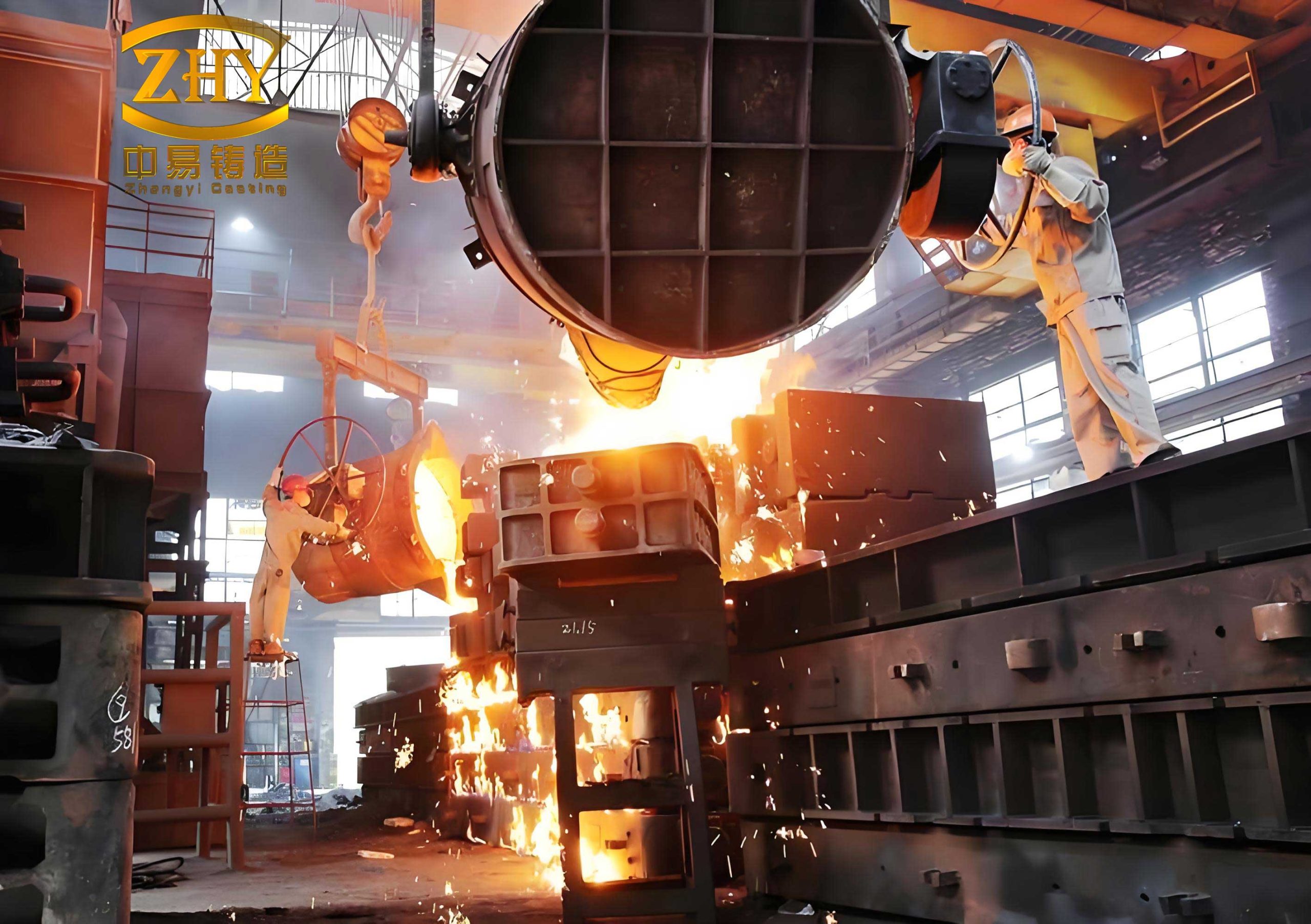
To systematically evaluate the performance of different inoculants, a series of controlled experiments were conducted. The base iron composition was tailored for high-strength applications common in automotive thin-wall cast iron parts. The key inoculants investigated included FeSiRE (Rare Earth Silicide), standard 75FeSi (Ferrosilicon), and Sr-FeSi (Strontium-bearing Ferrosilicon). Their nominal compositions are summarized below:
| Inoculant Type | Si (wt.%) | RE (wt.%) | Ca (wt.%) | Sr (wt.%) | Al (wt.%) |
|---|---|---|---|---|---|
| 75FeSi | 70-75 | – | ≤1.2 | – | ≤1.5 |
| FeSiRE | 40-45 | 28-32 | 0.6-1.2 | – | – |
| Sr-FeSi | 40-60 | – | 0.014 | 0.8-1.5 | ≤0.5 |
In the initial comparison, all inoculants were added at a fixed rate of 0.25 wt.% to melts held under identical conditions. The properties of the resulting cast iron parts, assessed via test bars and wedge samples, revealed clear trends:
| Inoculant (100%) | Tensile Strength (MPa) | Hardness (HB) | Chill Width (mm) | Graphite Morphology Note |
|---|---|---|---|---|
| 75FeSi | 265 | 205 | ~9 | Uniform Type A |
| FeSiRE | 316 | 215 | ~17 | Some Type B present |
| Sr-FeSi | 268 | 208 | ~10 | Uniform Type A |
The data unequivocally shows that pure FeSiRE inoculant provides a substantial strength boost of nearly 20% compared to traditional 75FeSi. However, this comes with a significant increase in chill width, indicating a stronger tendency to promote undercooling. The microstructure corroborates this, showing the onset of undercooled graphite (Type B). This presents a practical dilemma: how to harness the strengthening benefit of RE for thin-wall cast iron parts without inducing excessive chill or undesirable graphite forms. The solution lies in composite inoculation.
By blending FeSiRE with 75FeSi, we can tailor the residual RE level to stay within the optimal window. A subsequent experiment tested four blending ratios with a total addition of 0.25 wt.%. The relationship between RE content, mechanical properties, and chill tendency can be modeled. The strength increase often follows a law of mixtures initially, but the chill width increases non-linearly with RE concentration, indicative of its potent effect on undercooling:
$$ \sigma_b \approx \sigma_0 + k_{RE} \cdot [RE]_{res} \quad \text{(for low [RE])} $$
$$ W_{chill} \propto \exp(\beta \cdot [RE]_{res}) $$
Where $ \sigma_b $ is tensile strength, $ \sigma_0 $ is the base strength, $ k_{RE} $ is a strengthening coefficient, $ [RE]_{res} $ is the residual rare earth content, $ W_{chill} $ is the chill width, and $ \beta $ is a constant. The experimental results are tabulated below:
| Blend Ratio (FeSiRE / 75FeSi) | Tensile Strength (MPa) | Hardness (HB) | Chill Width (mm) | Microstructure Assessment |
|---|---|---|---|---|
| 20% / 80% | 270 | 209 | 9 | Excellent, uniform A-type graphite. |
| 40% / 60% | 276 | 206 | 11 | Good, predominantly A-type. |
| 60% / 40% | 295 | 211 | 14 | Very high strength, some B-type graphite appears. |
| 80% / 20% | 296 | 215 | 17 | High strength & hardness, clear B/D-type graphite, high chill. |
The optimal blend for most thin-wall cast iron parts requiring a balance of high strength and good castability lies between the 40/60 and 60/40 ratios. This provides significant strengthening (a 7-10% increase over plain 75FeSi) while maintaining acceptable chill levels and graphite morphology. This composite approach is the key to successfully implementing RE inoculants in production environments for complex cast iron parts.
Building on this principle, advanced RE-based composite inoculants have been developed for specific production challenges. One such innovation is a pre-alloyed RE-Cr-Mn-FeSi inoculant. This material addresses another common issue in high-strength cast iron parts: the need for alloying elements like chromium (Cr) to stabilize pearlite and increase hardness and wear resistance. However, Cr is a strong carbide promoter, exacerbating the chill problem in thin sections. By pre-alloying Cr and Mn with RE-silicide, the inoculant delivers these alloying elements in a more “friendly” manner. The RE components moderate the carbide-promoting effect of Cr, likely by forming complex (RE,Cr)(C,N) compounds that act as nuclei rather than allowing Cr to solely segregate and stabilize cementite. The manganese lowers the melting point of the inoculant, improving its dissolution and effectiveness. The application of this composite inoculant in mass production of engine cast iron parts allowed for a reduction in the separate additions of ferrochromium and copper, leading to substantial cost savings while maintaining, and often improving, specified properties.
| Sample | C (wt.%) | Si (wt.%) | Cr (wt.%) | Cu (wt.%) | Tensile (MPa) | Casting Hardness (HB) |
|---|---|---|---|---|---|---|
| 1 | 3.29 | 1.83 | 0.295 | 0.095 | 265 | 187-206 |
| 2 | 3.26 | 1.86 | 0.325 | 0.115 | 273 | 191-200 |
| 3 | 3.30 | 1.87 | 0.303 | 0.170 | 328 | 186-206 |
Another significant development is the RE-Cr-Mn-Ca-Ba-FeSi inoculant, designed specifically for melting processes prone to high undercooling, such as electric induction furnaces. These furnaces produce very clean iron with low endogenous nuclei, leading to a pronounced “inherited” chill tendency. Calcium (Ca) and Barium (Ba) are highly surface-active elements that powerfully deoxidize the melt. Their oxides and sulfides provide excellent nucleation sites. When combined with RE, the inoculant creates a multi-component, multi-layered nucleation complex with high thermal stability, resulting in exceptional fading resistance. This is crucial for modern high-volume production lines where holding times can be variable. The effectiveness of this inoculant can be related to its ability to maintain a high density of active nuclei ($N_a$) over time (t), countering the natural fading process often described by an exponential decay:
$$ N_a(t) = N_0 \cdot \exp(-k_f \cdot t) + N_{RE/Ca/Ba} $$
Here, $N_0$ is the initial nucleus count from other sources, $k_f$ is the fading rate constant, and $N_{RE/Ca/Ba}$ represents the stable, persistent nuclei provided by the composite inoculant. The table below shows performance data from thin-wall cast iron parts produced using dual melting (cupola + induction holding) treated with this inoculant:
| Batch | C (wt.%) | Si (wt.%) | Cr (wt.%) | Casting Hardness (HB) | Tensile Strength (MPa) |
|---|---|---|---|---|---|
| A | 3.26 | 1.83 | 0.168 | 201-210 | 285 |
| B | 3.25 | 1.85 | 0.167 | 193-204 | 278 |
| C | 3.27 | 1.89 | 0.145 | 184-196 | 258 |
In conclusion, the strategic use of rare earth-based inoculants represents a sophisticated metallurgical tool for engineering the microstructure of demanding thin-wall cast iron parts. Their dual nature—both graphitizer and chill-promoter—requires careful control, typically achieved through composite formulations with ferrosilicon. The development of advanced multi-component RE inoculants, such as RE-Cr-Mn-FeSi and RE-Ca-Ba-FeSi, allows foundries to simultaneously inoculate, alloy, and combat specific melting-related issues like fading and excessive undercooling. The result is a reliable production process for high-integrity cast iron parts that meet stringent mechanical property specifications while offering benefits in cost reduction and process robustness. The ongoing research and application in this field continue to push the boundaries of performance for cast iron parts across all industries.