
Throughout my career in the foundry industry, I have witnessed a significant paradigm shift in the manufacturing of large-scale machinery. The relentless drive towards larger, more precise, and heavier-duty equipment in sectors like energy, aerospace, and heavy machinery has placed unprecedented demands on foundational components. Among these, support structures—the beds, frames, beams, and platforms that form the skeleton of industrial giants—have undergone a remarkable material evolution. Increasingly, the material of choice for these critical, thick-sectioned parts is no longer limited to traditional gray iron or fabricated steel; it is ductile iron. The transition to using heavy-section ductile iron castings represents a confluence of technical ambition and economic pragmatism, pushing the boundaries of metallurgy and foundry science.
The intrinsic advantages of ductile iron are well-documented for typical casting sections. Its combination of castability, good machinability, high strength, and notable ductility, derived from the spheroidal graphite morphology, offers a compelling value proposition. However, these properties are not guaranteed when the section thickness escalates to what we classify as “heavy-section,” often meaning a controlling modulus exceeding several centimeters or wall thicknesses surpassing 150-200 mm. In these regimes, the solidification dynamics change dramatically. Prolonged cooling times can lead to graphite degeneration, carbide formation, severe segregation of alloying elements, and porosity—all of which can catastrophically degrade mechanical properties, particularly toughness and elongation. Therefore, the successful production of heavy-section ductile iron castings is not a simple scale-up; it is a specialized discipline requiring precise control over the entire process chain, from charge makeup and melt treatment to rigorous simulation-driven process design.
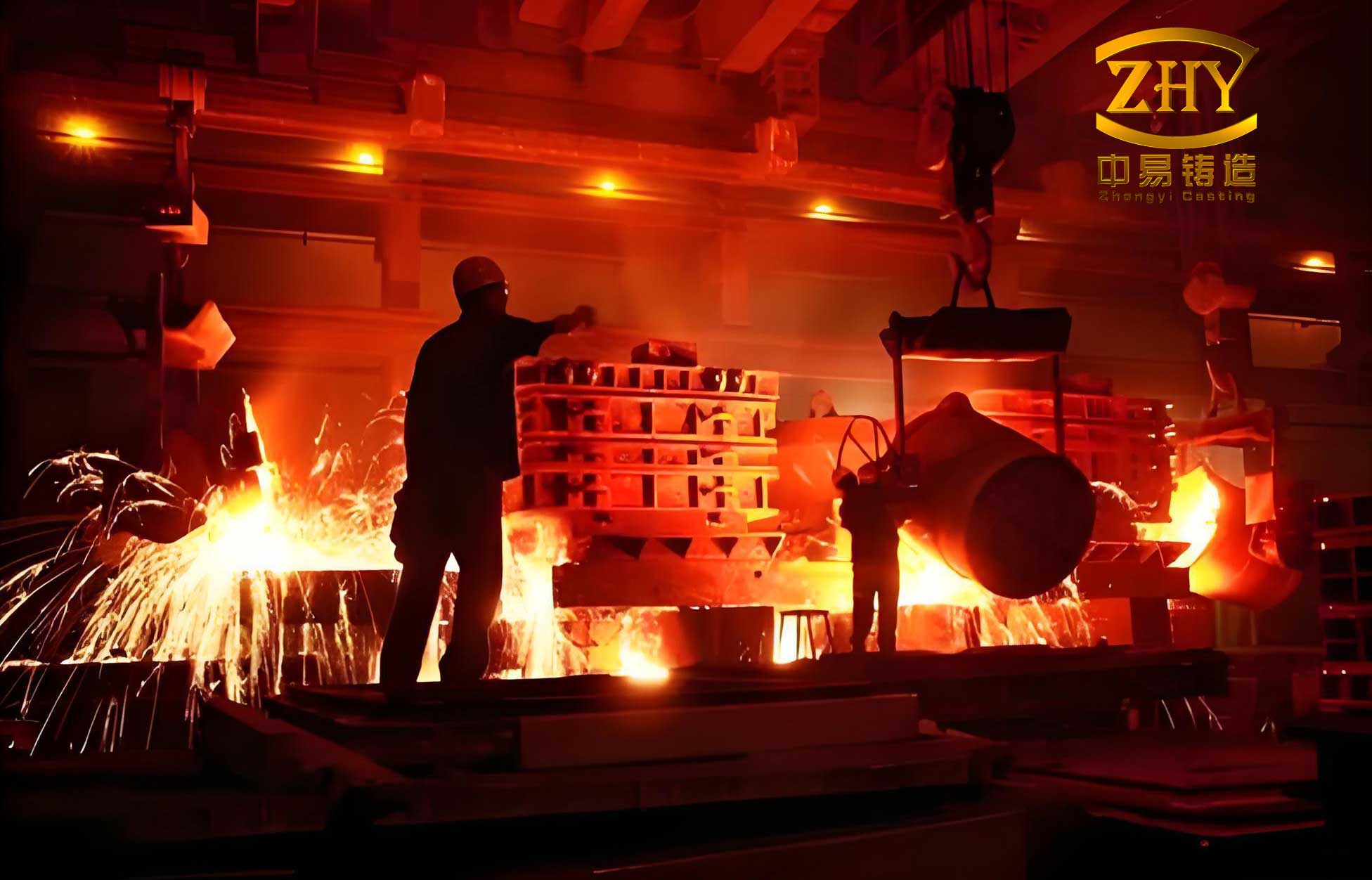
The core challenge in producing sound heavy-section ductile iron castings lies in managing solidification. The long freezing time allows for significant diffusion and interaction between elements. A primary concern is the promotion of a fully ferritic matrix to maintain ductility and toughness, while avoiding the formation of pearlite-stabilizing elements in the core, or worse, intercellular carbides. This is often addressed through a careful balance of alloying and inoculation. While silicon promotes ferrite, its content must be optimized to avoid excessive embrittlement at high levels. Elements like copper and tin are potent pearlite promoters and must be tightly controlled. Conversely, elements like cerium (from rare-earth-containing inoculants) can help counteract the deleterious effects of trace elements like lead or antimony that promote irregular graphite. The chemical composition window for heavy-section castings is notably narrower than for smaller ones. A typical target chemistry range for a ferritic-pearlitic grade like an EN-GJS-400-18U-LT (for low temperature) or a pearlitic grade like EN-GJS-700-2 for heavy sections might be summarized as follows:
| Element | Ferritic-Pearlitic Grade (e.g., 400-18) | Pearlitic Grade (e.g., 700-2) | Primary Function & Consideration for Heavy Sections |
|---|---|---|---|
| C | 3.5 – 3.8% | 3.5 – 3.7% | High carbon aids graphitization and feeding but must balance with shrinkage tendency. |
| Si | 1.8 – 2.4% | 1.9 – 2.3% | Ferritizer; higher levels aid ferrite formation but reduce toughness if too high. |
| Mn | < 0.3% | 0.2 – 0.5% | Segregates strongly; kept very low in ferritic grades to avoid intercellular carbides. |
| P | < 0.04% | < 0.04% | Severely reduces toughness; kept as low as possible. |
| S | < 0.015% | < 0.015% | Low levels are crucial for efficient Mg treatment and nodule count. |
| Mg | 0.035 – 0.055% | 0.040 – 0.060% | Nodularizing element; residual must be sufficient but not excessive to avoid dross. |
| Cu | 0 – 0.3% | 0.4 – 0.8% | Pearlite promoter; used selectively in pearlitic grades for strength. |
| Sn | < 0.02% | 0.04 – 0.08% | Very potent pearlite promoter; used with extreme caution in minute quantities. |
| Ce (RE) | 0.005 – 0.02% | 0.005 – 0.02% | Counteracts harmful trace elements; aids in graphite nodularity in thick sections. |
The metallurgical principles governing the microstructure of these castings can be partially described by considering the cooling rate’s influence on undercooling. The relationship between nodule count (N, in nodules/mm²) and cooling rate (ε, in °C/s) is often expressed empirically as:
$$ N = k \cdot \varepsilon^n $$
where \(k\) and \(n\) are material constants. For heavy-section ductile iron castings, \(ε\) is very small (often < 0.1 °C/s in the critical range), leading to a low nodule count. This increases the distance between nodules, allowing for larger eutectic cells and promoting the risk of intercellular imperfections. To combat this, effective inoculation strategies that provide long-lasting nucleation sites are paramount. Furthermore, the solidification time \(t_f\) for a simple shape is related to the modulus \(M\) (Volume/Surface Area) by Chvorinov’s rule:
$$ t_f = B \cdot M^n $$
where \(B\) is a mold constant. For heavy-section ductile iron castings, \(M\) is large, leading to prolonged \(t_f\), which directly impacts the diffusion-controlled processes of element segregation and carbide dissolution.
Beyond chemistry, the production process for these massive ductile iron castings is a feat of engineering. Gating and risering systems are designed not merely to fill the mold quietly but to utilize the graphite expansion phase effectively. The concept of “volume deficit” management is key. The solidification shrinkage of ductile iron occurs in two primary stages: liquid contraction and austenitic contraction. However, the expansion during the eutectic graphite precipitation (often 2-4% volumetric expansion) can counteract this shrinkage if properly harnessed. The condition for achieving sound, shrinkage-free castings often relies on creating a favorable temperature gradient and a controlled rigidity within the mold. This is described by the modulus extension principle and requires careful calculation of feeder needs, often aiming for feederless or minimally federed designs for compact shapes. The pressure generated by this expansion, \(P_{exp}\), can be estimated if constrained, contributing to feeding:
$$ P_{exp} \approx \frac{E_{mold} \cdot \beta \cdot \Delta V}{V} $$
where \(E_{mold}\) is the effective modulus of the mold wall, \(\beta\) is related to the expansion coefficient, and \(\Delta V/V\) is the volumetric expansion fraction. Modern production relies heavily on numerical simulation to predict thermal gradients, solidification sequences, and potential defect sites, allowing for virtual optimization of the casting process before any metal is poured.
The mechanical performance expectations for these components are stringent. They are not merely structural; they are often precision substrates for guideways and bearings. Therefore, properties must be consistent from surface to core. Typical specified properties for heavy-section ductile iron castings in support roles include:
| Property | Typical Specification for Heavy Sections | Test Standard | Importance for Support Structures |
|---|---|---|---|
| Tensile Strength (Rm) | 400 – 700 MPa | ASTM A536 / EN 1563 | Resists bending and static loads. |
| Yield Strength (Rp0.2) | 250 – 450 MPa | ASTM A536 / EN 1563 | Defines the limit for elastic deformation. |
| Elongation (A) | 12% – 3% (depending on grade) | ASTM A536 / EN 1563 | Critical for damage tolerance and energy absorption. |
| Charpy Impact (KV) | > 12 J at 20°C or -20°C | EN 1563 | Measures toughness, resistance to shock loads. |
| Hardness | 130 – 250 HBW | ASTM E10 / ISO 6506 | Indicative of machinability and wear resistance. |
| Ultrasonic Testing | Class 2 or 3 per EN 12680-3 | EN 12680-3 | Ensures internal soundness, absence of major shrinkage/porosity. |
| Magnetic Particle Testing | Class 2 or 3 per EN 1369 | EN 1369 | Ensures surface and near-surface integrity. |
The application spectrum for heavy-section ductile iron castings is vast and growing. In the machine tool industry, the bed or base is the heart of precision. For ultra-large vertical turning lathes or boring mills, beds can exceed 10 meters in length and weigh over 100 tons. Using ductile iron instead of welded steel or gray iron provides superior vibration damping, higher stiffness-to-weight ratio, and better stress distribution. Similarly, the crossrails and saddles on these machines, which carry the cutting tool across massive workpieces, are subject to complex bending and torsional stresses. A pearlitic grade ductile iron casting offers the necessary strength and wear resistance for guideways while maintaining enough ductility to withstand operational stresses without catastrophic failure.
Another prominent domain is in the bases and frames for large-scale industrial presses, injection molding machines, and test rigs. The tie-bar plates or stationary platens in giant injection molding machines are quintessential heavy-section ductile iron castings. They must withstand enormous and cyclical clamp forces (thousands of tons) while maintaining precise parallelism. The fatigue strength and consistent properties throughout the thick cross-section of a well-made ductile iron casting are superior to those of a welded fabrications, which are prone to residual stresses and weld defects. For platforms in semiconductor fabrication equipment or coordinate measuring machines, dimensional stability under thermal gradients and high inherent damping are critical, making heavy-section ductile iron castings the ideal solution.
The future development of these castings is tied to several key frontiers. First, the continued refinement of alloy systems to achieve even more consistent properties in ultra-heavy sections (e.g., >500 mm thick) is ongoing. This includes research into novel inoculants with higher nucleation potency and longer fade resistance. Second, the adoption of Austempered Ductile Iron (ADI) for heavy sections presents a tantalizing opportunity to combine exceptional strength (over 1000 MPa yield) with good toughness and wear resistance, though the challenge of through-hardening such massive pieces in a quench bath is significant. Third, the integration of additive manufacturing techniques for producing complex sand molds and cores with optimized cooling channel geometries will enable more efficient production of these giant, intricate ductile iron castings.
In conclusion, the movement towards heavy-section ductile iron castings for critical support structures is a testament to the material’s evolving capabilities. It is a field defined by the meticulous control of metallurgy, the sophisticated application of solidification science, and the boldness to cast components that form the backbone of modern industry. The advantages—superior damping, favorable mechanical properties, design flexibility, and cost-effectiveness at scale—are compelling. As simulation tools grow more powerful and our understanding of the solidification phenomena in these massive castings deepens, I am confident that the size, complexity, and performance envelope of ductile iron castings will continue to expand, solidifying their role as the material of choice for the most demanding structural applications in heavy industry.