
In my extensive experience within the heavy industry sector, specifically focused on the production of critical components for rail transportation, the evolution of mold-making materials has been a pivotal factor in advancing manufacturing efficiency and product quality. The traditional reliance on wood patterns for creating molds for large steel castings, such as railway truck bolsters and side frames, presented persistent challenges. These challenges included dimensional instability due to humidity, relatively low durability leading to frequent repairs or replacements, and limitations in achieving complex geometries with high precision through manual craftsmanship. The quest for a material that could combine the workability of wood with the stability and strength of metal has led to the exploration and successful implementation of advanced polymer-based substitute materials, often referred to as “wood substitutes” or “pattern boards.” This article delves into my first-hand perspective on this technological shift, detailing the material properties, manufacturing processes, and tangible benefits realized in the production of high-integrity steel castings.
The foundational step in creating any large steel casting is the production of a precise pattern or mold. Historically, this was the domain of skilled patternmakers working with high-grade timber. While effective, this method was inherently constrained. The introduction of metal patterns, typically machined from aluminum or iron, offered superior durability and precision but at a significantly higher initial cost and with longer lead times, especially for prototyping. The emergence of Computer Numerical Control (CNC) machining created a demand for materials that could be machined as easily as wood but would retain their shape and surface finish like metal. This is where synthetic wood substitute materials entered the scene, revolutionizing our approach to mold making for steel castings.
Material Science of Substitute Polymers: Epoxies vs. Polyurethanes
The core of this innovation lies in the use of high-performance thermosetting polymers. Unlike thermoplastics, which soften when heated, thermosetting resins undergo an irreversible chemical curing reaction, forming a rigid, cross-linked, and infusible network. This grants them excellent dimensional stability, thermal resistance, and mechanical strength—properties paramount for a mold that must withstand the rigors of the foundry environment and repeated use. The two primary families of resins used for this purpose are epoxy and polyurethane systems.
Epoxy Resins: Epoxy resins are characterized by the presence of epoxide groups in their molecular structure. Their versatility stems from the ability to be formulated with a vast array of curing agents (hardeners), modifiers, and fillers. A typical formulation for a wood substitute material might include the epoxy resin, a curing agent like an amine or anhydride, and substantial fillers such as milled glass fibers, mineral powders, or hollow microspheres to adjust density, mechanical properties, and machinability. The curing reaction can be summarized by the opening of the epoxide ring:
$$ \text{R–CH}_2\text{–CH(O)CH}_2 + \text{H}_2\text{N–R’} \rightarrow \text{R–CH}_2\text{–CH(OH)CH}_2\text{–NH–R’} $$
This reaction forms strong covalent bonds, creating a dense, three-dimensional network. The properties of the cured epoxy composite can be tailored, but general ranges for mold-making grades are as follows:
| Property | Symbol / Units | Typical Range |
|---|---|---|
| Density | ρ (g/cm³) | 0.75 – 1.35 |
| Shore D Hardness | HD | 78 – 84 |
| Tensile Strength | σt (MPa) | 30 – 60 |
| Flexural Strength | σf (MPa) | 50 – 90 |
| Compressive Strength | σc (MPa) | 80 – 140 |
| Coefficient of Thermal Expansion | α (10-6/°C) | 40 – 50 |
| Heat Deflection Temperature | HDT (°C @ 1.82 MPa) | 65 – 85 |
While epoxy-based materials offer excellent mechanical properties and good adhesion, their relatively lower Heat Deflection Temperature (HDT) can be a limiting factor in certain high-temperature molding processes or for molds used in direct contact with warm sand mixes. This prompted the investigation into polyurethane-based systems.
Polyurethane Resins: Polyurethanes are formed by the exothermic reaction between polyisocyanates and polyols. The diversity of available isocyanates and polyols allows for the creation of materials spanning from soft elastomers to rigid foams and solid boards. For mold applications, rigid, closed-cell polyurethane systems are employed. A key advantage is their inherent toughness and higher thermal stability compared to standard epoxies. The basic reaction is:
$$ \text{R–N=C=O} + \text{R’–OH} \rightarrow \text{R–NH–COO–R’} $$
This urethane linkage contributes to a material with high abrasion resistance and better performance under thermal cycling. Selected grades of polyurethane substitute materials exhibit significantly improved thermal properties, as shown below:
| Material Grade | Density ρ (g/cm³) | Shore D Hardness HD | CTE α (10-6/°C) | HDT (°C @ 1.82 MPa) |
|---|---|---|---|---|
| PU Grade A | 1.70 | 85-90 | 35-40 | 80-90 |
| PU Grade B | 1.70 | 85-90 | 35-40 | 125-130 |
| PU Grade C | 1.85 | 85-90 | 40-45 | 90-100 |
The data clearly indicates that Grade B polyurethane, with an HDT exceeding 120°C, is exceptionally well-suited for foundry applications involving steel castings, where molds may be exposed to elevated temperatures during core assembly or sand curing processes. The lower Coefficient of Thermal Expansion (CTE) also contributes to superior dimensional fidelity.
Advanced Manufacturing Process for Composite Molds
The adoption of these materials goes hand-in-hand with modern digital manufacturing methodologies. The process for creating a production-ready mold for complex steel castings using these substitutes is a blend of digital design, CNC machining, and composite layup techniques. The workflow can be broken down into distinct phases:
Phase 1: Digital Foundation & Master Model Creation
The process begins with a 3D CAD model of the final steel casting, incorporating all necessary casting allowances (shrinkage, draft, machining stock). From this, a digital negative (the mold cavity) is generated. A master model, or “positive,” is then machined. This master is typically machined from a medium-density modeling board or even a stable timber blank. Its purpose is to serve as the precise form around which the final production mold will be built. The dimensional accuracy of this master is critical, as it directly defines the cavity of the final mold for the steel castings. The machining parameters (feed rate, spindle speed, stepover) are optimized for the master material to achieve a superior surface finish.
Phase 2: Mold Fabrication via Composite Layup Technique
Instead of machining the final mold directly from a solid block of expensive high-performance polyurethane, a more efficient and cost-effective method is employed. The master model is first treated with a high-quality release agent. A special gel coat or a thin surface layer of the high-HDT polyurethane (e.g., Grade B) is then applied to the master. This layer, often just 3-6 mm thick, forms the critical working face of the mold that will contact the molding sand. Behind this skin, a backing structure is built up using a more economical, high-strength epoxy-based filler or a rigid polyurethane foam. This creates a composite structure: a hard, thermally resistant wear surface supported by a rigid, lightweight core. The backing material often has a lower density, which can be approximated for weight calculations:
$$ m_{mold} \approx \rho_{surface} \cdot V_{surface} + \rho_{backing} \cdot V_{backing} $$
where \( m_{mold} \) is the total mold mass, \( \rho \) denotes density, and \( V \) represents volume.
Phase 3: CNC Machining & Finishing
For molds with complex parting lines, undercuts, or integrated gating systems, the cured composite block may be mounted on a CNC mill for final machining operations. The polyurethane surface machines cleanly, producing sharp edges and smooth finishes without the tearing or splintering associated with wood. Dust extraction is efficient, as the material produces a granular chip. After machining, minimal hand finishing is required—often just a light sanding and the application of a sealant or a protective coating to further enhance release properties and durability for the production of steel castings.
Performance Analysis and Comparative Benefits in Production
The transition to polyurethane-based composite molds has yielded quantifiable improvements across multiple metrics in the production of railway steel castings. A comparative analysis against traditional wood and metal patterns reveals a compelling case for adoption.
| Evaluation Criteria | Traditional Wood Pattern | Metal (Aluminum) Pattern | Polyurethane Composite Mold |
|---|---|---|---|
| Dimensional Stability | Poor; susceptible to humidity and warping. | Excellent; minimal thermal expansion. | Very Good; low CTE and non-hygroscopic. |
| Mechanical Strength & Wear | Low; prone to dents, scratches, and edge damage. | High; resistant to abrasion. | High; excellent abrasion and impact resistance. |
| Lead Time for New Pattern | Moderate to Long (handcrafting). | Long (complex CNC programming/machining). | Moderate (master + layup process). |
| Modification & Repair Ease | Easy; can be hand-carved and built up. | Difficult; requires welding and re-machining. | Easy; can be filled, re-machined, or re-coated. |
| Weight | Low to Moderate. | High. | Low to Moderate (lightweight core). |
| Surface Finish on Casting | Good, dependent on craftsman skill. | Excellent. | Excellent; replicates CNC-machined finish. |
| Cost for Prototype/Low Volume | Moderate. | Very High. | Competitive; lower than metal. |
| Lifecycle Cost | High (frequent maintenance/replacement). | Low (high durability). | Very Low (high durability, easy repair). |
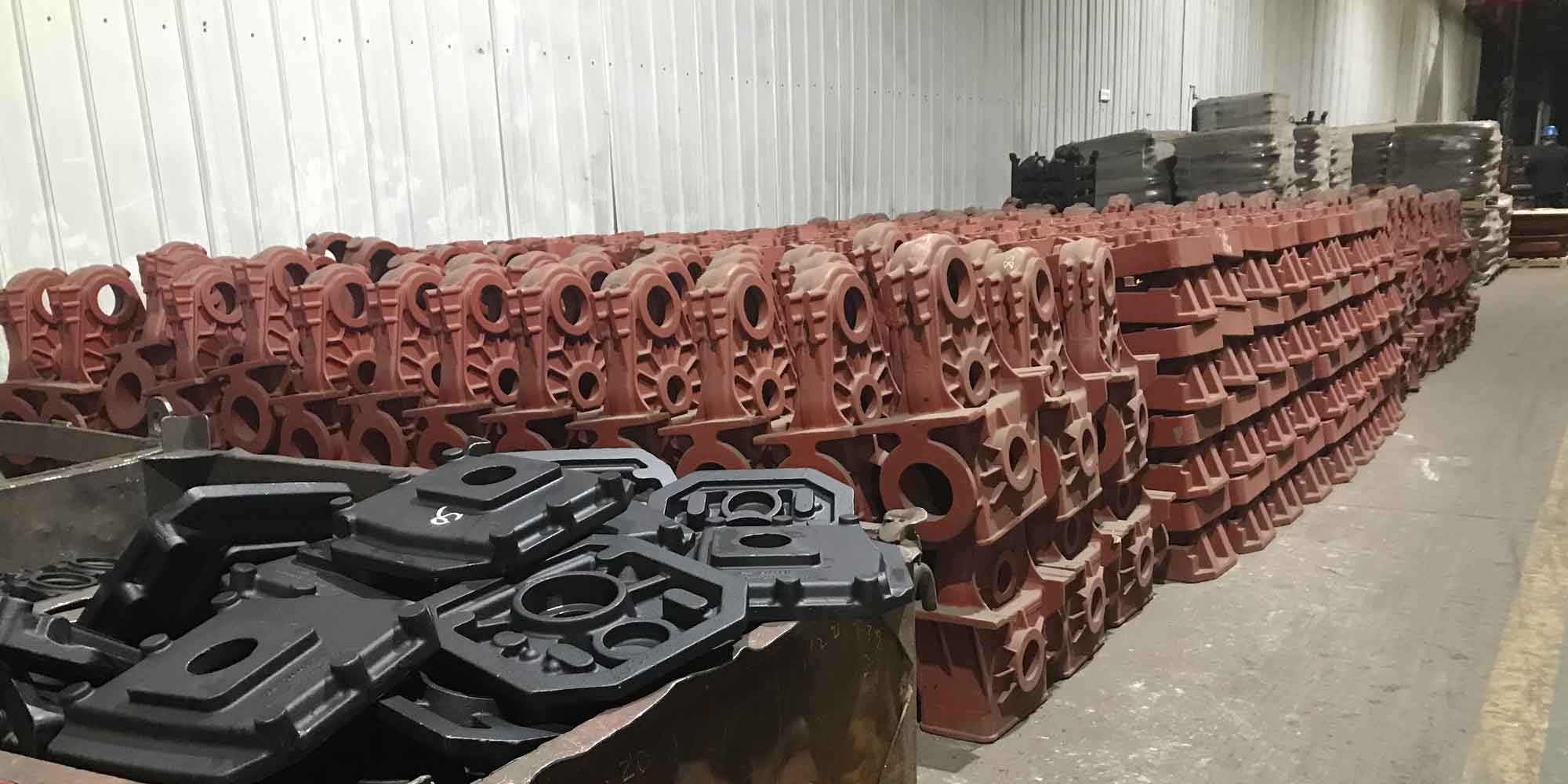
In practical application for components like bolster and side frame steel castings, the polyurethane composite molds demonstrate exceptional performance. The surface does not absorb moisture from the molding sand, eliminating a source of gas defects. Their rigidity prevents deformation during ramming, ensuring consistent wall thickness in the resulting steel castings. The wear resistance means that critical dimensions, such as the profile of a spring seat or the geometry of a draft angle, remain stable over hundreds of molding cycles. The ability to easily incorporate and machine complex core prints and gating systems directly into the mold body streamlines the overall casting process for these large steel castings.
Furthermore, from a stress perspective during mold handling, the composite structure offers a high strength-to-weight ratio. The bending stress on a mold plate during lifting can be estimated using the beam bending formula:
$$ \sigma_{bend} = \frac{M \cdot y}{I} $$
Where \( M \) is the bending moment, \( y \) is the distance from the neutral axis, and \( I \) is the area moment of inertia. The tailored stiffness of the composite mold minimizes deflection (\( \delta \)) under its own weight and handling loads, calculated generally as:
$$ \delta \propto \frac{F L^3}{E I} $$
where \( F \) is the load, \( L \) is a characteristic length, and \( E \) is the effective Young’s Modulus of the composite structure. This inherent stiffness ensures the mold retains its precise shape throughout its service life.
Future Directions and Concluding Remarks
The successful integration of polyurethane-based substitute materials marks a significant advancement in the tooling strategy for heavy-section steel castings. Looking forward, research is ongoing into next-generation materials with even higher HDTs, integrated sensor cavities for process monitoring, and the use of additive manufacturing (3D printing) to create directly the mold’s working surface from UV-curable or thermally cured polymers, potentially bypassing the need for a master model altogether.
In conclusion, the application of engineered polymer composites as wood substitutes in mold making has proven to be a transformative development. By offering an optimal balance of machinability, dimensional stability, thermal resistance, and durability, these materials directly address the limitations of traditional options. They enable the efficient, precise, and repeatable production of high-quality molds, which is a fundamental prerequisite for manufacturing reliable and safe steel castings for critical applications like railway freight vehicles. The move from craft-based woodworking to digitally-driven composite fabrication represents a necessary and highly beneficial modernization of foundry tooling practices, ensuring competitiveness and quality in the production of heavy industrial steel castings.