
For decades, our foundry’s production of cast iron parts relied entirely on the traditional green sand molding process. While this clay-bonded system served us well for a long time, the increasing demands for higher dimensional accuracy, better surface finish, and improved production efficiency for our cast iron parts necessitated a fundamental change. The decision to replace the entire clay sand system with a self-curing furan resin sand process was a significant technological leap. This transition was not merely an equipment upgrade but a complete re-engineering of our core manufacturing philosophy for producing cast iron parts. The journey involved overcoming challenges, refining parameters, and systematically understanding the new process’s intricacies. From my firsthand experience, mastering the production of cast iron parts with resin sand is a holistic endeavor where raw materials, process parameters, equipment, and stringent control must work in perfect harmony. This article details the comparative analysis and the critical process control points we have established to consistently produce high-quality cast iron parts.
The clay sand process, with its simple composition of sand, clay, water, and additives like coal dust, was deeply ingrained in our operations. A typical formulation for molding and core sands is summarized in the table below.
| Sand Type | New Sand (100/140 mesh) | Return Sand | Bentonite | Western Bentonite | Coal Dust | Asphalt | Carbon Black |
|---|---|---|---|---|---|---|---|
| Molding Sand | 25% | 68% | 3% | 3% | 1% | – | – |
| Core Sand | 25% | 26% | 20% | 3% | 3% | 15% | 6% |
The molded cores and molds required coating with a water-based graphite paint and, crucially, a lengthy drying cycle in a stove to remove moisture, a typical cycle of which is shown below. While this process had the advantages of low-cost materials and mature technology, its drawbacks became increasingly apparent. The labor intensity was high, the production cycle was long, and the need for drying made it energy-intensive. Quality control was challenging, often leading to defects like gas holes and sand burn-on on the final cast iron part. Furthermore, the dimensional accuracy and surface finish were limited, often requiring larger machining allowances. The work environment was dusty, posing significant health risks.
In contrast, the self-curing furan resin sand process uses synthetic resin as a binder, activated by a liquid acid catalyst at room temperature. The advantages for producing cast iron parts are transformative. The sand hardens without external heat, saving substantial energy. The quality of the cast iron part is superior, achieving a dimensional tolerance of CT8 to CT10 and a surface roughness (Ra) of 25μm to 100μm. The sand is easy to compact and shake out, greatly reducing cleaning labor. The used sand can be efficiently recycled, improving the working environment and enabling mechanization even for small-batch production. The strip time ranges from minutes to a few hours, drastically increasing productivity. However, the process is not without its challenges. The resin and high-quality sand are more expensive. The process is highly sensitive to ambient temperature and humidity, requiring strict control. There are also fumes during mixing, molding, and pouring that necessitate proper ventilation. The following table provides a direct comparison of the two processes for producing cast iron parts.
| Aspect | Clay Green Sand Process | Self-Curing Furan Resin Sand Process |
|---|---|---|
| Binder System | Clay, Water | Furan Resin, Acid Catalyst |
| Energy for Hardening | High (Drying Oven Required) | Low (Room-Temperature Reaction) |
| Cycle Time | Long (Hours for drying) | Short (Minutes to hours for strip) |
| Dimensional Accuracy (Typical for Cast Iron Part) | CT11-CT13 | CT8-CT10 |
| Surface Roughness (Ra) | >100 μm | 25-100 μm |
| Labor Intensity | High (Manual ramming, difficult cleaning) | Lower (Good flowability, easy shakeout) |
| Sand Reclamation | Limited, high waste | Efficient, high recycle rate (>90%) |
Environmental Impact
| High dust, moisture |
Chemical fumes, but low dust |
|
| Process Sensitivity | Less sensitive to ambient conditions | Highly sensitive to temperature & humidity |
| Cost Structure | Low material cost, high energy/labor cost | High material cost, low energy/labor cost |
The successful application of this technology for cast iron parts hinges on meticulous control across several key areas.
I. Control of Raw and Auxiliary Materials
The quality of base sand profoundly impacts resin consumption, sand strength, and the final quality of the cast iron part. For medium to large cast iron parts, we have specified the following technical requirements for silica sand.
| Parameter | Specification | Rationale for Cast Iron Parts |
|---|---|---|
| AFS Grain Fineness | 50-65 (approx. 30/50 to 40/70 mesh) | Balances surface finish and permeability for cast iron. |
| SiO2 Content | >96% | Ensures sufficient refractoriness for iron pouring temperatures. |
| Clay Content | < 0.2% | Minimizes resin demand and prevents unpredictable bonding. |
| Moisture Content | < 0.2% | Critical! Moisture interferes with acid catalyst, weakening bonds. |
| LOI (Loss on Ignition) | < 0.5% | Low LOI indicates clean sand, reducing gas potential in the cast iron part. |
| Acid Demand Value (ADV) | < 5 mL | Low ADV means less catalyst is neutralized by sand impurities, ensuring consistent hardening. |
| Rounded Grain Shape | Preferred | Improves flowability and compaction, requiring less resin for equal strength. |
The selection of resin is dictated by the alloy type and the required sand properties. For our range of gray and ductile iron castings, we use a medium-nitrogen furan resin with a high furfuryl alcohol content. This provides good thermal stability, reduces the risk of nitrogen-related porosity in thick-section cast iron parts, and offers a balance between cost and performance. The catalyst is a matched organic sulfonic acid. Its selection (e.g., slow, medium, fast hardener) is a primary tool for controlling work time and strip time based on shop conditions and the size of the mold for the cast iron part. A typical relationship between temperature and required catalyst type/percentage can be expressed as a rule-of-thumb formula for initial setup:
$$ C_{p} \approx k_{T} \cdot (T_{amb} – T_{ref}) + C_{base} $$
Where \( C_{p} \) is the catalyst percentage (relative to resin), \( T_{amb} \) is ambient temperature, \( T_{ref} \) is a reference temperature (e.g., 20°C), \( C_{base} \) is the base percentage at \( T_{ref} \), and \( k_{T} \) is a negative temperature coefficient. This must be fine-tuned daily.
Coatings are essential to prevent metal penetration and achieve a clean surface on the cast iron part. We primarily use alcohol-based graphite coatings. However, for heavy-section cast iron parts, corners, and hot spots prone to burn-on, we apply a primary layer of a high-refractoriness zircon-based or composite coating before the graphite coating. This two-layer system significantly enhances the mold’s resistance to chemical and mechanical penetration.
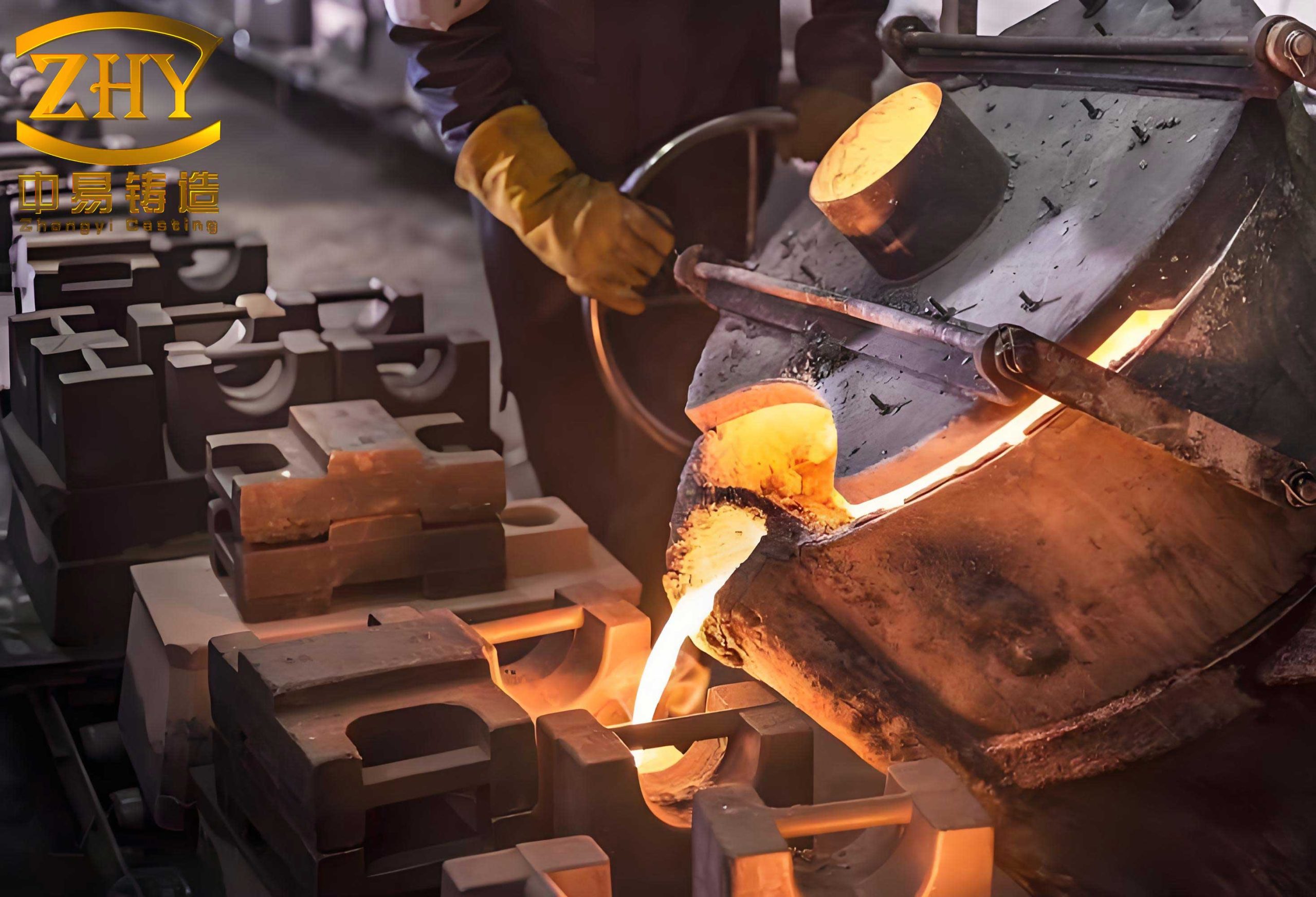
II. Sand Mixing Ratio and Molding Process Control
The heart of the process is the continuous mixer. Our standard formulation for producing molds for cast iron parts is as follows:
| Component | Percentage | Control Range & Notes |
|---|---|---|
| Silica Sand | 100% | Temperature controlled to 20-30°C if possible. |
| Furan Resin | 0.9 – 1.2% | Higher for complex cores, heavy sections. Lower for simple jobbing work. |
| Acid Catalyst | 30 – 55% of resin weight | Varies with temperature, humidity, and required work time. |
A more precise model for resin addition (\( R_{a} \)) based on sand surface area and desired tensile strength (\( \sigma_{t} \)) can be conceptualized. The specific resin demand is related to the surface area of the sand grains, which is a function of grain fineness and shape:
$$ R_{a} = \frac{A_{s} \cdot \rho_{r} \cdot \delta}{K} $$
Where \( A_{s} \) is the total surface area of sand per unit weight, \( \rho_{r} \) is the resin density, \( \delta \) is the desired resin film thickness on the sand grain, and \( K \) is a efficiency constant. In practice, for a given sand, we determine the optimal resin percentage to achieve a target 24-hour tensile strength of 1.2-1.6 MPa for molds and 1.8-2.2 MPa for cores for cast iron parts.
Molding requires a disciplined approach. A common misconception is that resin sand’s excellent flowability eliminates the need for adequate ramming. This is false. Insufficient compaction, especially in the face layer contacting the cast iron part, leads to soft molds, poor surface finish, and the risk of mold wall movement. We enforce a standard of achieving a mold hardness (B-scale) greater than 90 in all critical areas. For large molds without vibration tables, this is achieved through systematic hand ramming and the use of pneumatic rammers.
The coating application is a critical art. The general rule is one coat for every 15-20 mm of average section thickness of the intended cast iron part. Most molds require 2-3 coats, with very heavy sections needing up to 5. The coating viscosity must be carefully controlled—too thick, and it peels; too thin, and it doesn’t provide adequate coverage. We use a “drip test” where the coated brush should release a steady, unbroken stream. The sequence is crucial: the first coat is applied fully and immediately flame-dried. The second coat is applied, focusing on uniformity, and dried. Subsequent coats are used for reinforcement in hot spots. For critical areas on large cast iron parts, the first coat is the high-refractoriness zircon coating, followed by graphite coats.
III. Foundry Practice and Gating System Design for Cast Iron Parts
The casting process itself must be adapted to the characteristics of resin sand. Pattern design must account for the high bond strength. All patterns must be coated with a reliable release agent. Draft angles may need to be slightly increased compared to clay sand practice to ensure clean stripping without damaging the pattern or mold integrity for the cast iron part.
The most significant adjustments are in the gating and feeding system design. Furan resin sand begins to thermally decompose and lose strength rapidly above approximately 350-400°C, generating large volumes of gas. Therefore, the principles for gating a cast iron part in resin sand are: rapid and tranquil filling. To achieve this, we use exclusively open, pressurized, or step-gating systems designed to minimize turbulence. The cross-sectional areas of the sprue, runners, and ingates are typically increased by 15-20% compared to an equivalent clay sand mold to allow faster filling. The key formula governing fluid flow is the Bernoulli equation, but pragmatically, we use the choke area principle. The total choke area (\(A_{choke}\)) at the base of the sprue or in the gates is calculated based on the desired pour time (\(t\)) and the effective metallostatic head (\(h\)):
$$ A_{choke} = \frac{W}{\rho \cdot t \cdot C_{d} \cdot \sqrt{2gh}} $$
Where \(W\) is the weight of the cast iron part, \(\rho\) is the molten iron density, \(C_{d}\) is the discharge coefficient (typically 0.7-0.8 for resin sand), and \(g\) is gravity. We then enlarge this calculated area by the 15-20% safety factor to account for the gas generation and ensure rapid filling.
Venting is paramount. Inadequate venting leads to back-pressure, causing metal to boil or spit from the mold, resulting in mistruns or gas defects in the cast iron part. We liberally install vent plugs at the highest points of the mold cavity. The cope mold is thoroughly vented using vent wires or nails, creating channels for gas to escape to the atmosphere. The required vent area (\(A_{vent}\)) is often empirically related to the mold volume or pour rate, but a good rule is to ensure it is at least 2-3 times the total choke area:
$$ A_{vent} \geq (2 \text{ to } 3) \cdot A_{choke} $$
This aggressive venting is non-negotiable for producing sound cast iron parts with resin sand.
IV. The Interplay of Environmental Factors and Quality of the Cast Iron Part
Environmental control is the most dynamic aspect of managing the resin sand process. Temperature and humidity directly affect the kinetics of the acid-catalyzed polymerization reaction. High temperature accelerates the reaction, shortening work and strip times. High humidity introduces water vapor, which can dilute the acid catalyst, slow the reaction, and, more critically, react with the resin, weakening the final bond and potentially increasing gas defects in the cast iron part.
We monitor shop floor conditions constantly. Our data has led to the development of adjustment protocols. For instance, on a hot, dry day, we switch to a slower catalyst or reduce its percentage. On a cold, humid day, we use a faster catalyst, increase its percentage, and may even pre-warm the sand if possible. The impact can be quantified in a simplified manner where the effective catalyst activity (\(A_{eff}\)) is a function:
$$ A_{eff} = A_{0} \cdot e^{-E_a/(R T)} \cdot f(RH) $$
Where \(A_{0}\) is a constant, \(E_{a}\) is the activation energy, \(R\) is the gas constant, \(T\) is temperature, and \(f(RH)\) is a decreasing function of relative humidity. This conceptual model underscores why maintaining consistent sand temperature, through storage or conditioning, is as important as controlling resin and catalyst ratios to ensure consistent mold properties for every cast iron part.
In conclusion, the transition from clay sand to self-curing furan resin sand represents a paradigm shift in the production of cast iron parts. It is not a simple substitution but the adoption of a fundamentally different system with superior capabilities but also greater sensitivity. The advantages—exceptional dimensional accuracy, superb surface finish, reduced cleaning, and faster production cycles for cast iron parts—are substantial and realizable. However, they are contingent upon a rigorous, science-based approach to process control. Success hinges on the meticulous selection of high-purity raw materials, precise and adaptive sand formulation, disciplined molding and coating practices, and casting techniques specifically designed for the gas-generating nature of the binder. Furthermore, an unwavering focus on environmental monitoring and adjustment is critical. When these elements are integrated and controlled with precision, the resin sand process moves from being a costly alternative to becoming the reliable, high-performance core of a modern foundry dedicated to producing premium-quality cast iron parts. It is a continuous journey of optimization, where each batch of sand and each mold poured contributes to a deeper understanding and mastery of this powerful technology.