
For decades, my experience in foundry operations has been defined by the inherent challenges of traditional resin sand casting. The image of manual molding lines, crowded floors with scattered molds, and an environment clouded with dust and fumes is a familiar, if undesirable, one. The labor intensity, spatial inefficiency, and significant safety hazards were constant concerns. Today, the paradigm has shifted. I have been involved in the design, implementation, and operation of a new generation of resin sand casting facilities—fully intelligent, automated, and flexible production lines. This article details the core philosophy, technical architecture, and quantifiable benefits of such a system, moving beyond a simple case study to a comprehensive technical blueprint for the modern foundry.
The limitations of the traditional workshop are the primary drivers for innovation. A manual resin sand casting line typically suffers from several critical inefficiencies that can be summarized as follows:
| Challenge Category | Traditional Line Manifestation | Impact |
|---|---|---|
| Labor & Ergonomics | High number of workers for molding, closing, handling, and pouring. Repetitive heavy lifting. | High labor cost, physical strain, difficulty retaining skilled workforce, variable product quality. |
| Spatial Efficiency | “Floor-style” pouring and cooling. Sand molds occupy vast, unorganized floor space. | Low space utilization, congested workflow, difficult material tracking, safety risks from trip hazards. |
| Process Control & Traceability | Manual scheduling, reliance on operator experience for pouring sequence. No real-time data. | Inconsistent quality, difficult lot tracing, reactive (not proactive) problem-solving. |
| Environmental Control | Localized or insufficient fume extraction, especially during pouring. High resin consumption. | Poor workplace air quality, environmental non-compliance risks, higher material cost. |
The transition to an intelligent resin sand casting line is not merely an equipment upgrade; it is a systemic re-engineering of the entire production logic. The core objective is to replace manual, discrete operations with an integrated, data-driven flow. This system is designed for high-mix, variable-volume production—exactly the market demand that challenges traditional lines. The central components of this intelligent line are: the Automated Molding Cell, the Intelligent Three-Dimensional Storage (3D Warehouse), the Automated Pouring and Cooling Line, the Core Sand Regeneration System, and the unified Line Control System.
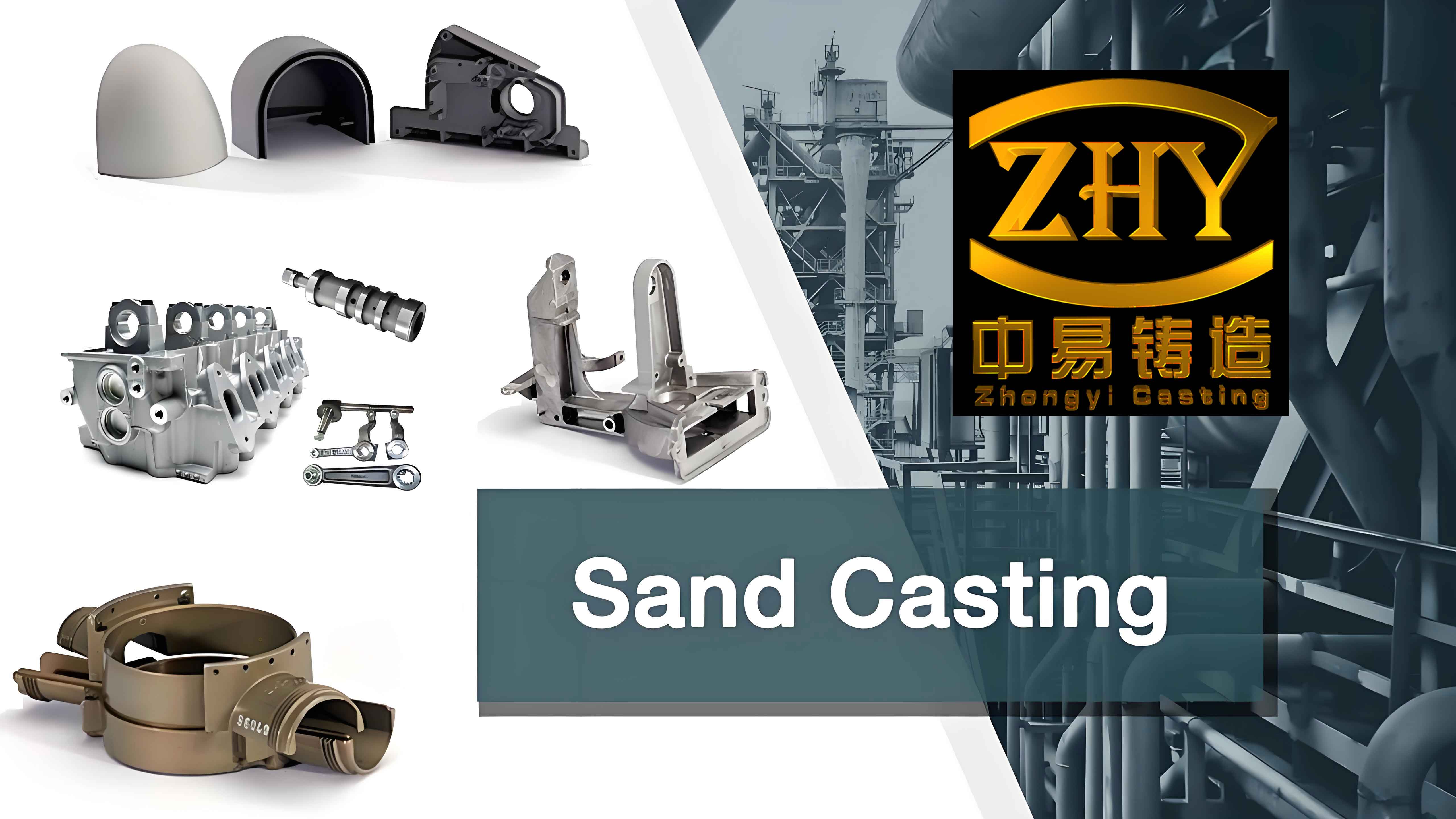
1. The Automated and Flexible Molding Cell
The journey begins at the molding station, which has evolved from a manual station into a programmable, flexible cell. The key to flexibility in resin sand casting is handling varying flask sizes without costly changeovers. Our cell is built around a universal molding pallet and an articulating, overhead manipulator.
The process flow is sequential and automated:
1. Sand Mixing & Delivery: The continuous mixer delivers resin-coated sand with precise ratios. The resin addition rate $A_r$ (as a percentage of sand weight) is a critical controlled variable, targeted at minimal levels (e.g., ≤ 0.8%) to reduce cost.
$$ A_r = \frac{M_{resin}}{M_{sand}} \times 100\% $$
2. Filling & Compaction: The flask is placed on a vibration table. Sand is blown and simultaneously compacted to achieve uniform density $ρ_{mold}$.
3. Curing: The mold is allowed to cure. The curing time $t_c$ is a function of resin type, catalyst ratio, and ambient temperature $T_a$, often modeled empirically.
$$ t_c = f(ResinType, Catalyst\%, T_a) $$
4. Pattern Stripping: The overhead manipulator, with adjustable grippers, lifts the cured mold from the pattern plate. The stripping force $F_s$ must be sufficient but controlled to prevent mold damage.
5. Finishing & Coating: Automated robots or dedicated stations perform minor repairs and apply a refractory coating via flow coating.
6. Core Setting & Mold Closing: Cores are placed manually or robotically. The manipulator then picks up the cope half and precisely aligns it with the drag half for closing. The alignment tolerance $δ_{align}$ is typically sub-millimeter.
7. Transfer to Storage: The closed, ready-to-pour mold is placed on a standardized pallet by the manipulator and transferred via an RGV (Rail-Guided Vehicle) to the 3D warehouse.
| Molding Cell Component | Key Technical Feature | Flexibility Parameter |
|---|---|---|
| Articulating Manipulator | Programmable gripper span, multi-axis movement. | Handles flask sizes from 1000mm x 800mm to 2000mm x 1700mm. |
| Universal Molding Pallet | Standardized interface for all flasks within range. | Eliminates mechanical adjustment; only program change required. |
| Process Control System | Closed-loop control of sand ratios, vibration time, curing parameters. | Ensures consistent mold quality across different part geometries. |
2. The Intelligent Three-Dimensional Storage System
This is the intelligent heart of the resin sand casting line, replacing chaotic floor storage. It is a high-density racking system served by computer-controlled stacker cranes. Every mold pallet is equipped with a unique barcode or RFID tag. Upon entry, the system performs two critical actions:
- Automatic Weighing: The stacker crane’s weighing module records the mold weight $W_{mold}$. This data is used for pour scheduling.
- Scanning & Registration: The ID is scanned, linking the physical mold to its digital twin in the Warehouse Management System (WMS).
The WMS maintains a real-time 3D map of inventory. Each storage location is identified (e.g., Aisle 1, Row 3, Level 5, Column 2). The system’s capacity $C_{wh}$ is a product of its dimensions:
$$ C_{wh} = N_{aisles} \times N_{rows} \times N_{levels} \times N_{columns} $$
For a 2-aisle, 2-row, 6-level, 11-column system:
$$ C_{wh} = 2 \times 2 \times 6 \times 11 = 264 \ \text{storage locations} $$
Each location is rated for a load $L_{max}$ (e.g., 4 tons). The primary advantage is the decoupling of production rhythms. The molding cell can produce at its optimal pace, storing molds. The pouring line can call for molds based on its own schedule and the available molten metal, creating a flexible buffer. The operator uses a simple HMI to “call” molds in a specific sequence, which the WMS and stacker crane execute autonomously.
3. The Automated Pouring and Controlled Cooling Line
This segment transforms pouring from a hazardous, skill-dependent task into a controlled, repeatable process. The workflow is triggered by the pour schedule.
- Dispatching: The operator sequences molds on the HMI based on part geometry, required metal grade $G_m$, and weight $W_{mold}$ to match the available furnace ladle capacity $C_{ladle}$. The rule is:
$$ \sum_{i=1}^{n} W_{mold_i} \leq C_{ladle} $$
for a batch of ‘n’ molds poured from one ladle. - Drying: Called molds are transported via RGV to a closed-loop hot-air drying tunnel. The drying removes residual moisture from the coating, crucial for preventing gas defects. The energy required $Q_{dry}$ is:
$$ Q_{dry} = m_w \cdot c_w \cdot \Delta T + m_w \cdot h_{fg} $$
where $m_w$ is mass of water, $c_w$ is specific heat, $\Delta T$ is temperature rise, and $h_{fg}$ is latent heat of vaporization. - Pouring: Molds enter a dedicated pouring station. An automated pouring furnace or a robotic ladle tip pours the metal. The pour rate and pour time are controlled. A full-coverage top-down canopy with high-efficiency extraction captures over 95% of fumes generated during the resin sand casting pour.
- Cooling: Poured molds enter an enclosed cooling tunnel. The controlled environment allows for predictable solidification and cooling rates, improving metallurgical consistency. The cooling time $t_{cool}$ to a safe shakeout temperature $T_{so}$ can be estimated from heat transfer models.
- Return to Storage: After sufficient cooling, molds are automatically returned via RGV to a designated area in the 3D warehouse, awaiting shakeout.
4. The Closed-Loop Sand Regeneration System
Sustainability and cost reduction in resin sand casting are driven by efficient sand recycling. The goal is to reclaim clean, cool, and consistent sand with minimal new sand addition. The process is a multi-stage physical separation and treatment:
$$ \text{Used Sand} \rightarrow \text{Shakeout} \rightarrow \text{Magnetic Separation} \rightarrow \text{Crushing} \rightarrow \text{Attrition Reclamation} \rightarrow \text{Cooling} \rightarrow \text{Storage} $$
The most critical stages are:
Attrition Reclamation: Mechanical scrubbing (e.g., in a high-intensity搓擦机) removes the spent resin film from sand grains. The efficiency $η_{reclaim}$ determines new resin demand.
Temperature Control: The exothermic curing reaction heats the sand. A vertical sand cooler with a closed-circuit water tower reduces sand temperature $T_{sand}$ to below 40°C, often targeting 25-30°C. Heat removal $Q_{remove}$ is vital:
$$ Q_{remove} = \dot{m}_{sand} \cdot c_{p,sand} \cdot (T_{in} – T_{out}) $$
where $\dot{m}_{sand}$ is mass flow rate. Cool sand is essential for consistent workability and resin kinetics in the next molding cycle.
| Regeneration Stage | Primary Function | Key Performance Indicator (KPI) |
|---|---|---|
| Vibratory Shakeout | Separate sand from casting and lumps. | Sand recovery yield > 99%. |
| Multi-stage Magnetic Separation | Remove ferrous debris (shots, nails). | Ferrous content in reclaimed sand < 0.1%. |
| Attrition Reclaimer | Remove resin coating from grains. | LOI (Loss on Ignition) of reclaimed sand < 2.0-2.5%. |
| Sand Cooling System | Reduce sand temperature. | Sand temperature at mixer inlet ≤ 30°C. |
5. Integrated Control & The Empty Flask Return Line
The final link is the automated return of empty flasks from shakeout back to the molding cell. A network of powered roller conveyors transports flasks without manual intervention. This is managed by the same central SCADA (Supervisory Control and Data Acquisition) system that orchestrates the entire resin sand casting line.
The SCADA system provides a single pane of glass for operators and managers. Real-time data is displayed: molding cell status, warehouse inventory map, pouring line sequence, sand system parameters, and equipment health. Production data—cycle times, weights, resin consumption, pour temperatures—is logged for analytics and continuous improvement. The system enables true remote monitoring and control.
6. Quantitative Analysis of Benefits and Production Takt
The design of such a line is governed by the required production takt time $τ_{takt}$, which is the average time between units of output. For a line producing one complete mold every 3.5 minutes, the daily capacity $P_{day}$ for a 20-hour operation is:
$$ τ_{takt} = 3.5 \ \text{min/mold} = 210 \ \text{sec/mold} $$
$$ P_{day} = \frac{\text{Operating Time}}{τ_{takt}} = \frac{20 \times 3600 \ \text{sec}}{210 \ \text{sec/mold}} \approx 343 \ \text{molds/day} $$
The benefits can be quantified across several dimensions, proving the viability of intelligent resin sand casting:
| Benefit Area | Traditional Line Baseline | Intelligent Line Performance | Impact |
|---|---|---|---|
| Labor Productivity | X workers per mold | Reduction of 50-70% in direct labor | Lower cost, reduced ergonomic risk. |
| Space Utilization | 1x (baseline footprint) | Storage density increase of 300-400% with 3D warehouse | Smaller factory footprint or capacity expansion within same space. |
| Material Efficiency | Resin usage ~1.2-1.5% | Resin usage sustained at 0.7-0.8% | Direct material cost reduction of 40-50% for resin. |
| Quality & Traceability | Manual tracking, variable quality | 100% mold tracking, controlled pour parameters, consistent cooling | Reduced scrap/rework, full digital traceability for each casting. |
| Environmental Control | Local extraction, visible emissions | Centralized, >95% fume capture at source; contained sand system | Compliance with strict regulations, improved worker environment. |
The formula for overall equipment effectiveness (OEE) in this context improves significantly due to increased Availability (less downtime from manual handling), Performance (consistent automated cycle times), and Quality (lower defect rates).
7. Conclusion: The Path Forward for Resin Sand Casting
The implementation of an intelligent resin sand casting production line represents a fundamental leap from artisanal practice to advanced manufacturing. It addresses the core competitive pressures of the modern foundry: the need for flexibility in high-mix production, relentless cost reduction, stringent quality and traceability demands, and the imperative to provide a safe, sustainable workplace.
The technology described here is not speculative; it is proven and operational. The integration of flexible automation, intelligent logistics via 3D warehousing, process digitization, and closed-loop material recycling creates a resilient and efficient production system. This approach makes resin sand casting, already valued for its dimensional accuracy and suitability for complex geometries, economically and operationally viable for the future. The foundry floor is transformed from a “dirty, chaotic, and strong” environment into a clean, data-rich, and highly controlled engineering center. This is the definitive pathway for the resin sand casting industry to thrive in the era of Industry 4.0, ensuring its relevance and competitiveness for decades to come.