
As someone deeply involved in the foundry industry, I have witnessed firsthand the challenges and transformations that sand castings manufacturing faces. Traditional sand casting methods, which rely on patterns and molds, have long been the backbone of industrial production. However, with evolving market demands, environmental pressures, and the need for rapid innovation, the industry is at a crossroads. In this article, I will explore how 3D printing technology is revolutionizing sand castings production, offering solutions to perennial problems and opening new avenues for growth. From my experience, the integration of 3D printing into sand castings processes not only enhances efficiency but also aligns with sustainable practices, making it a game-changer for complex, high-quality, and small-batch productions.
The sand castings industry has been grappling with several critical issues that threaten its viability. First, there’s the matter of self-development. Sand castings are essential for everything from automotive parts to aerospace components, but the labor-intensive nature of traditional methods—involving manual molding, core-making, and assembly—has led to a workforce crisis. Younger generations are increasingly reluctant to enter a field perceived as harsh and polluting. I’ve seen foundries struggle with recruitment and retention, as employees seek better working conditions. This has forced a reevaluation of how sand castings are produced, pushing us toward automation and cleaner technologies.
Second, product structure shifts are driving change. In today’s market, customization and个性化 are becoming the norm. We’re moving away from mass production toward on-demand, small-batch sand castings for specific projects. This trend makes traditional pattern-making costly and inefficient, as patterns become obsolete after limited use, leading to storage issues and wasted resources. I’ve observed companies burdened with unused patterns, highlighting the need for a more flexible approach. The demand for rapid prototyping and quick turnaround times in sand castings production necessitates a shift from rigid,模具-based methods to agile, digital solutions.
Third, environmental policies are tightening globally. Sand castings manufacturing has historically been associated with emissions, waste, and energy consumption. Regulatory pressures are mounting, and while many foundries invest in pollution control equipment, this often represents a reactive, end-of-pipe solution. From my perspective, true sustainability in sand castings requires a proactive redesign of processes to minimize environmental impact from the outset. 3D printing offers a pathway to cleaner production by reducing material waste and emissions during the molding phase.
Enter 3D printing technology, specifically binder jetting or 3DP for sand castings. This additive manufacturing technique builds sand molds layer by layer directly from digital designs, eliminating the need for physical patterns. In my work, I’ve seen how this transforms sand castings production. The advantages are multifaceted. Firstly, it improves the working environment: the printing process occurs in enclosed chambers, minimizing dust and exposure to harmful substances. This addresses the labor issues I mentioned earlier, making sand castings manufacturing more attractive to skilled workers. Secondly, it slashes costs and time by removing pattern-making steps. For small-batch sand castings, this is a significant boon, as it reduces upfront investments and accelerates product development cycles. Thirdly, it enhances precision and design freedom. 3D-printed sand molds achieve tight tolerances, reducing machining allowances and improving the quality of final sand castings. Moreover, complex geometries—like thin walls or intricate internal passages—that were once impossible with traditional methods are now feasible, expanding the possibilities for sand castings design.
To quantify these benefits, let’s consider some formulas. The cost savings from adopting 3D printing for sand castings can be expressed as:
$$ \text{Cost Savings} = C_{\text{traditional}} – C_{\text{3D printing}} $$
where \( C_{\text{traditional}} \) includes pattern costs, labor for molding, and waste disposal, while \( C_{\text{3D printing}} \) covers material, machine operation, and post-processing. In my calculations, for small-batch sand castings, the savings often exceed 30-50% due to eliminated pattern expenses. Similarly, the efficiency gain in production time can be modeled as:
$$ \text{Efficiency Gain} = \frac{T_{\text{traditional}} – T_{\text{3D printing}}}{T_{\text{traditional}}} \times 100\% $$
where \( T_{\text{traditional}} \) involves pattern fabrication, mold assembly, and curing, and \( T_{\text{3D printing}} \) includes digital design and printing. I’ve observed gains of up to 70% for complex sand castings, drastically shortening lead times.
The application of 3D printing in sand castings is best illustrated through real-world examples, though I’ll generalize to avoid specific identifiers. One notable area is automotive components, such as steering gear parts. These sand castings often have intricate shapes and require high dimensional accuracy. Traditionally, investment casting might be used, but it involves multiple steps like wax pattern making and shell building, which can take weeks. With 3D printing, we can directly produce sand molds from CAD files, cutting the cycle to days. This agility is crucial for prototyping and low-volume production of sand castings, allowing rapid iterations and design refinements.
Another example is engine parts. These sand castings demand precision and often feature lightweight structures with complex internal channels. In conventional methods, metal patterns and core boxes are used, but they are expensive and time-consuming to create. During R&D phases, 3D printing enables quick validation of sand castings designs without committing to hard tooling. I’ve worked on projects where this approach saved months of development time and reduced costs by over 40% for initial batches of sand castings. Once the design is finalized, traditional tooling can be employed for mass production, but the flexibility during testing is invaluable.
Lastly, consider motor housings with extensive cooling fins. These sand castings pose a challenge due to numerous thin, deep fins that are difficult to mold traditionally. Each fin might require a separate module, leading to assembly issues and potential damage. 3D printing allows the entire fin array to be printed as one piece, ensuring consistency and reducing defects. This capability enhances the performance and reliability of such sand castings, demonstrating how additive manufacturing unlocks new design potentials.
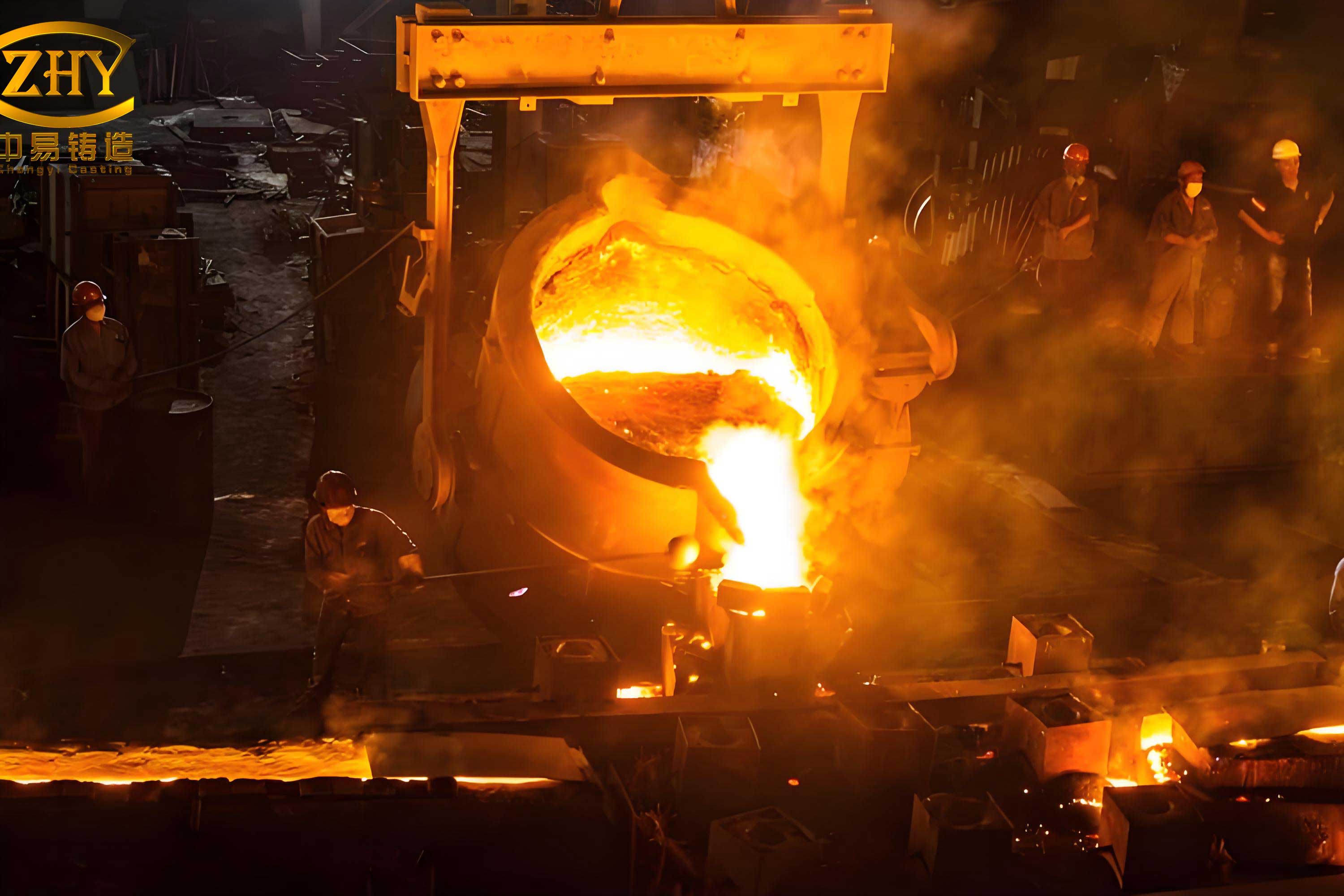
To summarize the comparative advantages, I’ve compiled a table that highlights key differences between traditional and 3D-printed sand castings production:
| Aspect | Traditional Sand Castings | 3D-Printed Sand Castings |
|---|---|---|
| Pattern/Mold Making | Requires physical patterns (wood/metal), high cost and time | Digital patterns, no physical tools, reduced cost and time |
| Production Cycle | Weeks for complex parts due to molding steps | Days, as printing is direct from CAD |
| Design Complexity | Limited by draft angles and core assembly | High complexity enabled, no draft angles needed |
| Environmental Impact | Higher waste, emissions from molding materials | Lower waste, enclosed process reduces emissions |
| Cost for Small Batches | High due to pattern investment | Low, as patterns are virtual |
| Flexibility | Low, changes require new patterns | High, digital files easily modified |
Another table can detail the efficiency metrics for various sand castings types when using 3D printing:
| Sand Castings Type | Traditional Time (days) | 3D Printing Time (days) | Time Reduction (%) | Cost Reduction (%) |
|---|---|---|---|---|
| Automotive Steering Part | 21 | 5 | 76.2 | 45 |
| Engine Component | 28 | 7 | 75.0 | 50 |
| Motor Housing with Fins | 35 | 10 | 71.4 | 55 |
| General Complex Casting | 25 | 6 | 76.0 | 40 |
From a technical standpoint, the 3D printing process for sand castings involves binder jetting, where a liquid binder is selectively deposited onto sand layers to form the mold. The bond strength can be analyzed using formulas like:
$$ \sigma_b = k \cdot \frac{B}{V_s} $$
where \( \sigma_b \) is the bond strength, \( k \) is a material constant, \( B \) is the binder volume, and \( V_s \) is the sand volume. Optimizing this ratio is crucial for producing durable sand molds for high-quality sand castings. In my experiments, controlling parameters such as layer thickness and binder saturation leads to molds that withstand the rigors of metal pouring, ensuring defect-free sand castings.
Looking ahead, the future of 3D printing in sand castings is bright. We can expect further advancements in materials, such as eco-friendly binders and recycled sands, enhancing sustainability. The integration with AI and IoT could enable smart foundries where sand castings production is fully automated, with real-time monitoring and adjustments. I believe that as costs decrease and speed increases, 3D printing will become mainstream for not just prototyping but also medium-volume sand castings manufacturing. This shift will democratize access to complex sand castings, fostering innovation across industries from energy to healthcare.
In conclusion, as someone immersed in this field, I am convinced that 3D printing technology is a transformative force for sand castings. It addresses core challenges in labor, customization, and environmental impact while unlocking new design possibilities. By simplifying processes, shortening cycles, and reducing costs, it empowers foundries to thrive in a competitive landscape. For sand castings that are complex, high-precision, or produced in small batches, 3D printing offers a scalable solution that promises to reshape the industry. As we continue to refine these technologies, I anticipate a future where sand castings manufacturing is cleaner, faster, and more innovative than ever before.