
In modern manufacturing, graphite mold casting stands out as a pivotal technique for producing high-quality casting parts, particularly in industries such as aerospace, automotive, and energy equipment. The method leverages the unique properties of graphite—like high thermal conductivity, thermal stability, and low thermal expansion—to achieve precise molding of complex geometries. However, the quality of the casting part is profoundly influenced by the interface heat transfer coefficient (IHTC), a parameter that governs the heat exchange efficiency between the molten metal and the graphite mold. In this article, I will delve into the role of IHTC, exploring its definition, influencing factors, measurement methods, variation patterns, and, most importantly, its impact on the quality of the casting part. By synthesizing theoretical analyses and existing literature, I aim to provide a comprehensive understanding that can guide process optimization for enhanced casting part performance.
The interface heat transfer coefficient, denoted as $h$, is a critical parameter in casting processes. It quantifies the rate of heat transfer per unit area per unit temperature difference across the interface between the casting part and the mold. Mathematically, it is expressed as:
$$ h = \frac{q}{A \times \Delta T} $$
where $h$ is the interface heat transfer coefficient (in W/m²·K), $q$ is the heat flux (in W), $A$ is the contact area (in m²), and $\Delta T$ is the temperature difference across the interface (in K). This coefficient is not constant; it dynamically changes during casting due to various factors, directly affecting the solidification behavior and final properties of the casting part. A higher $h$ value indicates more efficient heat extraction, which can refine the microstructure but also introduce thermal stresses. Understanding and controlling $h$ is essential for producing defect-free casting parts with optimal mechanical properties.
Numerous factors influence the interface heat transfer coefficient in graphite mold casting. These factors interact complexly, leading to significant variations in $h$ during the process. To summarize, I have categorized them into four main groups, as shown in the table below:
| Factor Category | Specific Factors | Effect on IHTC ($h$) |
|---|---|---|
| Material Properties | Thermal conductivity of graphite, specific heat capacity, density | Higher thermal conductivity increases $h$; variations with temperature affect dynamics. |
| Contact Conditions | Contact pressure, surface roughness, interfacial gap | Better contact (e.g., higher pressure, smoother surfaces) raises $h$; gaps reduce $h$ significantly. |
| Process Parameters | Pouring temperature, mold temperature, cooling rate | Higher temperature gradients initially boost $h$; controlled cooling can modulate $h$. |
| Interfacial Layers | Gas layers, oxide films, coatings on mold surface | These act as thermal barriers, decreasing $h$; coating thickness and composition are key. |
For instance, in graphite mold casting, the excellent thermal conductivity of graphite typically results in higher $h$ values compared to other mold materials. However, as the casting part solidifies and contracts, an interfacial gap may form, shifting heat transfer from conduction to radiation and causing $h$ to drop sharply. This dynamic behavior underscores the need for precise measurement and control to ensure consistent quality in the casting part.
Accurately determining the interface heat transfer coefficient is challenging due to its transient nature. Various methods have been developed, broadly classified into experimental measurements and numerical simulations. Experimental approaches often involve embedding thermocouples or heat flux sensors in both the casting part and the graphite mold to record temperature histories. From these data, $h$ can be inversely calculated using heat conduction equations. For example, one common technique involves solving the one-dimensional heat conduction equation:
$$ \frac{\partial T}{\partial t} = \alpha \frac{\partial^2 T}{\partial x^2} $$
where $\alpha$ is the thermal diffusivity, and boundary conditions include $h$ at the interface. By fitting measured temperature profiles, $h$ can be estimated as a function of time. Numerical simulations, such as finite element analysis, complement experiments by modeling the entire casting system. These simulations solve the energy equation:
$$ \rho C_p \frac{\partial T}{\partial t} = \nabla \cdot (k \nabla T) $$
with $h$ as a boundary condition, and iteratively adjust $h$ to match experimental data. This inverse method is powerful for complex geometries but requires accurate material properties. Regardless of the method, the goal is to obtain reliable $h$ values that reflect real-world conditions, enabling better prediction of the casting part’s solidification and quality.
The variation of the interface heat transfer coefficient during graphite mold casting follows a characteristic pattern, which is crucial for understanding its impact on the casting part. Typically, $h$ exhibits three distinct phases: a rapid increase to a peak, a sharp decline, and a gradual stabilization. In the initial stage, when molten metal contacts the cool graphite mold, the large temperature difference drives intense heat flux, causing $h$ to spike within seconds. This peak can be modeled empirically as:
$$ h_{\text{peak}} = f(T_{\text{pour}}, T_{\text{mold}}, k_{\text{graphite}}) $$
where $T_{\text{pour}}$ is the pouring temperature, $T_{\text{mold}}$ is the mold temperature, and $k_{\text{graphite}}$ is the thermal conductivity of graphite. As solidification progresses, the casting part contracts, creating an interfacial gap. This gap introduces thermal resistance, transitioning heat transfer from conduction to radiation, described by:
$$ q_{\text{rad}} = \sigma \epsilon (T_1^4 – T_2^4) $$
where $\sigma$ is the Stefan-Boltzmann constant, $\epsilon$ is emissivity, and $T_1$ and $T_2$ are the temperatures of the casting part and mold, respectively. Consequently, $h$ drops dramatically—often by several orders of magnitude. In the final stage, as the casting part cools further, the gap widens due to solid-state shrinkage, and $h$ stabilizes at a lower value. This pattern has been observed in studies comparing different mold materials. For example, research shows that graphite molds yield higher peak $h$ values than steel or composite molds, emphasizing the need to account for these fluctuations in process design. To visualize such dynamics, consider the following representation of interfacial heat transfer, which can be linked to practical casting scenarios:
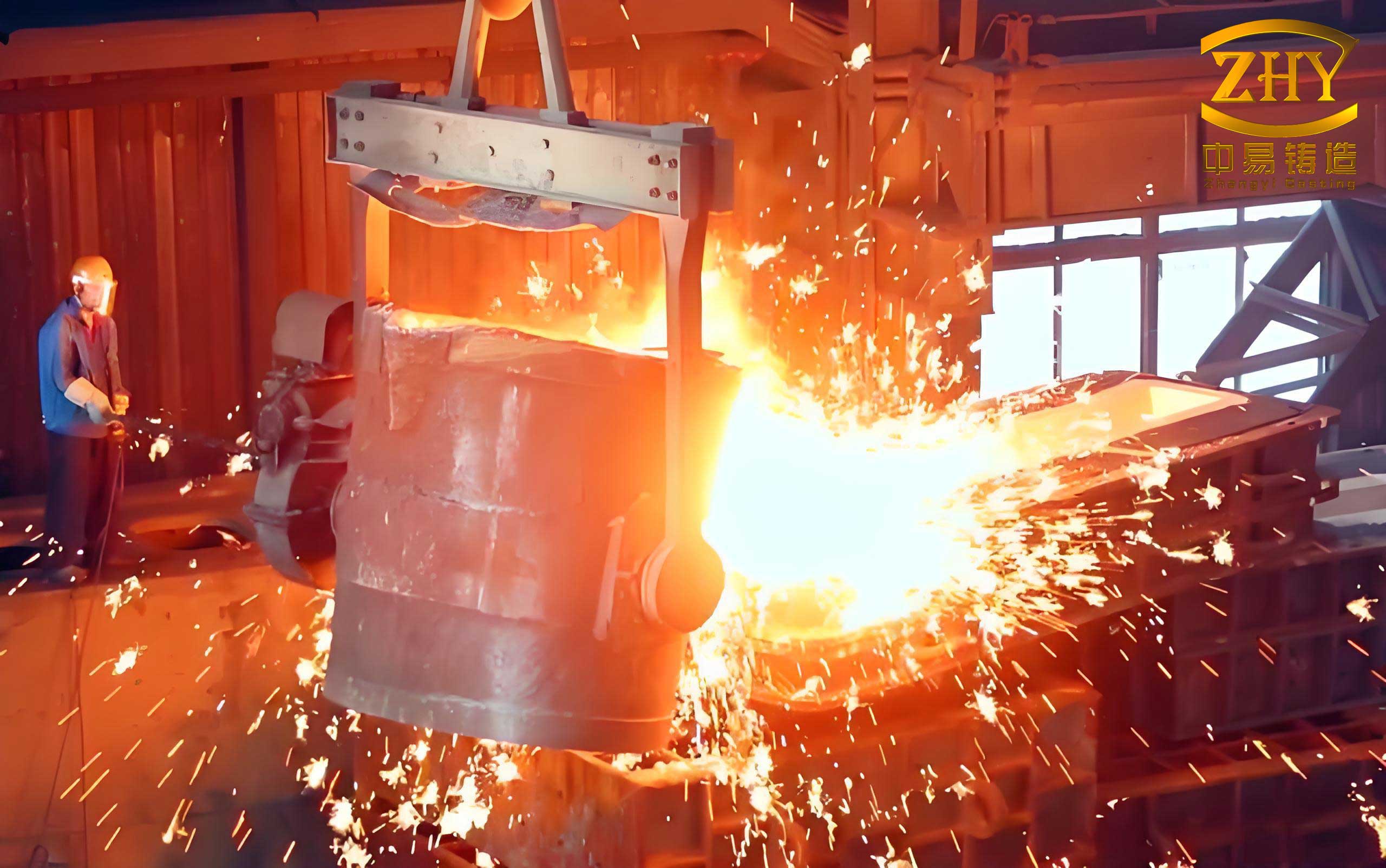
This image exemplifies the intricate interface between a casting part and its mold, highlighting the importance of heat transfer mechanisms. By analyzing $h$ variations, we can better predict temperature gradients and solidification sequences, ultimately enhancing the quality of the casting part.
The interface heat transfer coefficient exerts a profound influence on the quality of the casting part, affecting its solidification process, microstructure, and defect formation. Firstly, $h$ directly controls the cooling rate and solidification front velocity. A higher $h$ accelerates cooling, which can be expressed through the Fourier number for transient heat conduction:
$$ \text{Fo} = \frac{\alpha t}{L^2} $$
where $t$ is time and $L$ is a characteristic length. Rapid cooling promotes finer grains in the casting part, improving mechanical properties like strength and ductility. However, excessively high $h$ can lead to large thermal gradients, increasing the risk of hot tears or cracks due to thermal stresses. Conversely, a low $h$ prolongs solidification, which may exacerbate macro-segregation or gas porosity. Secondly, $h$ impacts microstructural features such as secondary dendrite arm spacing (SDAS), which correlates with cooling rate $\dot{T}$ as:
$$ \text{SDAS} = k \dot{T}^{-n} $$
where $k$ and $n$ are material constants. A finer SDAS, resulting from higher $\dot{T}$ driven by high $h$, enhances the homogeneity and performance of the casting part. Additionally, $h$ affects the formation of defects like shrinkage cavities. By modulating $h$ through mold temperature or coatings, we can encourage directional solidification, reducing such defects. For instance, applying a low-thermal-conductivity coating on the graphite mold lowers $h$, allowing for better feeding and denser casting parts. The table below summarizes key effects of $h$ on casting part quality:
| Aspect of Casting Part Quality | Effect of High IHTC ($h$) | Effect of Low IHTC ($h$) | Optimal Strategy |
|---|---|---|---|
| Solidification Rate | Fast cooling; short solidification time | Slow cooling; extended solidification | Moderate $h$ to balance speed and stress |
| Microstructure | Fine grains; reduced SDAS | Coarse grains; increased SDAS | Adjust $h$ to target specific grain sizes |
| Defect Formation | Risk of cracks due to thermal stress | Risk of porosity and segregation | Control $h$ to promote directional solidification |
| Mechanical Properties | Higher strength but possible brittleness | Lower strength but better ductility | Tune $h$ for desired property trade-offs |
| Surface Finish | Smoother surfaces due to rapid solidification | Potential for rough surfaces | Use coatings to manage $h$ and surface quality |
From this, it is clear that optimizing $h$ is essential for producing high-integrity casting parts. In graphite mold casting, strategies like preheating the mold or using tailored coatings can regulate $h$, thereby controlling the solidification sequence and minimizing defects. For example, in aerospace applications, where casting parts like turbine blades demand precise microstructures, controlling $h$ ensures the required fatigue resistance and dimensional accuracy. Similarly, in automotive engine components, managing $h$ helps achieve the desired balance between strength and weight reduction. Every casting part benefits from a carefully designed $h$ profile, underscoring its role as a cornerstone of quality assurance.
To delve deeper, let’s consider the mathematical modeling of $h$ effects. The heat transfer at the interface can be modeled using a boundary condition of the third kind (Robin condition):
$$ -k \frac{\partial T}{\partial n} = h (T_{\text{casting}} – T_{\text{mold}}) $$
where $k$ is thermal conductivity, and $\partial T / \partial n$ is the temperature gradient normal to the interface. Solving this with the heat equation allows predicting temperature fields in the casting part. For instance, in a simplified 1D case, the temperature distribution $T(x,t)$ in the casting part can be derived as:
$$ T(x,t) = T_{\text{mold}} + (T_{\text{pour}} – T_{\text{mold}}) \sum_{n=1}^{\infty} C_n \exp\left(-\alpha \lambda_n^2 t\right) \cos(\lambda_n x) $$
where $\lambda_n$ are eigenvalues dependent on $h$, and $C_n$ are coefficients from initial conditions. This shows how $h$ influences cooling curves, which in turn affect phase transformations and residual stresses in the casting part. Moreover, the solidification time $t_s$ for a casting part of thickness $L$ can be approximated by:
$$ t_s \approx \frac{L^2}{2\alpha} \cdot \frac{1}{1 + \text{Bi}} $$
where $\text{Bi} = hL/k$ is the Biot number. A high Biot number (large $h$) reduces $t_s$, favoring finer microstructures but also increasing thermal gradients. Therefore, for each casting part design, an optimal Bi range should be targeted to mitigate defects while achieving desired properties.
In practice, regulating the interface heat transfer coefficient involves several techniques. For graphite molds, preheating temperature is a key lever: higher mold temperatures decrease the initial temperature gradient, lowering $h$ and slowing solidification. This can be beneficial for thick-section casting parts to avoid shrinkage. Coatings are another powerful tool; by applying ceramic or insulating layers on the mold surface, we can reduce $h$ effectively. The coating’s thermal resistance $R_c$ adds in series with the interfacial resistance, modifying the effective $h$ as:
$$ \frac{1}{h_{\text{eff}}} = \frac{1}{h} + R_c $$
where $R_c = t_c / k_c$, with $t_c$ being coating thickness and $k_c$ its thermal conductivity. By adjusting $t_c$ or $k_c$, we can fine-tune $h_{\text{eff}}$ to suit specific casting part requirements. Additionally, process parameters like pouring rate or pressure can influence contact conditions, thereby affecting $h$. For example, higher pouring pressures improve mold-casting contact, increasing $h$ temporarily. However, this must be balanced against mold wear and casting part distortion. Through iterative experimentation and simulation, foundries can develop $h$ profiles that maximize yield and quality for each casting part type.
The implications of interface heat transfer coefficient extend beyond individual casting parts to entire production systems. In high-volume manufacturing, such as for automotive components, consistent $h$ control ensures batch-to-batch uniformity, reducing scrap rates and costs. For complex casting parts like battery housings in electric vehicles, where lightweight and high precision are critical, managing $h$ through graphite mold design enables meeting tight tolerances. Furthermore, in aerospace, where casting parts operate under extreme conditions, optimized $h$ contributes to enhanced fatigue life and creep resistance. As additive manufacturing and digital twins evolve, integrating real-time $h$ monitoring could revolutionize casting processes, allowing dynamic adjustments for each casting part produced. This proactive approach minimizes defects and enhances material utilization, aligning with sustainable manufacturing goals.
In conclusion, the interface heat transfer coefficient is a pivotal parameter in graphite mold casting, with far-reaching effects on the quality of the casting part. Its dynamic nature, influenced by material properties, contact conditions, process settings, and interfacial layers, necessitates careful measurement and control. Through experimental and numerical methods, we can capture $h$ variations and their impact on solidification kinetics, microstructure refinement, and defect formation. By leveraging strategies like mold temperature control and coatings, foundries can tailor $h$ to produce casting parts with superior mechanical properties, dimensional accuracy, and surface finish. As industries demand ever-higher performance from casting parts, continued research into $h$ optimization will remain essential. I hope this discussion provides a robust foundation for advancing graphite mold casting practices, ultimately leading to more reliable and efficient manufacturing of high-quality casting parts across diverse applications.