
In the realm of advanced manufacturing, prototype investment casting stands as a pivotal technology for shaping complex components from superalloys and titanium alloys. These materials are renowned for their exceptional high-temperature strength, corrosion resistance, and low density, making them indispensable in aerospace, energy, and other high-end sectors. The quality of cast parts is profoundly influenced by the properties of the shell mold materials, which directly interact with molten metal during the casting process. As demands for precision, performance, and reliability escalate, a deep understanding of how shell mold materials affect casting outcomes becomes crucial. This article, from a first-person perspective, synthesizes extensive research to elucidate the current state, challenges, and future directions of shell mold materials in prototype investment casting. We will delve into the technical characteristics of various materials, their impacts on casting processes, and emerging trends, with a focus on enhancing the viability of prototype investment casting for high-performance applications.
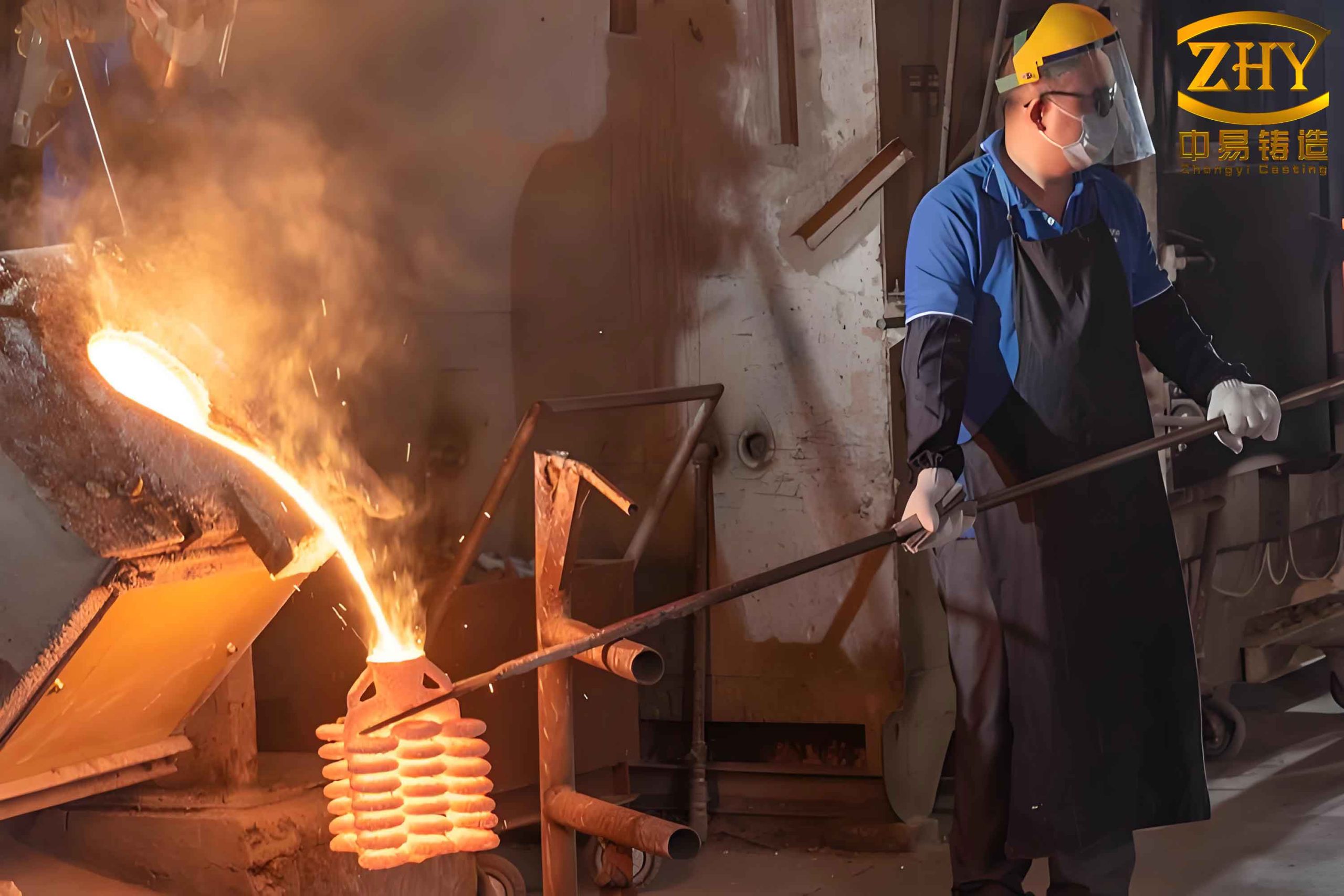
The fundamental concept of shell mold materials revolves around their role in constructing the mold cavity for prototype investment casting. These materials must withstand extreme thermal, mechanical, and chemical conditions during casting. Broadly, they can be classified into oxide ceramics (e.g., zircon sand/zircon flour, white alumina sand/powder, yttria (Y2O3), zirconia (ZrO2)), non-oxide ceramics (e.g., silicon carbide (SiC)), and composite materials. Each category offers distinct advantages tailored to specific alloy systems and casting requirements. For instance, in prototype investment casting, the selection of refractory materials has evolved toward精细化匹配, often involving multi-material strategies to optimize shell performance. The basic performance requirements for shell mold materials are stringent: high melting point, excellent chemical stability at elevated temperatures, adequate strength and toughness to resist thermal stress and metal冲刷, and controlled permeability to facilitate gas escape without metal penetration. These properties collectively determine the surface finish, dimensional accuracy, and metallurgical integrity of cast parts.
The preparation and forming processes of shell mold materials are critical to their effectiveness in prototype investment casting. Common methods include the investment casting process itself, where a wax pattern is coated with binder and refractory materials layer by layer, followed by dewaxing and firing to produce the shell. Binder systems, such as silica sol or ethyl silicate, play a key role in bonding the refractory particles. For example, in the production of覆膜砂 (pre-coated sand), natural quartz sand is coated with thermoplastic phenolic resin, hardeners, and additives via冷法 or热法 processes. This results in a material with high strength, low gas evolution, and good thermal stability, ideal for complex prototype investment casting of components like engine blocks. The formulation can be represented by a simplified equation for resin curing: $$ \text{Resin} + \text{Hardener} \xrightarrow{\Delta T} \text{Cross-linked Polymer} $$ where $\Delta T$ denotes the curing temperature. The quality of these processes directly impacts shell durability and casting outcomes.
To systematically compare different shell mold materials used in prototype investment casting, Table 1 summarizes their key properties and typical applications.
| Material | Chemical Composition | Melting Point (°C) | Key Advantages | Limitations | Common Use in Prototype Investment Casting |
|---|---|---|---|---|---|
| Zircon Sand/Flour | ZrSiO4 | ~2750 | High chemical stability, low reactivity | Impurities (FeO, TiO), radioactive elements | Face coat for superalloys and titanium alloys |
| White Alumina Sand/Powder | Al2O3 | ~2050 | High hardness, purity, wear resistance | Higher cost, potential for thermal shock | Backing layers, high-temperature applications |
| Yttria (Y2O3) | Y2O3 | ~2425 | Minimal interface reaction with TiAl alloys | Expensive, limited availability | Specialty casting of reactive alloys |
| Zirconia (ZrO2) | ZrO2 | ~2715 | Good thermal stability, phase transformation toughness | Cost, processing challenges | High-performance aerospace components |
| Fused Silica | SiO2 | ~1713 | Low thermal expansion, good collapsibility | Lower strength at high temperatures | Complex thin-walled castings |
Zircon sand and zircon flour have long been staples in prototype investment casting due to their high melting point and chemical inertness. However, natural zircon often contains impurities like FeO and TiO, which can lead to defects such as gas pores or inclusions in castings. The decomposition of zircon at elevated temperatures can be described by the reaction: $$ \text{ZrSiO}_4 \rightarrow \text{ZrO}_2 + \text{SiO}_2 $$ This decomposition may exacerbate interface reactions, particularly with superalloys, affecting surface quality. Moreover, the presence of radioactive thorium in some zircon sources necessitates careful handling, adding complexity to the prototype investment casting process. Despite these drawbacks, zircon remains widely used for its cost-effectiveness and performance in many applications.
White alumina sand and powder offer superior hardness and purity, making them excellent for applications requiring high wear resistance and minimal contamination. In prototype investment casting of superalloy components, such as turbine blades, alumina-based shells provide stable performance under high thermal loads. The thermal conductivity of alumina can influence cooling rates, which in turn affects microstructure development. For instance, faster cooling with alumina shells promotes finer grain structures, enhancing mechanical properties. This relationship can be approximated by the equation for cooling rate: $$ \frac{dT}{dt} = k \cdot \frac{(T_{\text{melt}} – T_{\text{shell}})}{d} $$ where $dT/dt$ is the cooling rate, $k$ is a material-dependent constant, $T_{\text{melt}}$ is the molten metal temperature, $T_{\text{shell}}$ is the shell temperature, and $d$ is the shell thickness. Optimizing these parameters is crucial in prototype investment casting to achieve desired material properties.
Advanced materials like yttria and zirconia have gained prominence for casting highly reactive alloys, such as titanium aluminides (TiAl). Research indicates that yttria shells exhibit the weakest interface reaction with molten TiAl alloys, reducing surface defects and improving casting quality. The reaction mechanism can be modeled using diffusion equations: $$ J = -D \frac{\partial C}{\partial x} $$ where $J$ is the flux of reacting species, $D$ is the diffusion coefficient, and $\partial C/\partial x$ is the concentration gradient. By minimizing $D$ through material selection, prototype investment casting can produce cleaner castings. Zirconia shells, while also beneficial, may face challenges related to phase transformations and cost. Other special materials, like graphite or high-melting-point metals, are explored for niche applications but often suffer from issues like carbon contamination or prohibitive expenses, limiting their use in mainstream prototype investment casting.
The application trends in shell mold materials for prototype investment casting are shaped by economic, environmental, and quality considerations. One major direction is the development of low-cost alternative materials. For example, studies on titanium alloy sand casting using additive manufacturing (3D printed sand molds) aim to reduce costs while maintaining precision. This approach aligns with the growing demand for affordable prototype investment casting solutions. The process can be represented by a cost function: $$ C_{\text{total}} = C_{\text{material}} + C_{\text{processing}} + C_{\text{environmental}} $$ where minimizing $C_{\text{total}}$ drives innovation in material substitutes. Additionally, the use of high-silica sands (e.g., with SiO2 content >99%) in覆膜砂 or 3D printing offers a balance of performance and economy for steel castings, applicable to prototype investment casting of certain alloys.
Green casting工艺 is another critical trend, focusing on reducing environmental impact in prototype investment casting. This involves optimizing processes to lower emissions, such as volatile organic compounds from resin curing, and promoting recycling of shell materials. For instance, reclaimed覆膜砂 can be reprocessed for reuse, aligning with circular economy principles. The environmental benefit can be quantified by an eco-efficiency metric: $$ \text{Eco-efficiency} = \frac{\text{Value of Casting}}{\text{Environmental Burden}} $$ where higher values indicate more sustainable prototype investment casting practices. Implementing green strategies not only meets regulatory demands but also enhances the long-term viability of the casting industry.
Quality control of shell mold materials is paramount to successful prototype investment casting. From raw material sourcing to final shell production, rigorous standards ensure consistency and performance. Table 2 outlines key quality parameters for common shell materials in prototype investment casting.
| Quality Parameter | Typical Specification | Impact on Prototype Investment Casting |
|---|---|---|
| Purity (e.g., Al2O3 content) | >99% for high-grade alumina | Reduces interface reactions, improves surface finish |
| Particle Size Distribution | Optimized for packing density | Enhances shell strength and permeability |
| Acid Demand Value | ≤5 mL/50g for silica sands | Indicates chemical reactivity, affects binder performance |
| Loss on Ignition | ≤0.5% for stable materials | Minimizes gas evolution during casting |
| Refractoriness | ≥1750°C for high-temperature alloys | Ensures dimensional stability under thermal load |
By adhering to these specifications, prototype investment casting can achieve higher yields and fewer defects. Advanced monitoring techniques, such as real-time sensors for shell drying and firing, further enhance quality assurance. The integration of digital tools with prototype investment casting processes represents a frontier for innovation, enabling predictive control of shell behavior.
In conclusion, shell mold materials play a decisive role in the success of prototype investment casting for superalloys and titanium alloys. From traditional zircon and alumina to advanced yttria and zirconia, each material offers unique benefits and challenges. The evolution toward low-cost alternatives, green practices, and stringent quality control reflects the dynamic nature of this field. As prototype investment casting continues to advance, ongoing research and development will focus on tailoring material properties to meet the ever-increasing demands for precision, performance, and sustainability. Through collaborative efforts, the future of prototype investment casting promises to deliver even greater capabilities for manufacturing high-integrity components across critical industries.
To further illustrate the technical nuances, consider the thermal stress experienced by shells during prototype investment casting, which can be modeled using the equation: $$ \sigma = E \cdot \alpha \cdot \Delta T $$ where $\sigma$ is the thermal stress, $E$ is the Young’s modulus of the shell material, $\alpha$ is the coefficient of thermal expansion, and $\Delta T$ is the temperature change. Selecting materials with匹配 thermal expansion coefficients to the alloy can minimize cracking and distortion, a key consideration in prototype investment casting. Additionally, the interaction between molten metal and shell can be analyzed through thermodynamic calculations, such as the Gibbs free energy change: $$ \Delta G = \Delta H – T \Delta S $$ where negative $\Delta G$ values indicate spontaneous reactions that should be avoided in prototype investment casting. By leveraging such scientific principles, the optimization of shell mold materials will continue to propel prototype investment casting toward new heights of excellence.