
In this article, I explore the intricacies of the investment casting process, a critical manufacturing technique in modern industry. As an expert in foundry technologies, I aim to delve into its global trends, resource utilization challenges, and future directions. The investment casting process, known for its precision and versatility, has evolved significantly, yet it faces pressures from environmental concerns and market shifts. Here, I will analyze these aspects in detail, incorporating tables and formulas to summarize key points. My perspective is rooted in first-hand experience and extensive research, focusing on how the investment casting process can adapt to sustainable practices while maintaining competitiveness.
The investment casting process, often referred to as lost-wax casting, involves creating intricate metal parts by pouring molten metal into a ceramic mold derived from a wax pattern. This method is renowned for producing high-quality components with excellent surface finish and dimensional accuracy. The core steps include pattern making, shell building, dewaxing, firing, pouring, and finishing. Each phase requires precise control, and the investment casting process is widely used in aerospace, automotive, and medical industries. To quantify its efficiency, we can model the material flow using equations such as yield rate: $$Y = \frac{W_f}{W_i} \times 100\%$$ where \(Y\) is the yield percentage, \(W_f\) is the final product weight, and \(W_i\) is the initial material weight. This formula highlights the importance of minimizing waste in the investment casting process.
Globally, the investment casting process has seen steady growth. According to industry reports, in 2018, the global precision casting market reached a value of $14.2 billion, a 3.1% increase from 2017. High-value products accounted for 57%, with automotive at 14% and general components at 29%. China contributed 21% to this market, dominating over 50% of global general components. The aerospace sector remains a key driver for the investment casting process. However, by 2019, China experienced a downturn due to factors like overcapacity in general components, environmental regulations, automotive industry slowdown, and trade tensions. Below is a table summarizing the global market distribution for the investment casting process in 2018:
| Region | Market Share (%) | Key Sectors |
|---|---|---|
| China | 21 | General Components, Automotive |
| North America | 30 | Aerospace, Medical |
| Europe | 25 | Automotive, Industrial |
| Others | 24 | Various |
This data underscores the significance of the investment casting process in manufacturing. Looking ahead, China’s potential as the largest aerospace market offers opportunities, but innovation is crucial. The investment casting process must integrate new technologies to thrive. For instance, non-metal and metal 3D printing can enhance pattern making, while computer simulations optimize fluid dynamics: $$ \frac{\partial \rho}{\partial t} + \nabla \cdot (\rho \mathbf{v}) = 0 $$ where \(\rho\) is density and \(\mathbf{v}\) is velocity, aiding in defect reduction. By embracing such tools, the investment casting process can improve yield and quality.
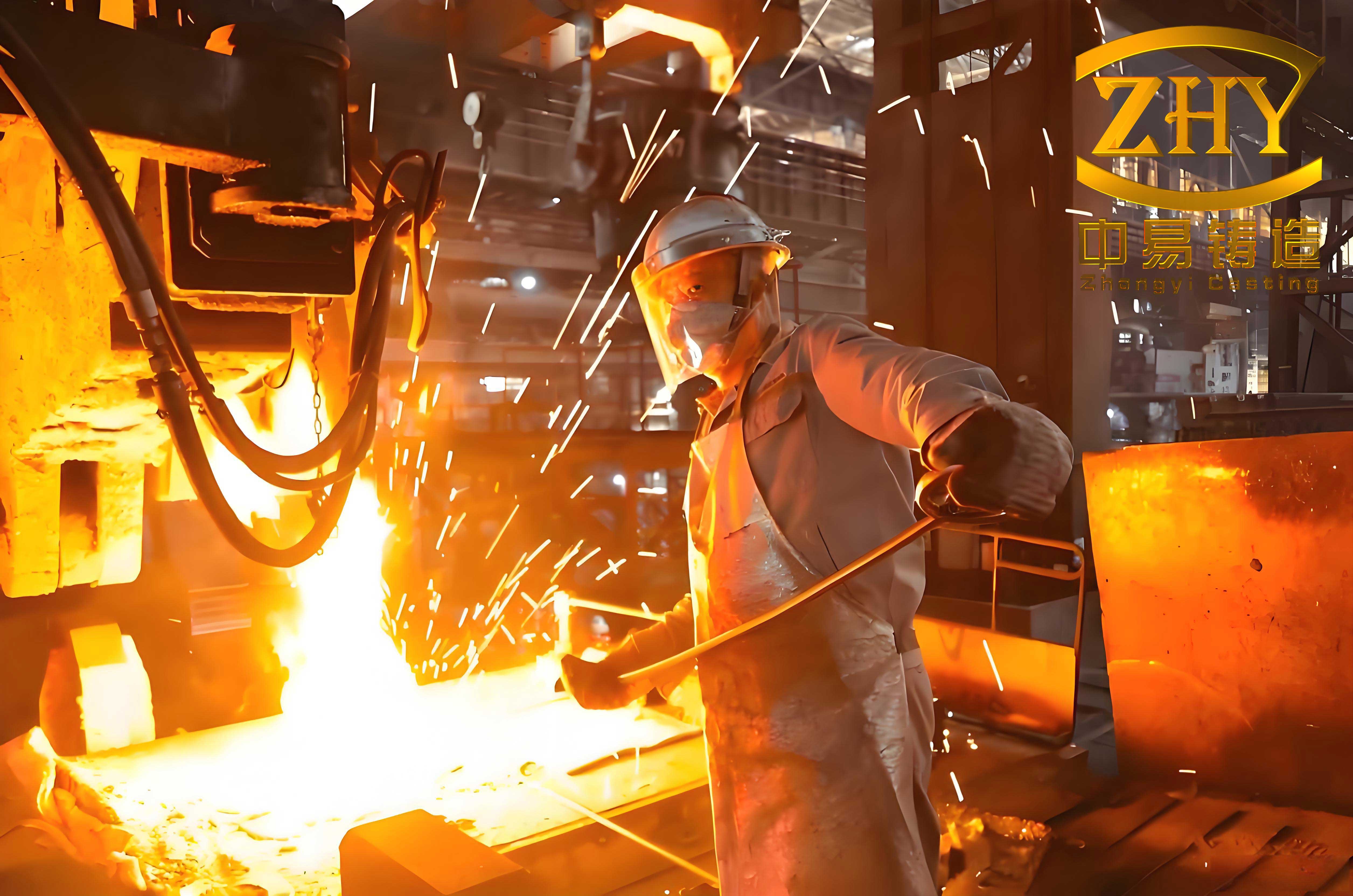
Resource utilization is a pressing issue in the investment casting process. Foundry waste sand, generated from molding and core-making, poses environmental challenges. Based on life cycle analysis, its characteristics include high silica content and potential contaminants. The investment casting process often relies on silica sand, and recycling waste sand is vital for sustainability. Research shows that waste sand can be used in concrete, road construction, brick-making, and ceramic production. I summarize the resource utilization methods in the table below:
| Utilization Method | Application | Benefits |
|---|---|---|
| Concrete Materials | Infrastructure projects | Reduces landfill use |
| Road Paving | Base or sub-base layers | Cost-effective |
| Brick Production | Construction bricks | Enhances durability |
| Ceramic/Glass | Raw material substitution | Promotes circular economy |
In the investment casting process, waste sand management can be modeled using a recycling rate equation: $$R = \frac{S_r}{S_t} \times 100\%$$ where \(R\) is the recycling rate, \(S_r\) is the amount of sand recycled, and \(S_t\) is the total sand used. By improving \(R\), foundries can lower costs and environmental impact. The investment casting process, when coupled with efficient sand reclamation, becomes more sustainable. For example, thermal reclamation systems can restore sand properties, reducing new sand demand by up to 90%. This aligns with global trends where the investment casting process is evolving towards green manufacturing.
The development of silica sand for the investment casting process is another critical area. Silica sand, primarily natural, is the backbone of sand casting, which complements the investment casting process in many foundries. China has abundant resources, with over 300 mining companies producing around 20 million tons annually for casting. The demand includes washed, scrubbed, and coated sands. However, high-purity sand is scarce, driving innovation. The table below compares silica sand types used in the investment casting process and related sand casting:
| Sand Type | Purity (%) | Common Uses |
|---|---|---|
| Natural Silica Sand | 85-95 | General casting molds |
| Washed Sand | 90-98 | Improved surface finish |
| High-Purity Sand | 99+ | Precision investment casting process |
| Recycled Sand | Variable | Sustainable applications |
In the investment casting process, sand quality directly affects mold integrity and final part accuracy. The particle size distribution can be described by the Rosin-Rammler equation: $$P(d) = 1 – \exp\left[-\left(\frac{d}{d_c}\right)^n\right]$$ where \(P(d)\) is the cumulative fraction finer than size \(d\), \(d_c\) is the characteristic size, and \(n\) is the distribution parameter. Optimizing this ensures better shell strength in the investment casting process. As environmental regulations tighten, foundries must prioritize sand reclamation and high-quality raw materials. The investment casting process, though less sand-intensive than sand casting, still benefits from these advancements.
Environmental impact assessment is essential for the investment casting process. Waste sand from foundries can leach heavy metals, necessitating careful handling. The potential environmental risk \(E\) can be estimated as: $$E = \sum_{i=1}^{n} C_i \times T_i$$ where \(C_i\) is the concentration of contaminant \(i\), and \(T_i\) is its toxicity factor. By implementing resource utilization strategies, the investment casting process can mitigate \(E\). For instance, using waste sand in concrete encapsulates contaminants, reducing leaching. In China, waste sand utilization is still emerging, and I recommend stricter policies and incentives to promote recycling in the investment casting process. This aligns with the shift from passive to active environmental stewardship.
Technological fusion is reshaping the investment casting process. Additive manufacturing, such as 3D printing of wax patterns, streamlines production. Computer simulations enable virtual testing of molds, reducing trial-and-error. The integration of these technologies into the investment casting process enhances precision and reduces lead times. For example, finite element analysis (FEA) models stress distribution: $$\sigma = E \epsilon$$ where \(\sigma\) is stress, \(E\) is Young’s modulus, and \(\epsilon\) is strain. This helps in designing robust molds for the investment casting process. Additionally, nondestructive testing (NDT) methods, like digital radiography, improve quality control. By adopting these innovations, the investment casting process can achieve higher competitiveness in high-value sectors like aerospace.
China’s role in the investment casting process is pivotal. Despite recent challenges, the country’s manufacturing scale offers advantages. To capitalize on this, foundries should transition from general components to high-value products through the investment casting process. Military-civil fusion initiatives can open new markets. Moreover, embedding eco-design principles into the investment casting process—such as using recyclable materials and energy-efficient furnaces—can lower carbon footprints. The equation for energy consumption per casting \(E_c\) is: $$E_c = \frac{E_t}{N}$$ where \(E_t\) is total energy and \(N\) is the number of castings. Minimizing \(E_c\) through process optimization is key for sustainable growth in the investment casting process.
In conclusion, the investment casting process stands at a crossroads of innovation and sustainability. By leveraging resource utilization, advancing silica sand technologies, and integrating digital tools, it can overcome market fluctuations and environmental hurdles. I emphasize that the investment casting process must evolve continuously, with a focus on quality, cost, and ecology. As global demand shifts towards lightweight and complex parts, the investment casting process will remain indispensable. Through collaborative efforts in research and policy, we can ensure that the investment casting process contributes to a greener and more efficient manufacturing landscape.