
In my years of research and practical application in foundry engineering, I have dedicated significant effort to understanding and refining the principles of proportional solidification for cast iron parts. This approach, often termed “equilibrium solidification” or “balanced solidification,” represents a paradigm shift from traditional methods by leveraging the dynamic interplay between shrinkage and expansion during the cooling and solidification of cast iron. The core idea is to harness the natural graphite expansion inherent in cast iron to offset part of the liquid and solidification shrinkage, thereby achieving a more efficient and defect-free casting process. For cast iron parts, this methodology has proven exceptionally effective in mitigating common defects such as shrinkage cavities, porosity, gas holes, slag inclusions, and hot tearing. Through systematic study, I have developed a comprehensive series of specialized techniques encompassing gating, risering, chilling, and overflow systems, which together form a robust framework for quality control in the production of cast iron parts.
The fundamental challenge with cast iron parts lies in their complex solidification behavior. Unlike many other metals, cast iron undergoes a phase transformation where graphite precipitates from the melt, causing a volumetric expansion. This expansion can counteract the shrinkage resulting from temperature drop and phase change. However, this process is not uniform; it varies dramatically with the casting’s geometry, cooling conditions, and alloy composition. Therefore, the goal of proportional solidification is to synchronize the timing and magnitude of shrinkage and expansion through deliberate process design. This ensures that at any given moment during solidification, the net volume change is minimized, reducing the reliance on external feeding and enhancing the inherent soundness of the cast iron parts.
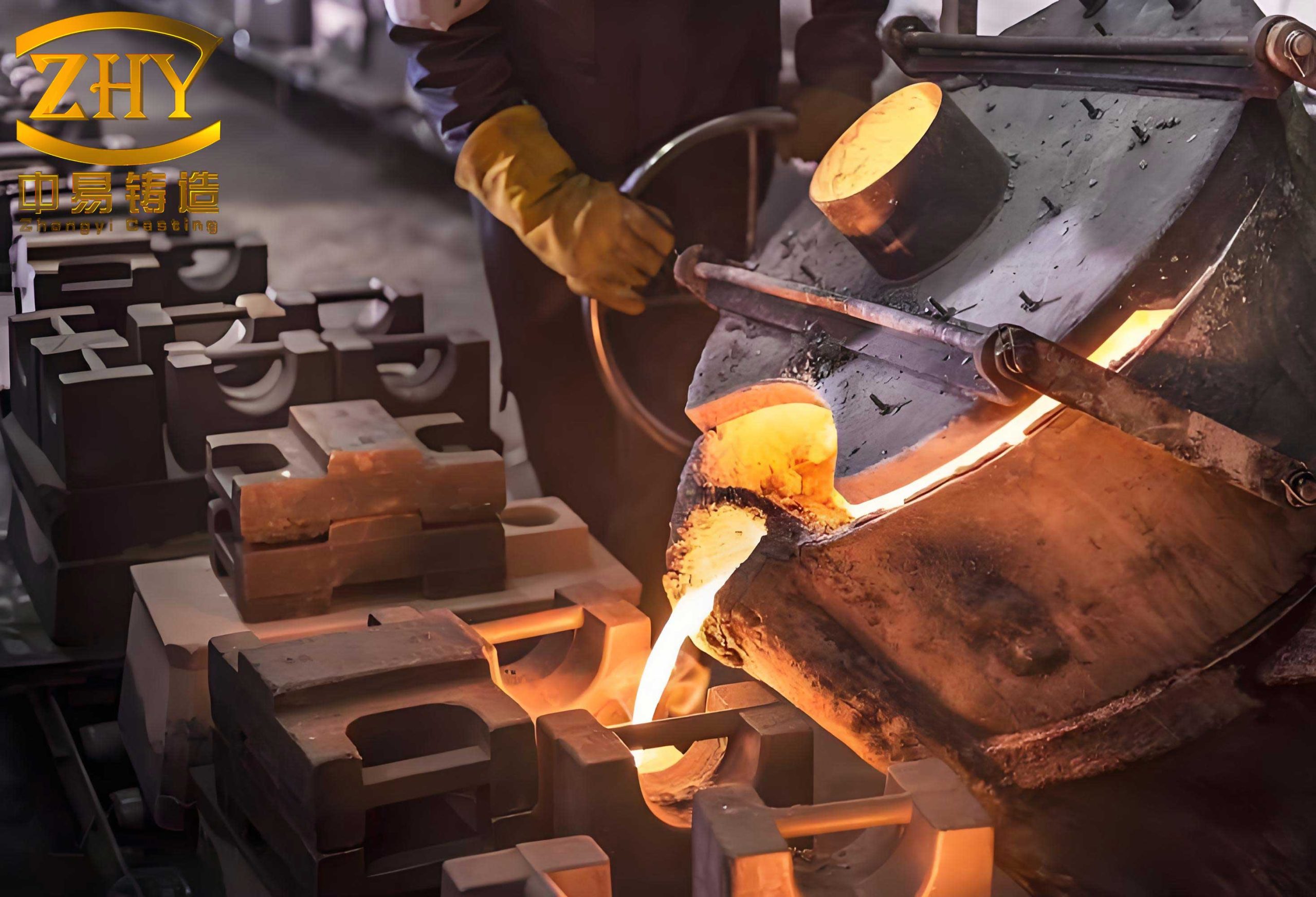
To delve deeper, let’s first explore the theoretical underpinnings of proportional solidification. The behavior of cast iron parts during solidification is governed by two opposing volumetric changes: contraction due to cooling and phase transition, and expansion due to graphite precipitation. The key insight is that these processes are not sequential but overlapping in time across different regions of a casting. For a single point, shrinkage occurs first, followed by expansion, but for the casting as a whole, various sections enter shrinkage and expansion phases at different times. This allows for dynamic superposition where, at any instant, some areas are contracting while others are expanding, with the molten iron remaining interconnected. Consequently, the net shrinkage observed macroscopically—what I term the “apparent shrinkage”—is the residual after offsetting by graphite expansion. This concept can be formalized using a time-dependent model.
Let \( V_s(t) \) represent the total shrinkage volume over time \( t \), \( V_g(t) \) the graphite expansion volume, and \( V_a(t) \) the apparent shrinkage. The relationship is:
$$ V_a(t) = V_s(t) – V_g(t) $$
where \( t \) ranges from 0 to the total solidification time \( t_s \). The point where \( V_a(t) = 0 \) is called the equilibrium point \( t_p \), indicating that shrinkage is fully compensated by expansion from that moment onward. The period from the start of solidification to \( t_p \) is the apparent shrinkage time \( t_{ap} \), during which external feeding (e.g., from risers) is required. The fraction of solidification time during which shrinkage occurs is defined as the shrinkage time fraction \( f \):
$$ f = \frac{t_{ap}}{t_s} $$
This fraction is crucial for riser design, as it dictates the duration of external feeding needed for cast iron parts. Importantly, \( f \) is not fixed; it depends on factors such as section thickness (modulus), cooling rate, mold rigidity, and alloy grade. Thinner sections or faster cooling reduce \( f \), making shrinkage more concentrated and demanding prompt feeding, while thicker sections or slower cooling increase \( f \), allowing more time for self-compensation. This variability underscores why the shrinkage value for cast iron parts is indeterminate and context-dependent, unlike the fixed shrinkage of the alloy itself.
The following table summarizes key factors influencing the apparent shrinkage and equilibrium point for cast iron parts:
| Factor | Effect on Apparent Shrinkage | Effect on Equilibrium Point \( t_p \) |
|---|---|---|
| Higher alloy grade (less graphite) | Increases | Shifts later |
| Higher pouring temperature | Increases | Shifts later |
| Dry sand mold (more rigid) | Decreases | Shifts earlier |
| Thicker section (larger modulus) | Decreases | Shifts earlier |
| Thinner section (smaller modulus) | Increases | Shifts later |
From this theoretical basis, I derive the principle of “limited feeding” for cast iron parts. Since self-compensation through graphite expansion is inherent, external risers need only supplement the deficit during the apparent shrinkage time. Thus, risers do not need to remain liquid until the complete solidification of the casting; they can be smaller and solidify earlier than dictated by traditional sequential solidification rules. This leads to significant improvements in yield and reduction in defects. Moreover, risers should be placed away from geometric hot spots to avoid creating “contact hot spots” that exacerbate shrinkage and cracking. Instead, they should be positioned at the edges of cast iron parts with short, thin, and wide necks that allow adaptive regulation of feeding.
The adaptive regulation of riser necks is a critical aspect. A riser neck with a large cross-sectional area but minimal thickness can remain open during feeding due to the suction from casting shrinkage and the influx of hot metal from the riser. Once the equilibrium point is reached and self-compensation begins, the neck rapidly solidifies, minimizing thermal interference. This self-adjusting mechanism accommodates variations in production conditions, ensuring robust feeding for cast iron parts despite fluctuations in shrinkage behavior.
Moving to practical applications, the technology of proportional solidification encompasses several interconnected systems: risering, gating, chilling, and overflowing. Each plays a vital role in achieving balanced solidification for cast iron parts.
Risering Technology for Cast Iron Parts
Riser design under proportional solidification follows distinct principles. First, the riser’s feeding time should cover only the apparent shrinkage period \( t_{ap} \), not the entire solidification. Second, the riser size is determined by the apparent shrinkage volume, not the total shrinkage. Third, risers are placed away from hot spots (the “riser-by-edge” principle) to prevent contact hot spots. Fourth, feeding distance is generally less restrictive due to the overlapping nature of shrinkage and expansion, so single or double risers are often sufficient for cast iron parts.
Common riser types suitable for cast iron parts include:
- Edge Riser: Positioned at the side of a casting with a thin neck.
- Feeding Edge Riser: Similar but with a wider neck for better feeding.
- Ear Riser: A small riser attached like an ear.
- Duckbill Riser: A wedge-shaped riser for directional feeding.
- Neck-down Top Riser: A top riser with a neck diameter less than half the riser diameter.
- Cold Joint Riser: Used with chills to enhance feeding.
- Annular Riser: For cylindrical cast iron parts.
For small to medium cast iron parts, hot risers (where gating passes through the riser) provide strong feeding, while for larger cast iron parts, cold risers (gating separate) are preferred to avoid excessive heat.
Two primary methods exist for riser sizing: the shrinkage modulus method and the segmented proportion method.
Shrinkage Modulus Method: This calculates the riser modulus \( M_r \) based on the casting modulus \( M_c \). The formula is:
$$ M_r = f_m \cdot f_s \cdot f_p \cdot M_c $$
where:
- \( f_m \) is the riser balance coefficient, typically 1.2.
- \( f_s \) is the shrinkage modulus coefficient, ranging from 0.25 to 0.85, selected based on casting modulus and weight.
- \( f_p \) is the feeding pressure coefficient, between 1.0 and 1.3, accounting for residual pressure.
The riser volume \( V_r \) is then:
$$ V_r = \frac{V_c \cdot P}{\eta} $$
where \( V_c \) is the casting volume in cm³, \( P \) is the feeding rate (typically 2.0–4.0%), and \( \eta \) is the riser efficiency (17–30%). The riser neck modulus \( M_n \) is:
$$ M_n = f_n \cdot f_s \cdot M_c $$
with \( f_n \) as the neck flow coefficient (0.6–0.9).
Segmented Proportion Method: This empirical approach sets the riser diameter \( D \) as a proportion of the casting thickness or hot spot diameter \( T \), varying with casting size:
| Casting Size (Weight) | Proportion \( D/T \) |
|---|---|
| Small (≤10 kg) | 1.2–2.0 |
| Medium-small (10–50 kg) | 1.0–1.2 |
| Medium (50–100 kg) | 0.8–1.0 |
| Medium-large (100–500 kg) | 0.7–0.9 |
| Large (≥500 kg) | 0.6–1.0 |
Thinner sections use higher proportions, while thicker sections use lower ones. This method is straightforward for designing risers for diverse cast iron parts.
Gating Technology for Cast Iron Parts
The gating system must facilitate not only smooth filling but also contribute to feeding. For cast iron parts, I recommend several principles. First, use multiple gates to disperse flow and avoid creating new hot spots at gate roots. Second, prefer top gating where possible, as it promotes early dynamic superposition—metal at the bottom cools and shrinks first, fed by later-poured metal from above, while graphite expansion at the bottom compensates for upper shrinkage. Third, avoid tangential gating, which causes turbulence and uniform cooling, hindering early superposition. Fourth, for bottom gating, use fast filling or stepped systems to minimize thermal stratification.
A stepped gating system combines initial bottom filling to reduce impact with subsequent top filling to equalize temperatures. The gating ratio should be open to prevent jetting. The cross-sectional areas can be calculated using fluid dynamics principles, such as the Bernoulli equation, to ensure low velocity and high flow rate. For instance, the flow rate \( Q \) through a gate is:
$$ Q = A_g \cdot v = A_g \cdot \sqrt{2gH} $$
where \( A_g \) is the gate area, \( v \) is velocity, \( g \) is gravity, and \( H \) is the effective head. Designing for a total gating area that maintains \( v < 0.5 \) m/s helps achieve quiescent filling for cast iron parts.
The table below outlines recommended gating practices for different cast iron parts:
| Casting Type | Gating Style | Key Consideration |
|---|---|---|
| Thin-walled small parts | Multiple top gates | Use gates as risers for feeding |
| Thick-walled medium parts | Radial or axial gates | Avoid hot spots; combine with risers |
| Large cylindrical parts | Stepped bottom gating | Ensure temperature uniformity |
| Complex box parts | Dispersed side gates | Prevent slag accumulation |
Chilling Technology for Cast Iron Parts
Chills are essential for controlling local solidification in cast iron parts. By accelerating cooling at thick sections or hot spots, chills balance temperature differences, promote earlier graphite expansion, and reduce apparent shrinkage. This not only prevents shrinkage porosity in heavy sections but also shifts the equilibrium point earlier, diminishing riser requirements. Chills can be placed at riser necks, gate entries, or opposite gates to eliminate contact hot spots and enhance feeding.
The effectiveness of a chill depends on its material (e.g., iron, copper), size, and contact area. The chill modulus \( M_{ch} \) should match or exceed the local casting modulus to ensure rapid heat extraction. For repeated use, chills must be managed carefully; oxidation and micro-cracks after 10–15 uses can reduce chilling power and cause defects like gas holes. In high-wear areas of cast iron parts, chills may be used up to 30–35 times before replacement.
A simple formula for chill design relates the chill volume \( V_{ch} \) to the heat to be dissipated:
$$ V_{ch} \cdot \rho_{ch} \cdot c_{ch} \cdot \Delta T_{ch} = V_h \cdot \rho_{fe} \cdot L $$
where \( V_h \) is the hot spot volume, \( \rho \) denotes densities, \( c \) specific heat, \( \Delta T \) temperature drop, and \( L \) latent heat. This ensures adequate heat capacity for chilling critical zones in cast iron parts.
Overflow Technology for Cast Iron Parts
Overflow systems are crucial for ejecting slag, gas-rich metal, and cold front metal during pouring, thereby improving the integrity of cast iron parts. Since gating alone cannot remove all inclusions, overflow channels—often integrated with risers—serve as escape routes for impurities. Key techniques include:
- One-End Gating with Opposite Overflow: For box or cover cast iron parts, metal is poured at one end, and slag accumulates at the far end, which is drained through an overflow riser.
- Top Gating with Radial Overflow Riser: In top-poured cast iron parts, the last metal containing slag is directed to a wide-necked riser opposite the gate.
- Axial Overflow with Annular Riser: For long cylindrical cast iron parts, an annular overflow ring atop the core directs impurities to side risers.
- Safety Overflow Risers in Riser-less Castings: Even in riser-less designs, small overflow risers act as safety valves to expel defects and adjust temperature distribution.
Overflow design should ensure that the overflow volume is sufficient to carry away contaminants without wasting excessive metal. Typically, overflow passages have cross-sectional areas 20–50% larger than the main gates to facilitate easy flow.
Comparative Analysis: Proportional vs. Sequential vs. Simultaneous Solidification
Understanding how proportional solidification differs from traditional approaches is vital for optimizing cast iron parts production.
Proportional vs. Sequential Solidification: Both aim at feeding, but sequential solidification requires risers to remain liquid until the casting fully solidifies, often placed at top hot spots. This leads to large risers and low yield. In contrast, proportional solidification for cast iron parts emphasizes self-compensation; risers feed only during the apparent shrinkage time, are smaller, placed away from hot spots, and focus on limited feeding. This reduces defects like shrinkage at riser roots and improves yield.
Proportional vs. Simultaneous Solidification: Simultaneous solidification seeks uniform cooling to minimize stress and distortion, often neglecting feeding. Proportional solidification for cast iron parts also promotes temperature uniformity by avoiding hot spots but actively addresses feeding through controlled gating and risering. Thus, it combines the benefits of reduced stress with effective feeding, making it superior for cast iron parts prone to both shrinkage and cracking.
The table below highlights these differences:
| Aspect | Sequential Solidification | Simultaneous Solidification | Proportional Solidification |
|---|---|---|---|
| Feeding Emphasis | Full external feeding | Minimal feeding | Limited feeding + self-compensation |
| Riser Placement | At hot spots | At thin sections | Away from hot spots (edge) |
| Riser Size | Large, solidifies last | Small or none | Moderate, solidifies earlier |
| Goal for Cast Iron Parts | Avoid shrinkage | Reduce stress | Balance shrinkage/expansion, reduce defects |
Advanced Modeling and Future Directions
In my work, I have also explored numerical simulation to predict the proportional solidification behavior of cast iron parts. Using finite element analysis, we can model the transient heat transfer and phase transformations, incorporating graphite expansion kinetics. The governing heat equation is:
$$ \rho c_p \frac{\partial T}{\partial t} = \nabla \cdot (k \nabla T) + \dot{q}_{latent} + \dot{q}_{graphite} $$
where \( \dot{q}_{latent} \) is latent heat release and \( \dot{q}_{graphite} \) is the heat effect from graphite expansion (often negative due to volume increase). Simulations help optimize riser and chill placements for complex cast iron parts, reducing trial-and-error.
Furthermore, the integration of real-time monitoring with thermal cameras and pressure sensors allows for adaptive control during pouring, ensuring that the dynamic superposition is achieved as planned. For high-quality cast iron parts, such as those used in automotive or machinery, this level of precision is becoming indispensable.
Looking ahead, advancements in alloy design—such as compacted graphite iron—may further enhance self-compensation, and additive manufacturing could enable novel gating geometries tailored for proportional solidification. The core principles, however, remain rooted in understanding the unique duality of shrinkage and expansion in cast iron parts.
Conclusion
Proportional solidification represents a holistic and efficient approach to manufacturing cast iron parts. By embracing the dynamic interplay between shrinkage and expansion, we can design processes that maximize self-compensation, minimize external feeding, and reduce defects. The technologies of risering, gating, chilling, and overflowing, when applied according to the principles outlined, form a cohesive system that enhances yield, quality, and consistency. Through continued research and application, I am confident that proportional solidification will remain a cornerstone in the foundry industry for producing superior cast iron parts across diverse sectors.
In summary, the key takeaways for implementing proportional solidification for cast iron parts are: prioritize self-compensation through controlled cooling, use risers as limited supplements with adaptive necks, design gating to promote early dynamic superposition, employ chills to balance sections and shift equilibrium, and incorporate overflows to eject impurities. By adhering to these guidelines, foundries can achieve significant improvements in the production of cast iron parts, leading to cost savings and higher performance in end-use applications.