
The pursuit of advanced materials for critical engineering components continuously drives innovation in foundry technology. Spheroidal graphite cast iron, renowned for its excellent castability, good machinability, and cost-effectiveness, occupies a vital position in industries ranging from wind power to machine tools. However, a fundamental trade-off between strength and toughness has traditionally limited its application, particularly in demanding low-temperature environments where reliable performance is non-negotiable. Components such as oxygen generator housings, which operate across a range of temperatures, require not only adequate room-temperature properties but also sustained impact resistance at sub-zero conditions to ensure system integrity and safety.
Common approaches to enhance the properties of spheroidal graphite cast iron often involve microstructural engineering, primarily by balancing the ratio of ferrite to pearlite in the matrix. While this can improve ductility, it frequently comes at the expense of tensile strength. This study explores an alternative pathway: the in-situ formation of secondary phase particles within the matrix to simultaneously strengthen and toughen the material. Among various potential reinforcing phases, titanium carbide (TiC) particles present a compelling option due to their high hardness, stability, and favorable interfacial characteristics with the iron matrix. The concept is to introduce titanium into the melt, allowing it to react with carbon to form fine, well-dispersed TiC particles during solidification. This endogenous method promises better particle-matrix bonding compared to exogeneous addition methods.
The core hypothesis is that a carefully controlled addition of titanium can refine the microstructure of spheroidal graphite cast iron—improving graphite nodularity and count while also refining the ferrite grains—without adversely affecting the graphite spheroidization process. The resulting TiC particles are expected to act as barriers to dislocation motion, enhancing strength, and potentially as sites for energy dissipation during fracture, improving toughness. This paper details a comprehensive investigation into the effect of titanium content on the microstructure, tensile properties, and, critically, the low-temperature impact toughness of spheroidal graphite cast iron. The mechanisms underlying the observed property enhancements are discussed within the framework of lattice mismatch theory and classic nucleation principles.
Experimental Methodology
The target component for this study was an oxygen generator housing, originally specified in grade QT400-18. The performance requirements for the housing material included a room-temperature tensile strength (Rm) ≥ 400 MPa, elongation (A) ≥ 18.0%, and a Charpy V-notch impact energy (KV2) ≥ 12.0 J/cm² at -40 °C. A green short-flow sand casting process was employed, integrating sintering, ironmaking, and casting systems. The base charge consisted of approximately 70% high-quality Q12 pig iron, 10% returns, and 20% cold-rolled plate briquettes.
The key modification was the addition of titanium ferroalloy (TiFe) powder alongside the charge materials. Within the molten iron, titanium reacts with carbon to form TiC in situ according to the reaction: Ti + C → TiC. A series of preliminary trials established that excessive titanium (>0.12 wt.%) severely deteriorated graphite spheroidization and made the melt viscous. Therefore, six separate casting trials were conducted with targeted titanium additions ranging from 0.03% to 0.09%. The chemical compositions of the primary raw materials and additives are summarized below.
| Material | C | Si | Mn | P | S | Ti | Mg | Other |
|---|---|---|---|---|---|---|---|---|
| Q12 Pig Iron | 4.41 | 1.08 | 0.08 | 0.033 | 0.017 | 0.042 | – | – |
| Cold Plate Briquette | 0.08 | 0.05 | 0.06 | 0.025 | 0.020 | 0.020 | – | – |
| Nodularizer | – | 42.5 | – | – | – | – | 7.4 | RE: 2.4, Ca: 2.3, Ba: 1.5 |
| Inoculant | – | 69.88 | – | – | – | – | – | Ca: 1.36, Ba: 4.68, Al: 1.30 |
| TiFe Alloy | – | 4.48 | 1.98 | 0.049 | 0.013 | 34.0 | – | Cu: 0.09 |
The final chemical compositions for the six experimental casts, as determined by spectroscopic analysis, are presented in Table 2. The amounts of nodularizer and inoculant were carefully controlled at 1.25% and 0.5% of the melt weight, respectively, to minimize potential interactions between Ti and rare earth/magnesium that could form undesirable inclusions.
| Heat No. | C | Si | Mn | P | S | Ti | Mg |
|---|---|---|---|---|---|---|---|
| 1 | 3.61 | 2.48 | 0.093 | 0.027 | 0.005 | 0.027 | 0.040 |
| 2 | 3.55 | 2.60 | 0.100 | 0.027 | 0.008 | 0.030 | 0.035 |
| 3 | 3.57 | 2.67 | 0.215 | 0.057 | 0.014 | 0.040 | 0.048 |
| 4 | 3.58 | 2.42 | 0.191 | 0.028 | 0.004 | 0.048 | 0.032 |
| 5 | 3.62 | 2.40 | 0.207 | 0.043 | 0.012 | 0.062 | 0.055 |
| 6 | 3.63 | 2.57 | 0.226 | 0.060 | 0.016 | 0.088 | 0.047 |
Based on microstructural analysis, the cast from Heat No. 2, with a titanium content of 0.03 wt.%, exhibited the optimal combination of retained graphite nodularity and the presence of TiC particles. This material, hereafter designated as QT400-180.03Ti for clarity, was selected for detailed characterization and mechanical testing. The casting parameters were optimized with a pouring temperature of 1370 °C and a pouring time of 36 seconds using a resin-bonded sand mold. Test specimens for metallography and mechanical testing were extracted from a location corresponding to one-quarter of the main wall thickness of the cast housing.
Microstructural examination was conducted on polished and etched (4% nital) samples using optical microscopy and scanning electron microscopy (SEM) equipped with energy-dispersive X-ray spectroscopy (EDS). Tensile tests were performed according to GB/T 228.1, and Charpy V-notch impact tests were carried out at room temperature (RT), -20 °C, and -40 °C following GB/T 229.
Microstructural Characteristics
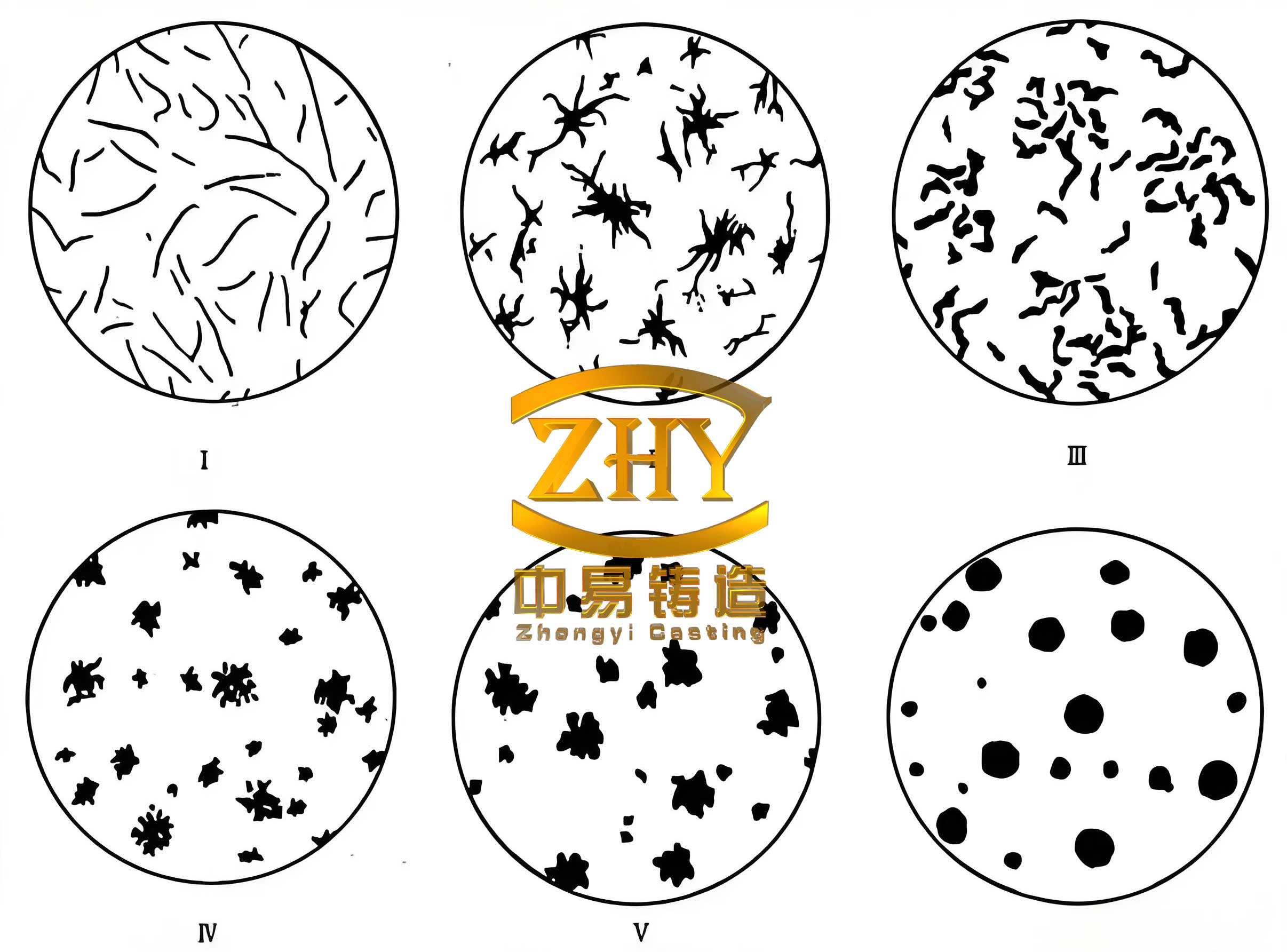
The microstructure of the QT400-180.03Ti spheroidal graphite cast iron is characterized by a predominantly ferritic matrix with uniformly dispersed graphite nodules. Quantitative image analysis revealed a graphite area fraction of approximately 32.4%, a nodule count of 187.3 nodules/mm², and an average graphite nodule diameter of 118.5 µm. Most importantly, the nodularity was measured at 93.89%, corresponding to a nodularity grade of 2, which fully meets the stringent microstructural requirements for high-quality ductile iron. The size distribution of the graphite nodules indicated a size rating of 8, signifying a relatively fine and well-distributed graphite phase.
Beyond the graphite morphology, the critical microstructural feature introduced by titanium addition is the presence of TiC particles. EDS point analysis on distinct, blocky particles within the ferrite matrix confirmed a high concentration of titanium, as shown in the spectrum below, with a concurrent significant carbon signal, identifying them as titanium carbides. It is noteworthy that the stoichiometry of these in-situ formed TiC particles often deviates from the ideal 1:1 Ti:C ratio due to carbon vacancies, which are common in non-stoichiometric carbides.
Elemental mapping further illustrated the distribution of key elements: carbon was concentrated in the graphite nodules, silicon was uniformly distributed in the ferrite, and titanium was highly localized at the TiC particle sites, with negligible presence in the graphite or the bulk ferrite matrix. The TiC particles were found to be finely dispersed within the ferritic grains and at grain boundaries. Statistical analysis of multiple SEM images indicated that the TiC particles formed were predominantly in the sub-micron to low micron size range.
Mechanical Performance
The tensile stress-strain curve for the QT400-180.03Ti material demonstrates a significant improvement over the baseline QT400-18 specification. The key tensile properties are compared in Table 3.
| Material | Tensile Strength, Rm (MPa) | Yield Strength, Rp0.2 (MPa) | Elongation, A (%) |
|---|---|---|---|
| QT400-18 (Specification Min.) | 400 | 250 | 18.0 |
| QT400-180.03Ti (Experimental) | 425.6 | 264 | 22.47 |
| Improvement | +5.3% | +5.2% | +22.8% |
The results clearly show that the modified spheroidal graphite cast iron achieves a simultaneous increase in both strength and ductility, overcoming the typical strength-toughness trade-off. The 22.8% enhancement in elongation is particularly remarkable.
The impact toughness, especially at low temperatures, is a critical performance indicator for the intended application. The Charpy V-notch impact absorption energies at different temperatures are summarized in Table 4 and compared to typical values for conventional low-temperature grade ductile iron (QT400-18L).
| Material | Room Temperature | -20 °C | -40 °C |
|---|---|---|---|
| QT400-180.03Ti (Experimental) | 17 | 13.2 | 12.3 |
| Typical QT400-18L | ~14-16 | ~12 | ≥12 (Avg.), ≥9 (Min.) |
| Improvement (Approx.) | + ~10% | + ~10% | Meets & Exceeds Spec |
The titanium-modified spheroidal graphite cast iron exhibits excellent low-temperature toughness, comfortably meeting the requirement of ≥12 J at -40 °C. The impact energy shows good retention from room temperature down to -40 °C, indicating a low ductile-to-brittle transition temperature.
Fractographic Analysis
Examination of the fracture surfaces provides insights into the toughening mechanisms. The tensile fracture surface of QT400-180.03Ti showed a mixed-mode morphology. The predominant feature was dimpled rupture, with graphite nodules acting as void initiation sites. The dimples were relatively uniform and deep, consistent with the high elongation measured. Interestingly, the presence of fine TiC particles led to the formation of numerous micro-voids around them, which coalesced during plastic deformation. Isolated regions exhibiting “river patterns” characteristic of cleavage fracture were also observed, but these were not the dominant failure mode.
The impact fracture surfaces, particularly at -40 °C, displayed more cleavage characteristics, as expected for a ferritic matrix under high strain-rate and low-temperature conditions. However, a significant population of tear ridges and secondary micro-voids was still evident. The cleavage facets appeared relatively small, and the fracture path was tortuous, suggesting that the microstructure effectively impeded crack propagation. The refinement of both graphite nodules and ferrite grains, coupled with the dispersion of TiC particles, contributed to a fracture surface that absorbed considerable energy through micro-void coalescence and crack deflection, even under conditions favoring brittle fracture.
Mechanisms of Strengthening and Toughening
The concurrent improvement in strength and toughness of the titanium-modified spheroidal graphite cast iron can be attributed to a synergistic effect of microstructural refinement and second-phase strengthening. The underlying mechanisms are explained through fundamental materials science principles.
1. Graphite Nucleation and Refinement: The addition of titanium led to the formation of TiC particles in the melt prior to or during the eutectic solidification of graphite. According to the lattice mismatch (or disregistry) theory proposed by Bramfitt, a substrate can act as an effective heterogeneous nucleation site for a solidifying phase if the planar disregistry (δ) between their matching crystal planes is less than 12%. The crystallographic calculation for the system is as follows:
For graphite (hexagonal, 0001 plane) nucleating on TiC (cubic, 111 plane), the mismatch δ can be evaluated. The interatomic spacing along a close-packed direction on the graphite (0001) plane, d[10-10]Gr, is approximately 0.246 nm. The corresponding spacing on the TiC (111) plane, d[1-10]TiC, is approximately 0.269 nm. The disregistry is calculated as:
$$
\delta = \frac{|d_{\text{TiC}} – d_{\text{Gr}}|}{d_{\text{Gr}}} \times 100\% = \frac{|0.269 – 0.246|}{0.246} \times 100\% \approx 9.35\%
$$
Since δ < 12%, TiC particles can serve as potent heterogeneous nuclei for graphite. This increases the number of nucleation events, leading to a higher nodule count (187.3 nodules/mm²) and a finer average nodule size. Finer, more numerous, and well-spheroidized graphite nodules reduce stress concentration and homogenize plastic deformation, significantly enhancing ductility and toughness.
2. Ferrite Grain Refinement: Similarly, TiC particles can act as nucleation sites for the primary ferrite (δ-ferrite) grains during solidification. The effectiveness of a particle as a nucleant for a solid phase (S) from a liquid (L) depends on the reduction in the critical nucleation energy barrier (ΔG*). The energy barrier for heterogeneous nucleation (ΔG*het) is lower than that for homogeneous nucleation (ΔG*hom) by a factor related to the contact angle (θ):
$$
\Delta G^{*}_{\text{het}} = \Delta G^{*}_{\text{hom}} \cdot f(\theta)
$$
where
$$
f(\theta) = \frac{(2 + \cos \theta)(1 – \cos \theta)^2}{4}
$$
For a low-interfacial-energy system where the substrate (TiC) wets the solid ferrite well, θ is small, making f(θ) << 1. Molecular statics simulations have confirmed that the interfacial energy between bcc-Fe (ferrite) and TiC is lower than the solid-liquid interfacial energy of bcc-Fe, validating TiC’s role as a potent nucleant. This grain refinement strengthens the material according to the Hall-Petch relationship:
$$
\sigma_y = \sigma_0 + k_y \cdot d^{-1/2}
$$
where σy is the yield strength, σ0 and ky are material constants, and d is the average ferrite grain diameter. A reduction in grain size (d) directly increases the yield strength. Furthermore, grain refinement is one of the few methods that simultaneously improves both strength and toughness, as finer grains provide more grain boundaries to block both dislocation motion (strengthening) and crack propagation (toughening).
3. Second-Phase (TiC) Strengthening: The finely dispersed, hard TiC particles contribute to strength via the Orowan bypass mechanism. During plastic deformation, dislocations must loop around these non-shearable particles, increasing the stress required for continued deformation. The increase in yield strength (Δσorowan) can be approximated by:
$$
\Delta \sigma_{\text{Orowan}} \approx \frac{Gb}{\lambda}
$$
where G is the shear modulus, b is the Burgers vector, and λ is the inter-particle spacing. The fine dispersion of TiC particles achieved through in-situ formation ensures a small λ, leading to significant precipitation strengthening. During fracture, these particles can also promote the formation of fine, closely spaced micro-voids. The coalescence of these micro-voids requires additional plastic work, thereby enhancing the overall toughness of the spheroidal graphite cast iron.
Conclusions
This investigation demonstrates a successful methodology for enhancing the comprehensive mechanical properties of spheroidal graphite cast iron, with a specific focus on low-temperature performance, through the micro-alloying with titanium. The key findings are summarized as follows:
- Microstructural Optimization: The addition of 0.03 wt.% titanium facilitates the in-situ formation of fine TiC particles within the melt. Crucially, at this level, the titanium addition does not interfere with the spheroidization process of graphite. Instead, it refines the microstructure, resulting in spheroidal graphite cast iron with high nodularity (~94%), increased nodule count, and a refined ferrite grain structure.
- Enhanced Mechanical Properties: The modified spheroidal graphite cast iron (QT400-180.03Ti) exhibits a superior combination of strength and ductility compared to the standard QT400-18 grade. Tensile strength and yield strength are increased by over 5%, while elongation is remarkably improved by 22.8%. Furthermore, the material possesses excellent low-temperature impact toughness, with impact energies at -20 °C and -40 °C showing approximately 10% improvement over conventional grades, comfortably exceeding the specification requirement of ≥12 J at -40 °C.
- Underlying Mechanisms: The property enhancements are attributed to a multi-faceted strengthening and toughening mechanism:
- The TiC particles act as highly effective heterogeneous nuclei for both graphite and ferrite, based on favorable lattice matching (δ ≈ 9.35% for graphite), leading to significant microstructural refinement.
- Grain refinement strengthens the material via the Hall-Petch mechanism and toughens it by impeding crack propagation.
- The dispersed TiC particles contribute directly to strengthening through the Orowan mechanism and indirectly to toughening by promoting fine-scale micro-void formation that increases the energy absorbed during fracture.
This work provides a viable and effective pathway for producing high-performance spheroidal graphite cast iron components suitable for demanding applications, such as oxygen generator housings, where reliable operation across a range of temperatures is essential. The approach of using endogenous TiC formation to refine and reinforce the microstructure offers significant potential for broadening the application scope of this versatile and economical engineering material.