
As a professional deeply involved in the casting industry, I have witnessed firsthand the paradigm shift brought about by 3D printing technology, particularly in the production of sand molds for metal castings. This innovation has revolutionized how we approach complex geometries, rapid prototyping, and small-batch production, with profound implications for sectors like aerospace casting. In this article, I will delve into the principles, applications, and quantitative aspects of 3D printed sand molds, emphasizing their critical role in aerospace casting. The integration of digital design directly into physical molds eliminates traditional tooling, enabling unprecedented flexibility and precision.
The core mechanism of 3D printing for sand molds involves a binder jetting process, where layers of sand mixed with a binder are selectively cured to build up a mold. The fundamental steps are: first, a recoater spreads a thin layer of sand uniformly across the build platform; second, a print head deposits a liquid binder according to the cross-sectional data from a CAD model, solidifying the sand; third, the build platform lowers incrementally, typically by a layer thickness of 0.28 mm; fourth, this cycle repeats until the complete mold is formed; fifth, unbound sand acts as support and is easily removed after printing; and sixth, the final sand mold is cleaned and prepared for casting. This process can be mathematically described by parameters such as layer thickness (L), print speed (v), and binder saturation (S). For instance, the total print time (T) for a mold of height H can be approximated by:
$$ T = \frac{H}{L} \cdot t_{layer} $$
where \( t_{layer} \) is the time per layer, which depends on the area A being printed and the print head speed: \( t_{layer} = \frac{A}{v} \). The binder saturation ratio, crucial for strength, is given by:
$$ S = \frac{V_{binder}}{V_{sand}} \times 100\% $$
where \( V_{binder} \) is the volume of binder deposited and \( V_{sand} \) is the volume of sand in the layer. Optimal S values typically range from 10% to 20% to ensure adequate bonding without excessive porosity. This precision control allows for molds with tolerances as tight as ±0.2 mm, making them ideal for high-accuracy applications like aerospace casting.
In traditional casting, the workflow involves multiple steps: design, pattern making, mold assembly, and finishing, which can take months for complex parts. With 3D printing, the process is streamlined drastically. The digital workflow reduces lead times from weeks to days, as seen in examples from engineering machinery and automotive sectors. However, it is in aerospace casting that 3D printing truly shines, due to the extreme complexity and performance requirements of components. Aerospace casting often involves intricate internal channels, thin walls, and exotic alloys, where traditional methods fall short. The ability to print monolithic sand cores with features like cooling channels as small as φ2 mm enables the production of lightweight, high-strength parts essential for aircraft engines and structural components. The design freedom afforded by 3D printing means that engineers can optimize parts for aerodynamic or thermal performance without being constrained by draft angles or parting lines, significantly reducing drag and improving efficiency in aerospace systems.
To illustrate the advantages, consider the following table comparing traditional casting and 3D printing for aerospace casting applications:
| Parameter | Traditional Casting | 3D Printing Sand Molds |
|---|---|---|
| Lead Time for Prototypes | 12-16 weeks | 1-2 weeks |
| Dimensional Tolerance | ±0.5 mm to ±1.0 mm | ±0.2 mm to ±0.3 mm |
| Minimum Feature Size | Limited by core assembly (≥5 mm) | As small as 2 mm |
| Design Flexibility | Constrained by draft and parting lines | Unrestricted, enabling complex geometries |
| Tooling Cost | High (for patterns and cores) | Low to moderate (digital files only) |
| Suitability for Aerospace Casting | Limited for highly complex parts | Excellent, especially for turbines and housings |
The table underscores how 3D printing excels in reducing lead times and enhancing precision, which are critical in aerospace casting where rapid iteration and high performance are paramount. Moreover, the elimination of seams and flash minimizes post-casting cleanup, saving labor and material. For aerospace casting, this translates to components with better surface finish and structural integrity, essential for safety-critical applications.
In aerospace casting, the material properties of the final metal part are heavily influenced by the mold characteristics. 3D printed sand molds can be tailored with specific permeability and thermal conductivity to control solidification rates. The heat transfer during casting can be modeled using Fourier’s law, where the heat flux q through the mold is:
$$ q = -k \cdot \nabla T $$
with k being the thermal conductivity of the sand mold, and \( \nabla T \) the temperature gradient. By adjusting the sand-binder composition, we can modify k to achieve desired cooling rates, reducing defects like shrinkage pores in aerospace alloys. For instance, adding ceramic particles to the sand mix can enhance thermal stability for high-temperature alloys used in aerospace casting. The solidification time \( t_s \) for a casting of volume V and surface area A can be estimated by Chvorinov’s rule:
$$ t_s = C \left( \frac{V}{A} \right)^n $$
where C and n are constants dependent on the mold material and metal properties. With 3D printing, we can design molds with variable wall thicknesses to optimize \( \frac{V}{A} \) ratios, ensuring uniform solidification in complex aerospace parts.
The application of 3D printing in aerospace casting extends beyond prototypes to full-scale production. For example, turbine blades with internal cooling channels, which are impossible to core using traditional methods, can be printed as single sand cores, then invested in ceramic shell processes for investment casting. This hybrid approach leverages the precision of 3D printing for the core and the surface finish of investment casting for the final metal part. The cost-effectiveness of such methods for small batches is evident when considering the total cost model:
$$ C_{total} = C_{design} + C_{print} + C_{cast} + C_{post} $$
where \( C_{design} \) is the digital design cost, \( C_{print} \) is the 3D printing cost proportional to mold volume and material, \( C_{cast} \) is the melting and pouring cost, and \( C_{post} \) is post-processing. For aerospace casting, \( C_{print} \) might be higher due to premium sands and binders, but it is offset by savings in tooling and faster time-to-market. A detailed breakdown for aerospace casting components is shown below:
| Cost Component | Traditional Casting (Aerospace Part) | 3D Printing (Aerospace Part) | Notes |
|---|---|---|---|
| Tooling/Mold Making | $20,000 – $100,000 | $5,000 – $20,000 (digital setup) | High savings for complex aerospace casting |
| Material Cost per Unit | $500 – $2,000 | $800 – $3,000 | 3D printing uses specialized sands, but less waste |
| Labor for Assembly | 40-60 hours | 10-20 hours | Reduced due to monolithic cores |
| Lead Time Impact | Months | Weeks | Critical for aerospace casting schedules |
| Design Change Cost | High (new tooling needed) | Low (CAD update only) | Facilitates rapid iteration in aerospace R&D |
This cost analysis highlights that while 3D printing may have higher per-unit material costs, the overall economics are favorable for low-volume, high-complexity aerospace casting, where traditional tooling is prohibitively expensive. Additionally, the ability to quickly adapt designs supports agile development cycles in the aerospace industry, enabling faster innovation and compliance with evolving standards.
The versatility of 3D printed sand molds is further demonstrated in their ability to incorporate functional elements like chills, vents, and filters directly into the mold design. For aerospace casting, this means improved metallurgical quality. For instance, chilling effects can be quantified by the heat extraction rate:
$$ Q = h \cdot A \cdot (T_m – T_c) $$
where Q is the heat transfer rate, h is the heat transfer coefficient, A is the contact area, \( T_m \) is the metal temperature, and \( T_c \) is the chill temperature. By 3D printing chills as part of the sand mold, we can precisely control local solidification, reducing hot tears in sensitive aerospace alloys. Moreover, the integration of ceramic filters for melt purification enhances the cleanliness of the final casting, crucial for aerospace components subjected to high stresses.
In my experience, the adoption of 3D printing for aerospace casting has accelerated due to advancements in printer technology and materials. High-end printers from companies like ExOne and Voxeljet offer build volumes exceeding 2 meters, suitable for large aerospace parts. The sand materials, often resin-coated silica or zircon sands, provide high refractoriness for superalloys. However, challenges remain, such as the dependency on imported equipment and raw materials, which can drive costs. The relative cost of 3D printing compared to traditional casting can be expressed as a ratio:
$$ R_{cost} = \frac{C_{3D}}{C_{traditional}} $$
For aerospace casting, \( R_{cost} \) tends to be greater than 1 for simple parts but drops below 1 for complex geometries, justifying its use as a complementary technology. Future developments in localized material sourcing and open-source printer designs may reduce these costs further.
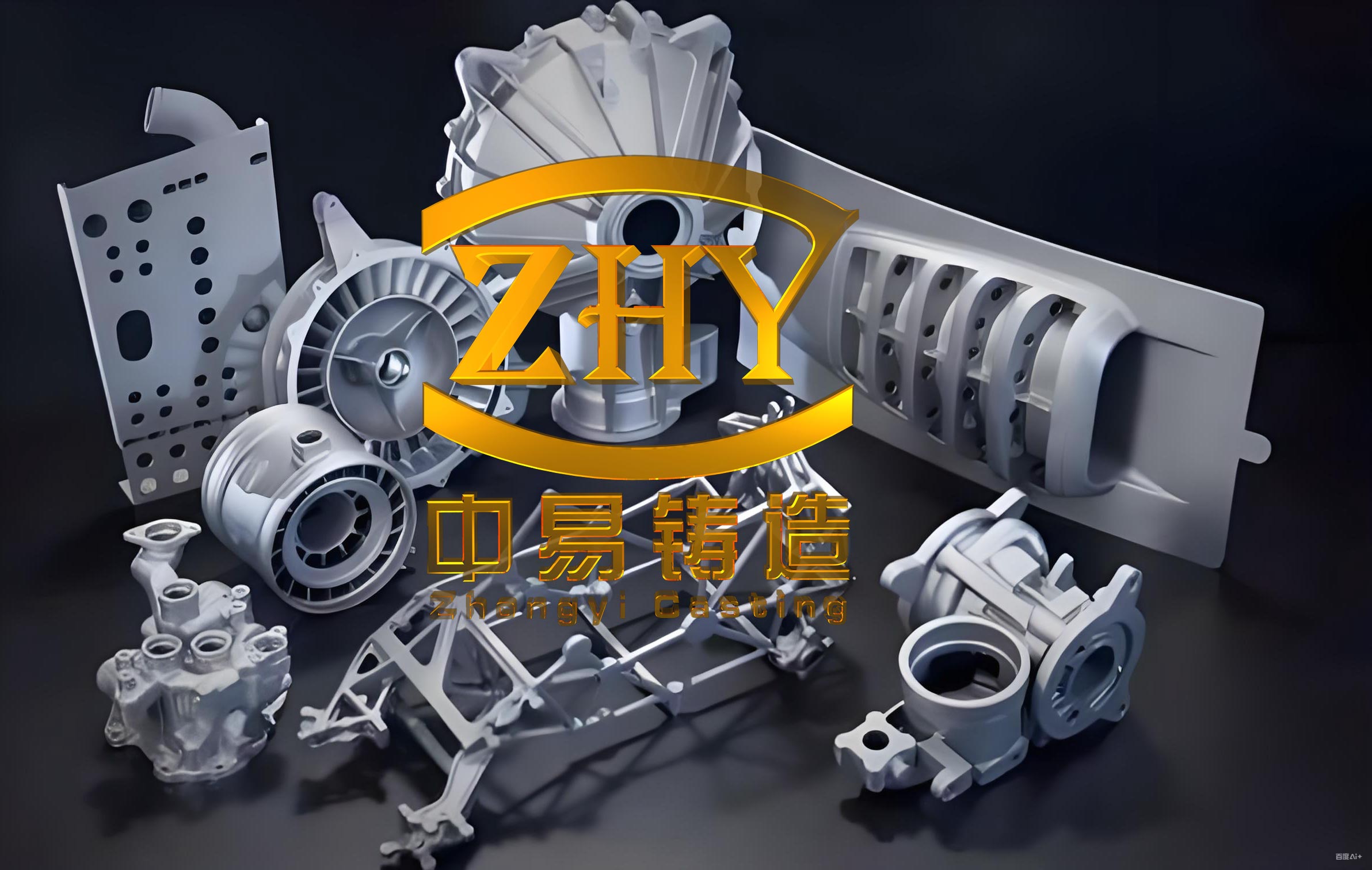
The image above illustrates typical aerospace casting parts produced via 3D printed sand molds, showcasing intricate features like thin walls and internal channels. Such components are integral to modern aircraft engines, where weight reduction and performance are critical. The role of 3D printing in enabling these designs cannot be overstated; it allows for consolidation of multiple parts into single castings, reducing assembly points and potential failure modes. This is particularly vital in aerospace casting, where reliability under extreme conditions is non-negotiable.
Looking ahead, the convergence of 3D printing with simulation and AI promises to optimize aerospace casting processes further. Predictive models for distortion and residual stress can be built using finite element analysis (FEA), with inputs from printed mold properties. For example, the stress \( \sigma \) in a casting due to thermal gradients can be approximated by:
$$ \sigma = E \cdot \alpha \cdot \Delta T $$
where E is Young’s modulus, α is the coefficient of thermal expansion, and ΔT is the temperature difference. By simulating this in the design phase, we can adjust mold geometries to minimize stresses, improving the lifespan of aerospace parts. Additionally, the use of topology optimization algorithms can generate organic, lightweight structures that are only feasible with 3D printing, pushing the boundaries of aerospace casting efficiency.
In conclusion, 3D printed sand molds represent a transformative tool in casting, especially for aerospace casting. They offer high precision, minimal flash, and rapid development cycles, making them ideal for prototyping and small-batch production of complex components. While costs remain higher than traditional methods for simple parts, the value proposition for aerospace casting—where complexity and performance dominate—is compelling. As technology matures, we can expect broader adoption across the aerospace sector, driven by the need for lighter, stronger, and more efficient components. The iterative design capability, enabled by digital models, ensures that aerospace casting can keep pace with innovation, solidifying 3D printing as a cornerstone of advanced manufacturing.