
As a professional deeply immersed in the casting industry, I have long grappled with the challenges of producing complex shell castings, such as turbocharger housings. These shell castings are characterized by intricate geometries, thin walls, and multi-layered structures, making traditional casting methods prone to issues like poor surface finish, inconsistent dimensional accuracy, and high scrap rates. In 2017, my company embarked on a journey to explore Three-Dimensional Printing and Gluing (3DP) technology as a solution. This article shares my insights into how 3DP has revolutionized the production of shell castings, offering a detailed comparison with conventional methods and highlighting its profound impact through extensive use of tables and formulas.
3DP, also known as Binder Jetting or Inkjet Powder Printing, is an additive manufacturing process that constructs parts by selectively depositing a liquid binder onto a powder bed. Unlike laser-based methods, 3DP uses a print head to jet binder, bonding the powder layer by layer. The process begins with a recoater spreading a thin layer of sand, typically 0.3 to 0.5 mm thick, which is compacted. The print head then deposits binder according to the digital model’s cross-section. After each layer, the build platform lowers, and the cycle repeats until the complete sand mold is formed. Excess powder is removed, revealing the final mold ready for casting. This approach eliminates the need for support structures, allows for complex internal cavities, and is highly efficient, making it ideal for shell castings with delicate features.
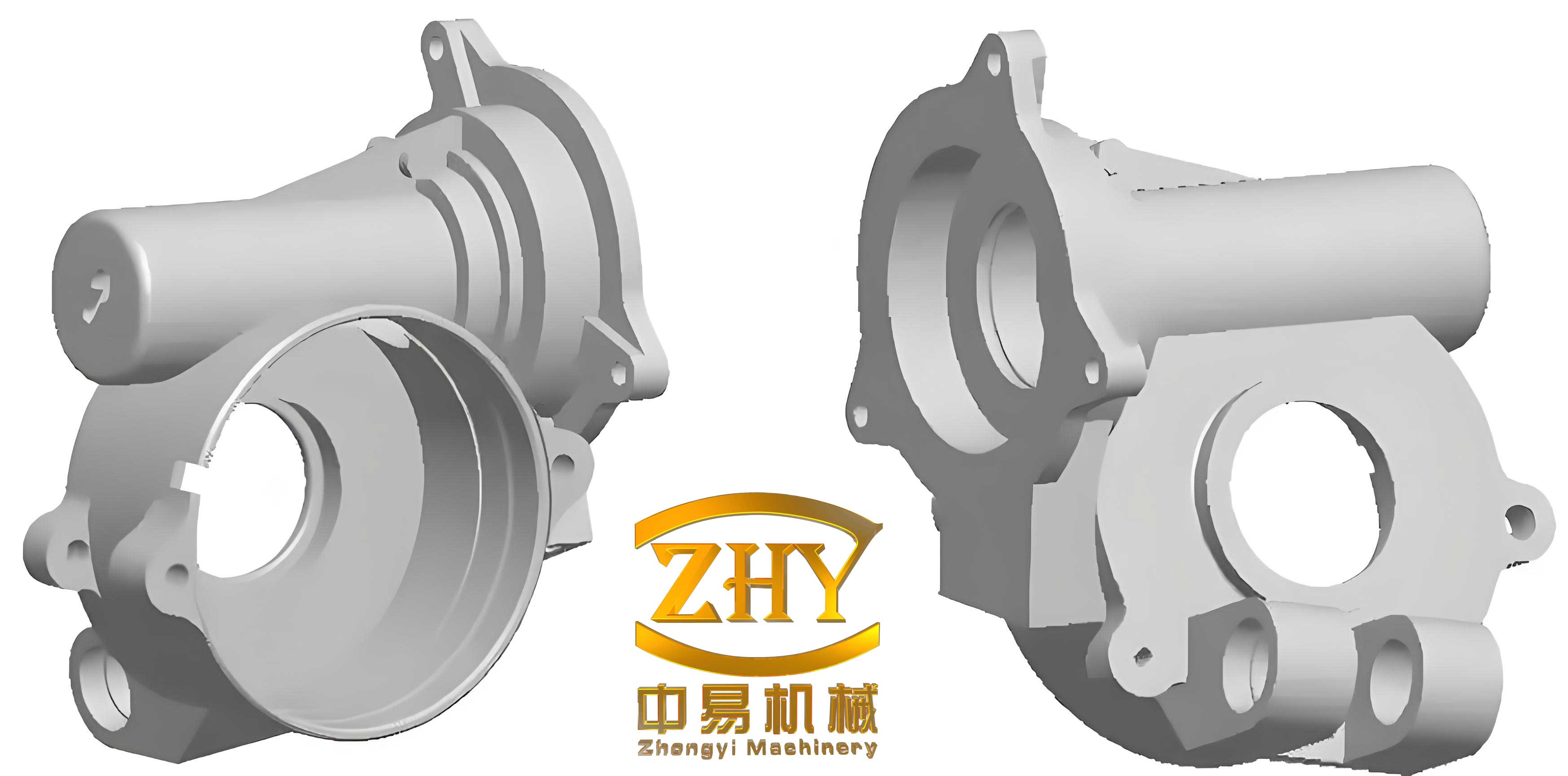
In our application, we utilized 3DP technology to produce a specific turbocharger shell casting. The process involved several steps: initial casting design, simulation using software to optimize fluid flow and solidification, virtual segmentation of the sand mold for printing, actual printing of the mold, assembly, pouring, and final extraction. This streamlined workflow drastically reduced lead times and minimized human intervention. For instance, traditional methods for such shell castings required 21 separate cores, leading to cumulative assembly errors, whereas 3DP enabled an integrated core design, enhancing precision and reducing post-casting cleanup.
To quantify the differences, let’s compare traditional casting and 3DP technology for shell castings across various aspects. The table below summarizes the development process:
| Aspect | Traditional Casting | 3DP Technology |
|---|---|---|
| Time from Design to Production | Approximately 35 days | Approximately 5 days |
| Number of Cores Required | 21 cores for complex shell castings | Integrated core, significantly reduced count |
| Manual Labor Intensity | High, due to core-making and assembly | Low, automated printing and handling |
| Environmental Conditions | Noisy, dusty, and hazardous | Quiet, clean, and worker-friendly |
This reduction in core count for shell castings minimizes error accumulation. The dimensional accuracy can be modeled using error propagation formulas. If each core introduces an error \( e_i \), the total error \( E_{\text{total}} \) in traditional casting is:
$$ E_{\text{total}} = \sqrt{ \sum_{i=1}^{n} e_i^2 } $$
where \( n \) is the number of cores. For 3DP, with an integrated core, \( n \) is reduced to 1 or a few, so \( E_{\text{total}} \) is much lower, enhancing consistency in shell castings.
Further, the printing time for 3DP shell castings can be estimated using layer-based calculations. If the sand mold height is \( H \) and layer thickness is \( d \), the number of layers \( L \) is:
$$ L = \frac{H}{d} $$
With a constant time per layer \( t_{\text{layer}} \), total print time \( T \) is:
$$ T = L \times t_{\text{layer}} = \frac{H}{d} \times t_{\text{layer}} $$
For typical shell castings, \( H \) might be 200 mm and \( d = 0.3 \) mm, so \( L \approx 667 \) layers. If \( t_{\text{layer}} = 10 \) seconds, \( T \approx 6670 \) seconds or about 1.85 hours, demonstrating the speed of 3DP for rapid prototyping of shell castings.
Material consumption and cost are critical factors. The table below compares material usage and prices for producing shell castings:
| Material | Traditional Casting (Percentage) | Price (10,000 CNY/ton) | 3DP Casting (Percentage) | Price (10,000 CNY/ton) |
|---|---|---|---|---|
| Resin | 1.2-1.4% | 2.2 | 1.5-2% | 3 |
| Curing Agent | 40-50% | 0.4 | 15-20% | 1 |
| Raw Sand | 100% | 0.045 | 100% | 0.08 |
| Coating | Applied as needed | 0.65 | Applied as needed | 0.8 |
| Cleaning Agent | Not typically used | N/A | 2% | 1.5 |
To compute the material cost per shell casting, let \( W \) be the weight of the sand mold in tons. For traditional casting, the cost \( M_t \) is:
$$ M_t = W \times (0.013 \times 2.2 + 0.45 \times 0.4 + 1 \times 0.045 + C_c) $$
where \( C_c \) is the coating cost. For 3DP, the cost \( M_{3dp} \) is:
$$ M_{3dp} = W \times (0.0175 \times 3 + 0.175 \times 1 + 1 \times 0.08 + C_c’ + 0.02 \times 1.5) $$
Assuming \( W = 0.5 \) tons for a medium-sized shell casting, and \( C_c = 0.1 \) and \( C_c’ = 0.12 \) (in 10,000 CNY), we get \( M_t \approx 0.4 \) and \( M_{3dp} \approx 0.55 \) in 10,000 CNY, showing higher material costs for 3DP shell castings, but this is offset by other savings.
The overall manufacturing cost includes fixed and variable components. For traditional casting of shell castings, the total cost per piece \( C_t(N) \) when producing \( N \) pieces is:
$$ C_t(N) = \frac{F_m}{N} + V_m + V_l $$
where \( F_m = 60,000 \) CNY is the mold cost, \( V_m = 142 \) CNY is the material cost per piece, and \( V_l = 90 \) CNY is the labor cost per piece. For 3DP shell castings:
$$ C_{3dp}(N) = \frac{F_e}{N} + V_m’ + V_l’ $$
with \( F_e = 600,000 \) CNY for equipment, \( V_m’ = 310 \) CNY, and \( V_l’ = 30 \) CNY. Using data from our production of 500 shell castings, \( C_t(500) = 302 \) CNY and \( C_{3dp}(500) = 345 \) CNY. However, factoring in scrap rates dramatically changes the economics. Let \( r_t \) and \( r_{3dp} \) be the scrap rates for traditional and 3DP shell castings, respectively. The effective cost per good piece \( C_{\text{eff}} \) is:
$$ C_{\text{eff}} = \frac{C}{1 – r} $$
Historically, for shell castings, \( r_t \approx 20\% \) and \( r_{3dp} \approx 5\% \). Thus:
$$ C_{t,\text{eff}} = \frac{302}{0.8} = 377.5 \text{ CNY} $$
$$ C_{3dp,\text{eff}} = \frac{345}{0.95} \approx 363.2 \text{ CNY} $$
This shows that 3DP offers lower effective costs for shell castings when quality improvements are considered, justifying its adoption.
The advantages of 3DP for shell castings extend beyond cost. Dimensional accuracy is superior, with printing precision of ±0.5 mm translating to wall thickness deviations within 1 mm for shell castings. Surface roughness achieves Ra25 per GB/T 6060.1-2018, compared to Ra50 for wooden patterns. According to ISO 8062, the成型精度 levels are CT10-CT13 for wooden patterns, CT9-CT12 for metal patterns, and CT8-CT11 for 3DP, indicating that 3DP shell castings consistently meet tighter tolerances. The table below summarizes quality metrics:
| Metric | Traditional Casting | 3DP Technology |
|---|---|---|
| Dimensional Accuracy (ISO 8062) | CT10-CT13 | CT8-CT11 |
| Surface Roughness (Ra) | Approximately 50 μm | Approximately 25 μm |
| Wall Thickness Deviation | Up to 2 mm | Within 1 mm |
| Number of Parting Lines | Multiple, due to core splits | Minimal, integrated design |
Moreover, 3DP enables integrated design, allowing multiple components to be consolidated into a single shell casting, enhancing functionality. From a human perspective, it fosters green manufacturing by reducing physical labor, noise, and pollution, aligning with sustainable goals for shell castings production.
Looking ahead, the future of shell castings manufacturing is inextricably linked with 3D printing technology. As demand grows for diverse, complex, and rapidly iterated shell castings, 3DP offers the flexibility and efficiency needed. The integration of 3DP with robotics and IoT will drive the development of green intelligent foundries, where shell castings are produced with minimal waste and maximum precision. We are already seeing trends toward larger build volumes and faster printing speeds, which will further benefit shell castings production.
In my experience since 2017, 3DP has been transformative for shell castings. We have successfully developed 75 types of turbocharger shell castings using 3DP for prototyping, reducing development time from weeks to days. By 2020, we extended 3DP to mass production, launching 25 varieties of axial flow turbocharger shell castings, with 15 in full production. The qualification rate for shell castings improved by 15%, underscoring the technology’s reliability. The journey has reinforced my belief that 3DP is not just an alternative but a cornerstone for the future of shell castings manufacturing, enabling us to produce higher-quality shell castings with greater efficiency and sustainability.