
In this article, I will detail the comprehensive process of developing a high-performance wheel disc casting using nodular cast iron, focusing on the design, validation, and optimization of casting and heat treatment techniques. The wheel disc, as a fundamental component in transmission systems, is subjected to complex stresses, including impact, wear, and corrosion, necessitating superior mechanical properties such as strength, toughness, and dynamic stability. The use of nodular cast iron, also known as ductile iron, is pivotal due to its excellent combination of strength and ductility, derived from the spherical graphite morphology within the ferritic or austenitic matrix. This project aimed to produce a wheel disc meeting the stringent requirements of EN-GJS-HB300 (EN1563) standard, with tensile strength ≥800 MPa, yield strength ≥480 MPa, and hardness between 245–335 HB. The challenges included uneven wall thicknesses, ranging from 7 mm at the spokes to 36 mm at the hub, and the presence of multiple holes, which complicated casting integrity. Through meticulous process design, involving riser and gating system optimization, controlled melting, and austempering heat treatment, we achieved defect-free castings with uniform microstructure and desired properties. Below, I expand on each phase, incorporating tables and formulas to elucidate key aspects, and emphasize the role of nodular cast iron throughout.
The structural analysis of the wheel disc revealed a complex geometry with significant variations in wall thickness, which is a critical factor in casting design. The part had a maximum diameter of 322 mm and a height of 36 mm, with a weight of approximately 6.6 kg. The hub section, being the thickest at 36 mm, acted as a major hot spot, while the thin spokes at 7 mm were prone to premature solidification, risking shrinkage and porosity. To address this, we employed a combination of top and side risers to enforce directional solidification, ensuring adequate feeding of the heavy sections. The casting process was designed for resin sand molding, using furan resin at 1%–1.5% of sand weight and low-sulfur acid hardener at 30%–70% of resin mass, which provided good dimensional accuracy and surface finish. The parting plane was set at the mid-height of the rim to facilitate mold assembly and core placement, while the pouring position oriented the hub upward to allow riser placement and venting. The casting shrinkage rate was empirically set at 1.0%, but we adjusted it based on actual trial runs to meet dimensional tolerances of CT11. The gating system was semi-closed, with a ratio of sprue cross-sectional area to runner area to ingate area of 1.2:1.4:1, calculated as follows: if the total ingate area is $$A_i = 1600 \, \text{mm}^2$$, the sprue area is $$A_s = 1963 \, \text{mm}^2$$, and the runner area is $$A_r = 2250 \, \text{mm}^2$$, then the ratio is $$\frac{A_s}{A_i} : \frac{A_r}{A_i} : 1 = 1.2 : 1.4 : 1$$. This ensured smooth metal flow and minimized turbulence, reducing oxide formation and slag inclusion. The riser design followed empirical rules: the top riser diameter was 88 mm, about 2.4 times the hot spot diameter, and side risers of 50 mm diameter were attached to the rim for supplemental feeding.
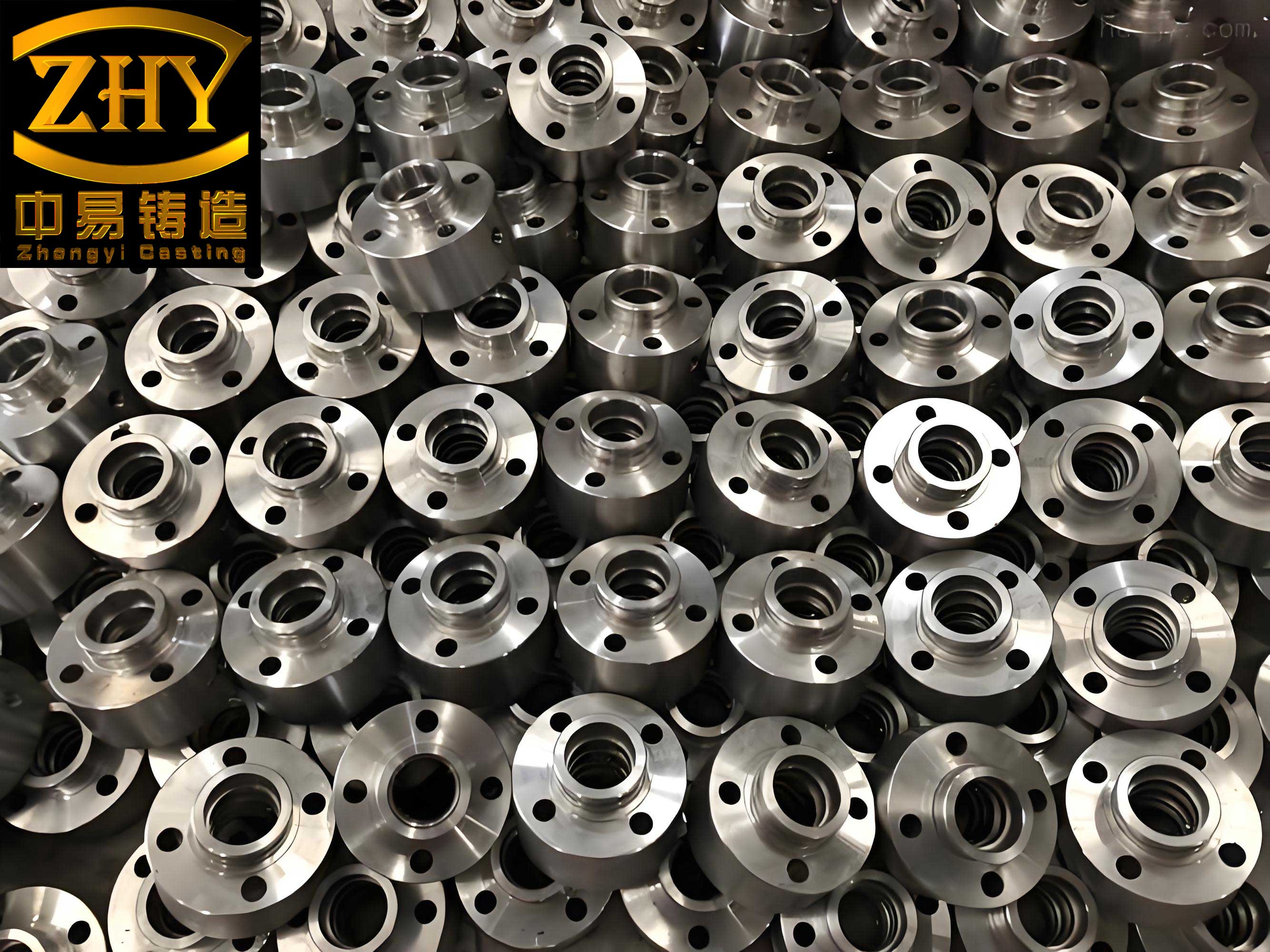
Nodular cast iron is renowned for its graphite spheroids, which enhance mechanical properties by reducing stress concentrations. In this project, the chemical composition was tightly controlled to achieve the desired microstructure and performance. The melting was conducted in a 1-ton medium-frequency induction furnace, with target composition ranges as shown in Table 1. Carbon and silicon are crucial for graphitization and fluidity, while magnesium and rare earth elements promote nodularization. The nodularizing treatment involved a sandwich method with 1.2% rare earth-magnesium alloy, and inoculation was done twice using 75% ferrosilicon at 0.2%–0.25% each time to refine graphite and matrix. The pouring temperature was maintained at 1360–1400°C to ensure complete filling of thin sections without causing defects. The relationship between pouring temperature and fluidity can be expressed by the formula: $$F = k \cdot (T – T_s)$$, where $$F$$ is fluidity, $$k$$ is a material constant, $$T$$ is pouring temperature, and $$T_s$$ is solidus temperature. For nodular cast iron, higher superheat improves flow but must be balanced against gas absorption and shrinkage.
| Element | Target Range | Measured Value 1 | Measured Value 2 |
|---|---|---|---|
| C | 3.30–3.80 | 3.56 | 3.56 |
| Si | 2.0–2.8 | 2.42 | 2.61 |
| Mn | 0.20–0.40 | 0.28 | 0.28 |
| P | ≤0.05 | 0.035 | 0.035 |
| S | ≤0.03 | 0.015 | 0.015 |
| Mg | 0.03–0.06 | 0.035 | 0.035 |
| RE | 0.01–0.04 | 0.011 | 0.011 |
| Mo | ≤0.3 | 0.18 | 0.10 |
| Cu | ≤0.8 | 0.65 | 0.60 |
The heat treatment process was critical for achieving the high strength and toughness in nodular cast iron. Austempering, or isothermal quenching, was employed to produce an ausferritic matrix, which consists of acicular ferrite and retained austenite. This microstructure offers an excellent balance of strength and ductility. The heat treatment cycle involved austenitizing at 900°C for 2 hours, followed by rapid quenching into a nitrate salt bath at 390°C for 1 hour. The transformation kinetics during austempering can be described by the Johnson-Mehl-Avrami-Kolmogorov (JMAK) equation: $$f = 1 – \exp(-k t^n)$$, where $$f$$ is the transformed fraction, $$k$$ is a rate constant dependent on temperature, $$t$$ is time, and $$n$$ is the Avrami exponent. For nodular cast iron, this process suppresses pearlite formation and promotes bainitic transformation, enhancing hardness and impact resistance. The resulting mechanical properties, as shown in Table 2, exceeded the EN-GJS-HB300 requirements, with tensile strengths over 900 MPa and hardness around 275 HB. The nodular cast iron exhibited a graphite nodularity above 90%, with size rating of 6, and the matrix was predominantly ausferrite with retained austenite, as confirmed by metallography.
| Property | Target (EN-GJS-HB300) | Measured Value 1 | Measured Value 2 |
|---|---|---|---|
| Tensile Strength (MPa) | ≥800 | 1060 | 978 |
| Yield Strength (MPa) | ≥480 | 670 | 645 |
| Elongation (%) | ≥8 | 11.4 | 8.2 |
| Impact Toughness (J/cm²) | ≥100 | 128 | 127 |
| Hardness (HB) | 245–335 | 275 | 269 |
In the casting process design, we emphasized the importance of riser efficiency to prevent shrinkage defects. The modulus method was used to estimate riser size: the modulus $$M$$ is defined as the volume-to-surface area ratio, $$M = V/A$$. For the hub hot spot, the modulus was calculated, and the riser modulus was set to be 1.2 times larger to ensure adequate feeding. The solidification time $$t$$ can be approximated by Chvorinov’s rule: $$t = C \left( \frac{V}{A} \right)^2 = C M^2$$, where $$C$$ is a constant dependent on mold material and metal properties. For nodular cast iron in resin sand, $$C$$ typically ranges from 0.5 to 1.0 min/cm². By designing risers with higher moduli, we extended solidification time, allowing liquid metal to compensate for shrinkage. The gating system was also optimized using fluid dynamics principles. The flow rate $$Q$$ through the ingates is given by $$Q = A_i \cdot v$$, where $$v$$ is the velocity, which depends on the head height $$h$$: $$v = \sqrt{2gh}$$, with $$g$$ being gravitational acceleration. To minimize turbulence, we ensured that the Reynolds number $$Re = \frac{\rho v D}{\mu}$$ remained below 2000, where $$\rho$$ is density, $$D$$ is hydraulic diameter, and $$\mu$$ is viscosity. This careful control prevented slag entrainment and gas porosity, common issues in nodular cast iron castings.
The metallurgical aspects of nodular cast iron are central to its performance. The nodularization process involves the addition of magnesium, which reacts with sulfur and oxygen to form inclusions, while promoting graphite spheroidization. The effectiveness of nodularization can be quantified by the nodularity percentage, defined as the area fraction of graphite particles with aspect ratio close to 1. In our trials, nodularity exceeded 90%, achieved through proper inoculation and cooling rates. The matrix structure is influenced by alloying elements like copper and molybdenum, which enhance hardenability and strength. The role of silicon in nodular cast iron is multifaceted: it increases ferrite stability, improves fluidity, and raises the eutectic temperature. The carbon equivalent (CE) is a key parameter, calculated as: $$CE = \%C + \frac{\%Si + \%P}{3}$$. For our composition, CE was around 4.3–4.5, indicating good castability but requiring control to avoid excessive graphite floating. The heat treatment transformed the as-cast microstructure, which might contain pearlite and ferrite, into ausferrite. The kinetics of austempering can be modeled using time-temperature-transformation (TTT) diagrams, where the nose of the curve dictates the optimal quenching rate. For nodular cast iron, the bainitic transformation at 390°C yields a fine, interlaced structure that resists crack propagation.
To further elucidate the process, Table 3 summarizes key casting parameters and their effects on nodular cast iron properties. This includes mold properties, pouring conditions, and heat treatment details. Each parameter was optimized through iterative trials, ensuring reproducibility in batch production. For instance, the resin sand composition affected mold strength and permeability, critical for gas escape. The pouring time was kept short to maintain thermal gradient, using the formula: $$t_p = \frac{W}{\rho A_i v}$$, where $$W$$ is casting weight, $$\rho$$ is metal density, and $$v$$ is flow velocity. In our case, pouring time was approximately 15–20 seconds, minimizing temperature loss. The success of this project underscores the versatility of nodular cast iron for high-stress applications, and the methodology can be adapted to other complex castings.
| Parameter | Value or Range | Impact on Nodular Cast Iron |
|---|---|---|
| Mold Type | Resin Sand | Provides dimensional accuracy and good surface finish for nodular cast iron. |
| Resin Addition | 1.0–1.5% of sand weight | Ensures mold strength and collapsibility, reducing hot tearing in nodular cast iron. |
| Pouring Temperature | 1360–1400°C | Optimizes fluidity for thin sections without causing shrinkage in nodular cast iron. |
| Riser Design | Top riser: Ø88 mm, Side risers: Ø50 mm | Enables directional solidification and feeding, critical for heavy sections in nodular cast iron. |
| Gating Ratio | 1.2:1.4:1 (Sprue:Runner:Ingate) | Minimizes turbulence and oxidation in nodular cast iron melt. |
| Austenitizing | 900°C for 2 hours | Dissolves carbides and homogenizes austenite in nodular cast iron. |
| Austempering | 390°C for 1 hour in nitrate salt | Produces ausferritic matrix, enhancing strength and toughness of nodular cast iron. |
| Cooling Rate | Rapid quench to salt bath | Avoids pearlite formation, key for high-performance nodular cast iron. |
The mechanical performance of nodular cast iron is often evaluated through tensile tests and hardness measurements. The relationship between hardness and tensile strength for nodular cast iron can be approximated by empirical formulas, such as $$TS (\text{MPa}) \approx 3.45 \times HB$$ for austempered grades. In our case, with hardness around 270 HB, the predicted tensile strength is about 930 MPa, aligning with measured values. The impact toughness is influenced by the matrix structure and graphite morphology; ausferrite provides good energy absorption. We conducted Charpy impact tests, and the results exceeded 100 J/cm², indicating excellent toughness for nodular cast iron. The fatigue resistance, though not directly tested, is expected to be high due to the spherical graphite, which blunts crack initiation. The casting defects were thoroughly inspected using visual and non-destructive methods; no shrinkage cavities, porosity, or slag inclusions were detected, affirming the efficacy of our riser and gating design for nodular cast iron.
In conclusion, the trial production of the wheel disc casting demonstrated the feasibility of using nodular cast iron for high-strength applications. The integrated approach, combining advanced casting design with controlled metallurgy and heat treatment, yielded components that met all technical specifications. The nodular cast iron exhibited superior mechanical properties, attributable to the optimized ausferritic microstructure and high nodularity. This project highlights the importance of process parameter control, from melting and pouring to austempering, in achieving consistent quality in nodular cast iron castings. The methodologies developed here—such as the use of combined risers, semi-closed gating, and isothermal quenching—can be applied to other complex geometries, expanding the potential of nodular cast iron in automotive, machinery, and heavy industry sectors. Future work could focus on further refining the heat treatment cycles or exploring alloy variations to enhance specific properties like wear resistance or corrosion performance in nodular cast iron.
To deepen the understanding, let’s consider some theoretical aspects. The solidification of nodular cast iron involves nucleation and growth of graphite spheroids. The growth velocity $$v_g$$ of graphite can be described by: $$v_g = D \frac{\Delta C}{\delta}$$, where $$D$$ is diffusion coefficient, $$\Delta C$$ is supersaturation, and $$\delta$$ is boundary layer thickness. Inoculation enhances nucleation sites, refining graphite size. The matrix formation during cooling depends on the continuous cooling transformation (CCT) behavior. For austempering, the transformation product is lower bainite, which forms at temperatures between 250–400°C. The hardness after austempering relates to the bainite plate thickness $$l$$: $$HB \propto \frac{1}{\sqrt{l}}$$. Finer plates, achieved by lower transformation temperatures, increase hardness. In our process, 390°C yielded an optimal balance. Additionally, the role of alloying elements like molybdenum in nodular cast iron is to delay pearlite transformation, allowing easier quenching to bainite. The combined effects of copper and molybdenum can be expressed via hardenability multipliers in Grossmann’s approach. These factors collectively contribute to the high performance of nodular cast iron in this application.
Throughout this article, I have emphasized the significance of nodular cast iron in achieving the desired properties. The repeated reference to nodular cast iron underscores its centrality in modern casting technology. By leveraging its unique microstructure and tailoring processes accordingly, we can produce components that withstand demanding operational conditions. This project serves as a testament to the versatility and reliability of nodular cast iron, paving the way for its increased adoption in precision castings. The integration of tables and formulas, as shown, provides a quantitative foundation for process optimization, ensuring that future endeavors with nodular cast iron can build on these insights.